Tag Archives: Mindfulness

Educational Labyrinth Journey’s for Children & Teens

Teaching Labyrinth Workshop held at Brentwood Bay Elementary in Central Sannich followed by sharing at the World Children’s Summit on Peace and Nature Event held in Greater Victoria on Sept. 21, 2015

Somatic experience & a pathway to connection

Renee Lindstrom offers a somatic learning experience for leadership development for children and teens that includes mindfulness, logic, perception and movement patterns.  These tools can reflect the skills to connect  that begins inside while, at the same time, connecting with others in a respectful way regardless of differences. These techniques turn blocked and closed experiences into open expansive opportunities.
.
Sharing the Teaching Labyrinth at St. Andrew’s Regional High School was a powerful experience to observe a shift from being closed and guarded to open and receptive in a group of teenagers.   There was ease and simplicity using these tools that created a shift that was noticeable to view.  They were noticeably  acting with deeper qualities of inclusion, respect and connection.  Checking in with the students afterwards this was what they described. Their experience of this was tangible.
.
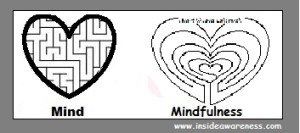
Maze Labyrinth Hearts
The purpose of the somatic exercises was to give these students a model and the opportunity to experience this shift using these integrative tools  so they could then duplicate it with ease and simplicity in the future.    After exploring personal and group movement patterns we moved on to exploring a labyrinth pathway.  A labyrinth has no barriers.  It is a pathway into the center (heart) and back out again.  It is not a maze which is confusing and a challenge requiring one to use their thinking.  A labyrinth shifts a walker from the chaos of their thinking into a calmer somatic experience.
 .
labyrinth thumbnail
.
The suggestion for walking a pathway in an inclusive and grounded way was it could be a more subtle and meaningful form of support in conflict resolution.  The concept is that everyone has differences and that if we include an opening shared experience for connecting deeper individually while walking together before talking,  this may open the space  to be more willing to hear these differences.
In communication practice I urge my students to stop and check in before reacting and speaking out.  The purpose is to pause and translate what they are thinking into a connection that the other person can hear.  This pathway reflects this process and together with some movement techniques for clarity and groundedness,  walking this pathway becomes a pattern reflecting this process.
I recommend these patterns as tools in organization and educational institutions:
  • as a preventative experience to cut conflict before it happens
  • as a way to connect before trying to resolve differences
  • to create respect and acceptance in a community experience
  • to bring together a community
  • to support making decisions
  • to cut anxiety before events, meetings, challenges

Support your school, business group or community organization to explore connection before solutions.  Cut thought the labels creating enemy images such as victim, perpetrator and bullying and support ways that are easy and simple. Move from the chaotic mind into mindfulness of acceptance and respect.

Inquire about school integrative labyrinth programs

← Back

Thank you for your response. ✨


Copyright 2014 – 2022 Renee Lindstrom, GCFP,
Feldenkrais® Practitioner since 2007, Value-Based Communication & Empathy Coach since 2004, Art of Placement  since 2000, Founder of Greater Victoria Peace & Intercultural Celebrations since 2010 & Greater Victoria Labyrinths since 2012, #yyj Peace Week Calendar Founder – 2014 & 2015

Follow Inside on:
Facebook             Twitter

‘Green Communication’

Green relationships

Green Communication is a Value Based Language & Enrichment Program

Intention:  Inclusiveness of hearing what is alive and meaningful in each person and translating *perspectives, opinions and believes into a point of shared *connection.

Purpose:  To connect equally in dialogues that is committed to a position of inclusiveness transforming positions of power over and power under to power with.

How:  With a dialogue that has a talking focus of shared connections; feelings and values.

Link to Definition of Green Behavior

_______________________________________________________


Definitions:

*Perspective:
  • Two-dimensional surface – give the right impression of their height, width, depth, and position in relation to each other when viewed from a particular point.
  • Particular attitude toward or way of regarding something; a point of view.
*Connection:
The ability to sense and feel is universal, as is the meaningfulness of values.   Value-needs are shared by humanity and the focus point of expanding beyond individual interpretations.  Identifying emotions is the first step of separating from habitual reactions and the start point of *empathetic- listening.   Naming the source of the emotion is the focus point of acknowledgement and recognition that nurtures understanding and willingness to the unique point of view of others.
.
*Empathetic-listening:
Empathetic-listening is the ability and willingness to listen without imposing personal believes interpretations, opinions and viewpoints into the conversation.  The willingness to clear “I” focus while hearing others and purposefully paying attention to the viewpoint that is being shared in a manner that could be directly shared back.

_______________________________________________________

Renee Lindstrom, GCFP,
Feldenkrais® Practitioner since 2007, Communication & Empathy Coach since 2004, Art of Placement  since 2000, Labyrinths of Victoria since 2012, #yyj Peace Week Grassroots Calendar Founder, Vice-Chair of World Children’s Summit on Peace & Nature in 2015

Comparisons & Restorative Justice, really? Our habits make us lazy.

After tearing down a contemplative installation that was Inside’s contribution in a shared event,  I ran in to view the remaining presentations.  I viewed a role-play on a topic that  I loved and seeing the participants respond was fun.   So it was with dismay and a difference in opinion when I heard the next presenters come up and compare their presentation to the one before it!  I ask myself, why? Are you in the habit of comparing yourself to others?  Is so, is there always a winner and a loser? comparison

The first sentence I heard in the presentation expressed was, ”  ..(blank) …..used the old school method while I am using the new method of presenting with audio visual and a bullet form presentation to follow along!  She did not open with an indicator to us that this was only her belief and that she wasn’t speaking for us all.  She stated it like it the truth, which to me,  meant she knew more than anyone else in the audience without realizing she was comparing two totally different teaching methods that cannot be compared in this way.  Hers was exclusive of audience participation and the style was speaking at us with words on a screen while the other method included the audiences participation and the learning was experiential.  It was presented though an exercise therefore included more than the senses of seeing and hearing.

In this one sentence she compared herself to the presenter before in a way that told us she was more effective.  One was old and one was new.  This may have not been her intent, yet I believe it demonstrates her lack of wisdom while commanding a hierarchical status quo.  I believe her intent was to apologize for using this form of audio visual and rather than explaining what need of hers she was not meeting, she chose to make it about the person before her.

This is a perfect demonstration of a non-physical form of violence that begins inside as comparison and is expressed in a language of violence.  The root source that results in the need for restorative justice.   It is my perspective that there is no comparison between the sharing styles or techniques.  One is a speaking systems designed for  behavior awareness that reduces the need for the restorative action to meet ones need for justice.

My discomfort continued to grow with the use of labels such a perpetrators, victims,  and so on and I found my mind wandering back to a belief that is expanding.   It is based upon being courageous and having the willingness to speak with honesty and with acceptance together with *understanding there are differences in opinions.   This belief is a growing understanding that our habits are lazy.  It is easier for us to protect ourselves from feeling the discomfort that comes when speaking our truth and sharing a common value.  Our immediate choice is to stay in a mental dominated state of analyzing, labeling and talking at issues with a language of solutions.  We are choosing not to take the extra effort to *process them by checking in first to identify a personal value connection first before going to solutions.  The process we are ignoring becomes the effort and life draining experience and the need behind restorative justice.

*Understanding differences in opinions:  This is knowing that your opinion is not what others believe to be true.  It is a skill to be able to hear others and know that this does not mean you have to agree or disagree with them.

.

*Dealing with issues:  We are not expressing ourselves in a simple, concise way in the moment while pausing long enough to check in with others to confirm how they are hearing us.  This simple skill seems to be a frightening option for many and they will withhold.  The outcome is not being recognized.  That is if this time and step is not taken it is exactly what leads us into resentment and life draining relationships.  It become the source of our need for restorative justice!

Definition of Sacred Space @ Inside

Sacred space is an experience created by one’s inner connection that is reflected in one’s outer nature and the their environment.  It is the ability to experience a particular connection to; oneself,  what is above, what is below and around oneself in the landscape.  This connection includes reverence and honor.  It represents balance within oneself of the physical (north, south, east & west), mental (masculine), emotional (feminine) and belief systems (values, devotion).

______________________________________________________

 Renee Lindstrom, GCFP,
Feldenkrais® Practitioner since 2007, Communication & Empathy Coach since 2004, Art of Placement  since 2000, Labyrinths of Victoria since 2012, #yyj Peace Week Grassroots Calendar Founder, Vice-Chair of World Children’s Summit on Peace & Nature in 2015

_______________________________________________________

Inside on Mindfulness in Nature & Mindfulness for Nature

Mindfulness in Nature & Mindfulness for Nature (can you see tanker in background?)

Mindfulness in nature is an outdoor experience and mindfulness for nature, is how we care for the environment.   Healthier decisions for the environment  will be made when there is a direct connection with nature.  Inside Awareness has the perspective that wo/man will be more willing to take care of  the planet collectively once they individually connect to their inner values and clearly understand what is meaningful to them in  relationship to nature.  If one is not aware of what is meaningful for them in their environment, it is a disconnection and the first step to an imbalance in caring for it.

*mindfulness – an attentive awareness of the reality of things 
photo taken along Dallas Road, Victoria, B.C.

.

Inside’s Mindfulness Behavior Principle

Sooke Potholes

Grounded Stillness

Inside Awareness Behavior principles are founded upon one similar to the first steps in a of Buddhist Mediation.  In meditation one is sitting on a cushion to become comfortable being still in space while watching their thoughts.  The purpose is to become *mindful and to experience the environment coming into ones awareness softly versus directing ones attention outwardly. The difference in these two focuses of attention is that one is open and expanded,  and other one is closed and limiting.

read more on:  Inside on Mindfulness in Nature & Mindfulness for Nature 

*mindfulness – an attentive awareness of the reality of things 

photo taken at Sooke Potholes, Victoria, B.C.

Week five of the New Year already! New Week – New Value:

getting InTouch - Value - Believing - 2

______________________________________________________________
Renee Lindstrom, GCFP
Feldenkrais® Practitioner since 2007, Language Enrichment Systems since 2004, Art of Placement since 2000

Learning Systems for:

  • Developing trust, courage, confidence, inner-support and awareness
  • Understanding relationships of the body – brain connections first and then with others
  • Connecting belief system to real-time (present) experiences
  • Integration tools for moving forward with more conscious awareness and ease

Facebook             Google Plus          Twitter          Pinterest