
Legacy Education Project
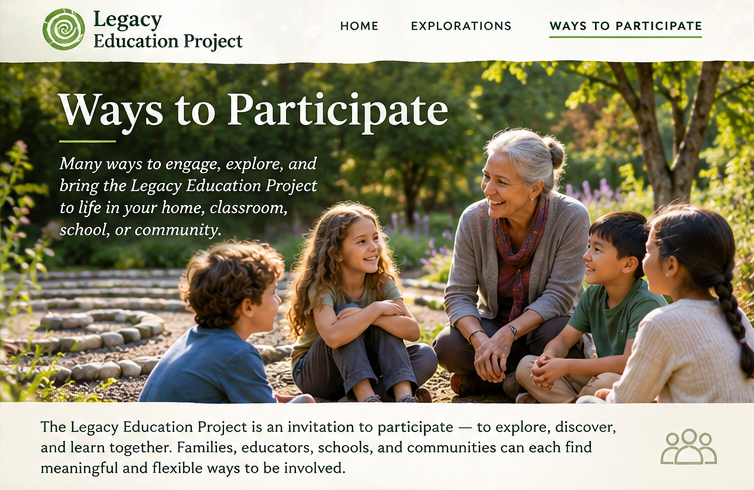
Learning Together Through Lived Experience
The Inside Awareness Legacy Education Project welcomes interest from parents, caregivers, educators, schools, and communities who wish to explore how children learn through movement, sensory experiences, values, communication, and relationships.
The project offers an educational approach in which conscious recognition develops through everyday experiences rather than instruction alone.
Children are natural explorers. Adults can support their discoveries by becoming more attentive to how children sense, move, interpret, communicate, and participate in their surroundings.
The invitation is to explore together, with curiosity and without predetermined outcomes.
Participation Pathways
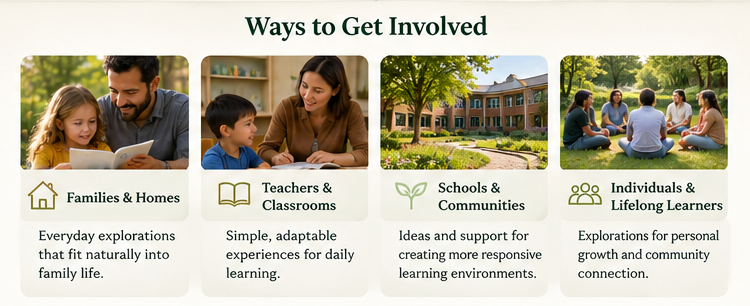
Children & Youth
Exploring movement, awareness, and relationships
Guided learning experiences introduce opportunities for children and young people to recognize themselves and their relationships with others.
Activities may include:
- Functional movement and balance explorations.
- Sensory awareness through creative activities.
- Listening and communication experiences.
- Discovering feelings and values.
- Nature walks and teaching labyrinths.
- Nine Life Area explorations supporting growing independence.
Learning experiences are adapted to children’s developmental stages, interests, and abilities.
Parents & Caregivers
Recognizing and supporting natural learning
Children learn through their relationships with the adults who surround them.
Parent and caregiver explorations introduce opportunities to recognize how everyday interactions influence a child’s developing experience.
The focus includes listening, values, emotional awareness, movement, personal autonomy, and recognizing the different needs of adults and children.
Participants are invited to explore their own experiences while discovering ways to support children’s growing independence.
The intention is not to introduce another parenting formula. It is to develop conscious recognition within the relationships already taking place.
Teachers & Classrooms
Integrating awareness into everyday learning
The Legacy Education Project builds upon educational resources developed through the Culture of Values program, including teacher planning calendars, children’s vocabulary workbooks, classroom activities, and guided experiences.
These resources introduce shared themes that can be explored through movement, storytelling, creative expression, classroom dialogue, and personal reflection.
A weekly value can become a familiar reference throughout ordinary classroom activities.
Teachers may begin the day with a simple invitation and return to the experience later, allowing students to recognize how the value appeared in their own lives.
Movement and listening diagrams offer additional opportunities to connect spoken instructions with actual sensory and functional experiences.
The intention is to support existing classroom learning rather than create an entirely separate subject that must be mastered.
Learning Environments & Invisible Influences
- Recognizing How Our Surroundings Participate in Learning
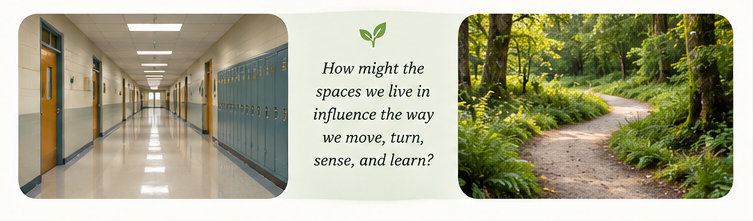
Children learn within environments that influence their movements, attention, communication, and relationships.
Some influences are immediately recognizable. Others become so familiar that they are rarely noticed.
Classroom furniture, learning spaces, daily routines, spoken instructions, and cultural expectations all participate in shaping children’s experiences.
A chair offers physical support. A desk provides a surface for learning activities. An instruction introduces an intention. Together, these influences may encourage familiar patterns of sitting, moving, listening, and responding.
As children progress through school, their learning environments often change. Early classrooms may provide opportunities for floor activities, movement, and creative exploration. Later classrooms may introduce longer periods of sitting, more structured activities, and increasing expectations for sustained attention.
The Legacy Education Project invites recognition of these influences without treating them as problems requiring correction.
Through guided sensory, movement, and communication explorations, children and educators can begin recognizing how their surroundings participate in their experiences.
They may discover the difference between being physically still and being attentive, between following an instruction and understanding its intention, or between using a chair for support and limiting their movement to one familiar position.
The intention is to nurture greater flexibility in how children relate to their environments.
When an influence becomes recognizable, new possibilities for participation may emerge.
Schools & Communities
Creating shared opportunities for participation
School-wide and community experiences can bring children, families, and educators together through common themes.
The original Culture of Values monthly calendars introduced shared values that could inspire school activities, creative projects, discussions, and celebrations.
The Teaching Labyrinth offers another form of shared participation through movement, silence, observation, and reciprocal encounters.
The Legacy Education Project carries forward this approach through opportunities to explore relationships with oneself, others, and the natural environment.
Shared values provide a common focus, while individual experiences and interpretations remain welcome.
Educator & Facilitator Mentorship
Supporting the continuation of experiential learning
An important intention of the Legacy Education Project is to support adults who wish to introduce guided learning patterns within their own educational environments.
Mentorship focuses on the qualities of observation, listening, timing, and responsive participation.
Rather than memorizing a script or directing children toward predetermined discoveries, facilitators develop familiarity with recognizing spontaneous learning and offering experiences that can support its development.
The longer-term vision is to make these learning approaches accessible to future educators, families, and communities.
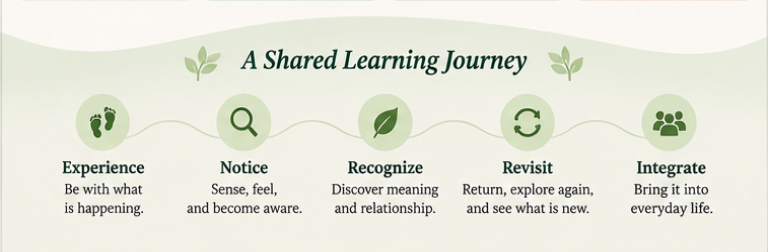
A Learning Approach That Can Be Revisited
The Legacy Education Project is designed to grow through experience.
A child may explore a movement pattern, value, or relationship at one age and discover something entirely different when revisiting the experience later.
The same is true for adults.
Participation does not require prior knowledge of somatic education, Nonviolent Communication, or contemplative practices.
Curiosity and willingness to explore are enough to begin.
Connecting with the Legacy Education Project
The Legacy Education Project is continuing to develop its educational resources, guided explorations, and opportunities for participation.
Parents, caregivers, educators, and community organizations are welcome to connect with Inside Awareness to learn more about the project and discuss possibilities for future participation.
Inside Awareness Legacy Education Project – Developed by Renee Lindstrom | @insideawareness
Copyright 2014 – 2026
Informed by the Feldenkrais Method of Somatic Education, Nonviolent Communication, contemplative practice, and embodied environmental awareness.

