
Legacy Education Project
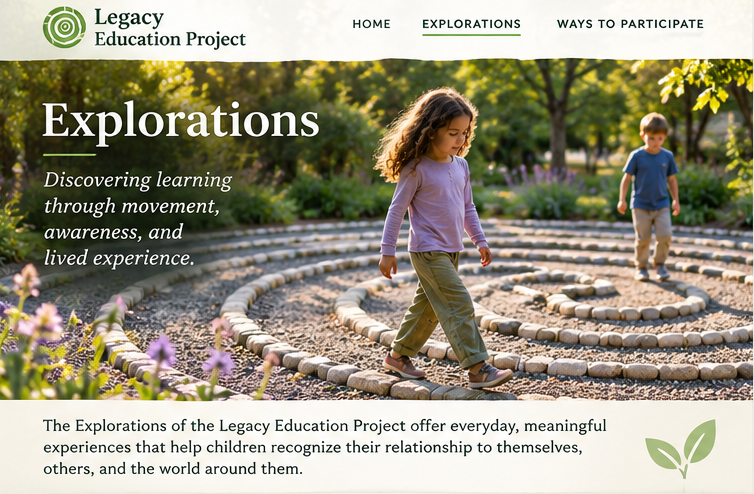
Explorations in Living and Learning
Recognizing the Learning Already Taking Place
Children begin learning through movement, sensory experiences, curiosity, and relationships long before they can explain what they are discovering.
From the earliest explorations of rolling, sitting, crawling, standing, and walking, children develop relationships with themselves and their surroundings through direct experience.
They discover movement, balance, coordination, sounds, textures, and communication through their participation in everyday life.
The adult doesn’t need to teach the child spontaneity. The adult can learn to recognize when spontaneity is already present and how to support it.
The Inside Awareness Legacy Education Project introduces guided patterns that nurture this natural capacity for learning as children grow.
The explorations integrate movement, sensory awareness, communication, values, relationships, and nature. They offer opportunities for children to recognize their own experiences, understand differences, and develop greater independence through lived participation.
The intention is not to introduce more expectations for children to perform. It is to provide experiences they can return to, explore, and integrate into everyday life.
Areas of Exploration
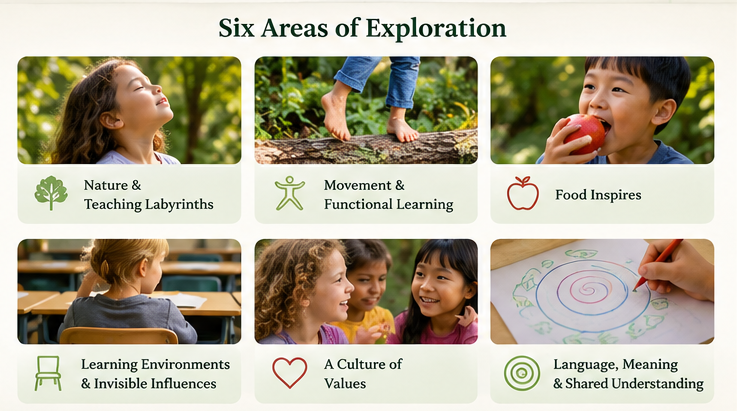
1. Movement & Functional Learning
Discovering how movement works from the inside
Children begin life discovering movement through their relationship with gravity, support, and their developing skeletal system.
These explorations introduce conscious recognition of the movements underlying everyday functions such as rolling, sitting, standing, walking, reaching, and turning.
Through gentle guided patterns, movement diagrams, and familiar activities, children can discover relationships among their feet, legs, pelvis, spine, ribs, shoulders, head, and hands.
The focus is on sensing movement and discovering possibilities, rather than performing exercises correctly.
2. Sensory Awareness & Perception
Discovering how we experience the world
Sight, sound, touch, smell, and taste offer different ways of receiving information from the environment.
Children naturally respond to these experiences, yet each child may notice and interpret different qualities within the same surroundings.
Through creative activities, movement, listening, and environmental exploration, children are invited to discover their own sensory experiences and recognize differences in those of others.
These experiences provide an early foundation for curiosity, self-awareness, acceptance, and understanding.
3. Communication & Listening
Discovering the dance of inner and outer communication
Communication begins before spoken words.
Children experience relationships through movement, gestures, facial expressions, sounds, sensations, and the responses of those around them.
These explorations introduce listening through shared movement, speaking, storytelling, and reciprocal dialogue.
Children have opportunities to recognize the difference between what they hear, what they think it means, and what another person wishes to communicate.
Like two people meeting on a labyrinth path, one person may pause while another continues. Leading and following can change naturally as each person recognizes the other.
The intention is to nurture the freedom to speak, listen, pause, and participate without losing connection to oneself.
4. Values & Feelings
Discovering what is meaningful through lived experience
Children encounter words such as kindness, respect, consideration, courage, acceptance, and cooperation throughout their education.
Yet knowing a word does not necessarily mean recognizing its meaning through experience.
The Culture of Values educational explorations introduce opportunities to discover personal meanings for familiar values.
Through stories, creative activities, talking circles, and reflective experiences, children can begin recognizing feelings associated with values and needs that are met or unmet.
Equal attention is given to celebrating what is going well and understanding experiences that are difficult.
The original Culture of Values calendars, first developed in 2013, provide seasonal and weekly themes that can be revisited as children’s understanding develops.
5. Nature & Teaching Labyrinths
Discovering relationships through the natural environment
Nature offers opportunities for spontaneous learning through movement, changing surroundings, and sensory experience.
Walking on different surfaces, listening to environmental sounds, observing seasonal changes, and exploring open and enclosed spaces invite children to recognize their participation in the world around them.
Teaching labyrinths introduce another dimension of learning through walking, pausing, meeting others, making room, and discovering one’s inner sense of centre.
These experiences support personal recognition, shared participation, and developing relationships with the natural world.
6. Life Areas & Growing Independence
Recognizing personal interests, choices, and possibilities
As children grow, their experiences expand through family, friendships, education, community, personal interests, and emerging responsibilities.
The Nine Life Area Squares provide an accessible way to explore these relationships.
Through age-appropriate activities, children can begin recognizing what interests them, what influences their choices, and what is meaningful in their daily lives.
The Past–Present/Health–Future orientation offers another opportunity to distinguish remembered experiences, present awareness, and imagined possibilities.
As young people approach the transition from school into adulthood, these familiar learning patterns may support greater clarity, autonomy, and confidence when considering their future directions.
Learning Environments & Invisible Influences
Recognizing How Our Surroundings Participate in Learning
Children learn within environments that influence their movements, attention, communication, and relationships.
Some influences are immediately recognizable. Others become so familiar that they are rarely noticed.
Classroom furniture, learning spaces, daily routines, spoken instructions, and cultural expectations all participate in shaping children’s experiences.
A chair offers physical support. A desk provides a surface for learning activities. An instruction introduces an intention. Together, these influences may encourage familiar patterns of sitting, moving, listening, and responding.
As children progress through school, their learning environments often change. Early classrooms may provide opportunities for floor activities, movement, and creative exploration. Later classrooms may introduce longer periods of sitting, more structured activities, and increasing expectations for sustained attention.
The Legacy Education Project invites recognition of these influences without treating them as problems requiring correction.
Through guided sensory, movement, and communication explorations, children and educators can begin recognizing how their surroundings participate in their experiences.
They may discover the difference between being physically still and being attentive, between following an instruction and understanding its intention, or between using a chair for support and limiting their movement to one familiar position.
The intention is to nurture greater flexibility in how children relate to their environments.
When an influence becomes recognizable, new possibilities for participation may emerge.
Growing Through Experience
The Legacy Education Project recognizes that learning changes as children mature.
Explorations can be adapted for Kindergarten–Grade 2, Grades 3–5, Grades 6–8, and Grades 9–12.
The same experience or value can be revisited over time, allowing new understanding to emerge through changing abilities, relationships, and life experiences.
Learning does not have to be completed in one lesson.
An experience can be revisited. A discovery can deepen. A new possibility can emerge.

A Shared Learning Experience
Parents, caregivers, and educators are invited to recognize the learning already occurring in children while exploring their own patterns of observation, listening, and participation.
The intention is to nurture meaningful relationships between children, adults, and their environments.
Sensing myself. Sensing another. Discovering how to participate together.
Inside Awareness Legacy Education Project – Developed by Renee Lindstrom | @insideawareness
Informed by the Feldenkrais Method of Somatic Education, Nonviolent Communication, contemplative practice, and embodied environmental awareness.

