
Eating for Function
An Inside Awareness Exploration
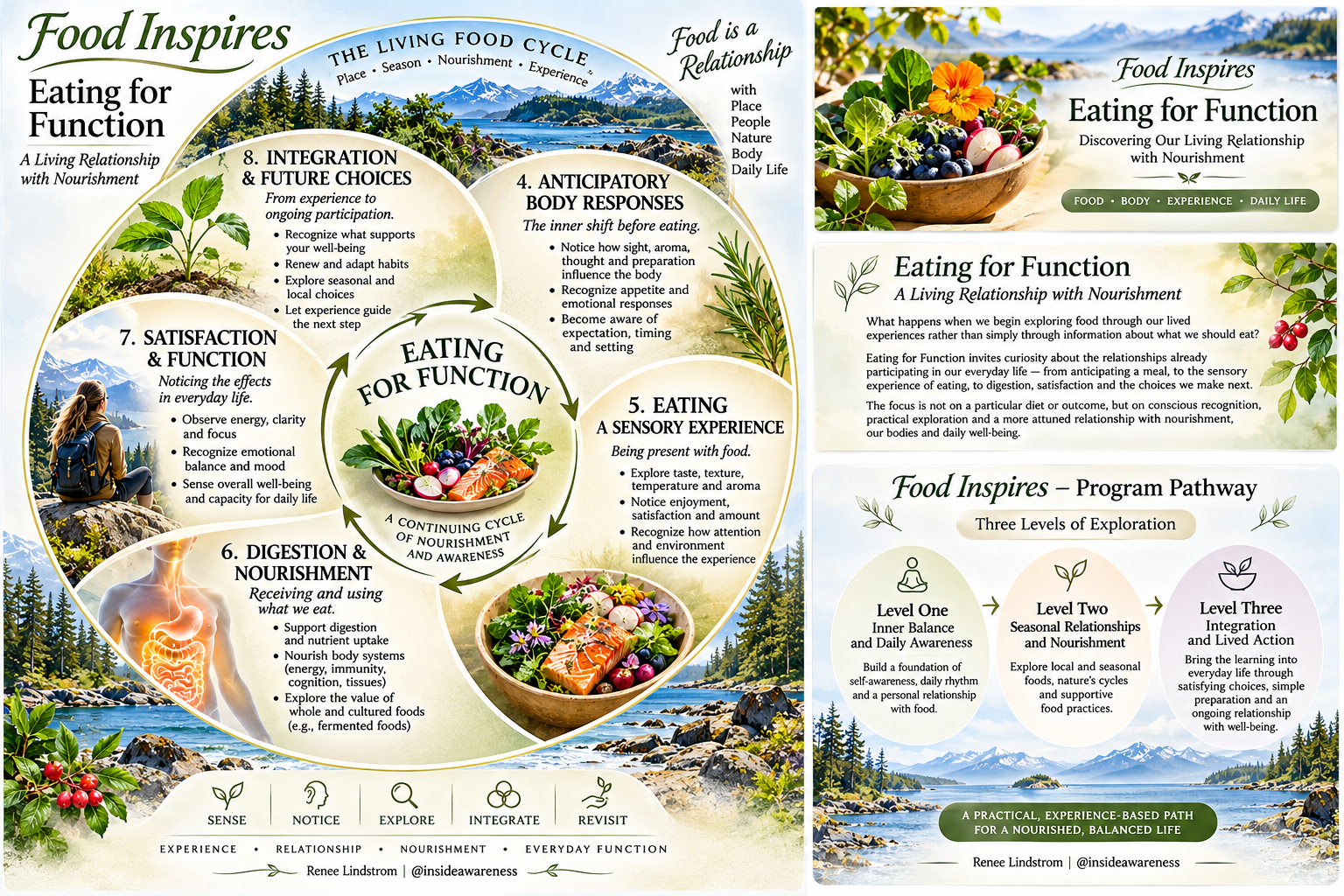
What happens when we begin exploring food through our lived experiences rather than simply through information about what we should eat?
Our relationship with nourishment involves more than selecting ingredients or planning meals.
It includes how we anticipate food, how we experience eating, how our bodies receive and use nourishment, and how those experiences influence our future choices.
It also includes our emotional responses, familiar habits, memories, expectations and the environments in which we eat.
Through Food Inspires, Eating for Function offers opportunities to explore these relationships through sensory awareness, personal experience and conscious recognition.
The intention is not to introduce another diet or strategy for correcting the body.
It is to become curious about the relationships already participating in our everyday experiences.
4. Anticipatory Body Responses
Recognizing the Body’s Relationship with Food Before Eating
Our experience of nourishment can begin before food enters our mouths.
Seeing familiar ingredients, noticing an aroma, hearing the sounds of food preparation or anticipating a favourite meal may influence our appetite and bodily responses.
The digestive system can begin preparing for food through processes involving saliva, stomach activity and digestive secretions.
Our emotional experiences may also participate in these moments.
Sometimes preparing food feels inviting and enjoyable. At other times, eating may be influenced by urgency, distraction, fatigue, uncertainty or familiar routines.
These experiences offer opportunities for recognition.
An invitation to explore:
What do I notice in myself when I begin thinking about, seeing or preparing something to eat?
There is no particular response to achieve. The invitation is simply to begin recognizing what is already happening.
5. Eating — A Sensory Experience
Discovering Our Relationship with Food in the Moment
Eating offers a direct experience of taste, texture, temperature, aroma and the sensations of receiving food.
A familiar meal can become an opportunity to discover something previously unnoticed.
We may recognize how our preferences change, how textures influence our enjoyment or how our attention moves between the food, our surroundings and our thoughts.
There may be moments when eating is satisfying and others when it feels hurried or disconnected.
Rather than judging these differences, we can become curious about them.
An invitation to explore:
What changes in my experience when I become aware of the food I am eating?
This exploration is not about concentrating harder or performing mindful eating correctly.
It is about making room for sensory discovery within an ordinary activity.
6. Digestion and Nourishment
Recognizing the Body’s Ongoing Participation
Our relationship with food continues after eating.
Through digestion and absorption, the body processes food and receives nutrients that participate in many interconnected functions.
Nourishment contributes to the ongoing activities of our muscles, bones, nervous system, organs and other tissues.
These processes support everyday physical, cognitive and emotional functioning, although our experiences are also influenced by sleep, health, stress, activity and many other relationships.
We may not directly sense the movement of nutrients through the body, but we can begin developing an understanding of the functions they support.
For some people, this may open an interest in learning more about particular foods, nutrient relationships, food preparation or cultured foods.
An invitation to explore:
What am I beginning to recognize about the nourishment my body needs to participate in everyday life?
Knowledge about nutrition can become another reference for curiosity, rather than a set of rules that replaces personal experience.
7. Satisfaction and Function
Listening to Our Experiences of Everyday Well-Being
One of the continuing explorations within Food Inspires is the relationship between nourishment and how we experience ourselves.
Our physical energy, mental activity, emotional responses and sense of satisfaction may vary throughout the day.
Food is one participant in these changing experiences.
As we become more familiar with our daily rhythms, we may begin noticing relationships among eating, rest, movement, attention and our capacity to engage with everyday activities.
Satisfaction can also involve enjoyment, familiarity, connection and the experience of having enough.
These relationships are personal and may change with circumstances.
An invitation to explore:
How am I experiencing myself before eating, while eating and afterwards?
The intention is not to attribute every physical or emotional change to food.
It is to develop a broader awareness of the relationships that contribute to how we function and feel.
8. Integration and Future Choices
From Conscious Recognition to Everyday Participation
As experiences become more recognizable, they can begin influencing our choices.
We may discover renewed interest in familiar foods, curiosity about seasonal ingredients or enjoyment in preparing something ourselves.
We may notice that certain routines are supportive while others no longer reflect our circumstances or preferences.
These discoveries can become references when making future decisions.
Rather than relying entirely on an external strategy, we can begin including our own experiences in the process of choosing.
Over time, learning may become part of everyday participation without requiring a separate activity to maintain it.
An invitation to explore:
How might what I have discovered influence my next experience with food?
Our choices remain open to change as our experiences and circumstances change.
The discovery remains open even after we have found words to describe it.
Cultured Foods — An Opportunity for Further Exploration
For some people, curiosity about nourishment may lead to exploring the living processes involved in cultured foods.
Fermented foods such as kefir, sauerkraut and other traditional preparations offer opportunities to notice transformations in ingredients, aromas, textures, flavours and preparation processes.
These experiences can also introduce an interest in microorganisms, food traditions and nutritional science.
Culturing foods is one possible exploration within Eating for Function, not a requirement for participation.
The focus remains on developing a living relationship with food through experience, curiosity and learning.
A Living Relationship, Rather Than a Prescribed Outcome
The five areas of Eating for Function are not intended as steps toward achieving a particular result.
They are interconnected opportunities for recognizing relationships among the body’s functions, our sensory experiences, emotional responses and everyday choices.
Someone may begin by noticing their relationship with appetite.
Another may become curious about how nourishment contributes to movement or mental activity.
Someone else may discover renewed enjoyment in preparing food, exploring seasonal ingredients or revisiting familiar food traditions.
Each experience can become an entry point for further discovery.
Ways to Participate
Personal Guided Explorations
Individual sessions offer opportunities to explore nourishment, sensory experience and everyday function through the Inside Awareness approach.
The learning is responsive to personal interests, circumstances and discoveries.
Food Inspires — Facilitator Mentorship
For individuals interested in supporting experiential learning, facilitator mentorship introduces the same foundational explorations with additional attention to listening, observing, guiding inquiry and recognizing another person’s independent learning.
Begin with an Inquiry
Are you interested in discovering a different relationship with food, nourishment and everyday function?
Food Inspires offers an opportunity to begin with the experiences you already have and explore what becomes recognizable through them.
Food Inspires — Guided Patterns for Lived Function
Renee Lindstrom | @insideawareness
Renee Lindstrom, GCFP – @insideawarens – Copyright 2014 – 2026
With respect and gratitude,
I acknowledge the practices and teachings that have contributed to the ground from which this work has grown: Moshe Feldenkrais and the Feldenkrais Method® of somatic education; Marshall Rosenberg and Nonviolent Communication; Chögyam Trungpa Rinpoche and the Shambhala teachings; and Dyan Grant Francis, Subtle Energy Solutions and Black Sect Feng Shui.
These influences are acknowledged with appreciation for the learning they made possible, while the patterns and interpretations presented here reflect my own continuing inquiry, lived experience and educational development.

