
Discovering the Relationship Between Inner Awareness and Shared Experience
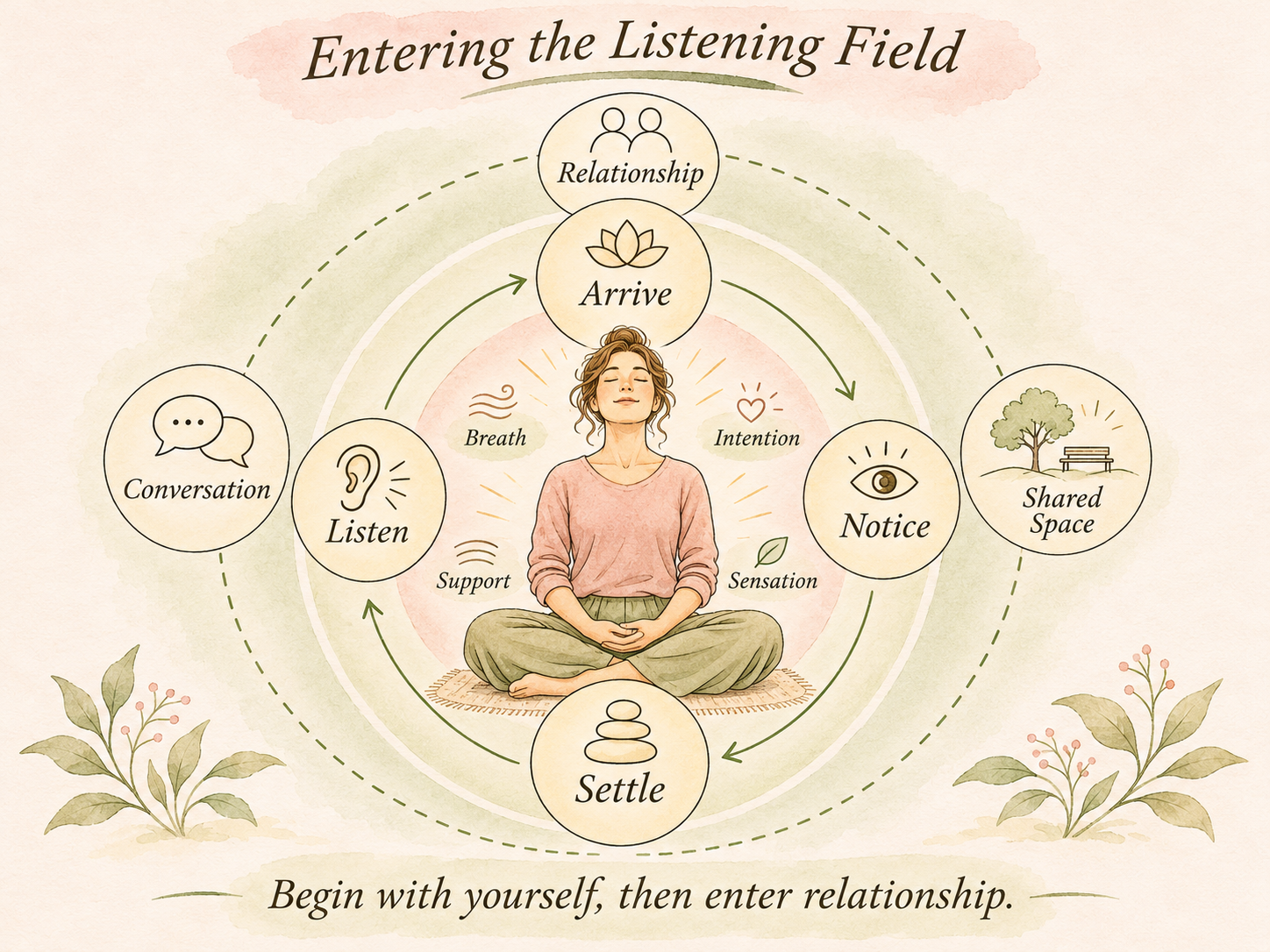
Listening is often understood as something we do when another person speaks.
Yet our listening experience may begin long before a conversation takes place.
We arrive carrying memories, expectations, personal intentions, feelings, thoughts, and interpretations shaped by our earlier experiences.
Sometimes we arrive curious and available.
At other times, we may be anticipating disagreement, preparing what we want to say, hoping to be understood, or feeling uncertain about what will happen.
These experiences can influence how we listen, speak, and participate with others.
The Inside Awareness Listening Field introduces opportunities to become conscious of these relationships through personal experience.
Rather than beginning with instructions about how someone should listen, we begin with an invitation to notice what is already happening.
We don’t have to arrive without expectations. We can begin by recognizing that we have them.
Through inner awareness, reciprocal listening, and ongoing inquiry, we can explore how understanding develops within ourselves and between people.
01 — Emerging Questions
Recognizing What Is Present Before We Have an Answer
Our experiences often introduce questions before we have words to describe them.
We may notice discomfort within a conversation without understanding what is contributing to it.
We may become aware that we are preparing a response while another person is still speaking.
Or we may recognize that we have entered a conversation with expectations about what the other person will say or do.
These experiences provide opportunities for inquiry.
What Am I Arriving With?
Before beginning an interactive listening exploration, participants are invited to recognize their experience of arriving.
This may include noticing physical support, breathing, sensations, feelings, thoughts, and the surrounding environment.
Attention can then shift toward the intentions and expectations we are bringing into the shared experience.
What am I hoping will happen?
What am I concerned might happen?
Have I already formed an interpretation?
Am I hoping to understand, contribute, be heard, resolve something, or establish a particular outcome?
These are not questions requiring immediate answers.
They offer opportunities to recognize influences that may already be participating in our listening.
Discovering Without Immediately Interpreting
A person may recognize discomfort without needing to explain it.
They may discover curiosity, uncertainty, or a wish to defend a familiar position.
Recognizing these experiences does not require judging them or trying to remove them.
Sometimes the most meaningful discovery is simply becoming conscious of something that was previously unnoticed.
An emerging question can become the beginning of a living inquiry rather than a problem requiring an immediate solution.
02 — Shared Participation
Discovering the Relationship Between Listening to Ourselves and Listening to Another
When two people enter a conversation, each brings a different history of experiences, interpretations, expectations, and intentions.
These differences may not be immediately visible.
One person may wish to share an experience.
Another may believe they are being asked for advice.
One may be hoping for understanding while the other is preparing to explain or defend a position.
Without conscious recognition, these expectations can begin influencing the relationship before the participants have established what they are actually hoping to share.
The Listening Field invites recognition of this shared experience.
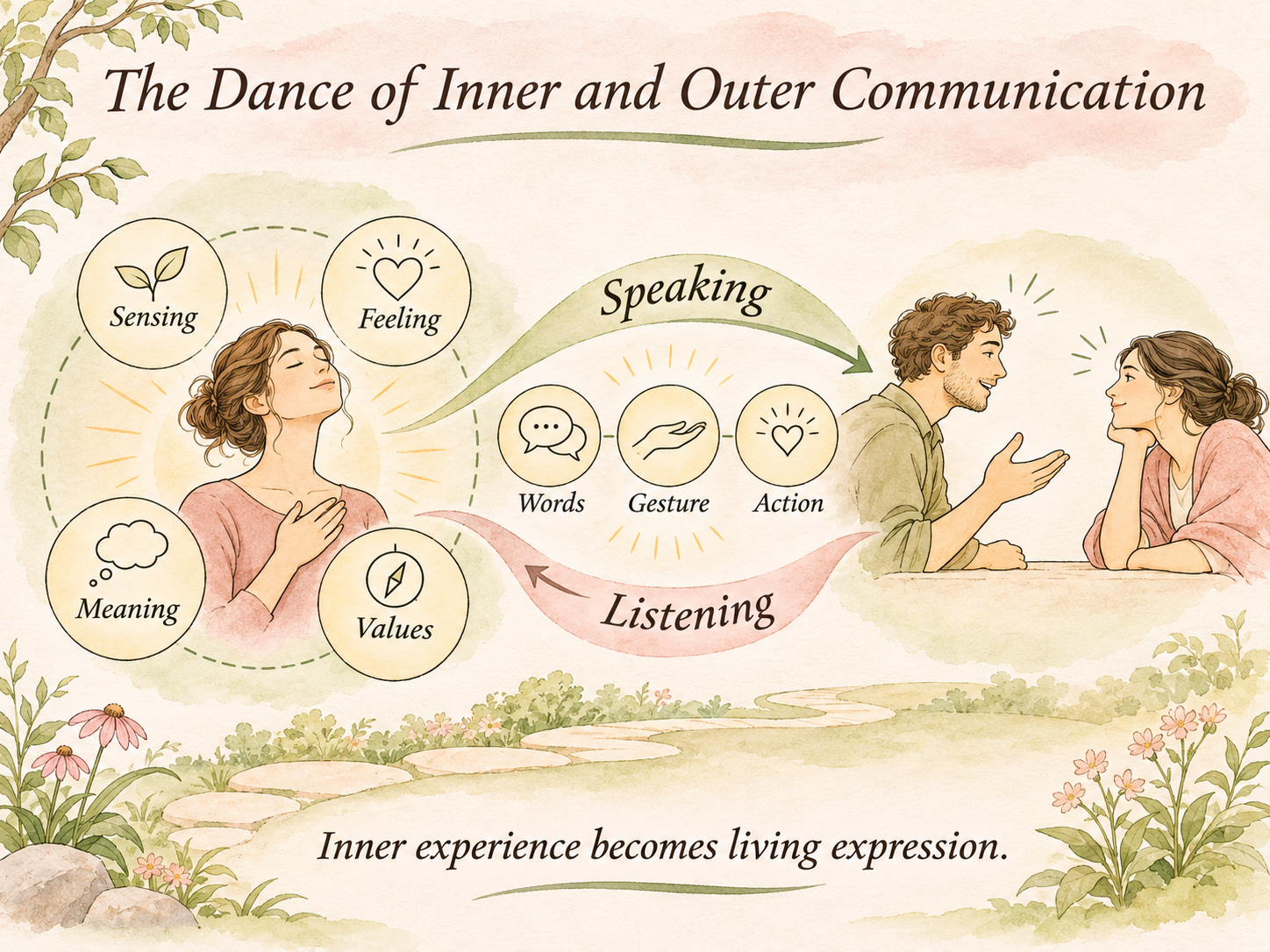
Inner and Outer Listening
Inner listening introduces awareness of what is happening within ourselves.
We may recognize sensations, feelings, thoughts, personal values, or familiar responses.
Outer listening invites attention to what another person is actually expressing.
Rather than immediately deciding what their words mean, we can listen for their intended meaning and check whether we have understood.
This does not require abandoning our own experience.
We can remain aware of ourselves while making room for another person’s perspective.
Reciprocal Listening
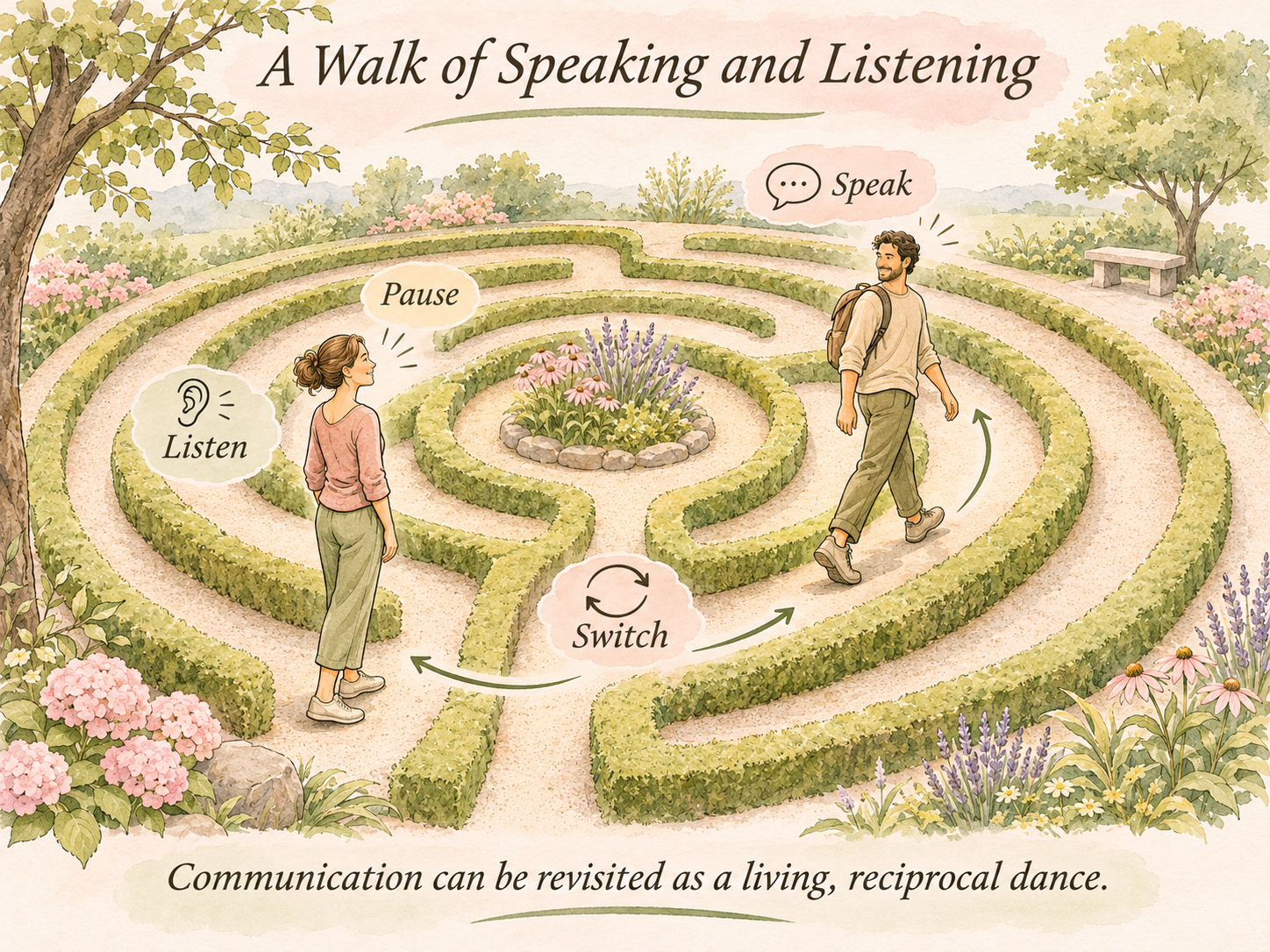
A guided interactive pattern introduces opportunities to experience the changing roles of speaking and listening.
One person expresses an experience using first-person language.
The listener receives what is being shared without immediately correcting, evaluating, advising, or defending.
The listener then reflects what they understood, allowing the speaker to clarify their intended meaning.
The participants may exchange roles, introducing opportunities for each to experience speaking, being heard, and listening.
Understanding does not require agreement.
A person’s experience can be recognized without requiring another person to adopt the same interpretation.
Discovering Mutual Participation
Sometimes an exchange creates greater understanding.
At other times, differences remain.
A participant may recognize that they need more time, that a particular subject requires a boundary, or that the conversation is not presently available for mutual exploration.
These discoveries are also part of conscious participation.
A reciprocal listening relationship does not require two people to become the same. It offers an opportunity for each person’s experience to become more recognizable within a shared encounter.

03 — Space for Discovery
Allowing Understanding to Emerge Through Lived Experience
Not every experience needs to be understood immediately.
Sometimes we begin a conversation believing we already know what matters.
Through listening, we may discover an experience, intention, or meaning we had not previously considered.
At other times, a conversation may reveal that we are not yet ready to explore a particular subject together.
The Listening Field provides opportunities to recognize these developments without requiring a predetermined outcome.
From Familiar Interpretation to New Possibility
Our earlier experiences can influence how we understand what is happening in the present.
A familiar word, expression, or behaviour may immediately introduce an interpretation based on something we previously experienced.
That interpretation may be useful.
It may also be incomplete.
By becoming conscious of the relationship between what we observe and the meaning we assign to it, we may discover opportunities for further inquiry.
What did I actually hear?
What meaning did I make?
What is the other person intending to express?
What might become clearer if I ask?
The intention is not to question every thought or abandon our personal understanding.
It is to recognize when additional information or another perspective may be meaningful.
Listening as an Ongoing Relationship
Conversations do not always conclude with a shared decision, agreement, or complete understanding.
Sometimes listening introduces a question that becomes clearer later.
Sometimes a new experience changes how we understand something we previously discussed.
Revisiting can be meaningful when participants are willing and available.
It need not become an obligation to continue defending or explaining ourselves indefinitely.
Space for discovery includes respecting autonomy, boundaries, and the changing availability of each person.
The willingness to listen creates possibilities for discovery. It does not require us to know in advance what we must discover.
Listening as a Living Relationship
Emerging Questions, Shared Participation, and Space for Discovery introduce different dimensions of the same experiential learning process.
We begin by recognizing ourselves.
We discover how our inner experiences participate in listening and speaking.
We make room to hear another person’s intended meaning.
And we remain open to what becomes recognizable through the encounter.
This is not a formula for achieving agreement or preventing every misunderstanding.
It is an opportunity to develop familiarity with the living relationship between inner awareness, outer experience, and conscious participation.
Before beginning a conversation, we can discover that we are already participating in a relationship.
Related Explorations
- Inner Awareness Through Listening
- The Dance of Inner and Outer Communication
- Orientation of Communication
- Culture of Values
- Intention in Lived Experience
- Living Relationships with Nature
Listening Field – Guided Patterns for Lived Function – Inside Awareness | Renee Lindstrom
@insideawarens – Copyright 2014 – 2026
Developed through years of values-based educational exploration, influenced by Marshall Rosenberg’s Nonviolent Communication, somatic learning through the Feldenkrais Method, and the integration of intention and conscious recognition through lived experience.

