
Discovering the Relationship Between Inner Awareness and Everyday Action
Awareness Through Goals | Inside Awareness
Intention is already participating in our everyday lives.
We sit, stand, walk, reach, speak, listen, work, rest, and engage in relationships. Each activity involves a direction of attention or action, whether we consciously recognize it or not.
We may intend to reach for something, stand from a chair, begin a conversation, find understanding, make a decision, or create an experience that is meaningful to us.
Some intentions are consciously chosen. Others emerge through familiar habits, learned responses, and spontaneous interests.
The Inside Awareness explorations of intention invite us to become more familiar with these experiences.
Rather than beginning with a goal we believe we should achieve, we begin by recognizing what is already influencing our participation.
Intention is not only something we set for the future. It is something we can begin recognizing within the living experiences of the present.
The intention of this educational approach is to nurture conscious recognition of the relationship between personal values, inner awareness, motivation, movement, and action.
01 — Recognizing Intention
Discovering What Is Already Motivating Our Actions
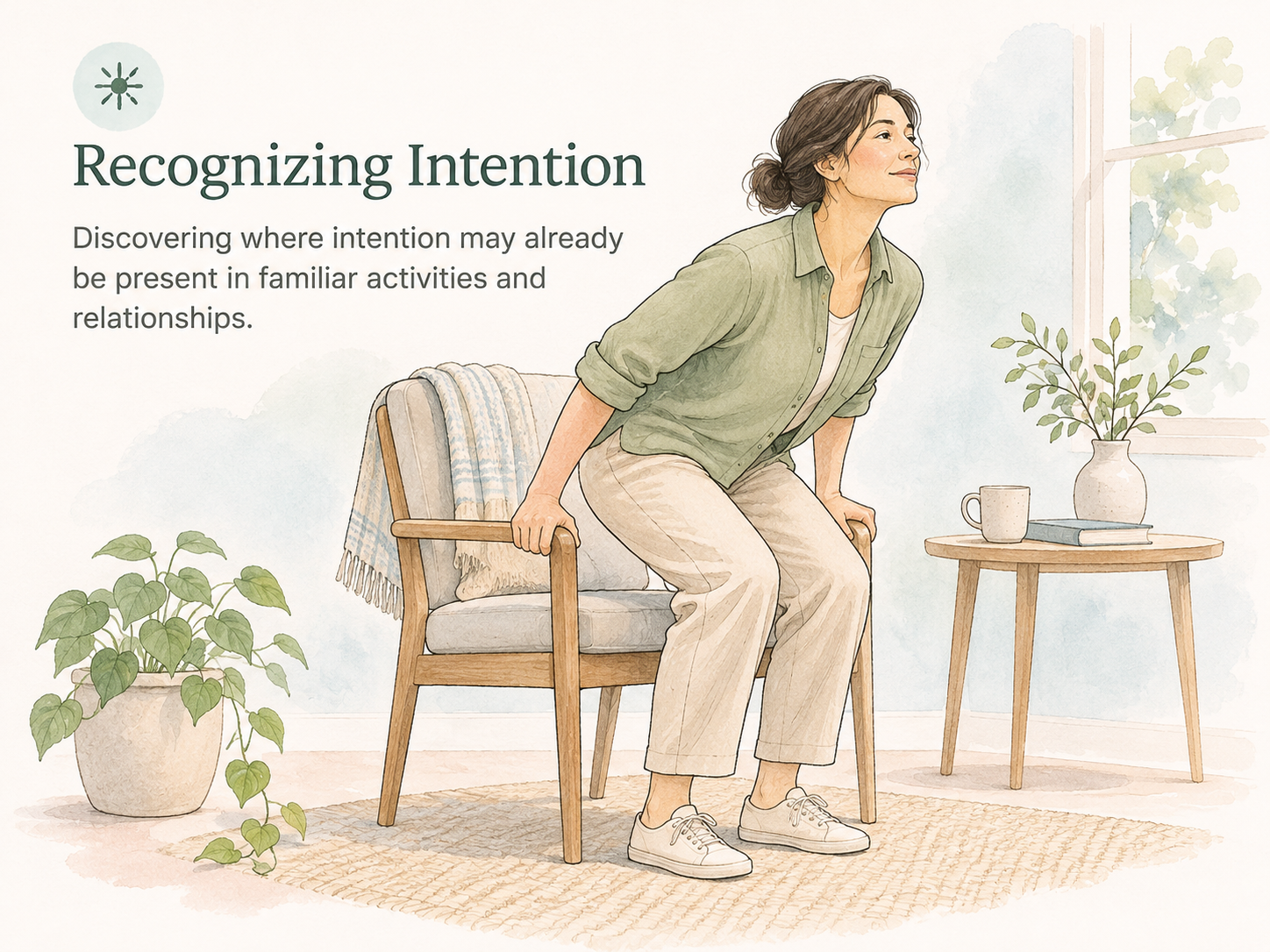
Intention can be explored through the simplest activities of daily life.
Consider moving from sitting to standing.
Before the movement becomes recognizable, there may already be an intention to change position, reach something, join another person, or begin walking.
The skeleton organizes through changing relationships of support, weight transfer, balance, and movement.
Much of this occurs without needing to think consciously about each individual movement.
Through somatic exploration, we can begin recognizing the relationship between what we intend and how we organize ourselves to participate in the action.
A similar relationship can be explored through communication.
We may begin speaking because we wish to share something meaningful, seek understanding, ask for help, express disagreement, or connect with another person.
Yet the intention motivating our words may not always be consciously recognizable.
We may believe we are simply explaining something while also seeking reassurance, recognition, acceptance, or agreement.
These possibilities are not presented as judgments about our behaviour.
They offer opportunities for inquiry.
Intention and Inner Awareness
Our intentions can be influenced by personal values, feelings, sensory experiences, memories, expectations, and learned social or cultural patterns.
Sometimes we recognize what motivates us immediately.
At other times, the meaning of an action becomes clearer through revisiting the experience.
We may discover an intention beneath a familiar response that we had not previously considered.
This includes responses we find satisfying as well as those that feel uncomfortable or confusing.
What was meaningful to me?
What was I hoping to experience?
What influenced my response?
What am I recognizing now that I did not recognize before?
The intention is not to analyze every movement or conversation before participating.
It is to develop greater familiarity with the relationship between our inner experiences and outward actions.
When intention becomes consciously recognizable, we may discover greater choice in how we participate.
02 — Cycles of Inquiry
Revisiting What Is Meaningful Through Changing Experiences
Intention is not necessarily a single decision followed by action.
Our experiences continue changing, and what is meaningful to us may become clearer through participation.
The Inside Awareness goal-inspired programs developed as a way to explore intention through recurring experiences of recognition, action, reflection, and integration.
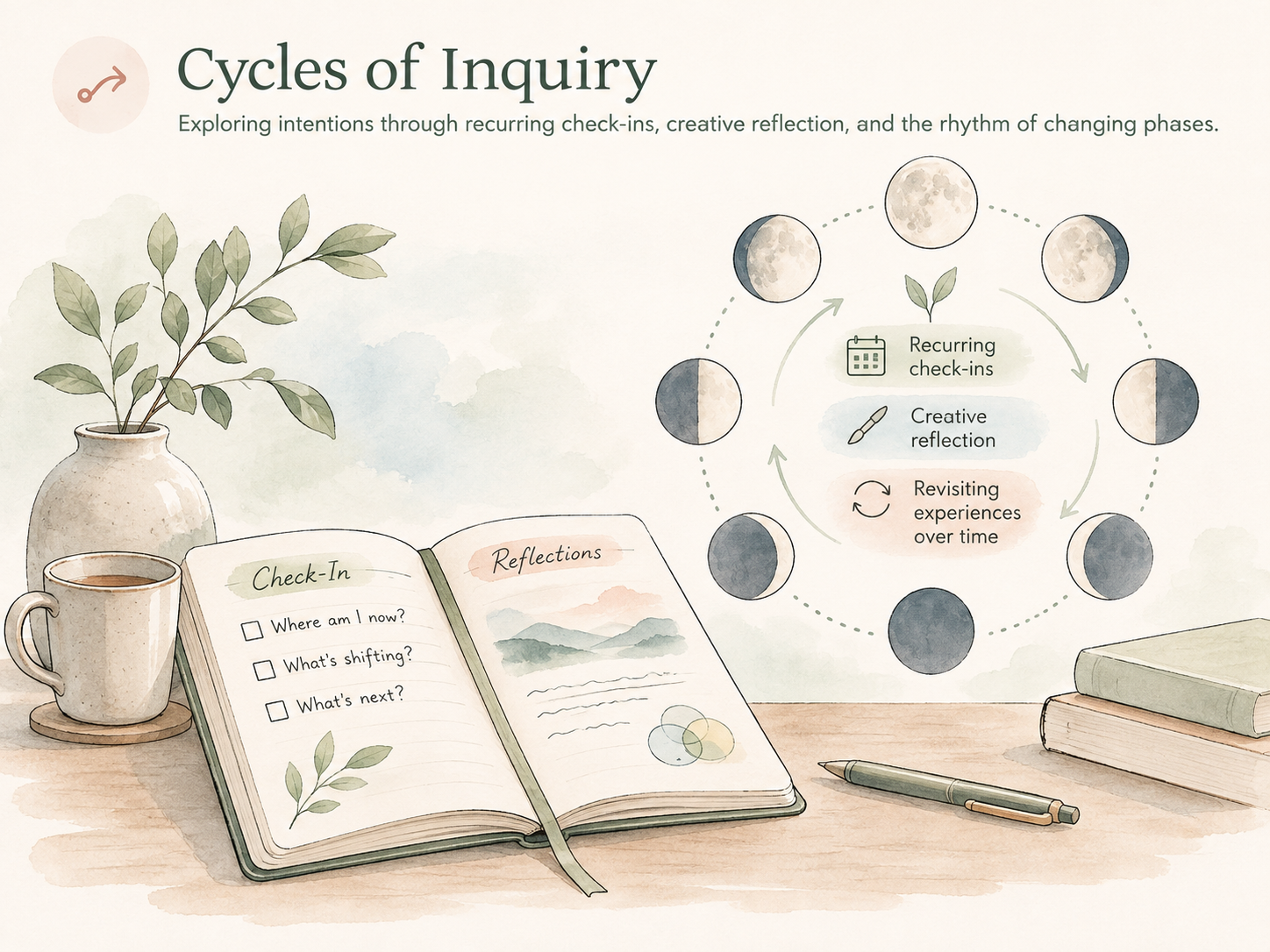
The early Culture of Values journal introduced a daily opportunity to recognize two experiences.
One involved an action in which something personally meaningful had been met.
The other involved an experience in which a value or need remained unmet.
This counterbalance offered opportunities to celebrate what was working while also becoming curious about experiences that were difficult.
Rather than concentrating exclusively on what needed to change, participants could begin recognizing what was already meaningful within their lives.
An Eight-Phase Pattern of Exploration
The eight phases of the moon later provided a familiar rhythm for exploring intentions over time.
Each changing phase offered an opportunity to return attention to an intention, recognize experiences, and consider what was becoming meaningful.
The pattern introduced recurring opportunities to explore, take action, revisit, acknowledge developments, celebrate, and let go.
The moon phases provided a structure for reflection, not a requirement to follow a particular belief or achieve a predetermined result.
An intention could be revisited as circumstances changed.
An experience might reveal something previously unnoticed.
An earlier goal might become less meaningful, while another possibility began emerging.
The pattern offered time for learning to develop through lived experience.
Structure Supporting Spontaneity
One of the more meaningful discoveries within these explorations has been the relationship between intentional structure and spontaneous participation.
A recurring pattern of reflection can help us become more familiar with what matters to us.
As this familiarity develops, recognizing meaningful possibilities may become more accessible in ordinary moments.
What began as a conscious effort to acknowledge intention may gradually become part of a more spontaneous way of participating.
This relationship continues to be explored through other Inside Awareness programs, including Food Inspires, Walking with Inner Awareness, and the integration of values into everyday living.
The structure provides opportunities for revisiting. The discoveries remain individual and responsive to lived experience.
03 — Choice & Participation
Recognizing Possibilities Through Conscious Action
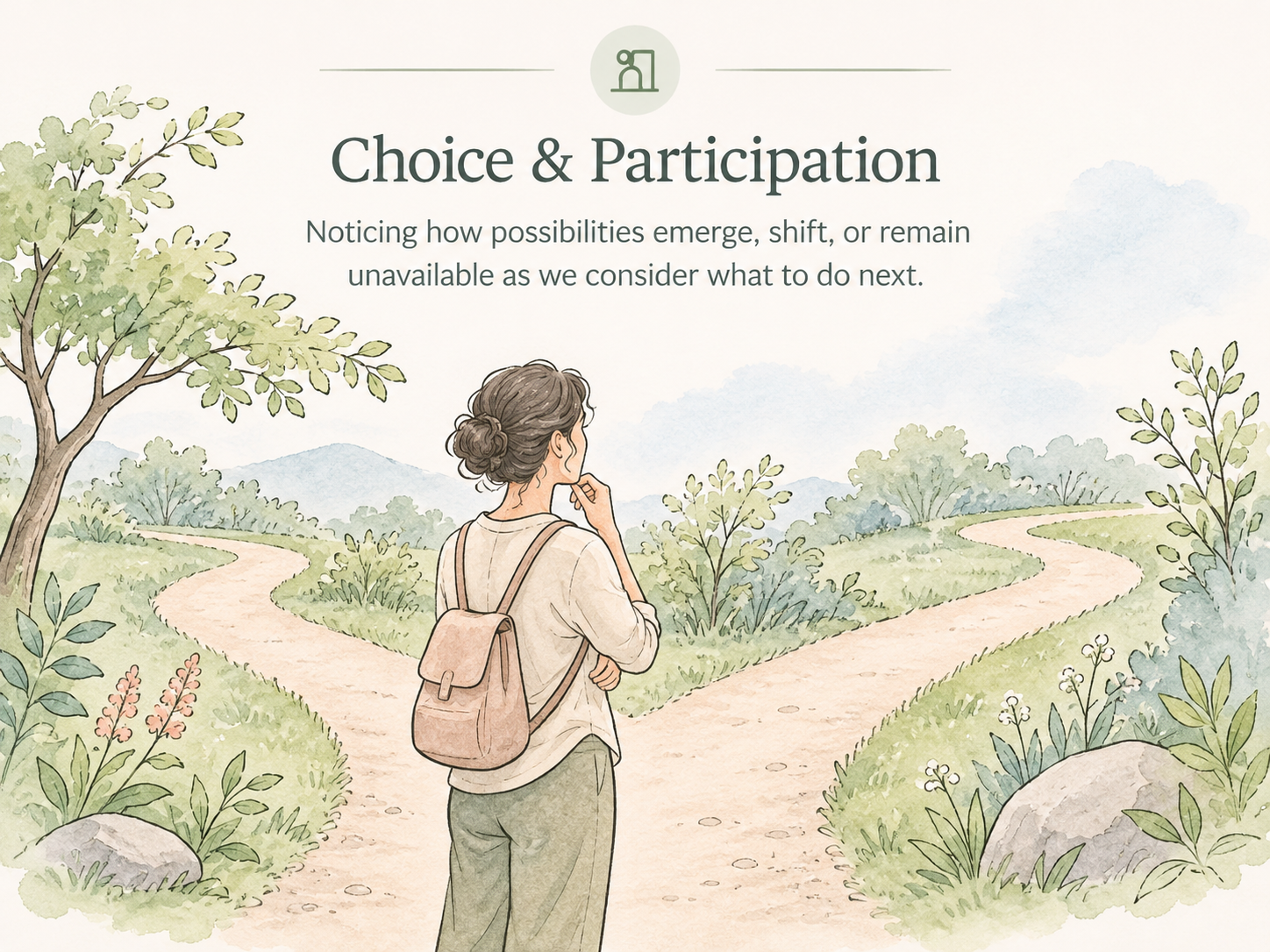
Our choices are influenced by more than the options immediately visible to us.
We may respond through familiar habits, established beliefs, social expectations, or remembered experiences.
Sometimes an action feels automatic because we have participated in similar circumstances many times before.
Conscious recognition can introduce another possibility.
We may begin noticing what is motivating a familiar response and whether that response is connected with what is meaningful to us now.
For example, someone may ask us to take on an additional responsibility.
We may automatically agree because agreeing has become familiar.
Yet, through recognizing our values and present circumstances, we may discover that another choice would better support our need for balance, consideration, or personal responsibility.
We might choose to say yes, decline, suggest another arrangement, or request time to consider.
The importance lies not in which response is selected, but in developing a conscious relationship with our participation.
When Possibilities Change
Not every intention can become the action we originally imagined.
Circumstances change. Relationships develop. Opportunities arise or become unavailable.
Sometimes we discover that what we initially wanted no longer holds the same meaning.
Recognizing these changes can introduce opportunities to revisit an intention without treating a changed direction as failure.
An intention may continue through a different action.
It may be released.
Or it may remain meaningful while we wait for another possibility.
The invitation is to recognize what is available in the present and discover how we wish to participate.
Intention in Movement, Communication, and Relationships
Intention can become recognizable through many different experiences.
In movement, we may discover how the desire to change position influences our organization and balance.
In communication, we may recognize whether we are speaking to express ourselves, understand another person, seek reassurance, or reach an agreement.
In relationships, intention may influence whether we move toward connection, create distance, establish a boundary, or invite a shared experience.
During a walk in nature or on a labyrinth, we may bring attention to something meaningful and discover how our experience changes through movement and awareness.
In everyday decisions, we may recognize how personal values influence choices that previously felt automatic.
These are not separate kinds of intention requiring different rules.
They are different opportunities to explore the relationship between inner awareness and outward participation.
The focus is not on achieving the correct response. It is on recognizing what is meaningful and discovering how we choose to participate.
Intention as a Living Relationship
The Inside Awareness exploration of intention is not limited to planning, goal achievement, or personal improvement.
It is an invitation to recognize how meaning, motivation, sensory experience, thought, movement, and action participate together.
Our intentions may be logical, practical, creative, spontaneous, or influenced by experiences we have not yet consciously recognized.
Becoming familiar with these relationships can introduce opportunities for inner alignment, self-acceptance, and greater choice.
Sometimes recognition occurs before an action.
Sometimes it emerges during an experience.
And sometimes we understand our intention only after looking back on what happened.
Each offers an opportunity for learning.
Intention becomes a living relationship between what is meaningful to us and how we participate in creating our everyday experiences.
Related Explorations
- Culture of Values — Recognizing What Is Meaningful
- Listening and Communication — Intention, Expression, and Interpretation
- Movement in Lived Function — Intention and Movement Transitions
- Food Inspires — Sensory Awareness and Spontaneous Choice
- Walking with Inner Awareness — Centering Through Nature
- The Inner Labyrinth — Intention and Returning to Centre
nside Awareness | Renee Lindstrom
Certified Feldenkrais Practitioner since 2007. Guided Patterns for Lived Function integrates somatic education, functional movement, and conscious recognition through everyday experience.
Guided Patterns for Lived Function — Renee Lindstrom – Inside Awareness
I acknowledge the practices and teachings that have contributed to the ground from which this work has grown: Moshe Feldenkrais and the Feldenkrais Method® of somatic education; Marshall Rosenberg and Nonviolent Communication; Chögyam Trungpa Rinpoche and the Shambhala teachings; and Dyan Grant Francis, Subtle Energy Solutions and Black Sect Feng Shui.

