
Orientation of Communication
Discovering Where We Are Speaking and Listening From
Conscious Recognition Through Lived Experience
Communication is influenced by much more than the words we choose.
Our sensory experiences, feelings, thoughts, memories, personal values, and learned expectations all participate in how we understand ourselves and others.
Two people can hear the same words, witness the same event, or participate in the same conversation and come away with different understandings.
These differences are not necessarily evidence that one person is right and another is wrong.
They may reflect the different experiences and perspectives each person brings into the relationship.
The Inside Awareness Orientation of Communication introduces opportunities to recognize these influences and become more familiar with how they participate in our everyday conversations.
The intention is not to teach one correct way to communicate. It is to nurture conscious recognition of the experiences influencing how we listen, interpret, speak, and respond.
Recognizing Our Inner and Outer Experiences
We are continually receiving information through our senses and responding within the environments we inhabit.
We see, hear, touch, taste, and smell. We experience physical sensations, feelings, thoughts, memories, and interpretations.
Some of this information becomes consciously recognizable. Other responses may occur through familiar habits before we have considered what influenced them.
Orientation begins by distinguishing what we are experiencing from what we believe our experiences mean.
For example, hearing someone’s words is different from interpreting their intention.
Recognizing a feeling is different from deciding that another person caused it deliberately.
Observing someone’s action is different from knowing everything that influenced their choice.
These distinctions create opportunities for curiosity and greater understanding within ourselves and our relationships.
Social and Cultural Influences
Our communication patterns develop through years of participation in families, educational environments, workplaces, communities, and cultures.
We learn expectations about how to speak, listen, behave, cooperate, express emotions, and respond to authority.
Some patterns support relationships and belonging. Others may become so familiar that we no longer recognize their influence.
An individual may learn to agree to avoid disagreement, remain silent to preserve belonging, or defend an interpretation as though it were the only possible understanding.
The Orientation of Communication offers opportunities to recognize these learned responses without automatically judging or correcting them.
When a familiar pattern becomes recognizable, another possibility may become available.
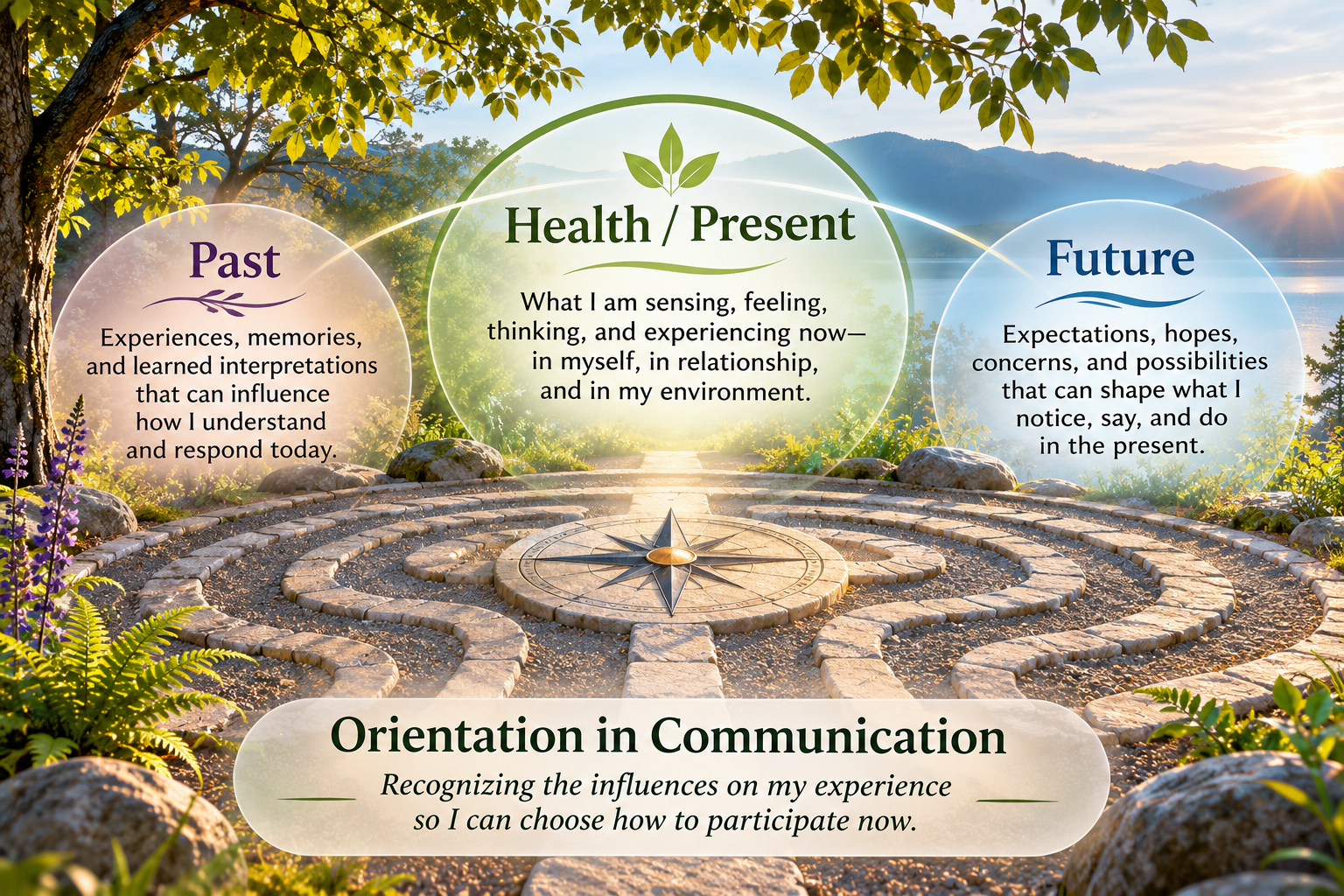
Past, Health/Present, and Future
Our focus of attention can influence how we experience a conversation.
An event remembered from the past may stimulate feelings and interpretations in the present.
A concern about what might happen in the future may influence what we hear or how we respond today.
Meanwhile, our present experience continues through our senses, feelings, physical responses, and relationships.
The Past–Health/Present–Future orientation introduces an opportunity to recognize these different influences.
Am I responding to something happening now?
Am I remembering an earlier experience?
Am I anticipating something that has not yet occurred?
What am I sensing and experiencing in the present?
This exploration is particularly meaningful when conversations involve longstanding disagreements, family relationships, or different interpretations of shared experiences.
The intention is not to dismiss the past or ignore future concerns.
It is to recognize how they may be influencing our present participation.
Recognizing Different Life Experiences
Our understanding develops through the experiences available to us at different stages of life.
A childhood event may be remembered decades later through the perspective of the child who originally experienced it.
A parent may remember the same event through responsibilities and circumstances that were not recognizable to the child.
People of different ages, family roles, professions, and life histories may bring knowledge and assumptions that others have not experienced firsthand.
These differences can influence how confidently people speak and how they interpret another person’s experience.
Recognizing the limits of our own perspective can introduce opportunities for empathy and curiosity.
Each person can speak with personal authority about their own experience without assuming complete authority over another person’s.
Listening to differing perspectives does not require abandoning our own understanding.
Values, Feelings, and Intention
An important foundation of the Inside Awareness communication approach is developing familiarity with what is personally meaningful.
Through the Culture of Values explorations, individuals are invited to develop their own understanding of values such as acceptance, consideration, respect, autonomy, kindness, and belonging.
Feelings may offer information about values and needs that are satisfied or unsatisfied.
Recognizing these relationships can provide another orientation for communication.
Rather than focusing exclusively on what is wrong or what another person should change, we can begin exploring what is meaningful and what we hope to contribute through our responses.
Intention becomes part of this inquiry.
What is motivating me to speak?
Am I seeking understanding, connection, support, clarity, or an agreement?
Am I responding to a present experience or repeating a familiar reaction?
The intention is not to analyze every conversation before speaking. It is to develop enough familiarity with our inner experiences that conscious recognition becomes increasingly accessible in daily life.
Acceptance, Autonomy, and Belonging
Communication brings different people and experiences into relationship.
We may wish to be understood while also wanting to understand another.
We may recognize shared values without sharing identical beliefs or interpretations.
Acceptance does not require agreement with everything another person says or does.
Likewise, belonging does not have to depend upon abandoning our own feelings, needs, or experiences to fit another person’s expectations.
The Orientation of Communication invites exploration of how we can remain connected to ourselves while participating in relationships with others.
This includes recognizing personal boundaries, allowing differences, and becoming curious about the experiences influencing each person’s responses.
An Invitation to Explore
The Orientation of Communication is not a method for deciding who is right or wrong.
It is an opportunity to become familiar with the influences shaping our inner and outer experiences.
These explorations draw upon years of studying and facilitating Marshall Rosenberg’s Nonviolent Communication, together with somatic learning through the Feldenkrais Method, personal values education, and contemplative awareness.
Each has contributed a different entry point into recognizing ourselves through lived experience.
The intention is to offer additional possibilities for listening, understanding, and participating in relationships with greater ease.
When I recognize where I am speaking and listening from, I may discover more choice in how I wish to participate.
Sensing myself. Sensing another. Discovering how to participate together.
Inside Awareness | Renee Lindstrom
Continue Exploring
Listening — Discovering the experience of receiving, sensing, and recognizing ourselves and others.
The Dance of Inner and Outer Communication — Exploring how inner experience becomes expression, how we respond to one another, and how relationships continue developing through lived experience.
Food Inspires | Guided Patterns for Lived Function – Renee Lindstrom, GCFP – @insideawarens – Copyright 2014 – 2026
With respect and gratitude,
I acknowledge the practices and teachings that have contributed to the ground from which this work has grown: Moshe Feldenkrais and the Feldenkrais Method® of somatic education; Marshall Rosenberg and Nonviolent Communication; Chögyam Trungpa Rinpoche and the Shambhala teachings; and Dyan Grant Francis, Subtle Energy Solutions and Black Sect Feng Shui.
These influences are acknowledged with appreciation for the learning they made possible, while the patterns and interpretations presented here reflect my own continuing inquiry, lived experience and educational development.

