
Discovering Our Living Relationships with Space
We experience our surroundings through movement, sensory awareness, memories, feelings, personal values, and the activities of everyday life.
Yet many of the influences within our environments remain outside conscious recognition.
Inside Awareness Place & Design offers opportunities to begin noticing these relationships through guided experiences, personal inquiry, and observation.
Rather than beginning with recommendations about what should change, participants are invited to discover how they are already responding to their surroundings.
Participation may involve exploring a familiar home or workplace, considering design possibilities, or developing the ability to recognize environmental influences through ongoing observation.
The invitation is to listen to a place through lived experience before deciding what may be meaningful to do.
01 — Place Explorations
Discovering How We Experience the Spaces Around Us
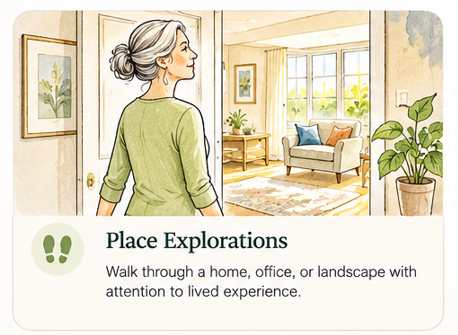
Place Explorations introduce opportunities to experience familiar and unfamiliar environments with greater conscious awareness.
A guided exploration may take place within a home, office, garden, landscape, or another environment meaningful to the participant.
Rather than immediately assessing the space, we begin by noticing.
What happens as I enter?
Where does my attention travel?
What do I experience through light, colour, sound, temperature, and physical support?
How do I move through the space?
What relationship do I notice between myself and my surroundings?
An Experiential Approach
Walking through a place can introduce opportunities to recognize influences that were previously familiar but unnoticed.
A doorway may create a transition between different experiences.
A window may establish a meaningful connection with nature.
Furniture may influence movement, orientation, and interaction.
The arrangement of a room may invite different experiences of openness, enclosure, comfort, or attention.
These observations do not need to lead immediately to changes.
Sometimes recognizing an existing relationship introduces appreciation for something already present.
At other times, awareness may reveal new possibilities for using or arranging a space.
Place Explorations begin with experiencing an environment rather than evaluating it.
02 — Design Conversations
Exploring Choices Through Personal Meaning and Environmental Awareness
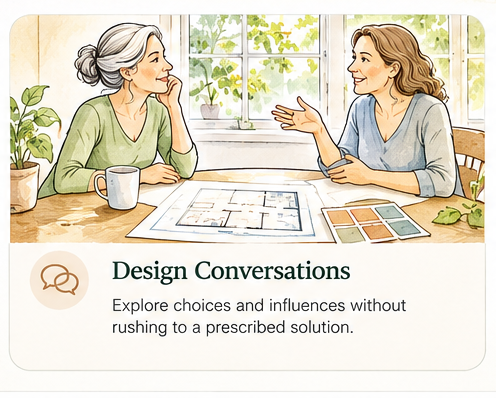
Design Conversations introduce opportunities to consider changes within a home, office, landscape, or personal environment.
The focus is on discovering the relationships among physical features, daily activities, personal values, and intended use.
Participants may wish to explore furniture placement, colour, room function, entrances, pathways, indoor–outdoor relationships, or possibilities associated with a property transition.
Rather than beginning with prescribed solutions, the conversation invites recognition of what is already meaningful.
Recognizing Influences Before Making Changes
A person may wish to rearrange a room without being certain what feels uncomfortable or incomplete.
Another may be considering a new colour, furnishing, or design feature.
Someone preparing to move may be exploring how a new environment could support a changing stage of life.
These situations provide opportunities to consider both practical and experiential relationships.
What is the intention for this space?
How is it currently experienced?
What is already supporting that intention?
What possibilities are becoming recognizable?
Guided dialogue may include observations of orientation, colour, form, function, movement, and personal responses.
Feng Shui references, including the Nine Life Areas, can provide another way of considering relationships between place and life experience.
The intention is not to determine one correct arrangement or design.
It is to support choices that emerge through a conscious understanding of the person, their activities, and their environment.
Design becomes a conversation between what is meaningful inwardly and what is being created outwardly.
03 — Learning Through Observation
Developing Environmental Awareness and Mentoring Others
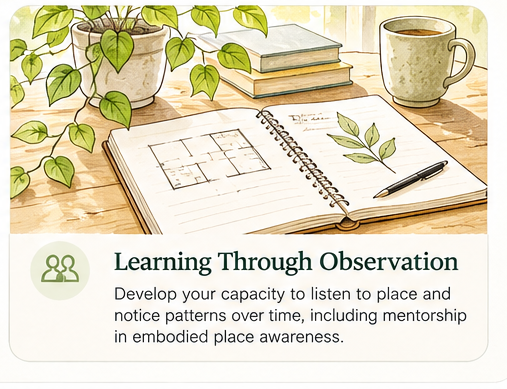
Learning Through Observation introduces opportunities to develop greater familiarity with the influences of place through everyday experiences.
This exploration can begin in environments we already know.
A familiar room may reveal different qualities when entered at another time of day.
A change in light may draw attention to a previously unnoticed colour relationship.
Moving a chair or adjusting our orientation may introduce a different experience of working, resting, or communicating.
The relationships among furniture, pathways, entrances, and surrounding landscapes can become opportunities for inquiry.
Revisiting Familiar Environments
Conscious recognition often develops through returning to an experience.
Rather than relying upon a single assessment, participants can begin noticing how their relationships with a place change over time.
What becomes recognizable when I revisit this room?
How does my experience change during different activities?
What happens when I explore another arrangement or orientation?
Am I responding to the environment itself, an expectation, or a remembered experience?
These inquiries help develop the capacity to recognize environmental influences without immediately turning observations into judgments.
Mentorship in Embodied Place Awareness
An important intention of Inside Awareness is to support others in developing their ability to explore and facilitate this form of environmental learning.
Mentorship can introduce the qualities of observation, sensory awareness, responsive listening, timing, and inquiry.
Rather than learning to identify what is wrong with a space or prescribe what another person should experience, developing facilitators can explore how to recognize relationships and support others in making their own discoveries.
The focus includes respecting individual differences, recognizing the limits of interpretation, and allowing time for personal experiences to become meaningful.
This creates possibilities for bringing embodied environmental awareness into homes, workplaces, educational settings, and community environments.
The intention is not to become an authority over another person’s experience of place. It is to develop the ability to recognize environmental influences and support conscious participation.
Continuing the Exploration
Place Explorations, Design Conversations, and Learning Through Observation are complementary ways of engaging with our environments.
They are not levels to complete in a prescribed order.
Someone may begin with a question about their home, become curious about a design relationship, or simply develop greater awareness of a familiar environment.
A discovery may lead to a practical change.
It may invite further inquiry.
Or it may deepen appreciation for what is already present.
The learning continues as we develop a more conscious relationship with the places in which we live, work, move, and participate.
Exploring Participation
Individuals, families, organizations, and prospective facilitators interested in embodied place awareness are welcome to connect with Inside Awareness to discuss available explorations, design conversations, and developing mentorship opportunities.
Back to Living Relationships with Space
Guided Patterns for Lived Function — Renee Lindstrom – Inside Awareness
I acknowledge the practices and teachings that have contributed to the ground from which this work has grown: Moshe Feldenkrais and the Feldenkrais Method® of somatic education; Marshall Rosenberg and Nonviolent Communication; Chögyam Trungpa Rinpoche and the Shambhala teachings; and Dyan Grant Francis, Subtle Energy Solutions and Black Sect Feng Shui.

