Over the years, my relationship with walking labyrinths has become closely connected to my explorations of movement, listening, communication, intention, and conscious recognition.
I would like to share some of what has developed through these experiences and why the labyrinth has become meaningful within my educational work.
For me, walking a labyrinth is an opportunity to discover an inner sense of centre through lived experience.
Walking in Nature and Walking a Labyrinth
Walking through nature offers a beautiful opportunity to connect with ourselves through our surroundings.
A woodland pathway may meander through trees, curve around rocks and logs, rise and fall with the terrain, and introduce unexpected discoveries through changing seasons.
The ground beneath our feet, the sounds, scents, light, and changing spaces continually invite sensory awareness.
Our bodies respond to these changes through movement, balance, and orientation.
We are walking with ourselves while being held by nature.
A labyrinth is also a guided pathway, although it offers a different experience.
Rather than travelling through changing terrain toward a destination, the labyrinth provides an organized pathway that moves inward toward a centre and outward again.
There is a place to arrive, turn, and begin the outward journey.
The pathway is already established. We don’t need to decide where to go next.
There is an opportunity to let go of directing the journey and simply experience walking it.
This predictable outer structure may create room for greater attention to our inner experiences.
Movement, Rotation, and Orientation
My work as a Feldenkrais practitioner has introduced another dimension to how I experience labyrinths.
Much of our built environment is organized through straight lines and square corners: homes, classrooms, hallways, sidewalks, roads, and furniture.
Our bodies, however, are three-dimensional. Functional movement includes changing relationships among the feet, pelvis, spine, ribs, shoulders, and head.
Turning involves rotational movement and counterbalance, not simply changing the direction of a rigid structure.
A circular labyrinth offers a particularly interesting experience of changing direction through its winding circuits.
As we walk, our orientation continually changes. Weight transfers through our feet. Our skeleton participates in the curves and turns.
Some labyrinth designs have rounded circuits, while others use square pathways. More elaborate designs introduce quadrants and directional relationships that can be explored in connection with the compass.
Each provides different opportunities for movement awareness.
My interest is not in identifying one design as better than another. It is in recognizing how the structure of a pathway may influence movement, attention, and our experience of ourselves.
The Intention Belongs to the Walker
One person may enter a labyrinth while experiencing grief.
Another may be exploring a difficult decision, wishing to release a reaction, or hoping to find greater emotional clarity.
Someone may walk in prayer or connection with God, spirit, or another expression of higher meaning.
Another may simply wish to experience walking, breathing, balancing, or unwinding.
The labyrinth does not require everyone to share the same intention or belief.
What I have come to appreciate is the opportunity to bring something meaningful into awareness and explore it through movement.
The pathway creates a familiar structure. The experience belongs to the individual.
Three Experiences That Have Stayed with Me
At a busy outdoor festival, I had created a small rope labyrinth on the grass.
On the afternoon of the final day, another booth holder decided to walk it.
Afterward, they shared that partway through the walk, something had shifted. They suddenly became aware of the trees and natural surroundings.
We had been beneath those trees, in a large grassy area, for two and a half days.
Yet they had not consciously noticed them until that moment.
I found this meaningful. The environment hadn’t changed. Something in their awareness had.
Another experience was more personal.
Following a difficult year of interactions with one of my children, I had laid out a labyrinth using coloured braided material for an upcoming event.
We visited the location around their birthday, and I spontaneously suggested that we walk the labyrinth together.
The intention was to let the past year go and walk into the new one together.
I remember entering the pathway carrying uncomfortable feelings.
As we walked inward, I became aware of those feelings and the effort I was carrying.
At the centre, something shifted.
Walking outward was a different experience. I felt calmer, clearer, and less burdened by the emotional responses I had brought into the walk.
My immediate experience of connection with my child had changed.
They later shared that their experience had shifted in a similar way.
The labyrinth hadn’t resolved all the circumstances of the previous year. Yet, in that moment, it offered an opportunity for a different experience of ourselves and our relationship.
A third experience came through a woman attending one of my labyrinth workshops.
She became interested in how walking a labyrinth individually, before gathering together, might influence the experience of a group.
She was preparing to attend a difficult meeting involving significant institutional decisions.
She decided to invite the participants to walk a labyrinth before beginning.
Later, she shared that the meeting had been noticeably different from previous ones. She experienced greater calm, respect, and kindness among the participants.
I cannot know everything that contributed to those changes.
What interests me is the possibility that an individual experience of centering before coming together may influence how people participate in a shared conversation.
The Relationship With Listening and Communication
These experiences have influenced my explorations of inner and outer communication.
When we enter a conversation, we bring more than words.
We bring our physical responses, memories, feelings, values, interpretations, and expectations.
Sometimes we are responding to the present. At other times, our past experiences or future concerns are influencing what we hear and how we respond.
The labyrinth offers me a physical experience of recognizing where I am, what I am carrying, and how I am participating.
Walking inward may provide an opportunity for recognition.
Reaching the centre offers a point of orientation and turning.
Walking outward may introduce a different experience of returning to our relationships and surroundings.
This is not a required outcome or an instruction about how someone should feel.
It is an invitation to explore.
The intention connects with what I have been developing through Inside Awareness: recognizing our inner experiences while participating in the world around us.
Sensing myself. Sensing another. Discovering how to participate together.
Returning to Centre
I have come to experience the labyrinth as an organized pattern that can support centering through movement, sensory awareness, intention, and relationship.
It offers a physical path for exploring connections among mental, emotional, physical, and spiritual experiences, according to what is meaningful to each walker.
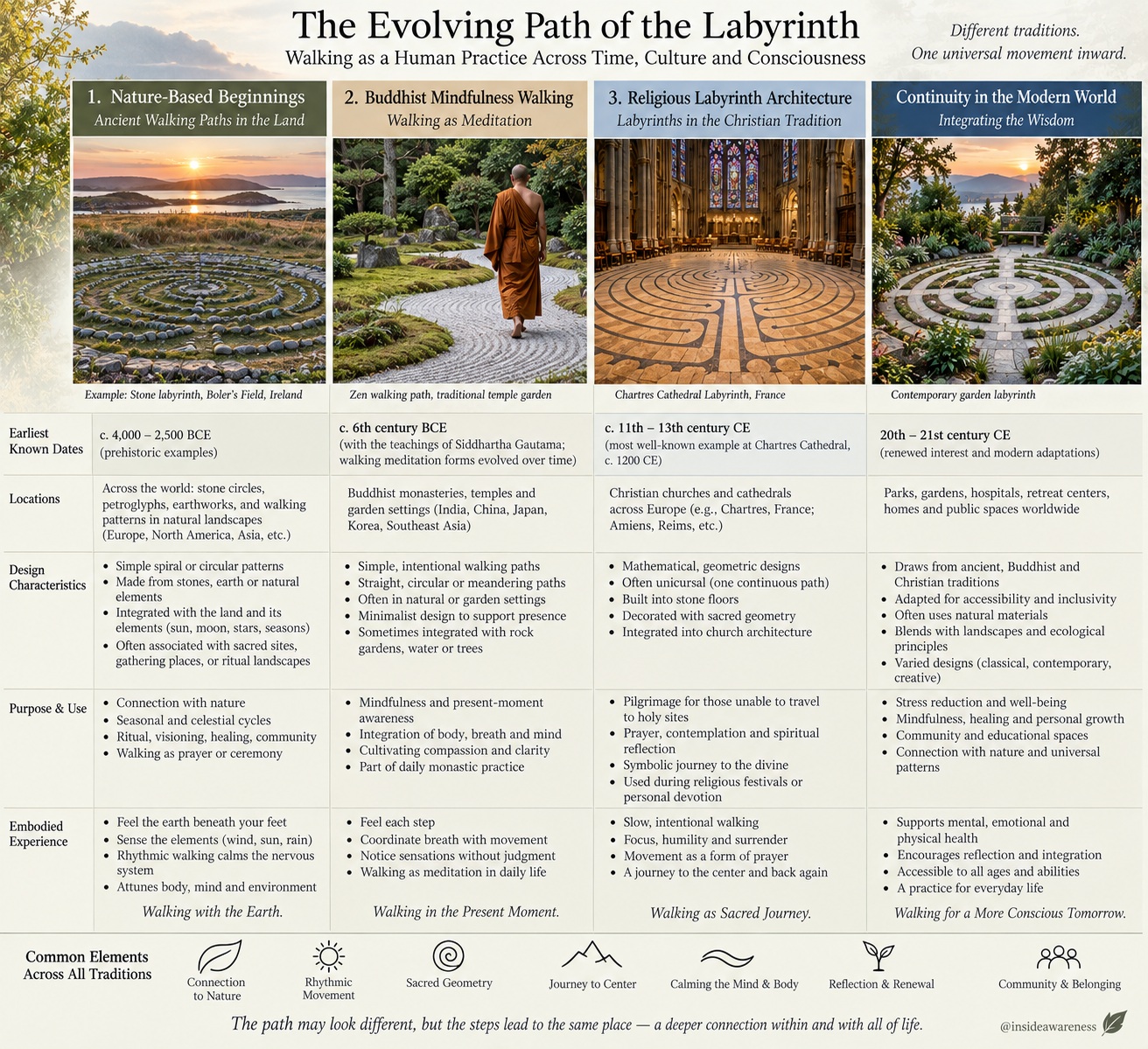
Its historical and spiritual associations remain meaningful to many people. My own exploration adds a somatic and educational perspective without asking anyone to replace their existing understanding.
For me, the labyrinth has become a living opportunity to recognize what is happening within myself while remaining connected to the environment and people around me.
Sometimes we may discover something unexpected.
Sometimes there may be no remarkable change.
And sometimes the experience of following a familiar pathway may simply offer a moment of ease.
The centre of the labyrinth is a physical place. The inner sense of centre is something we may discover through the experience of walking.
That is the relationship I continue to explore.
Renee Lindstrom | Inside Awareness
@insideawareness





 Inside is pleased to announce that ‘