Tag Archives: Renee Lindstrom

Walking the Labyrinth โ€” A Living Experience of Centre, Movement, and Conscious Recognition

Over the years, my relationship with walking labyrinths has become closely connected to my explorations of movement, listening, communication, intention, and conscious recognition.

I would like to share some of what has developed through these experiences and why the labyrinth has become meaningful within my educational work.

For me, walking a labyrinth is an opportunity to discover an inner sense of centre through lived experience.

Walking in Nature and Walking a Labyrinth

Walking through nature offers a beautiful opportunity to connect with ourselves through our surroundings.

A woodland pathway may meander through trees, curve around rocks and logs, rise and fall with the terrain, and introduce unexpected discoveries through changing seasons.

The ground beneath our feet, the sounds, scents, light, and changing spaces continually invite sensory awareness.

Our bodies respond to these changes through movement, balance, and orientation.

We are walking with ourselves while being held by nature.

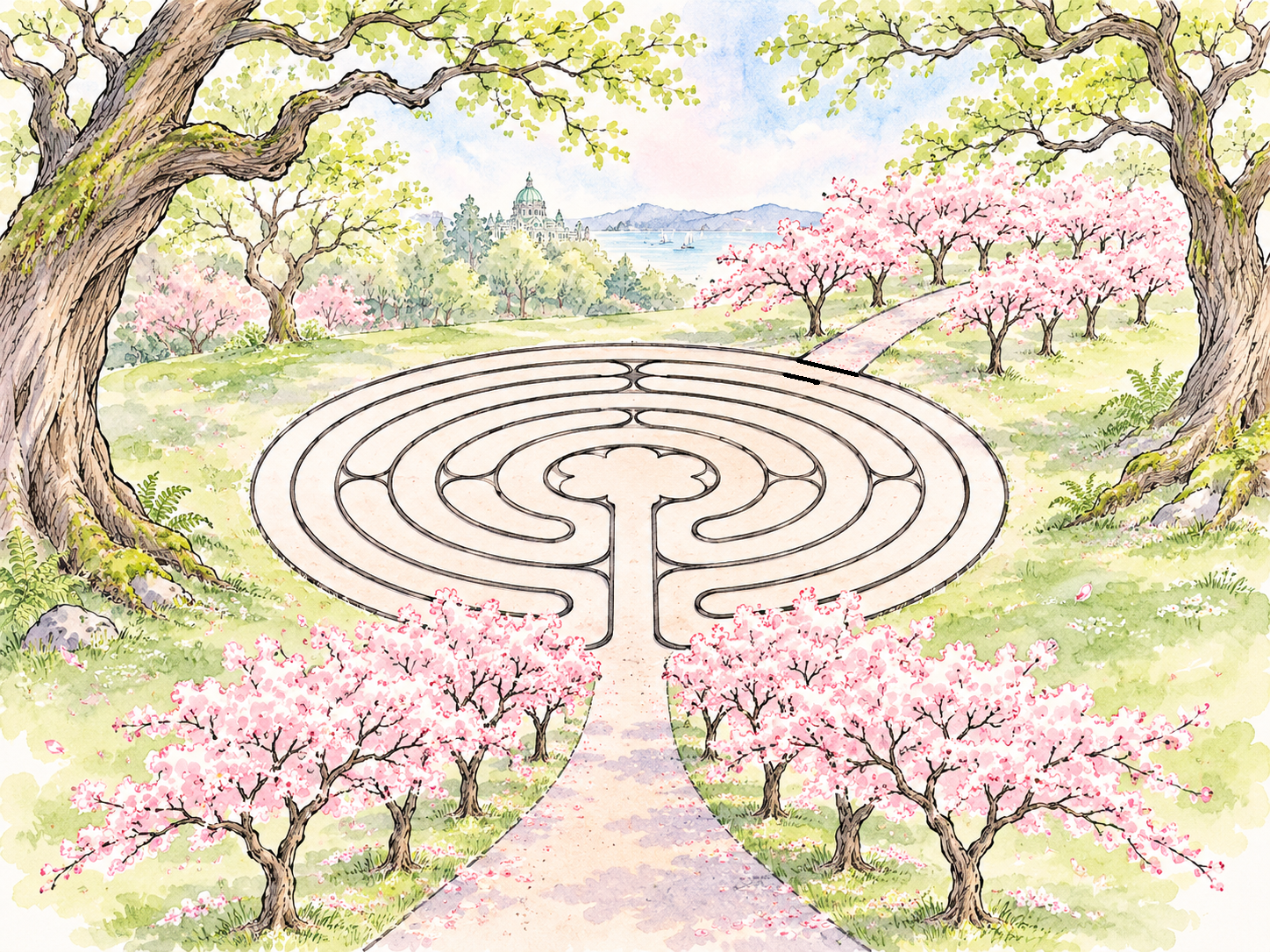
A labyrinth is also a guided pathway, although it offers a different experience.

Rather than travelling through changing terrain toward a destination, the labyrinth provides an organized pathway that moves inward toward a centre and outward again.

There is a place to arrive, turn, and begin the outward journey.

The pathway is already established. We don’t need to decide where to go next.

There is an opportunity to let go of directing the journey and simply experience walking it.

This predictable outer structure may create room for greater attention to our inner experiences.

Movement, Rotation, and Orientation

My work as a Feldenkrais practitioner has introduced another dimension to how I experience labyrinths.

Much of our built environment is organized through straight lines and square corners: homes, classrooms, hallways, sidewalks, roads, and furniture.

Our bodies, however, are three-dimensional. Functional movement includes changing relationships among the feet, pelvis, spine, ribs, shoulders, and head.

Turning involves rotational movement and counterbalance, not simply changing the direction of a rigid structure.

A circular labyrinth offers a particularly interesting experience of changing direction through its winding circuits.

As we walk, our orientation continually changes. Weight transfers through our feet. Our skeleton participates in the curves and turns.

Some labyrinth designs have rounded circuits, while others use square pathways. More elaborate designs introduce quadrants and directional relationships that can be explored in connection with the compass.

Each provides different opportunities for movement awareness.

My interest is not in identifying one design as better than another. It is in recognizing how the structure of a pathway may influence movement, attention, and our experience of ourselves.

The Intention Belongs to the Walker

One person may enter a labyrinth while experiencing grief.

Another may be exploring a difficult decision, wishing to release a reaction, or hoping to find greater emotional clarity.

Someone may walk in prayer or connection with God, spirit, or another expression of higher meaning.

Another may simply wish to experience walking, breathing, balancing, or unwinding.

The labyrinth does not require everyone to share the same intention or belief.

What I have come to appreciate is the opportunity to bring something meaningful into awareness and explore it through movement.

The pathway creates a familiar structure. The experience belongs to the individual.

Three Experiences That Have Stayed with Me

At a busy outdoor festival, I had created a small rope labyrinth on the grass.

On the afternoon of the final day, another booth holder decided to walk it.

Afterward, they shared that partway through the walk, something had shifted. They suddenly became aware of the trees and natural surroundings.

We had been beneath those trees, in a large grassy area, for two and a half days.

Yet they had not consciously noticed them until that moment.

I found this meaningful. The environment hadn’t changed. Something in their awareness had.

Another experience was more personal.

Following a difficult year of interactions with one of my children, I had laid out a labyrinth using coloured braided material for an upcoming event.

We visited the location around their birthday, and I spontaneously suggested that we walk the labyrinth together.

The intention was to let the past year go and walk into the new one together.

I remember entering the pathway carrying uncomfortable feelings.

As we walked inward, I became aware of those feelings and the effort I was carrying.

At the centre, something shifted.

Walking outward was a different experience. I felt calmer, clearer, and less burdened by the emotional responses I had brought into the walk.

My immediate experience of connection with my child had changed.

They later shared that their experience had shifted in a similar way.

The labyrinth hadn’t resolved all the circumstances of the previous year. Yet, in that moment, it offered an opportunity for a different experience of ourselves and our relationship.

A third experience came through a woman attending one of my labyrinth workshops.

She became interested in how walking a labyrinth individually, before gathering together, might influence the experience of a group.

She was preparing to attend a difficult meeting involving significant institutional decisions.

She decided to invite the participants to walk a labyrinth before beginning.

Later, she shared that the meeting had been noticeably different from previous ones. She experienced greater calm, respect, and kindness among the participants.

I cannot know everything that contributed to those changes.

What interests me is the possibility that an individual experience of centering before coming together may influence how people participate in a shared conversation.

The Relationship With Listening and Communication

These experiences have influenced my explorations of inner and outer communication.

When we enter a conversation, we bring more than words.

We bring our physical responses, memories, feelings, values, interpretations, and expectations.

Sometimes we are responding to the present. At other times, our past experiences or future concerns are influencing what we hear and how we respond.

The labyrinth offers me a physical experience of recognizing where I am, what I am carrying, and how I am participating.

Walking inward may provide an opportunity for recognition.

Reaching the centre offers a point of orientation and turning.

Walking outward may introduce a different experience of returning to our relationships and surroundings.

This is not a required outcome or an instruction about how someone should feel.

It is an invitation to explore.

The intention connects with what I have been developing through Inside Awareness: recognizing our inner experiences while participating in the world around us.

Sensing myself. Sensing another. Discovering how to participate together.

Returning to Centre

I have come to experience the labyrinth as an organized pattern that can support centering through movement, sensory awareness, intention, and relationship.

It offers a physical path for exploring connections among mental, emotional, physical, and spiritual experiences, according to what is meaningful to each walker.

Its historical and spiritual associations remain meaningful to many people. My own exploration adds a somatic and educational perspective without asking anyone to replace their existing understanding.

For me, the labyrinth has become a living opportunity to recognize what is happening within myself while remaining connected to the environment and people around me.

Sometimes we may discover something unexpected.

Sometimes there may be no remarkable change.

And sometimes the experience of following a familiar pathway may simply offer a moment of ease.

The centre of the labyrinth is a physical place. The inner sense of centre is something we may discover through the experience of walking.

That is the relationship I continue to explore.

Renee Lindstrom | Inside Awareness
@insideawareness
Food Inspires โ€” Level 1 – Inner Balance and Daily Awareness

Discovering Ourselves Through Living Relationships with Nature

Guided Patterns for Lived Function

Renee Lindstrom | @insideawareness


An Invitation to Inner Awareness

What happens when we begin experiencing ourselves in relationship with our surroundings rather than simply moving through them?

Food Inspires begins with a familiar human capacity: sensing, experiencing and discovering.

Before exploring our relationship with food, we begin by becoming curious about how we experience ourselves in everyday life.

Our physical sensations, thoughts, feelings, surroundings and daily activities are interconnected. Yet we may spend much of our time thinking about what we need to accomplish without consciously recognizing how we are experiencing ourselves while doing it.

Level One โ€” Inner Balance and Daily Awareness introduces opportunities to recognize these relationships through lived experience.

The intention is not to change ourselves or achieve a particular state of balance. It is to become familiar with the experience of sensing and recognizing ourselves.

Beginning with Inner Balance

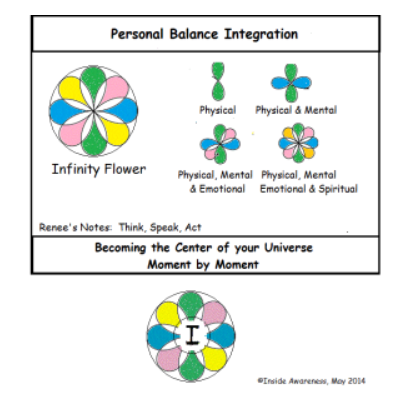
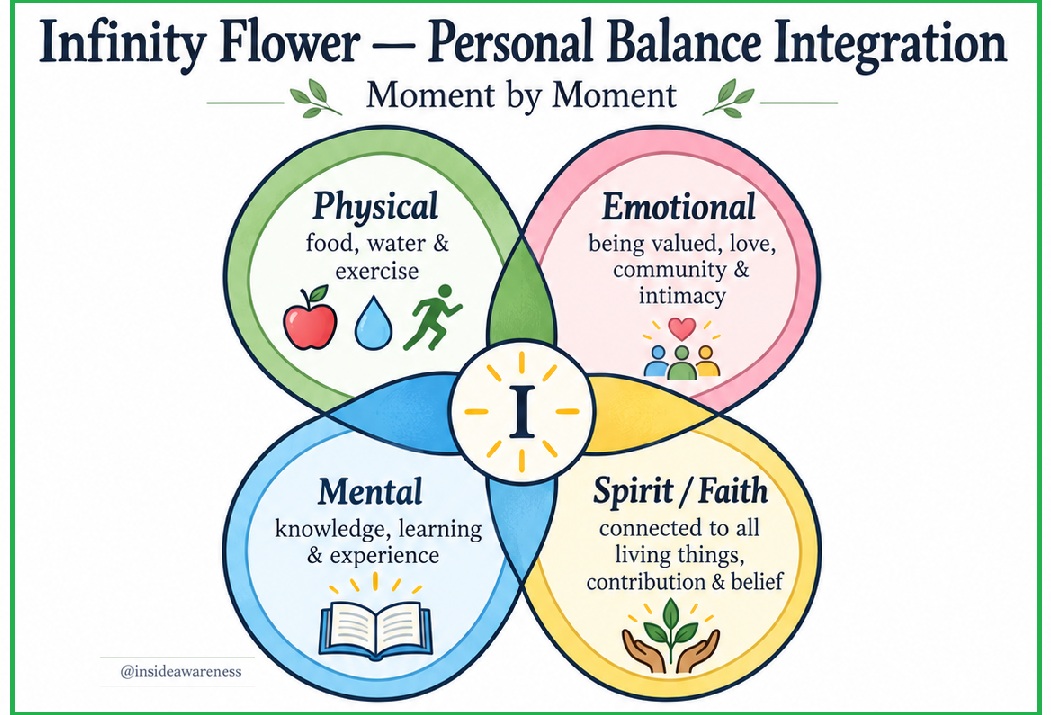
The Infinity Flower introduces four interconnected qualities of our inner experience:

  • Physical
  • Mental
  • Emotional
  • Spirit/Faith

At the centre is โ€œIโ€, representing ourselves as participants in our own lived experience.

Through gentle reflection, listening and simple meditation, we can begin noticing these different qualities without needing to judge or change them.

What am I sensing physically?

What thoughts are present?

What feelings am I experiencing?

What gives me a sense of connection, meaning or inner support?

These inquiries offer opportunities for becoming more familiar with ourselves.

Inner Walking Patterns โ€” Living Relationships with Nature

Nature offers an ever-changing environment through which we can explore our relationship with ourselves.

A familiar pathway may move from an open landscape into a sheltered woodland. The softness of moss, changing colours of leaves, movement of clouds or spaces between tree branches may attract our curiosity.

Light and shade, openness and enclosure, stillness and movement provide contrasting environmental qualities.

The principles of yin and yang may offer a language for recognizing these differences without prescribing how they should be experienced.

As we become curious about our surroundings, we may begin recognizing our own responses.

Perhaps we notice our breathing, a physical sensation, a feeling or a change in our attention.

There is no particular experience to achieve.

The invitation is to discover ourselves in relationship with the environment rather than simply identify what we see.

These explorations can take place through comfortable walking, standing or sitting in nature.

From Sensory Experience to Conscious Recognition

As we move through different environments, opportunities arise to pause and revisit our experience.

What attracted my attention?

What am I sensing?

How am I experiencing myself in these surroundings?

Is something different from a few moments ago?

The intention is not to think our way toward a particular experience.

It is to allow sensory participation to introduce discoveries that may later become consciously recognizable.

Through conversation, drawing, journaling or quiet reflection, we can begin identifying relationships that were present within our experiences.

The experience comes first. Recognition offers an opportunity to revisit what we have discovered.

Bringing Our Discoveries into Everyday Life

As our relationship with nature develops, we may begin recognizing similar qualities of sensory participation in other environments.

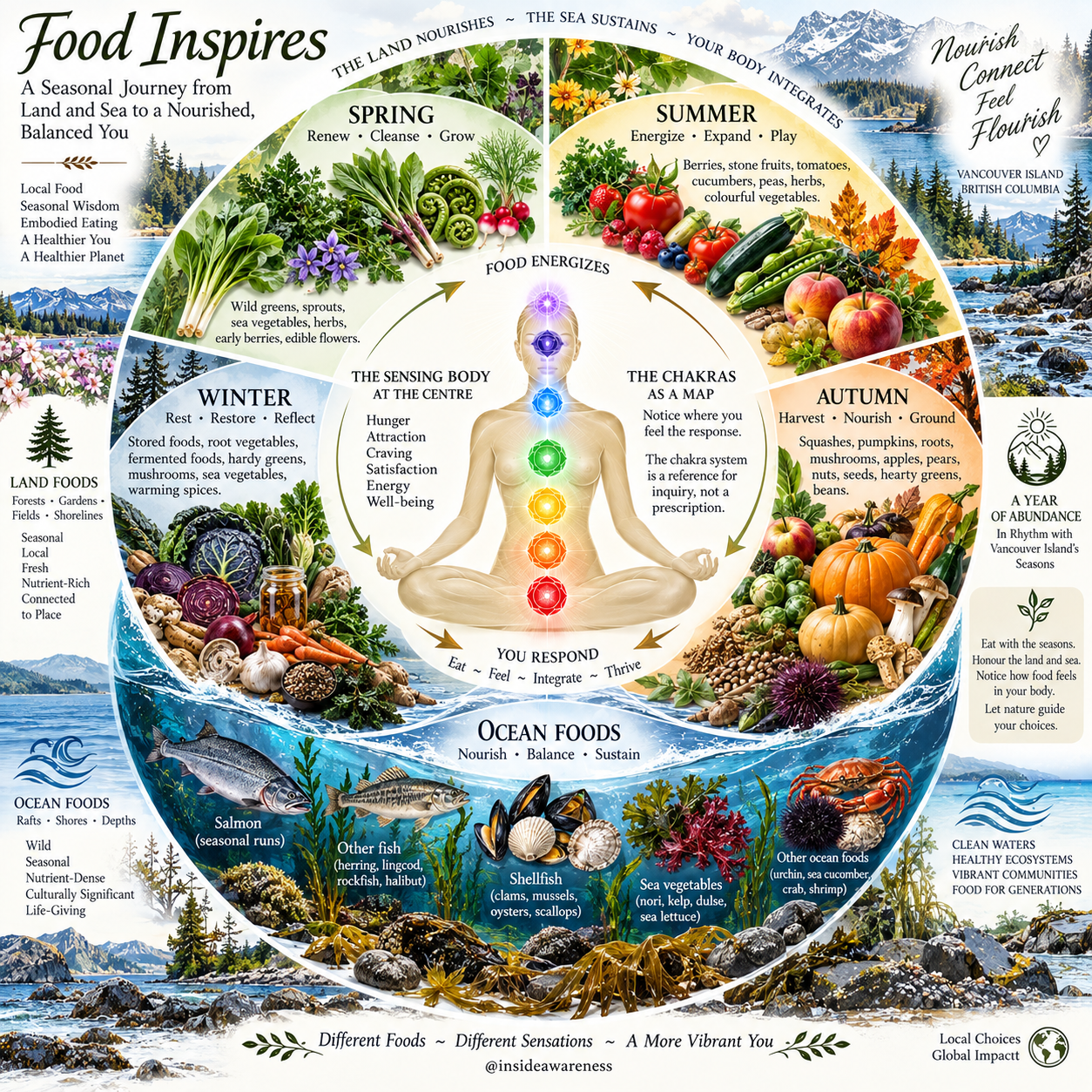
The colours and textures of nature may inspire curiosity about seasonal foods.

The changing qualities of a pathway may introduce awareness of movement and physical balance.

Light, colour, space and arrangement may influence how we experience our homes and kitchens.

Recognizing our thoughts, feelings and sensory responses may introduce opportunities for greater clarity around personal intentions and choices.

These are not expected outcomes. They are possibilities that may emerge through a growing relationship with ourselves and our surroundings.

Within Food Inspires, this foundation becomes a bridge to the next level: Timing and a Living Relationship with Food.

The same curiosity that attracts us to the colours, textures and aromas of nature can accompany us into selecting, preparing and enjoying nourishment.

Continuing the Discovery

Level One introduces a foundation for learning through sensory experience and conscious recognition.

It is not a movement program to perform or a collection of techniques for creating a particular emotional state.

It is an invitation to discover the living relationships already present within our everyday experiences.

As we become more familiar with ourselves through nature, we may begin recognizing opportunities for greater participation in movement, nourishment, relationships and personal intentions.

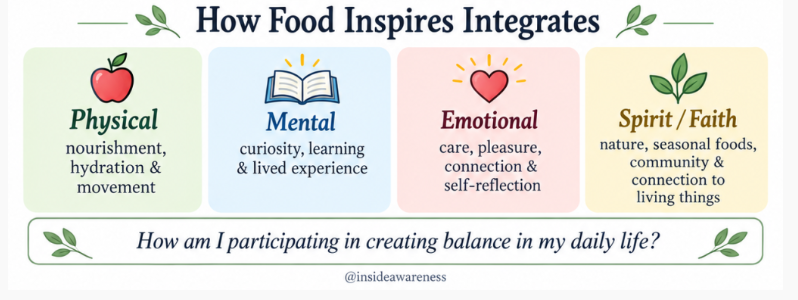
How am I participating in creating balance in my daily life?

The discovery remains open even after we have found words to describe it.


Interested in Exploring Food Inspires?

Food Inspires offers guided opportunities to discover relationships with nature, nourishment and everyday living through your own experiences.

Whether you are interested in participating or learning more about facilitator mentorship, you are welcome to begin with an inquiry.

Make an Inquiry


ยฉFood Inspires โ€” Guided Patterns of Learning for Lived Function โ€“ Renee Lindstrom | @insideawareness

Back to Food Inspires

Food Inspires โ€” Level 3 – Living Relationships with Place, Food and Nourishment

Discovering Our Relationship with the Foods Growing Around Us

Guided Patterns for Lived Function

Renee Lindstrom | @insideawareness

From Nature to Nourishment

What happens when we begin recognizing the relationship between the foods we enjoy and the place where we live?

Throughout Food Inspires, we have been exploring how sensory awareness and conscious recognition can deepen our relationship with everyday experiences.

In Level One, Living Relationships with Nature introduced opportunities to discover ourselves through the changing qualities of our surroundings.

In Level Two, A Date with Food invited us to make room for the sensory experience of selecting, preparing and enjoying nourishment.

Level Three expands this awareness into our own communities, seasonal food relationships and the nourishment that supports our daily functioning.

The invitation is to become curious about the living environment just beyond our front doors.

Discovering the Food Landscape Around Us

Every community has its own relationship with food.

Gardens, fruit trees, farms, local markets, nearby waters and changing seasons provide opportunities to discover where nourishment originates.

Some foods are grown or harvested close to home. Others reach our kitchens through relationships with communities and environments farther away.

We may pass places where food is growing without recognizing them as part of our own food landscape.

As our curiosity expands, familiar surroundings may become interesting in new ways.

A fruit tree along a neighbourhood pathway, seasonal vegetables appearing at a market or herbs growing outside a kitchen window may invite us to explore their relationship with nourishment.

The intention is not to encourage everyone to grow or gather their own food.

It is to discover the living relationships that connect our food with the environments and communities in which we participate.

A Growing Appreciation Through Experience

My own relationship with food began changing as I became increasingly curious about the living environment around me.

At one time, I raised hens from chicks. Their playfulness and my growing familiarity with them created a rewarding relationship.

Collecting their eggs became more than obtaining an ingredient.

The enjoyment of caring for the hens continued into preparing their eggs for meals and baking.

Other explorations led me toward learning about plants, seasonal foods and the natural resources growing nearby.

These experiences weren’t originally intended to create a nutritional program.

They became opportunities for discovering how a growing relationship with nature could inspire a greater appreciation for food and the experience of nourishment.

Food Inspires invites each participant to discover their own relationships, interests and possibilities.

Recognizing Our Seasonal Food Relationships

As the seasons change, so may our interests in food.

Perhaps warmer weather invites an interest in fresh fruits, salads and lighter meals.

Cooler weather may inspire familiar soups, roasted vegetables, baked foods and the comforting aromas of a warm kitchen.

For some, these preferences may reflect the foods growing locally. For others, they may arise through memories, cultural traditions, family experiences or simple enjoyment.

There is no particular seasonal eating pattern to follow.

Instead, we can become curious:

What seasonal foods do I look forward to eating?

Are there foods I enjoy in one season but seldom choose in another?

What aromas, colours and flavours remind me of a particular time of year?

What foods available in my community are attracting my curiosity?

These inquiries invite us to recognize relationships that may already influence our food choices without having become consciously familiar.

Nourishment and Lived Function

As our relationship with food develops, another opportunity for discovery becomes available.

We can begin exploring how the foods we enjoy contribute to the nourishment of our functioning bodies.

Our bones, muscles, nerves, organs and other interconnected systems depend upon nutrients that support everyday activities.

Movement, thinking, sensing and responding all involve bodily functions supported, in part, by adequate nourishment.

Rather than beginning with a collection of nutritional rules, we can become curious about the foods already participating in our lives.

What nutritional qualities does a familiar ingredient offer?

How do different foods contribute to the body’s interconnected needs?

How might growing nutritional understanding support more informed and personally meaningful choices?

Food Inspires introduces these relationships through curiosity and conscious recognition.

A more detailed educational exploration is available through the connected Inside Awareness focus, Feeding the Body โ€” Nourishment for Lived Function.

From Discovery to Daily Participation

Developing a relationship with nourishment does not require us to change everything we eat.

Sometimes a discovery begins with recognizing something already familiar.

A seasonal fruit may attract our attention.

An ingredient we have overlooked may inspire curiosity.

A visit to a local market may introduce a conversation about growing food.

Or an enjoyable meal may invite us to revisit a flavour, preparation or experience.

As these relationships become more familiar, they may begin participating in our everyday choices.

The intention is not to create another strategy to follow, but to recognize possibilities that become meaningful through lived experience.

Our circumstances, available time, physical abilities and resources will differ. Each person’s exploration can develop in ways that are accessible and appropriate to their life.

Continuing the Living Relationship

Level Three brings together the foundations of Food Inspires:

Our relationship with nature.

Our relationship with time.

Our relationship with food.

Our relationship with the nourishment supporting our bodies.

And our growing ability to recognize how these experiences participate in our daily lives.

The learning does not end with identifying a seasonal food, discovering its nutritional qualities or preparing a meal.

Each experience can become another opportunity to explore, recognize and revisit the relationships that continue developing around us.

How am I participating in creating balance in my daily life?

The discovery remains open even after we have found words to describe it.


Interested in Exploring Food Inspires?

Whether you’re curious about participating in Food Inspires or learning about facilitator mentorship, you’re welcome to begin with an inquiry.

Discover opportunities to explore nature, nourishment and everyday living through your own experiences.

Make an Inquiry


Food Inspires โ€” Guided Patterns for Lived Function – Renee Lindstrom | @insideawareness

Food Inspires: Level 2 – Introducing Timing – A Date with Food

There is a difference between thinking about what we need to do and experiencing ourselves while doing it.

Through Walking with Inner Awareness, we have been exploring this relationship by noticing our feet meeting the ground, the rhythm of breathing, shifting weight and our responses to the surrounding environment.

Now we begin exploring how this same quality of attention might extend into our relationship with food.

We can spend considerable time thinking about food, planning meals or meeting daily expectations without giving ourselves much opportunity to experience the nourishment itself.

What might happen if we made a date with food?

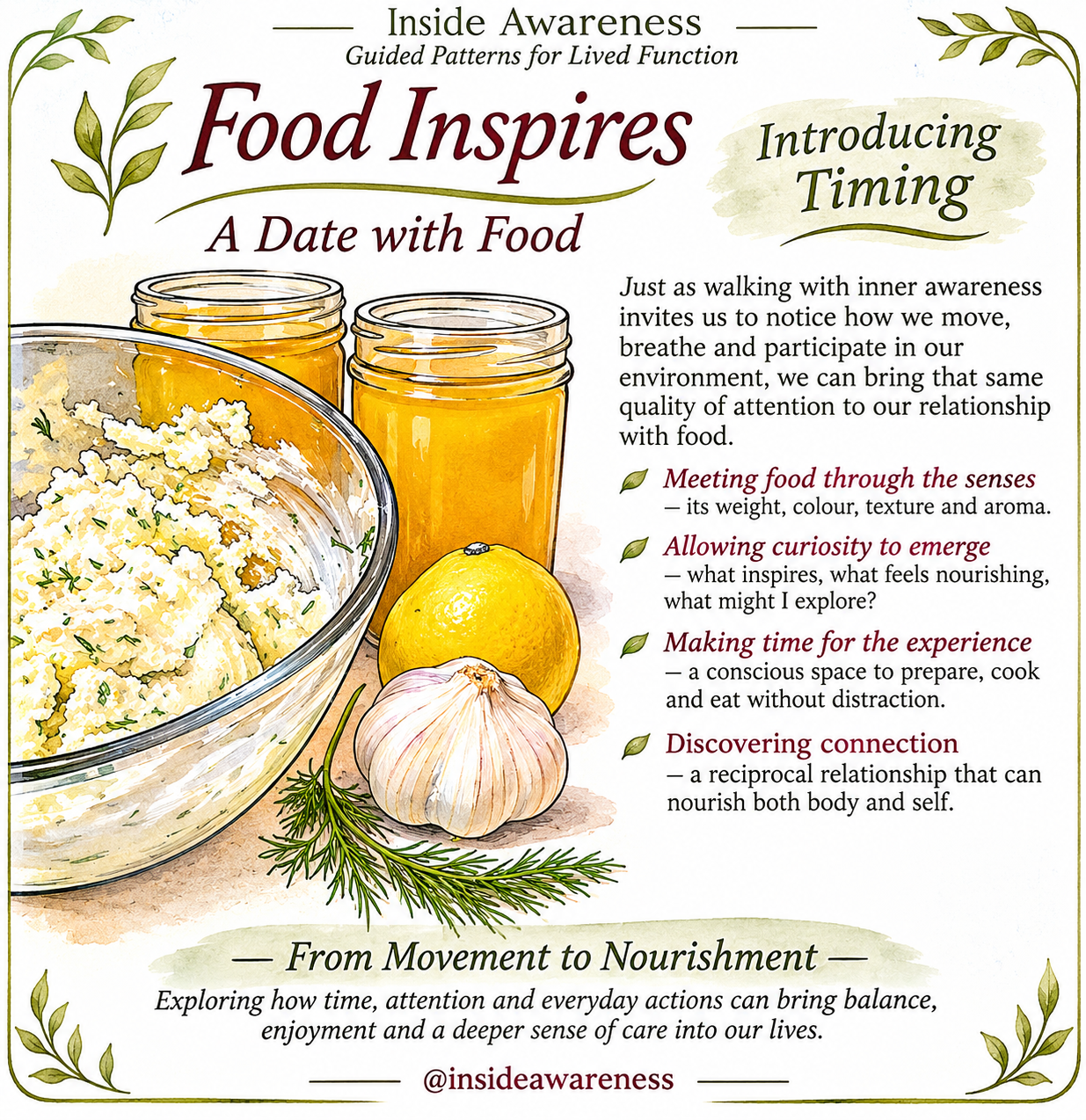
Perhaps the experience begins by picking up an ingredient and noticing its weight, texture, colour or aroma.

Curiosity may arise naturally. An unexpected combination, a new possibility or an inspiration to create something different.

Rather than directing every moment through expectations, we allow the experience to inspire our participation.

My recent exploration with homemade kefir cheese is one expression of this curiosity.

Food Inspires is not about following dietary rules or preparing food in a particular way. It is an invitation to explore our relationships with nourishment, time, sensory awareness and everyday choices.

Perhaps as we become more engaged in nourishing ourselves, we may discover a growing appreciation for food, creativity and our own experience of living.

How am I participating in creating balance in my daily life?


ยฉFood Inspires โ€” Guided Patterns of Learning for Lived Function – Renee Lindstrom | @insideawareness

Exploring Counterbalance Through Joint Movement

Guided Patterns of Learning for Lived Function

Renee Lindstrom | @insideawareness

This short video shares some of my ongoing explorations of transitional movement, counterbalance, and the relationship between skeletal support, gravity, and muscular effort.

The focus is on the ankle and foot joints and how movement changes when unnecessary muscular effort is reduced.

Rather than lifting and holding the body upright through muscular effort, the exploration begins with the relationship between the bones, joints, and the supporting floor.

As the knees bend and straighten, weight shifts through the feet. The ankles, heels, balls of the feet, and toe joints have opportunities to participate in subtle changes of balance. These small movements influence the organization of the knees, pelvis, spine, and head.

The inquiry is not about eliminating muscular activity. It is about discovering how muscles can participate without unnecessary holding or bracing.

As weight transfers through the skeletal structure, counterbalance becomes a changing relationship between the moving parts of the body and the supporting surface.

The head does not need to remain fixed in position while the body moves beneath it. Instead, it can follow the changing movement relationships through the spine.

In these explorations, the feet are leading and the rest of the body is responding.

Movement as a process of discovery

Over many years of guiding balance classes, I have observed that participants often arrive with limited awareness of the movement possibilities within their feet and ankles. Some experience numbness, restricted joint movement, or fear about their ability to support themselves.

Rather than beginning with an expectation that participants can already sense these relationships, the guided patterns introduce small opportunities for joint movement and changing skeletal support.

Through their own explorations, participants frequently discover sensations and movement possibilities they had not previously recognized.

They may say, “I didn’t know that,” or “I’ve never felt that before.”

The movement itself becomes an opportunity for developing felt sense, recognition, and trust in their own functional possibilities.

The intention behind these transitions

These are not fitness exercises or demonstrations of positions to achieve.

The interest is in the transitions themselves: the subtle movements through which weight shifts, joints articulate, muscles respond, and the skeleton reorganizes in relationship with gravity and the ground.

The larger muscles are still participating, but they need not always be leading through effort.

They can become quieter participants in an ongoing relationship of movement and support.

My inquiry continues to be how guided patterns of movement can make these relationships available for conscious discovery, particularly for people who have never considered their bodies from this perspective.

The intention is not to prescribe a correct movement, but to create opportunities for learning through one’s own lived experience.

An ongoing exploration influenced by the Feldenkrais Methodยฎ and developed through years of teaching, observation, and lived inquiry.

Follow socials:

Renee Lindstrom | @insideawareness

Copyright 2014 โ€“ 2026

Food Inspires – Origins of an Inquiry

Relationship with Nature and Nourishment

By Renee Lindstrom | @insideawareness

What is available outside my door that could support sustaining life that is not being recognized?

This question became an important part of my personal exploration of nature, nourishment and the living environment.

A second question accompanied it:

How can I inspire an interest in others to explore their own food journey and connection to nature, both inside and out?

These inquiries did not begin as an organized food program. They emerged through a longstanding curiosity about our relationships with the world around us and the ways those relationships influence our daily experiences.

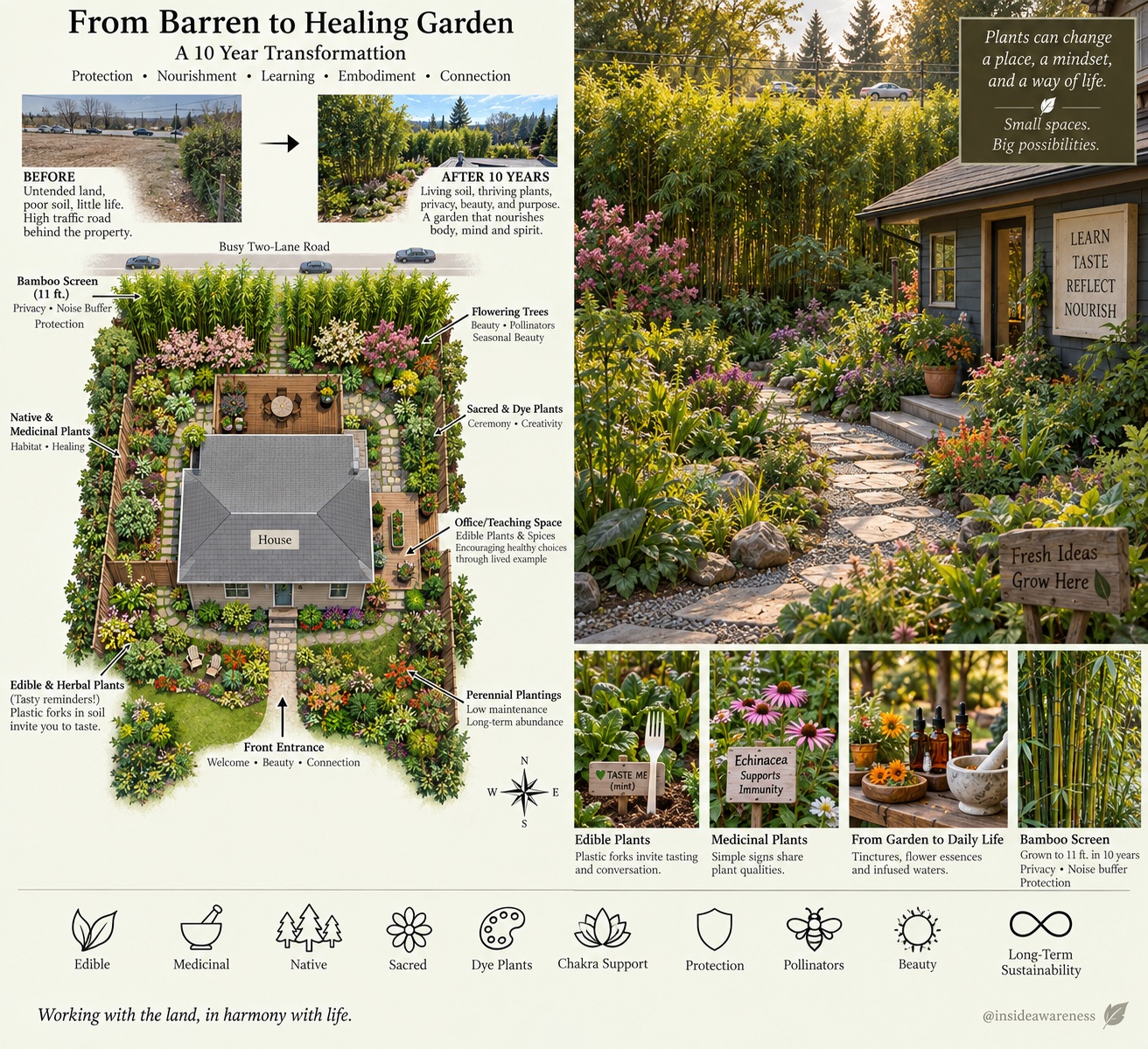
Over time, my home and office surroundings became a living environment for exploration.

I began paying closer attention to what was growing nearby, including native plants, introduced species, familiar garden plants and plants often dismissed as weeds.

Some offered possibilities for food. Others inspired explorations of natural dyes, flower essences, herbal preparations or simply a deeper understanding of the environment.

Not everything growing around us is edible or appropriate for medicinal use. Part of the exploration involves learning to recognize plants accurately, respect their ecological relationships and understand appropriate uses and safety considerations.

What interested me was not simply collecting information about plants.

It was recognizing what had previously escaped my attention.

Curiosity Through Lived Experience

My personal food explorations often begin without a particular outcome in mind.

An ingredient attracts my attention.

Something familiar suggests another possibility.

An experience with kefir inspires a new experiment, perhaps making kefir cheese or exploring whether it could become part of a cheesecake.

A seasonal plant, herb or flavour invites another discovery.

Sometimes I photograph these experiences and share them. I may reflect on the sensory qualities, the season, the nature connection or the chakra qualities I associate with an experience.

Some explorations turn out as I imagined. Others surprise me.

The enjoyment is in the exploration itself.

These personal discoveries are not intended as instructions that others must follow. They are examples of curiosity in action.

Sharing the Experience

I have found it useful to distinguish my spontaneous creative experience from the process of communicating it afterward.

A gentle pattern helps me organize a photograph or reflection into something others can follow:

Inspiration โ€” What attracted my attention?

Exploration โ€” What did I become curious enough to try?

Experience โ€” What did I notice through my senses?

Connection โ€” What relationship did I recognize with nourishment, nature, season, daily living or the chakra qualities?

Invitation โ€” What might inspire someone else’s curiosity?

These are possible points for reflection, not five steps that must be followed whenever I prepare food.

The creative experience remains spontaneous. The structure simply helps me communicate what I discovered afterward.

This distinction is important to the educational intention of Food Inspires.

From Personal Exploration to Guided Learning

Food Inspires provides a different kind of structure.

My personal explorations demonstrate how curiosity participates in my daily life.

The educational program offers guided patterns through which others can begin recognizing their own relationships with nourishment, movement, rest, nature and everyday living.

The intention is not for participants to reproduce my food choices, interests or discoveries.

It is to create opportunities for their own curiosity and recognition.

The program begins with familiar experiences of daily rhythm, inner awareness, movement and nourishment. Later explorations introduce seasonal relationships, the qualities associated with the chakras, and deeper inquiries into embodied intention and lived function.

These experiences are connected through a central question:

How am I participating in creating balance in my daily life?

As this inquiry develops, nourishment becomes more than a choice about what to eat.

It becomes an opportunity to recognize relationships with ourselves, our community, the natural environment and the living systems that sustain us.

An Invitation

Food Inspires is not an invitation to adopt someone else’s relationship with food or nature.

It is an invitation to become curious about your own.

Perhaps that curiosity begins with a familiar ingredient, a favourite meal, something growing outside your door or the simple pleasure of preparing food.

Sometimes the smallest discovery opens an entirely new relationship with an ordinary experience.

What might you discover when you begin noticing what is already available?


https://insideawareness.com/2026/10/19/food-inspires-origins-of-an-inquiry/

Food Inspires โ€” Guided Patterns of Learning for Lived Function

Renee Lindstrom
Inside Awareness | @insideawareness

For inquiries about individual coaching and future Food Inspires educational programs, please contact Inside Awareness.

Food Inspires Programs

Discovering a More Conscious Relationship with Nourishment and Daily Living

By Renee Lindstrom | Inside Awareness
Guided Patterns of Learning for Lived Function

How am I participating in creating balance in my daily life?

The Infinity Flower reflects four interconnected aspects of lived experienceโ€”physical, mental, emotional and spirit/faithโ€”with the โ€œIโ€ at the centre. It offers a simple invitation to explore nourishment, inner awareness and the relationships that shape daily life.

This question has become an invitation within my educational work, particularly when exploring our relationships with food, movement, rest and the living environment.

Food is essential to our lives, yet the experience of nourishment can become overshadowed by routines, responsibilities, dietary expectations and the many opinions about what we should or should not eat.

For some, eating becomes another task to complete in a busy day. For others, food becomes a subject of considerable planning, measurement and self-evaluation.

There are many valuable approaches to nutritional education. My interest through Food Inspires is to introduce another dimension of learning: becoming more consciously connected to our own lived experience of nourishment.

From Food Rules to Food Curiosity

What happens when our attention shifts from what we believe we should eat toward becoming curious about our relationship with food?

We might begin noticing what attracts our senses, what we enjoy preparing, how we experience meals, or the relationships between nourishment and our daily activities.

Perhaps inspiration arises through an unfamiliar ingredient, the scent of fresh herbs, a seasonal harvest or the discovery of a new way to prepare a familiar food.

A simple experience can invite curiosity.

Curiosity can lead to exploration.

Exploration may bring recognition of something we had not previously considered.

This is one of the foundations of Food Inspires.

The intention is not to replace nutritional understanding or individual health considerations. It is to expand our relationship with nourishment beyond instructions and expectations alone.

Nourishment and the Whole Person

My educational work has long explored the relationships between physical, mental, emotional and spirit/faith aspects of lived experience.

These are not isolated parts of ourselves.

Our physical experiences may influence how we feel and think. Our emotions and daily responsibilities may influence the attention we give to rest and nourishment. Our relationships with nature, community and personal values may shape what gives meaning to our experiences.

Food participates in all these relationships.

It supports physical function, but it can also offer opportunities for learning, pleasure, creativity, connection and appreciation.

A meal might nourish the body while inviting conversation, recalling a meaningful experience or connecting us with the season in which its ingredients were grown.

Through this wider perspective, nourishment becomes more than an individual food choice.

It becomes part of our participation in everyday life.

Listening to Our Lived Experience

Much of my work has been influenced by Feldenkrais movement education, where guided attention offers opportunities to recognize familiar habits and explore possibilities through direct experience.

Over the years, I have brought this orientation into communication, environmental awareness, personal values and daily living.

Rather than beginning with a prescribed answer, I invite curiosity about what is already happening.

This includes recognizing how expectations, learned beliefs, inner dialogue and familiar routines may influence our experiences.

The intention is not to judge these patterns or determine that they are right or wrong.

It is to become more conscious of them.

When something becomes recognizable, there may be an opportunity for another choice.

In Food Inspires, this same educational orientation is brought into our relationships with nourishment, daily activity and self-care.

Nature, Seasons and the Living Environment

My relationship with food has also been influenced by an interest in the natural environment and the changing seasons.

Living in the Pacific Northwest offers many opportunities to explore the relationships between locally available foods, plants, seasonal rhythms and the experience of preparing meals.

I enjoy experimenting with cultured foods, including kefir, as well as exploring ingredients and seasonal possibilities through curiosity rather than a need to become an accomplished cook.

Some experiments turn out beautifully. Others simply become part of the learning.

What matters to me is the experience of exploration and discovery.

Food offers an opportunity to recognize our participation in a much larger living environment.

The land, water, plants, growing seasons, people who produce food and communities in which we live all contribute to the nourishment available to us.

Becoming more conscious of these relationships can invite appreciation, curiosity and a different quality of engagement with everyday eating.

Making Room for Nourishment

Our relationship with food is also influenced by how we organize our days.

Do we make time for meals?

What space is available for rest, movement, preparation and enjoyment?

How do familiar responsibilities influence the attention we give to ourselves?

These inquiries bring nourishment into the wider experience of daily living.

Food Inspires is being developed through guided patterns of learning that explore these relationships in accessible stages.

The early experiences focus on daily awareness, comfortable movement, rest, sensory curiosity and our relationship with the whole self.

Further explorations introduce seasonal nourishment, symbolic qualities of lived experience, personal values and the relationship between inner awareness, intention and everyday action.

The purpose is not to prescribe what each participant must discover.

It is to create an educational environment in which recognition, curiosity and possibilities for conscious choice can develop through personal experience.

An Invitation to Discover

I have come to appreciate that meaningful changes in daily living do not always begin with greater effort.

Sometimes they begin with curiosity.

An experience becomes interesting. Something previously overlooked becomes recognizable. A familiar activity begins to offer a different possibility.

Food can become an invitation into that experience.

What might I discover when I begin exploring nourishment through curiosity rather than judgment?

And perhaps, through that exploration, another question becomes meaningful:

How am I participating in my own nourishment and balance?

These are the inquiries at the heart of Food Inspires.

Not a destination to achieve, but an invitation to explore a more conscious, enjoyable and personally meaningful relationship with nourishment and daily living.


Explore Food Inspires

Food Inspires is part of Guided Patterns of Learning for Lived Function through Inside Awareness.

The approach is being developed for individual coaching and experiential educational programs, with opportunities to explore nourishment, inner awareness, movement, seasonal relationships and self-care.

If this perspective interests youโ€”whether for your own learning, professional curiosity or an educational groupโ€”I welcome your inquiry.

Food Inspires is part of a developing body of work through Inside Awareness that brings together nourishment, movement, rest, curiosity and self-reflection through lived experience. If you are interested in learning more about this approach, individual coaching, or future educational offerings, I welcome your inquiry.

Food Inspires is an experiential educational approach and does not replace individualized medical or nutritional care.

Contact Inside Awareness to ask about individual coaching, educational sessions or future Food Inspires programs.

Back to Food Inspires

Follow socials:

Renee Lindstrom
Inside Awareness
@insideawareness
Copyright 2014 โ€“ 2026