Tag Archives: Empathy

An Invitation to Listening

Creating Space for Conscious Recognition Through Lived Experience

By Renee Lindstrom founder of Inside Awareness Center of Integrative Somatic Learning
What becomes possible when we listen to another person’s experience without immediately interpreting it through our own?

This question has been part of my educational exploration, coaching and teaching for many years.

Through my work with somatic awareness, communication, relationships and the influences of our environment, I have been exploring how guided patterns of learning can support conscious recognition and expand our possibilities for participation in everyday life.

One particularly meaningful part of this exploration began through a sacred circle I hosted for four years.

The Experience of Empathy

The circle initially focused on Nonviolent Communication (NVC). I prepared the physical environment with intention, including an altar and arrangements traditionally associated with sacred gatherings.

Although our intention was to develop communication and connection, I began recognizing how readily interpretation entered our listening experiences.

During this period, I attended a residential learning gathering with Marshall Rosenberg, the founder of Nonviolent Communication.

Each day began and ended in a listening circle. Participants could express what was alive in them in the moment, while others listened. Throughout the day, Marshall offered opportunities for learning through direct interaction and stories drawn from lived experience.

As the days passed, I began sensing a deepening quality of empathy within the group.

It was not simply something being described or demonstrated. It was becoming recognizable through participation.

During personal interactions, I experienced Marshall’s capacity to listen with an attentiveness that allowed deeply painful experiences to be expressed without needing to be corrected, interpreted or immediately resolved.

That experience offered an important recognition.

Empathy could be experienced through the quality of listening itself.

When I returned to the circle I was hosting, the participants began recognizing a difference in how we were engaging. Over the following three years, our exploration moved increasingly toward the lived experience of empathy.

We were not simply learning what empathy meant. We were exploring what happened when we participated in it.

Recognizing the Environment of Listening

At the same time, I had been exploring the influences of environment through Feng Shui.

My understanding of environment was expanding beyond the arrangement of physical spaces.

I was recognizing that our surroundings include people, their words, the ways they engage with us, and the internal conversations we have with ourselves.

Our experiences are influenced by what surrounds us, what takes place within us, and the relationships between them.

Through my environmental studies, I had been exploring entrainment: how patterns and conditions within an environment may influence the experiences of those participating in it.

As my listening work developed, I began recognizing something related.

The listening pattern itself could hold the space.

The quality of the gathering did not depend entirely upon the arrangement of the room or the objects placed within it.

It could emerge through the shared intention, attention, listening and participation of the people present.

This opened another direction in my educational work.

Bringing Universal Values Into Lived Experience

I began recognizing that people could be familiar with the names of universal values without necessarily having an inner, experiential understanding of what those words meant to them.

A word such as respect, autonomy, kindness, consideration or belonging might be understood conceptually, yet not be consciously connected to a particular lived experience.

Without that personal connection, the value might not be readily available in someone’s inner dialogue or everyday responses.

I began introducing a guided pattern in which participants explored one universal value each week.

We gathered in a talking circle, with opportunities for each person to express their own understanding of the value through their lived experience.

The intention was not to establish one correct definition.

It was to invite participants to recognize where and how that value had been experienced in their lives.

As people listened to one another, they could encounter different expressions of the same value without needing to replace their own understanding.

The word could gradually become more meaningful through conscious recognition.

This was another way of integrating values into lived function.

Rather than expecting someone to demonstrate respect because they had been told what respect meant, the learning experience encouraged recognition of what respect actually felt like, how it was received, and how it might be expressed through one’s own actions.

When the Pattern Becomes the Environment

One experience during these gatherings brought another recognition.

A new participant suggested introducing candles and other ritual elements to give the gathering a more recognizable sacred quality.

I listened to the suggestion and began considering what was already happening within our circle.

Unlike my earlier sacred-circle gatherings, I had not arranged the room with ceremonial adornments. This was not intended to exclude ritual or diminish its value.

It simply wasn’t our focus of attention.

Our attention was directed toward listening, recognizing and expressing the meaning of universal values through lived experience.

As I listened to the suggestion, I recognized that something I had previously associated with the preparation of sacred space was already being experienced through our participation.

The quality of space we were seeking was becoming available within us and between us.

The talking circle itself offered a pattern through which presence, respect, consideration and connection could be experienced.

The experience did not require participants to adopt a spiritual or ceremonial interpretation.

I believe Marshall’s modelling of empathy influenced an important development in my understanding of the environment of listening. Through his presence and participation, I witnessed empathy becoming a lived experience rather than remaining a concept or technique. I had previously encountered profound qualities of presence through Tibetan Buddhist teachers, where devotion and spiritual practice provided an important context. With Marshall, I encountered something related through the ordinary human experience of being heard. I began recognizing that the qualities I had associated with sacred space could also emerge through the way people listened and participated together. This recognition later became increasingly visible in my own talking circles, where the pattern of listening itself began to provide the shared environment.

It emerged through how we listened, how we expressed ourselves and how we participated together.

This became another important relationship in my understanding of environment.

An environment can be influenced by physical arrangements, yet it can also be shaped by the patterns of attention and interaction taking place within it.

And through repeated lived experience, some of the qualities initially supported by an external environment may become more available within ourselves.

Returning to Listening

Recently, I hosted a gathering between two people experiencing different stages of regret and pain within their relationship.

The listening pattern I introduced was not new to my teaching or coaching practice. However, this particular experience helped me recognize its potential for more clearly organized educational programs.

The intention was not to negotiate an outcome, determine who was right or wrong, offer therapy or prescribe reconciliation.

It was to provide a shared environment in which both individuals could express their own experiences and have an opportunity to be heard.

The gathering revealed moments of recognition, emotional expression and greater understanding. It also revealed how easily established patterns of interpretation can return.

This contrast brought greater clarity to the distinction between listening to recognize another person’s experience and listening while preparing our own interpretation of it.

Interpretation is a natural part of human understanding. The invitation is not to eliminate it.

Rather, it is to recognize when our interpretation begins replacing our attention to what another person is actually communicating.

That recognition may create an opportunity to pause, become curious, clarify what we have heard and respond with greater awareness.

An Invitation to Listening

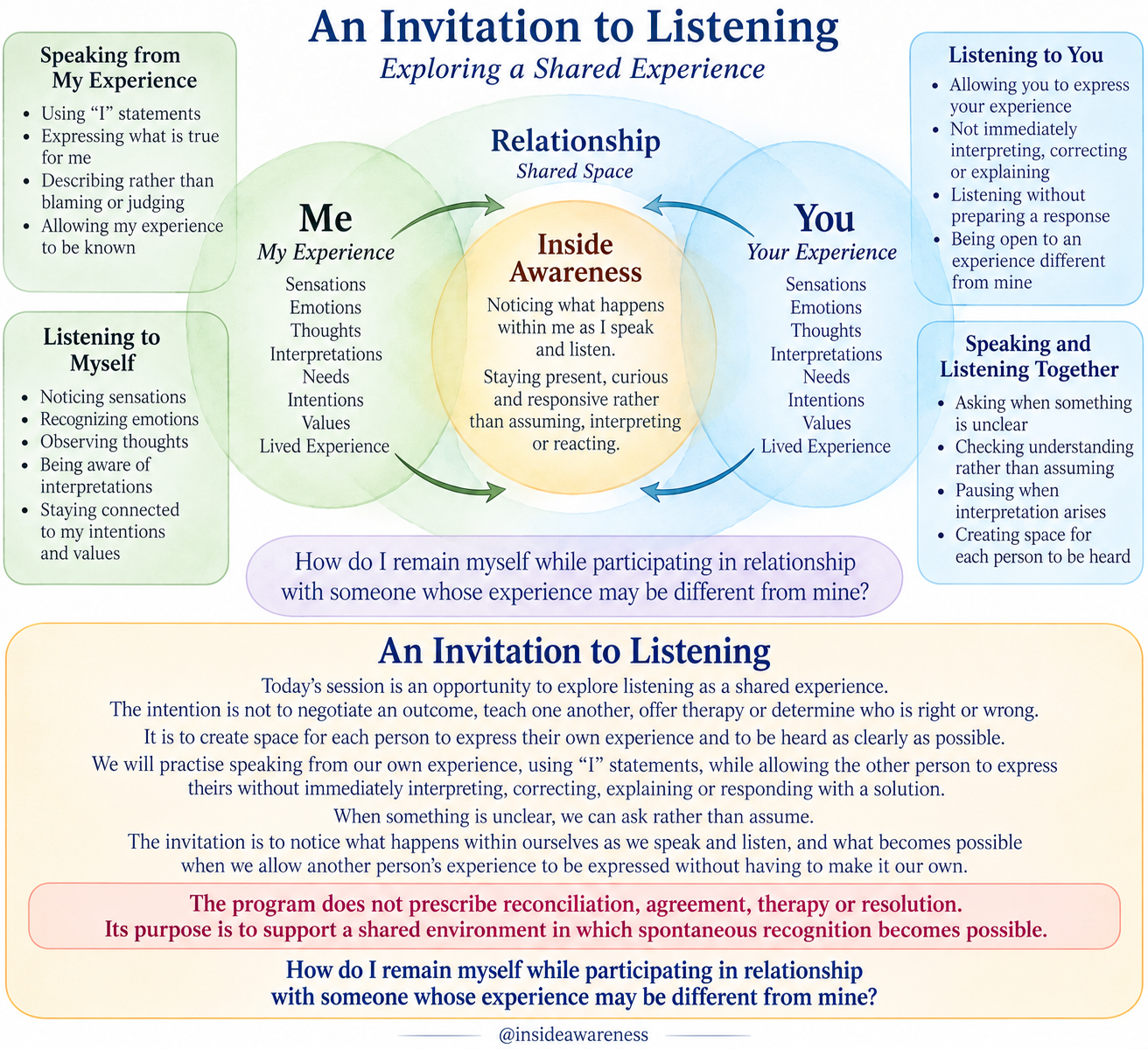
The accompanying diagram illustrates relationships that are present whenever two people communicate.

Listening to myself: Recognizing the sensations, emotions, memories, thoughts, interpretations and values arising within my own experience.

Listening to another: Allowing another person’s experience to be expressed without immediately correcting, analyzing or replacing it with my own.

Listening within relationship: Participating in a shared environment in which clarification, curiosity and reciprocal recognition become possible.

At the centre is Inside Awarenessโ€”recognizing what is happening within ourselves as we participate in an experience beyond ourselves.

The intention is not to teach someone the correct way to feel, think or respond.

It is to create conditions in which conscious recognition may become possible.

From Guided Patterns to Lived Function

These explorations have been part of my educational work across several subjects, including movement, communication, personal values and environmental awareness.

The learning environments may differ, but an underlying principle remains:

A guided pattern can direct attention without prescribing what the learner must discover.

In movement, we may explore unfamiliar possibilities through relationships with gravity, skeletal support and the surrounding environment.

In communication, we may explore unfamiliar possibilities by recognizing our inner experience while listening and responding to another person.

In both, the learning begins through participation.

I now see opportunities to organize these longstanding practices into listening programs suited to different environments, including personal reflection, families, educational settings, workplaces and community groups.

Each setting may require different considerations for safety, participation, clarity and consent.

The intention remains consistent.

The program does not prescribe reconciliation, agreement, therapy or resolution. Its purpose is to support a shared environment in which spontaneous recognition becomes possible.

At the heart of this exploration is an inquiry that continues to guide my work:

How do I remain myself while participating in relationship with someone whose experience may be different from mine?

Perhaps the possibility begins with recognizing that listening is more than receiving someone’s words.

It is also a lived experience of relationshipโ€”within ourselves, with one another, and with the environment we create through our participation.

An Invitation to Listening
Guided Patterns of Learning for Lived Function

Renee Lindstrom
@insideawareness

Follow socials:
Copyright 2014 โ€“ 2026

Embodied Feng Shui โ€” Listening to Place

Where Life Path Meets Place

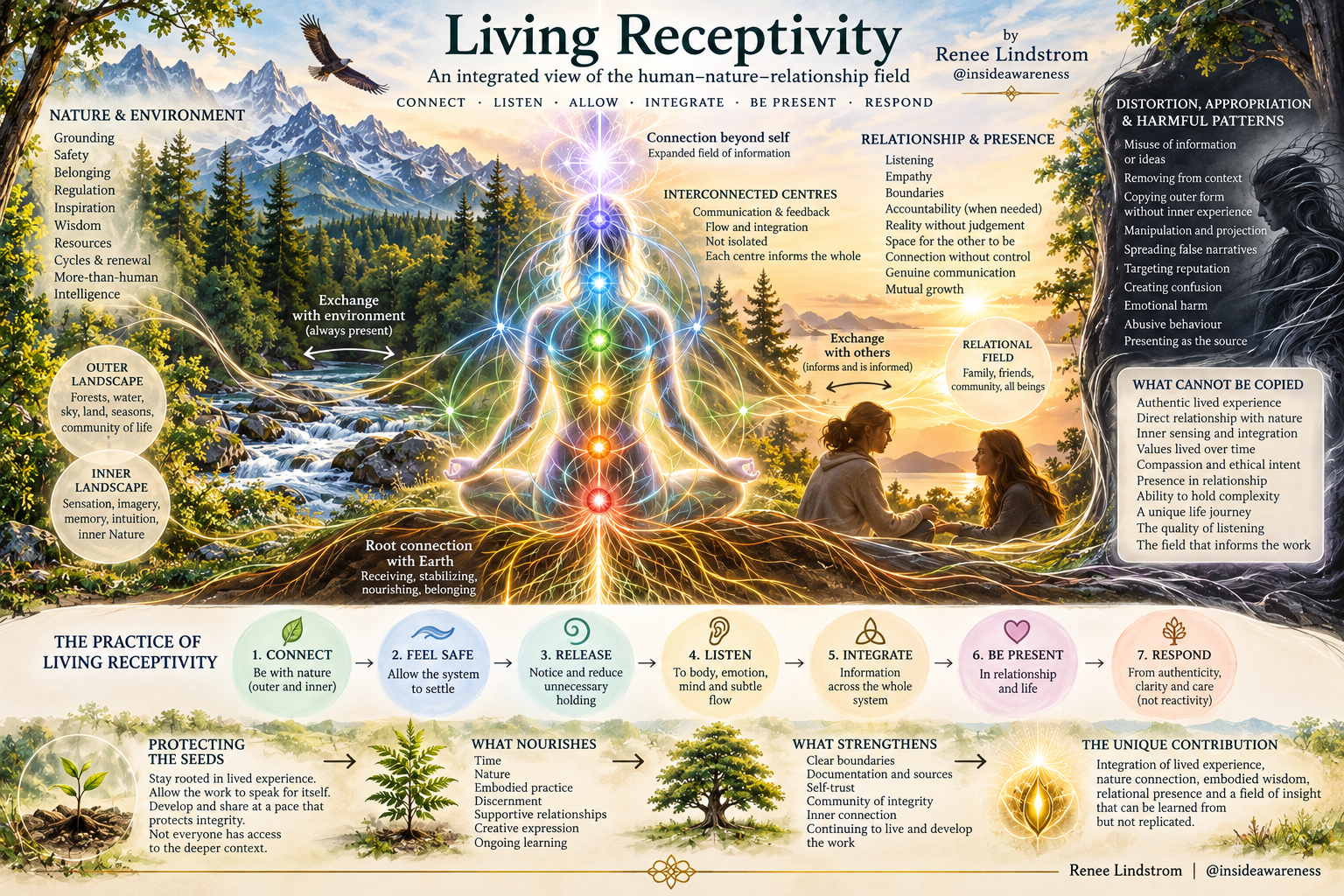
My approach to Feng Shui is not primarily concerned with identifying what is right or wrong within an environment or prescribing corrections to its arrangement.

I am interested in exploring the influences of place on lived experience.

Every environment offers a particular arrangement of space, movement, relationships, sensory experiences, and possibilities for participation.

Through Embodied Feng Shui, I invite people to become curious about how they experience their surroundings, what they notice, what may have become familiar or overlooked, and how the environment relates to their intentions and everyday choices.

The nine life areas provide a framework for differentiating these relationships. They offer opportunities to explore where attention is directed, which aspects of life may be receiving greater emphasis, and which possibilities may not yet have been consciously recognized.

Rather than interpreting a home or property for someone, my intention is to support the person in recognizing their own relationship with place.

This approach shares a foundation with my work in functional movement and communication.

The intention is not to fix the person, correct the environment, or prescribe the right response. It is to make the relationship between them more available for conscious recognition and choice.

When we begin to recognize how we participate in our environments, we may discover new possibilities for organizing our spaces in ways that support our values, intentions, and lived experiences.

Renee Lindstrom
@insideawareness

Copyright 2014 – 2026

From Habitual Participation to Conscious Choice

The Dance of Inner and Outer Communication

Guided Patterns of Learning for Lived Function

Over the past several days, I have been bringing together patterns of learning that have developed through many years of observation, teaching, personal exploration, and lived experience.

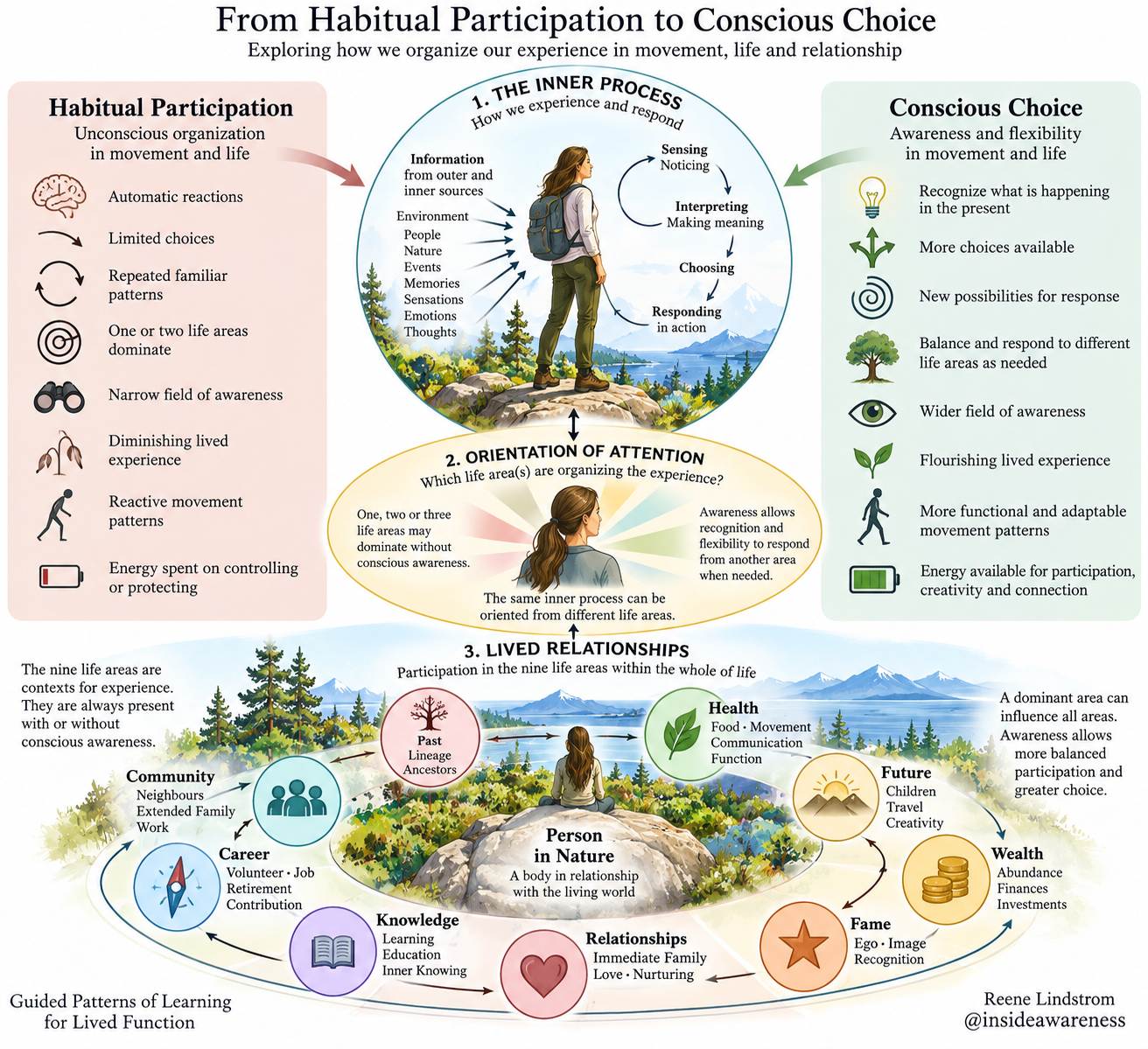
The accompanying diagram reflects an emerging integration of three areas of study that have been central to my educational work:

  • Nature and human nature through Feng Shui: exploring the relationships between people, their environments, and the nine life areas through which lived experience unfolds.
  • Inner and outer patterns of transitional movement: exploring how the body organizes itself in relationship with gravity, support, balance, movement, and changing circumstances.
  • Inner and outer patterns of listening and interpretation: exploring how information is received, sensed, interpreted, and expressed through inner language, communication, behaviour, and choice.

Although these areas have often been presented as separate educational subjects, I have increasingly recognized a common process connecting them.

How do we organize ourselves in response to our experiences, and how much of that organization is habitual rather than consciously recognized?

In functional movement education, a person may have developed familiar ways of shifting weight, finding support, or transitioning from one position to another. These patterns can become so automatic that other possibilities are no longer readily available.

The same question can be explored through inner language, listening, and communication.

A person may respond to a situation through a familiar interpretation without recognizing the process through which that interpretation arose. Their response may feel immediate, natural, or inevitable, even when another possibility exists.

The diagram introduces three interconnected dimensions of lived experience.

The inner process represents how an individual receives information, senses, interprets, and responds to experiences arising within themselves and from their environment.

The orientation of attention explores how particular values, intentions, and life areas may influence that processing, sometimes without conscious recognition.

The nine life areas offer a way to differentiate the contexts in which life unfolds, including Health, Relationships, Community, Career, Knowledge, Past, Future, Wealth, and Fame.

At the centre is a person in nature.

This placement is intentional. A person participates in the natural world and in relationships regardless of whether they consciously recognize the processes influencing their choices.

The nine life areas are not separate compartments of living. They are distinguishable orientations within an interconnected lived experience.

One or two areas may become so dominant that they influence how a person interprets and responds within many others. This may restrict available choices without the individual recognizing the underlying pattern.

The intention is not to establish equal attention to all nine areas or prescribe a correct way of living.

It is to make the organization of experience more available for conscious recognition.

This is also the foundation of Awareness Through Movement learning.

The learner does not have to reproduce the experience the teacher helped create. The learner can begin to recognize how learning happens within their own lived experience.

Through guided patterns, the learner is invited to notice familiar responses, differentiate the processes involved, explore variations, and discover possibilities that may not have been previously recognized.

This emerging educational focus brings movement, communication, inner listening, and life orientation into relationship without requiring them to become the same subject.

It is an exploration of the difference between habitual participation and conscious choice.

How am I participating in the process of my own experience, and can I discover another way?

Renee Lindstrom
@insideawareness

Follow socials:
Copyright 2014 โ€“ 2026

The Life Path

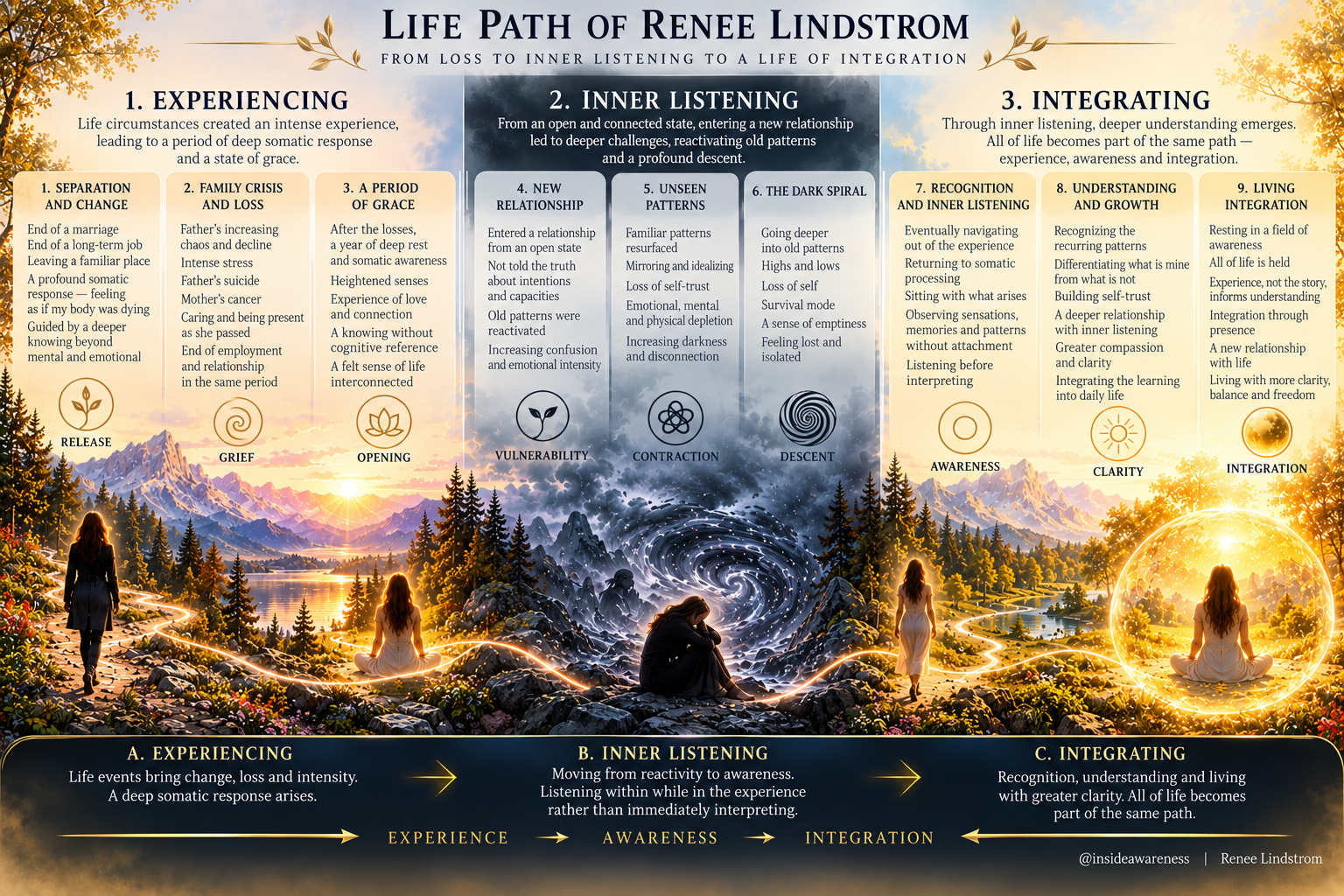
Infographic titled 'Life Path of Renee Lindstrom: From Loss to Inner Listening.' It outlines a three-stage process: Experiencing, Inner Listening, and Integrating, detailing personal growth through grief, awareness, and integration of life experiences. Each stage includes key concepts and emotional responses, illustrated with scenic backgrounds representing transformation and understanding.

A pattern of inner listening to the experience has emerged through my own life path that has shaped the awareness integration sessions and classes for a number of years. The organic connections that emerged have been put into guided patterns that will be available through boutique group learning in early 2027.

Each human has a path forward that could be called their life path.

This path is influenced by experiences and choices. In turn, what has already been experienced and chosen influences how the present is encountered and how future possibilities are approached.

Much of a life path is walked without full awareness of where it is leading. Circumstances arise, we respond to them, and choices are made within them. Those choices become part of what shapes the next steps along the pathway.

Yet many of the influences shaping the path remain elusive. The walker’s attention is naturally drawn toward navigating what is immediately happening. Attention may become occupied with deciding what is right or wrong, solving problems, assigning blame, avoiding shame, or relying upon familiar strategies that have workedโ€”or seemed to workโ€”in the past.

Over time, these learned responses can become habitual ways of walking the path. New experiences may then be approached through patterns established by earlier ones. Attention can become absorbed in resolving the difficulties that arise, while the patterns influencing those difficulties remain largely unnoticed.

In this way, the patterns of one’s lifestyle become a core influence on the lived experience of the life path. They can be quiet, elusive, and outside conscious attention. What has become familiar may simply feel like the way life is.

What if the life path itself could become a place for cultivating awareness?

What if simple guided patterns could be integrated into ordinary life experiencesโ€”not to prescribe the path or determine where it should lead, but to make visible what has previously been elusive?

As patterns become recognizable, there is an opportunity to pause, sense what is present, and notice how an experience is being interpreted. What was once habitual can become available for inquiry.

Awareness creates the possibility for greater clarity.

And with greater clarity, choices along the life path can become more conscious.

The intention is not to interpret another person’s life path for them.

It is to cultivate the awareness through which they can begin to interpret their own.

Read initiation to Life Path in Octobers Newsletter

Fill in Contact Form below to express an interest in Life Path Boutique Learning Opportunities coming in 2027

โ† Back

Thank you for your response. โœจ

Copyright 2026 Renee Lindstrom, GCFP

With respect and gratitude, this work acknowledges the ground provided by the teachings and practices of Moshe Feldenkrais, Marshall Rosenberg, Chรถgyam Trungpa Rinpoche, and Dyan Grant Francis. Their contributions are honoured as part of the learning from which Inside Awareness continues to grow.

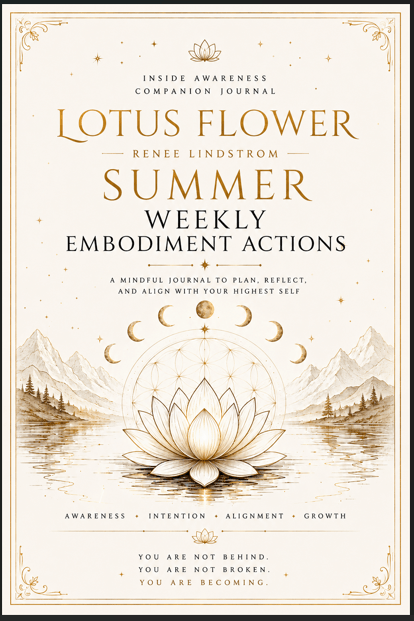
Announcing The Lotus Flower Summer Embodiment Journal

Now Available on Amazon

Companion Activity:

Lotus Flower Embodiment Action Cards

Awareness. Intention. Alignment. Growth.

A mindful journal to plan, reflect, and align with your highest self. The Lotus Flower Summer Weekly Embodiment Actions Journal is designed to support this journey.

Like the lotus flower, growth often emerges through challenge. Each page of this journal is an invitation to slow down, notice what matters, and take intentional steps toward the life you wish to create.

Inside these pages, you will find space to:

  • Set meaningful intentions
  • Track habits and progress
  • Reflect on emotions and experiences
  • Practice gratitude
  • Strengthen self-awareness
  • Align your actions with your values

This journal has been created through 26 years of experience integrating somatic awareness as support for understanding and increasing clarity in behaviour through movement, communication and listening. The cognitive behaviour and somatic behaviours are intertwined and this author practitioner and mentor has recognized a lack of balance and understanding between the two. Mainstream guided pattern focus in education has mainly been on cognitive function and not on somatic experience. Therefore, the somatic reactions can be out of control without the skills to keep impulse control in check. This is demonstrated through a lack of body connections to how the skeleton functions at the core patterns and in the inner processing of information due to limited filters of understanding. The guided patterns in this journal support the integration of balancing the interrelationships between the body and mind responses.

Below you will find two more somatic oriented activates that engage the mind through guided patterns. One is meditation and the other through sound.

Connect to learn more about Lotus Flower Embodiment Learning Series that integrates functional movement and mindfulness for converting out of balance reactions into conscious responses.


Listen to Meditation to support Lotus Flower Embodiment Series:

Listen to Music Playlist to support Lotus Flower Embodiment Series:

Please like and subscribe if you like this content.

Followย Socials:

Facebook,ย LinkedIn,ย Instagram,ย TikTok,ย Xย orย Pinterest,ย Tumblr

Copyright 2014 โ€“ 2026 Renee Lindstrom, GCFP

Subscribe to get the latest posts sent to your email.

Recognizing a gap between a somatic newborn and a cognitive societies social conditioning

by Renee Lindstrom, founder Inside Awareness Center for Integrative Somatic Learning

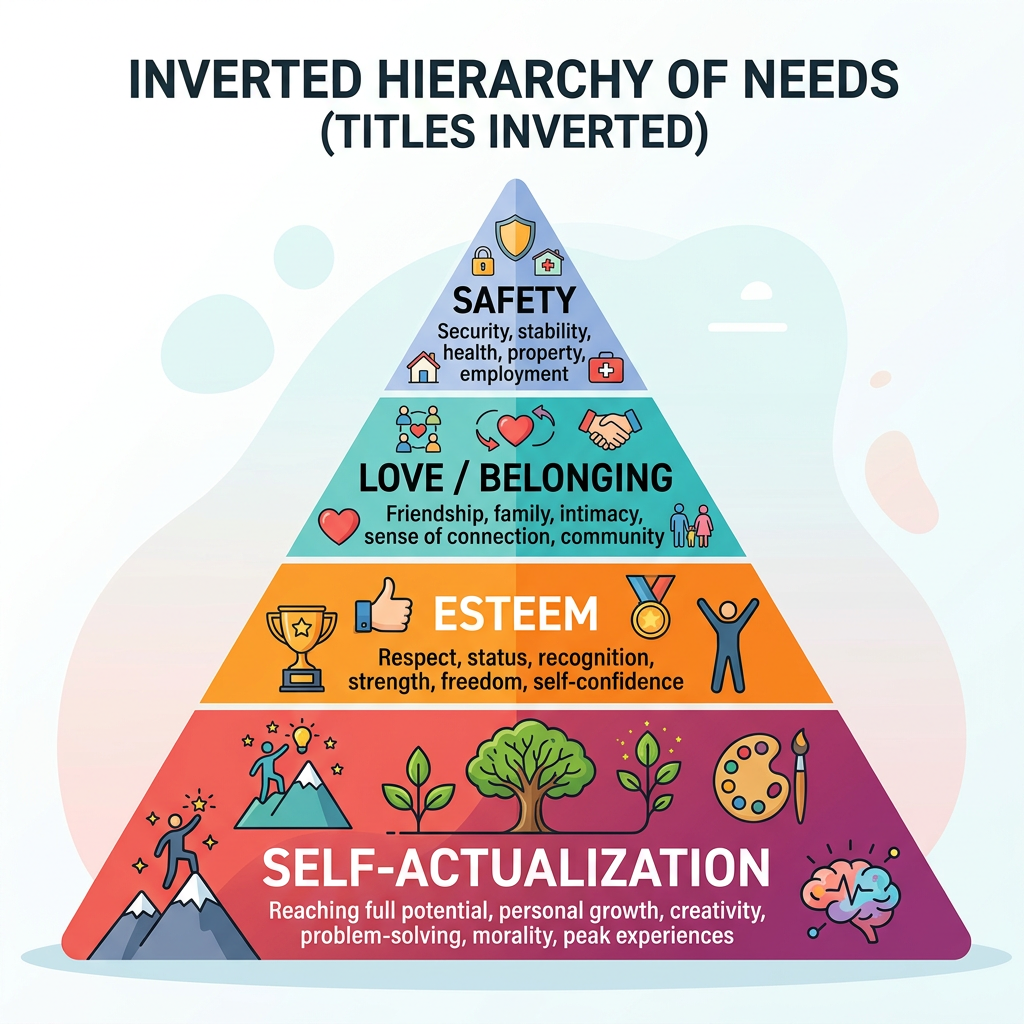
Invert hierarchy titles: safety top, self-actualization bottom

This blog article below was written on this author’s personal website http://www.reneelindstrom.com recently. It is from a perspective of a somatic empath that carries the ability to identify the authentic somatic experience and the cognitive conceptualization that those not in their somatic experience believe it is. No judgement, simply a gap this author is bringing focus to. You can read this article by clicking the article link below or listen on You tube at link below it. I hope this content will be of interest in those sincerely interested in actively going beyond what they think they know from societies conditioning in accepting the stories attached to their mental, emotional and physical states of being. The first step to breaking free of acceptance to labels, assessments, and moral judgements, etc., is having clarity on the separation that supports it.

Below are two earlier articles from this authors personal web site on Maslow’s Hierarchy of Needs from an interesting perspective that may be interesting to read after digesting and integrating this perspective from a somatic empath. Understanding this first stage will support how society is perhaps being misguided by this lack of clarity by those who are seeking to meet their needs without compassion and empathy for others.

If you would like to connectย to learn moreย about educational opportunities, coaching, mentoring , consulting or functional integrations

Podcast

Please like and subscribe if you like this content.

Follow Socials:

Facebook,ย LinkedIn,ย Instagram,ย TikTok,ย Xย orย Pinterest,ย Tumblr

Feldenkraisยฎ, Feldenkrais Methodยฎ, Awareness Through Movementยฎ, and Functional Integrationยฎ,ย are registered service marks of theย Feldenkrais Guildยฎ of North America. Feldenkrais Methodยฎ

Copyrighted Property posted on Reneeโ€™s authentic accounts only:

Body Mindfulness Core Body Functional Breathing Audio

by Renee Lindstrom, founder, Inside Awareness Center for Integrative Somatic Learning

Functional Breathing Patterns sensed with somatic awareness

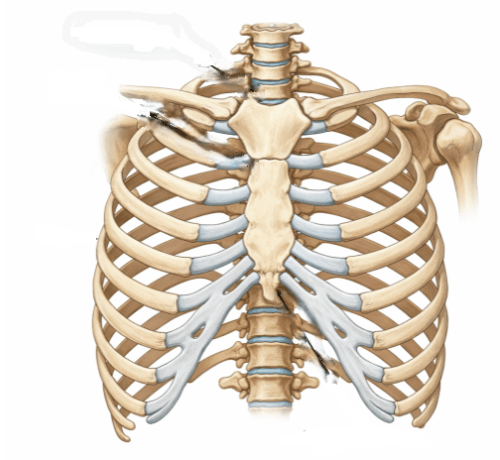
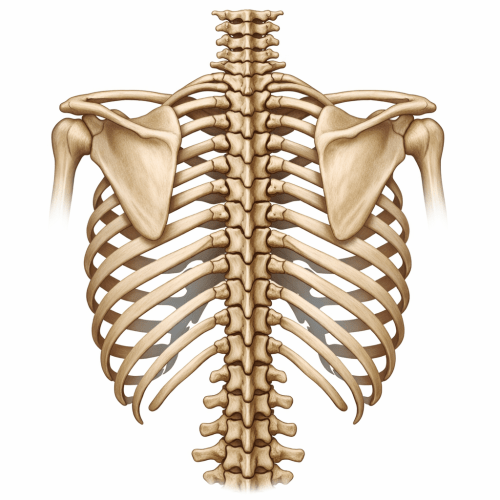
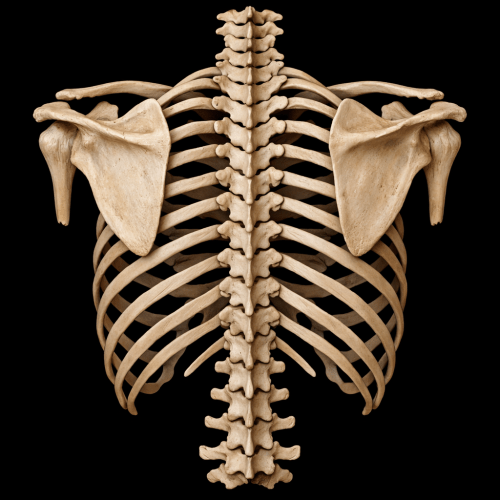
Often when observing the breath patterns of an individuals I will see that there is a lack of skeletal movements in their patterns of expansion and contraction in the moving parts that could be recruited for fuller body supported whole movement for drawing in air and expelling it.

The body parts I refer to are the bones and joints that create flexibility, balance, expansion and contraction, and counterbalance.

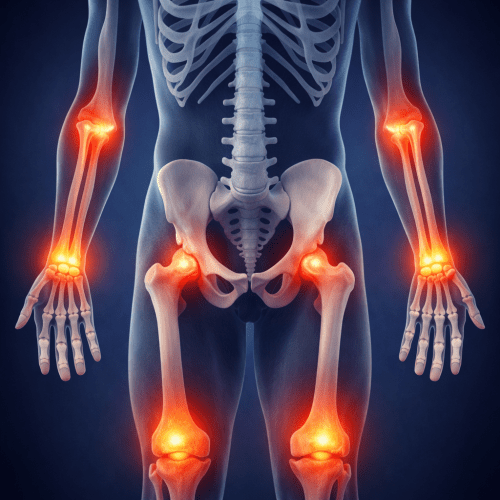
Shown here in this slideshow.

  • Posterior view of thoracic vertebrae with ribs and scapulae
  • Rear view of human rib cage with scapulae and spine bones
  • Human skeleton front view showing skull, rib cage, spine, arms, and pelvis bones
  • Anterior view of a human skeleton showing skull, rib cage, spine, pelvis, arms, and legs
  • Clearly include and define knee joints

The above slideshow demonstrates the moving parts of the skeleton that supports whole breath through core functional skeletal movement patterns.The focus of attention in these guided patterns is movement where the muscles, ligaments and soft tissue are spontaneously moving in response to the skeletal micromovements. These micromovements with a skeletal focus treats the muscle and soft tissue as partners that follow and hold the bones in alignment. This focus is on core bone strength and the resilience of the muscles that are not resistant to functional movement patterns. Muscle strength is separate from bone strength, yet often in cognitive intellectualization does not include the understanding of the bone movement in functional postural transitions.

The patterns in The Mindfulness Body Breath workshop and Audios focus attention on education of whole function through postural transitions to enhance and improve natural rhythms of breathing. The guided patterns balance the somatic experience with the cognitive conceptualizations for increasing mindfulness through function.

More on Body Mindfulness Audio plus added bonus below: Free Intro to expanding somatic sensing in video embedded down below

These guided patterns are from Feldenkrais workshop that Renee has held since 2007. The feedback after each workshop has been positive with appreciation expressed.

Core Body Functional Breathing Audio

The Audio for Core Body Functional Breathing will guide you through patterns of movement to explore breathing with the focus on micromovements to release bones held in rigid patterns to encourage fuller intake and expulsion of breath and that is a natural function and not forced through concepts. These guided patterns generate a conscious felt sense connection to contraction and expansion through movement. This increase in awareness can support consciously releasing the constraints to blocking the resilience through the patterns of opposites that initiate contraction and expansion through bone movement that is needed for organic fuller breath patterns.

Included in this audio lesson offer is an intro and outro for the intent to learn how to engage the sensory awareness using the five senses in harmony and partnership with cognitive function. It is this practitioners experience that integration and development of new neural pathways do not develop through thinking that is dependant on beliefs, opinions and evaluative thinking. Neural pathways are developed on new actions that engage growth through novelty, exploration and discovery.

Read more on the benefits of Somatic Body Mindfulness and research of Feldenkrais below


How to purchase and enjoy – Core Body Functional Breathing Audio


How can you move a body part through function when you don’t know what it is somatically or the ability to different it from your body mass?

Intro to how to use your senses of sight (visions) and sound to differentiate felt senses of individual body parts.

In this short video Renee introduces the potential of expanding the felt sense of the bones inside through vision and imagination. Using pictures of the bone parts through the sensory perception of sight and sound the listener can focus on integrating this knowledge into their somatic sensory perception that can create a connection to the bone through the sensory ability to feel them independently through *function.


Read more on the benefits of Somatic Body Mindfulness and research of Feldenkrais below:

Learn More about Body Mindfulness

Some of the conditions that SBM guided patterns that Renee has observed improve are:

  • Anxiety and Depression
  • Artheritis
  • Back and Neck Pain
  • Loss of Balance
  • Bell’s Palsy
  • High Blood Pressure
  • Shallow Breathing
  • Chronic Pain
  • Eating Disorders
  • Fibromyalgia
  • Lack of Flexibility
  • Hip, Knee and Ankle Joint Pain
  • Injuries
  • Insomnia
  • Pulled Muscles
  • Multiple Sclerosis
  • Parkinsons
  • Locked Shoulders
  • Stroke
  • TMJ

Some of the Benefits that Research has shown are:

  • Improved:
    • proprioception
    • coordination and ease of movement
    • posture and stability
    • well-being
    • feeling of confidence
    • breathing
  • Decreased
    • pain
    • spasm

Research Evidence:

  • Improves:
    • body awareness:  Multiple sclerosis, pain, stroke, able-bodied  
    •  mobility
    •  stability
    •  coordination
    •  ease of movement
    •  posture
    •  balance confidence
    •  mood
    •  breathing
    •  well-being and quality of life
    •  sleep
    •  self efficacy and health locus of control
    •  self image
    •  greater recruitment of the affected part of the motor cortex  (stroke)
  • Reduces, decreases:
    • decreased pain
    • fatigue
    • anxiety and stress
    • medical costs

To learn more about this Research on the Benefits of Feldenkrais, go to the link in the description box and tap the link

Introduction: Grounding thru Body Mindfulness

Benefits:

  • reduce and reverse aging
  • increasing flexibility and resilience
  • develop body awareness
  • reduce body tension, pain, anxiety and effort
  • increase relaxation and windows of emotional tolerance and self-connection
  • improve sleep and sleep sounder
  • increase body functions, cognition and emotional responses of calm, mindfulness and joy

Exploring the body anatomy through the felt senses increases inner awareness โ€‹ and trust. This โ€‹body exploration is a different type of strength training. The difference โ€‹is theโ€‹ focus of attention on the body, mind and felt senses through guided patterns designed to expand conscious awareness of the body function. The strength of feeling oneโ€‹’s body through moving joints and bones deepens awareness of physical connections โ€‹as โ€‹postures change, like in the shifting transitions from sitting to standing and back to sitting. Movement is a series of shifting postures. The functioning healthy body is not stationary, nor poses. It is designed for a continuous flow of integrative movement patterns.


Feedback On Body Mindfulness Introduction

“I am excited!!! This is great! It is like you are there with me step by step. It’s what all of us are looking for, real Feldenkrais support” S
“That was great, Renee! You have such a calm and lovely voice. I’m happy to add this to my calming strategies. Thank you. ” H
“I really like this sort of thing and would welcome further โ€œinstallmentsโ€ in the series and/or a revised version of this one. I liked the pace at which you spoke, not too rushed and left enough time to do the exploration of the particular area of the body to which you were drawing attention.
I liked that you offered options re leg position (straight out or with bolster under knees) but wondered whether one position or the other is preferable. Or is it just that one would notice different things, depending on how the legs are positioned?”   K


Connect for Lifestyle Coaching and Learning Needs


Follow Socials:


Copyright 2014 โ€“ 2026 Renee Lindstrom, GCFP

Feldenkraisยฎ, Feldenkrais Methodยฎ, Awareness Through Movementยฎ, and Functional Integrationยฎ, are registered service marks of the Feldenkrais Guildยฎ of North America