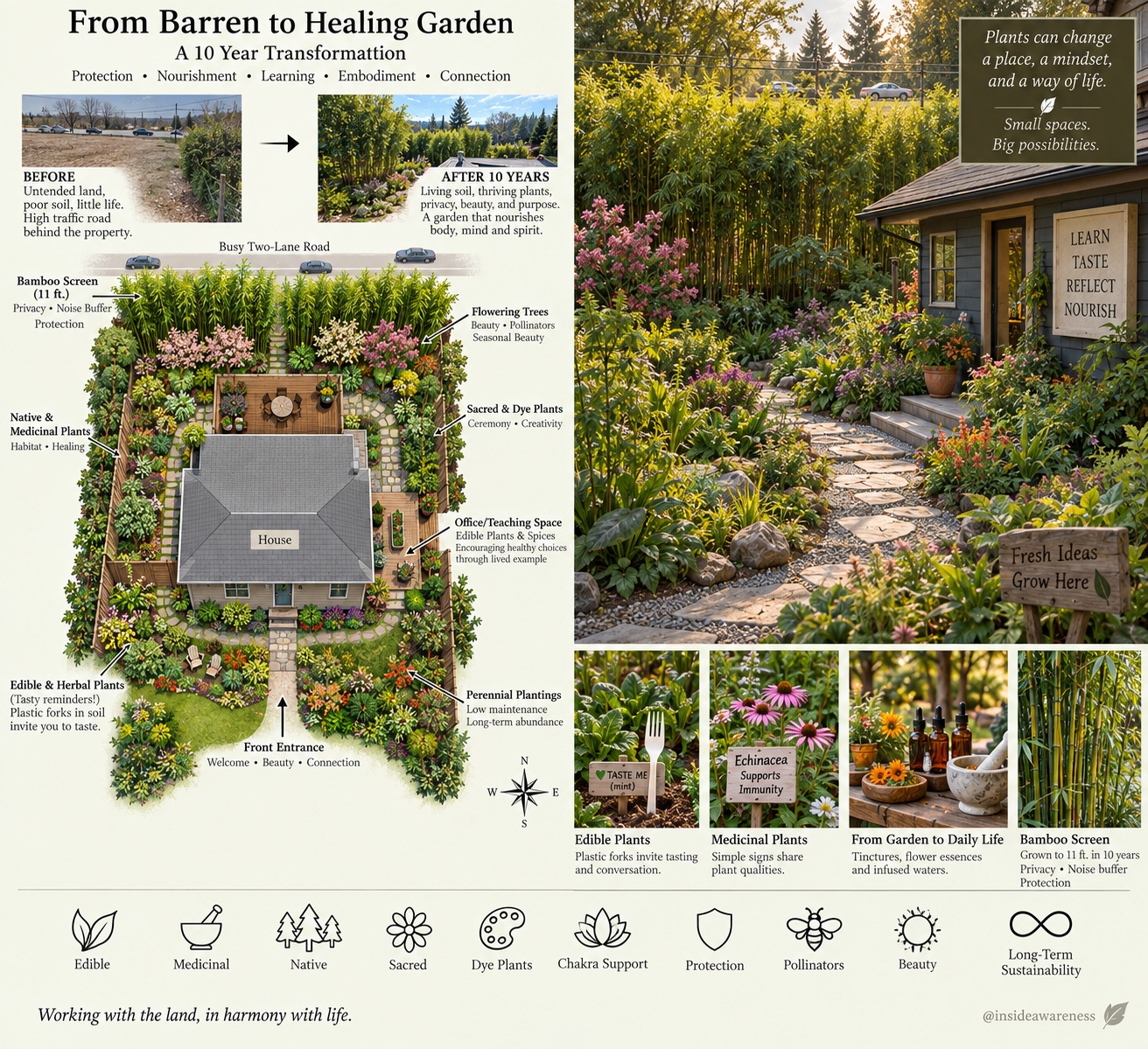
What is available outside my door that could support sustaining life that is not being recognized?
This question became an important part of my personal exploration of nature, nourishment and the living environment.
A second question accompanied it:
How can I inspire an interest in others to explore their own food journey and connection to nature, both inside and out?
These inquiries did not begin as an organized food program. They emerged through a longstanding curiosity about our relationships with the world around us and the ways those relationships influence our daily experiences.
Over time, my home and office surroundings became a living environment for exploration.
I began paying closer attention to what was growing nearby, including native plants, introduced species, familiar garden plants and plants often dismissed as weeds.
Some offered possibilities for food. Others inspired explorations of natural dyes, flower essences, herbal preparations or simply a deeper understanding of the environment.
Not everything growing around us is edible or appropriate for medicinal use. Part of the exploration involves learning to recognize plants accurately, respect their ecological relationships and understand appropriate uses and safety considerations.
What interested me was not simply collecting information about plants.
It was recognizing what had previously escaped my attention.
Curiosity Through Lived Experience
My personal food explorations often begin without a particular outcome in mind.
An ingredient attracts my attention.
Something familiar suggests another possibility.
An experience with kefir inspires a new experiment, perhaps making kefir cheese or exploring whether it could become part of a cheesecake.
A seasonal plant, herb or flavour invites another discovery.
Sometimes I photograph these experiences and share them. I may reflect on the sensory qualities, the season, the nature connection or the chakra qualities I associate with an experience.
Some explorations turn out as I imagined. Others surprise me.
The enjoyment is in the exploration itself.
These personal discoveries are not intended as instructions that others must follow. They are examples of curiosity in action.
Sharing the Experience
I have found it useful to distinguish my spontaneous creative experience from the process of communicating it afterward.
A gentle pattern helps me organize a photograph or reflection into something others can follow:
Inspiration — What attracted my attention?
Exploration — What did I become curious enough to try?
Experience — What did I notice through my senses?
Connection — What relationship did I recognize with nourishment, nature, season, daily living or the chakra qualities?
Invitation — What might inspire someone else’s curiosity?
These are possible points for reflection, not five steps that must be followed whenever I prepare food.
The creative experience remains spontaneous. The structure simply helps me communicate what I discovered afterward.
This distinction is important to the educational intention of Food Inspires.
From Personal Exploration to Guided Learning
Food Inspires provides a different kind of structure.
My personal explorations demonstrate how curiosity participates in my daily life.
The educational program offers guided patterns through which others can begin recognizing their own relationships with nourishment, movement, rest, nature and everyday living.
The intention is not for participants to reproduce my food choices, interests or discoveries.
It is to create opportunities for their own curiosity and recognition.
The program begins with familiar experiences of daily rhythm, inner awareness, movement and nourishment. Later explorations introduce seasonal relationships, the qualities associated with the chakras, and deeper inquiries into embodied intention and lived function.
These experiences are connected through a central question:
How am I participating in creating balance in my daily life?
As this inquiry develops, nourishment becomes more than a choice about what to eat.
It becomes an opportunity to recognize relationships with ourselves, our community, the natural environment and the living systems that sustain us.
An Invitation
Food Inspires is not an invitation to adopt someone else’s relationship with food or nature.
It is an invitation to become curious about your own.
Perhaps that curiosity begins with a familiar ingredient, a favourite meal, something growing outside your door or the simple pleasure of preparing food.
Sometimes the smallest discovery opens an entirely new relationship with an ordinary experience.
What might you discover when you begin noticing what is already available?
Sensing myself. Sensing another. Discovering how to participate together.
For nearly twenty years, my exploration of balance has developed through teaching, observing, and listening to the unique ways individuals organize themselves in movement.
Throughout these years, I have become increasingly interested in the transitions between movements rather than the completion of individual exercises or postures.
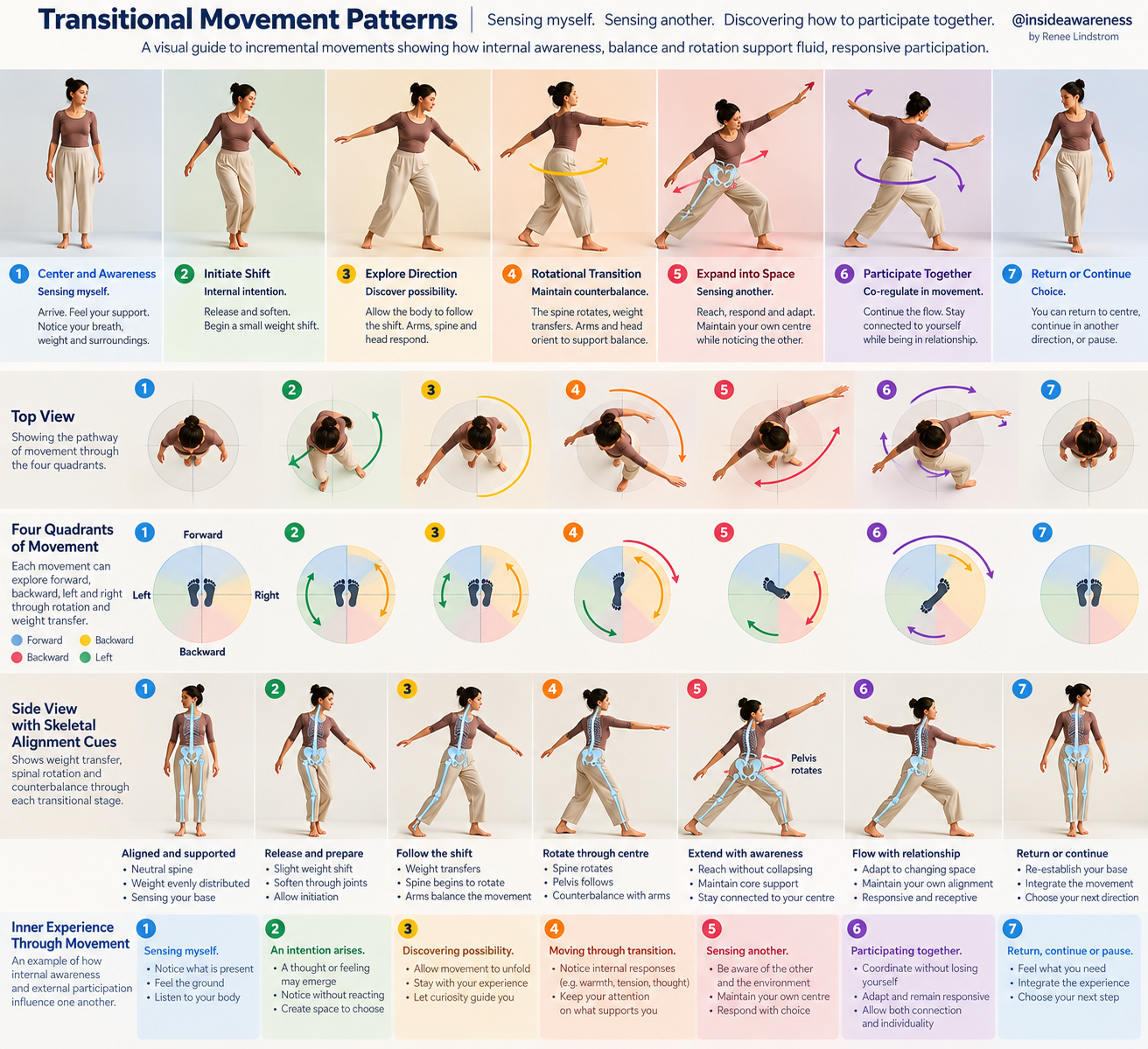
How does the skeleton organize itself to transfer weight? What happens as we change direction, rotate, reach, or shift from one supporting leg to another? How can an awareness of gravity, skeletal support, and counterbalance offer new possibilities for movement with less unnecessary muscular effort?
These questions have gradually influenced the development of Guided Patterns of Learning for Lived Function.
More recently, I have begun recognizing something unexpected within my own spontaneous movement. As the relationships between skeletal support, rotation, and counterbalance become increasingly familiar, movement can begin to flow creatively, almost like a dance.
This expression is not intended to reproduce an established dance form, yoga posture, or tai chi sequence. Rather, recognizable shapes may emerge naturally through the exploration of functional movement relationships.
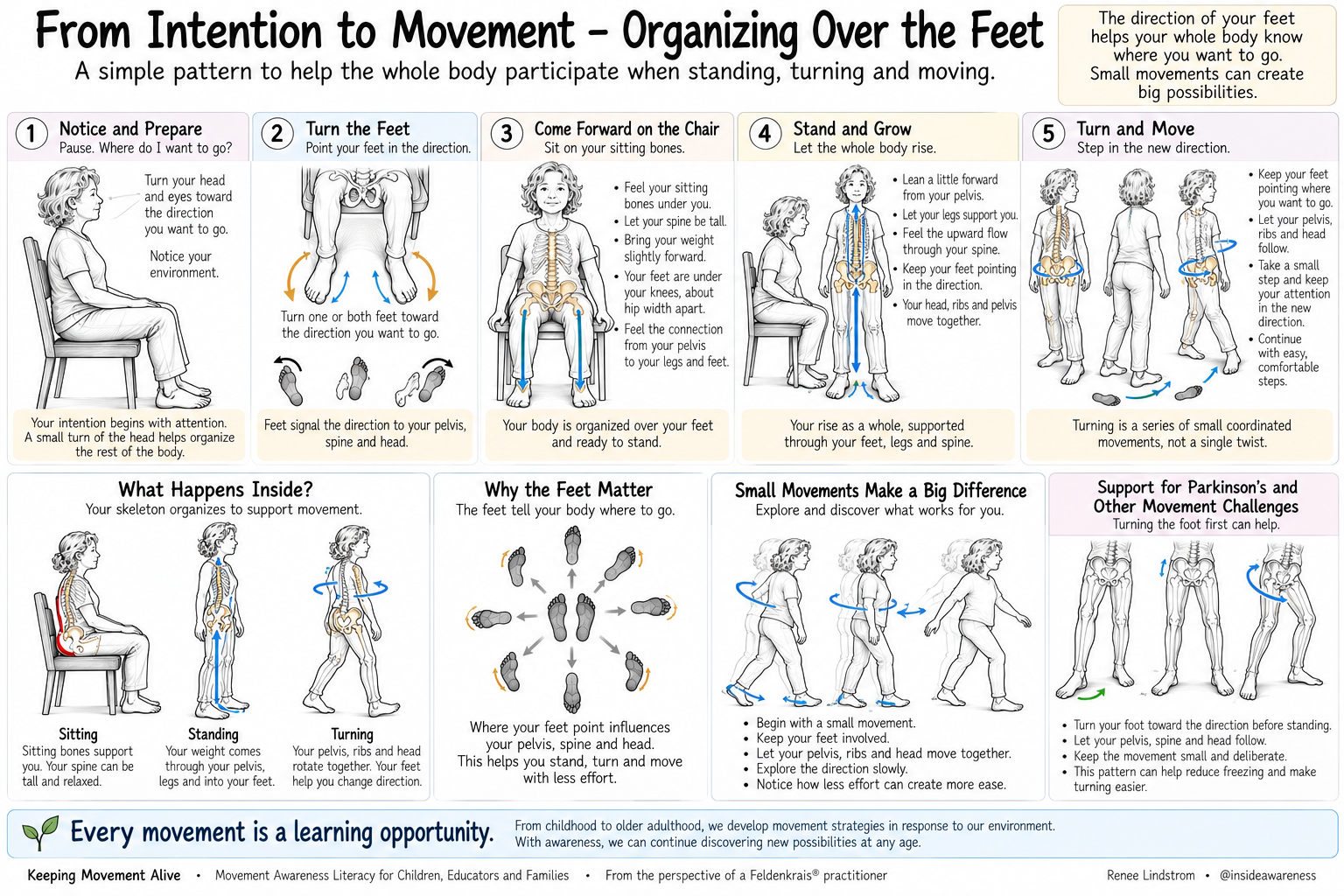
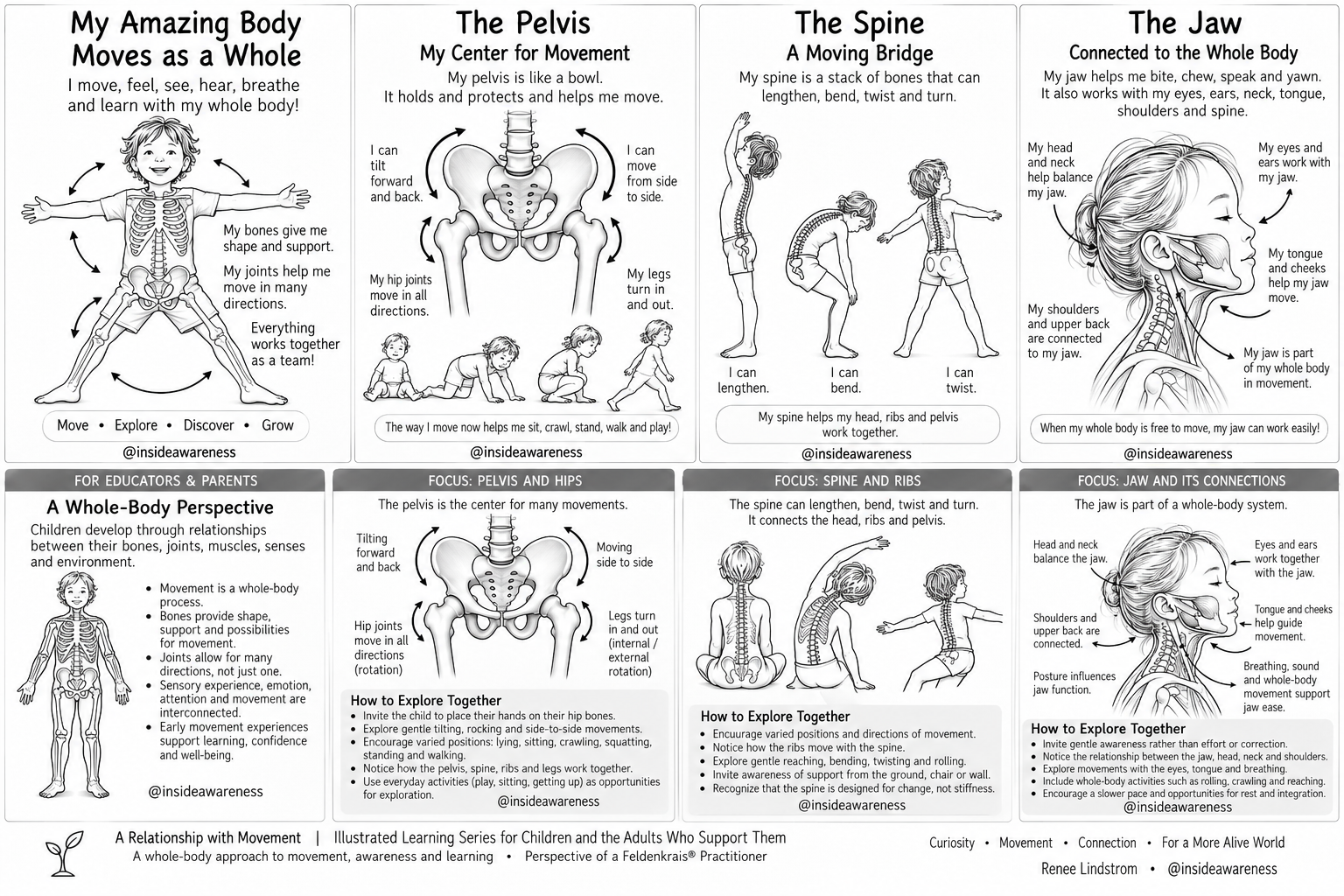
The accompanying diagram, Transitional Movement Patterns, introduces some of these possibilities through incremental illustrations of movement, including side-view skeletal relationships.
For participants in my Balance classes, these images may offer an alternative to remembering a list of exercises. They can become visual invitations to recognize how the body organizes itself through movement, allowing each person to explore within their own abilities and circumstances.
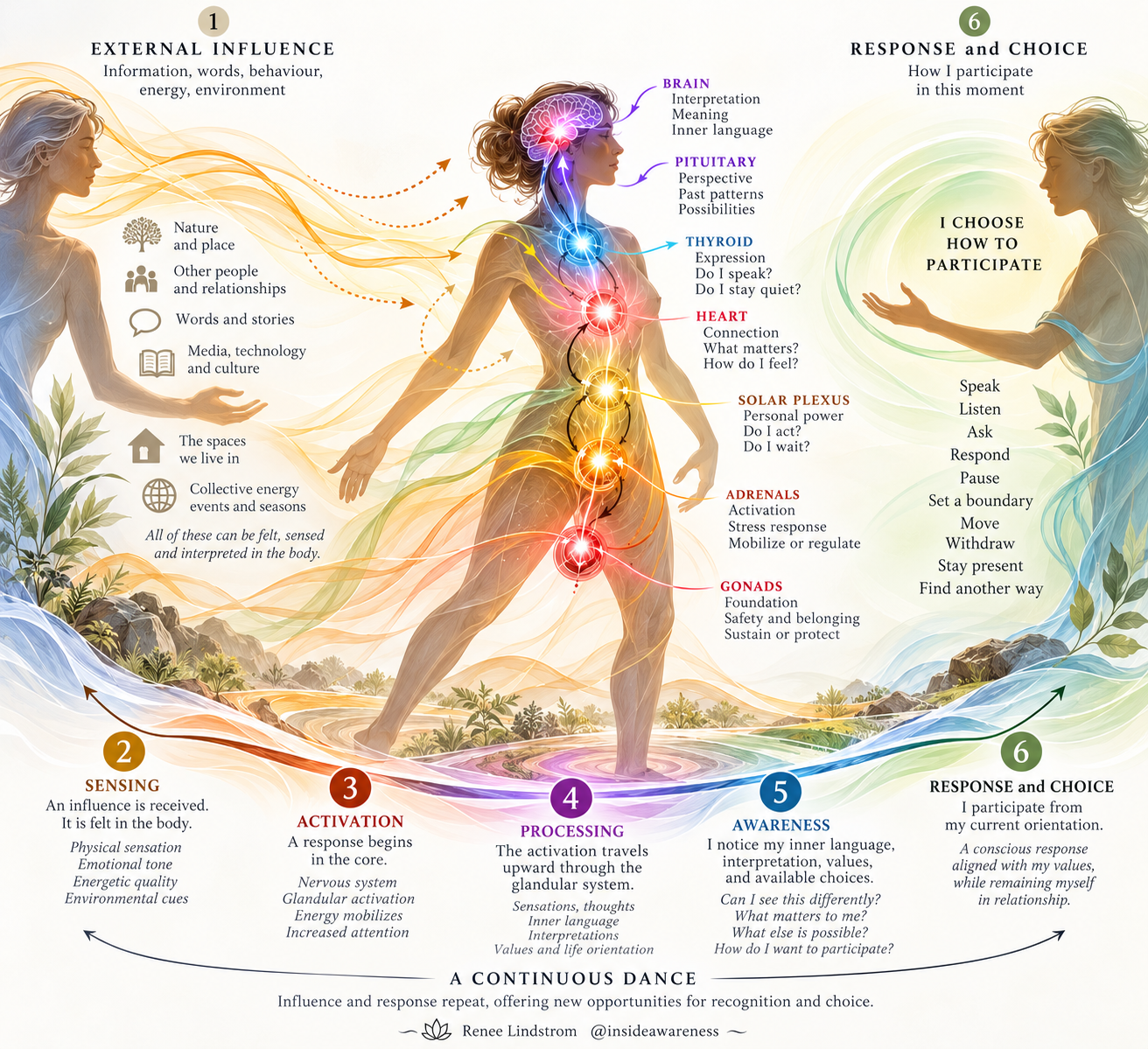
An additional direction is emerging through this work: the relationship between internal sensory awareness, the surrounding environment, and participation with others.
What happens to our spontaneous movement when another person enters our experience? How do our internal interpretations influence the way we move, respond, or choose to act?
These questions are beginning to connect the movement patterns with my developing explorations of inner language, listening, and conscious recognition.
I am also considering how these foundational movement relationships might be introduced in early childhood education, supporting opportunities to develop sensory awareness, movement choice, and participation in relationships from an early age.
This is an evolving exploration rather than a completed system.
My intention is to create accessible learning experiences that invite curiosity, encourage individual discovery, and support the integration of awareness into ordinary lived function.
The focus is not on achieving a particular movement. It is on discovering the relationships that make movement possible.
Feldenkrais®, Feldenkrais Method®, Awareness Through Movement®, and Functional Integration®, are registered service marks of North America. Feldenkrais Method®
“Before planting new seeds, take time to recognize what has already grown.”
Gratitude begins with recognizing what is already present.
As we become conscious of the intentions woven through our lived experiences, we discover the relationships, choices, and actions that have shaped our lives.
In recognition, we find appreciation.
In appreciation, we nurture awareness.
Through awareness, new possibilities for conscious participation emerge.
Embodying Intention · Oct 10/11, ’26
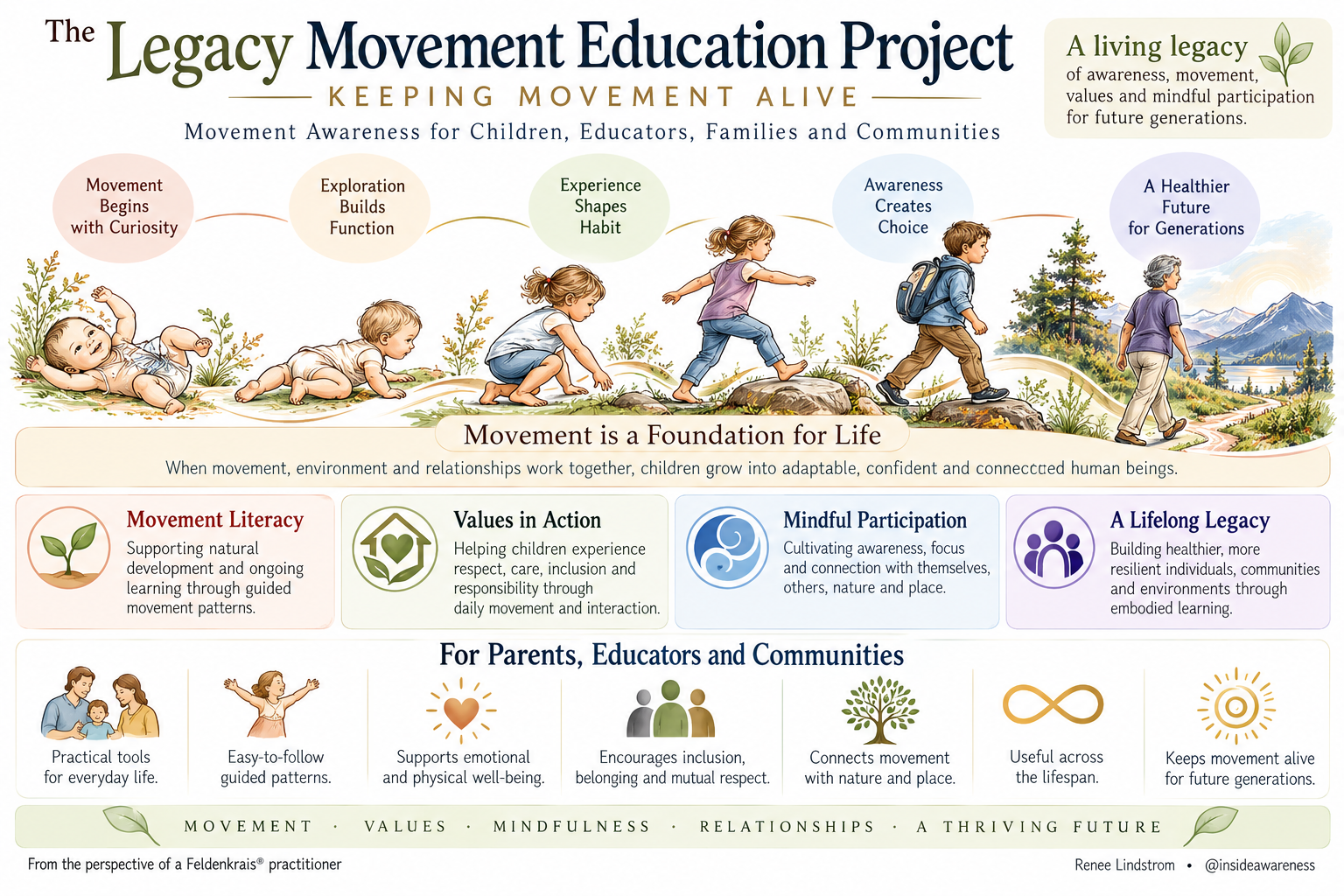
The Legacy Education Project — Keeping Movement Alive
The Legacy Education Project — Keeping Movement Alive
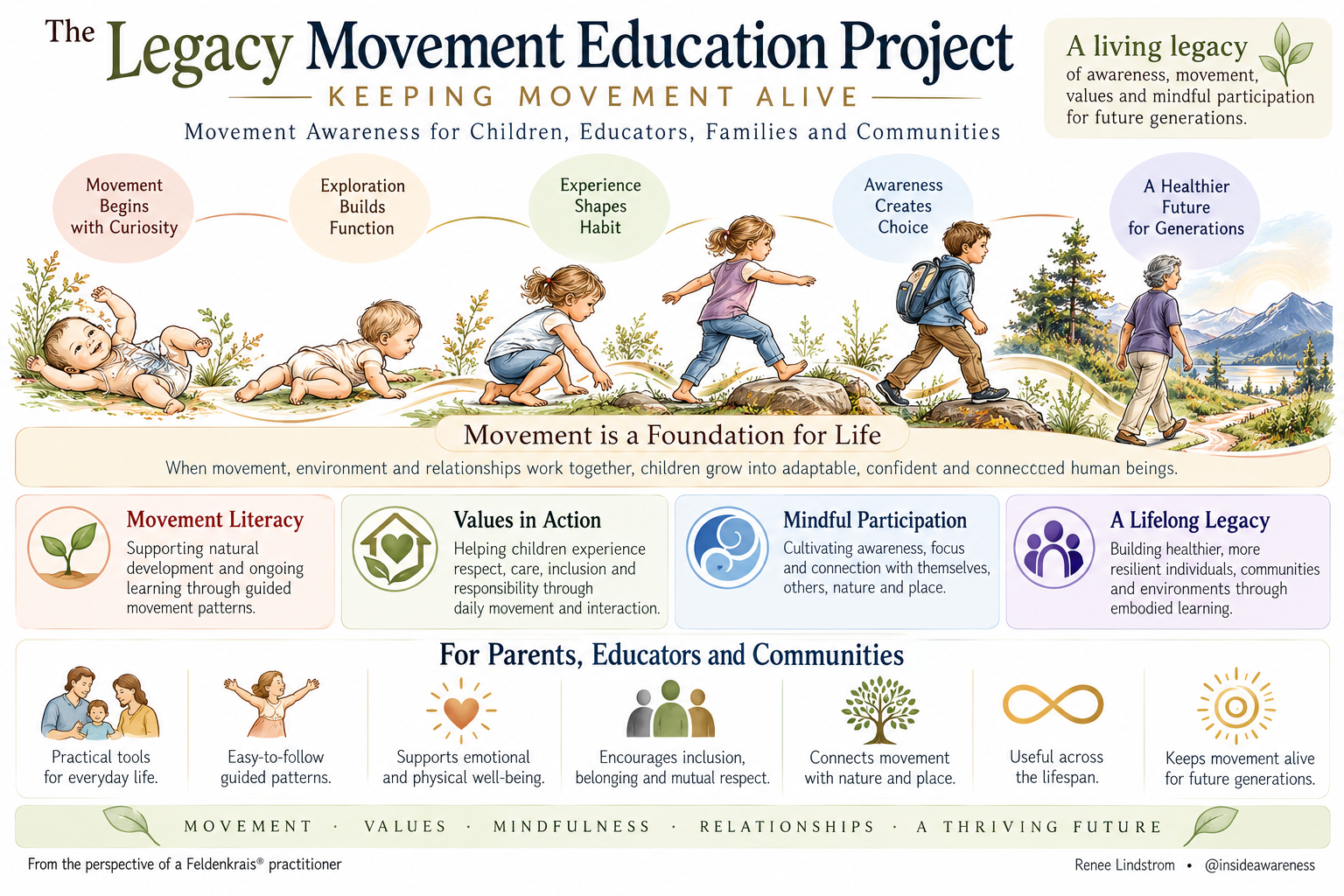
I would like to share an update on the Legacy Education Project, which I began writing about on my personal page earlier this year.
The accompanying article introduces the developing project and includes illustrated diagrams exploring skeletal relationships and the transitions that take place within everyday movement.
The seeds of this project were planted somewhere along the way during my years of teaching *Balance*, a guided functional movement workshop I began offering around 2007. For nearly two decades, these classes have continued for approximately 40 weeks each year. That represents hundreds of weeks—perhaps close to 800—of listening, observing, exploring, and learning alongside adults ranging in age from their mid-forties to over ninety.
Throughout these years, I have encountered remarkably individual patterns of movement and mobility. I have listened to how people understand their bodies, observed the strategies they have developed, and explored the relationships between skeletal support, movement, and everyday function.
At some point, an intention began to emerge.
I wondered whether some of the movement relationships I was helping adults rediscover could be consciously recognized and nurtured much earlier in life, particularly during the transition from a child’s natural movement exploration into organized education.
What if children could retain a conscious relationship with the movement intelligence they are already developing?
This is not an exercise or fitness program. Those approaches have their own value in developing physical capacity and maintaining health.
The focus here is different. It is an invitation to recognize how weight shifts through the skeleton, how one part of the body participates with another, and how these relationships support our everyday movements.
I hope the diagrams accompanying the article begin to communicate this intention.
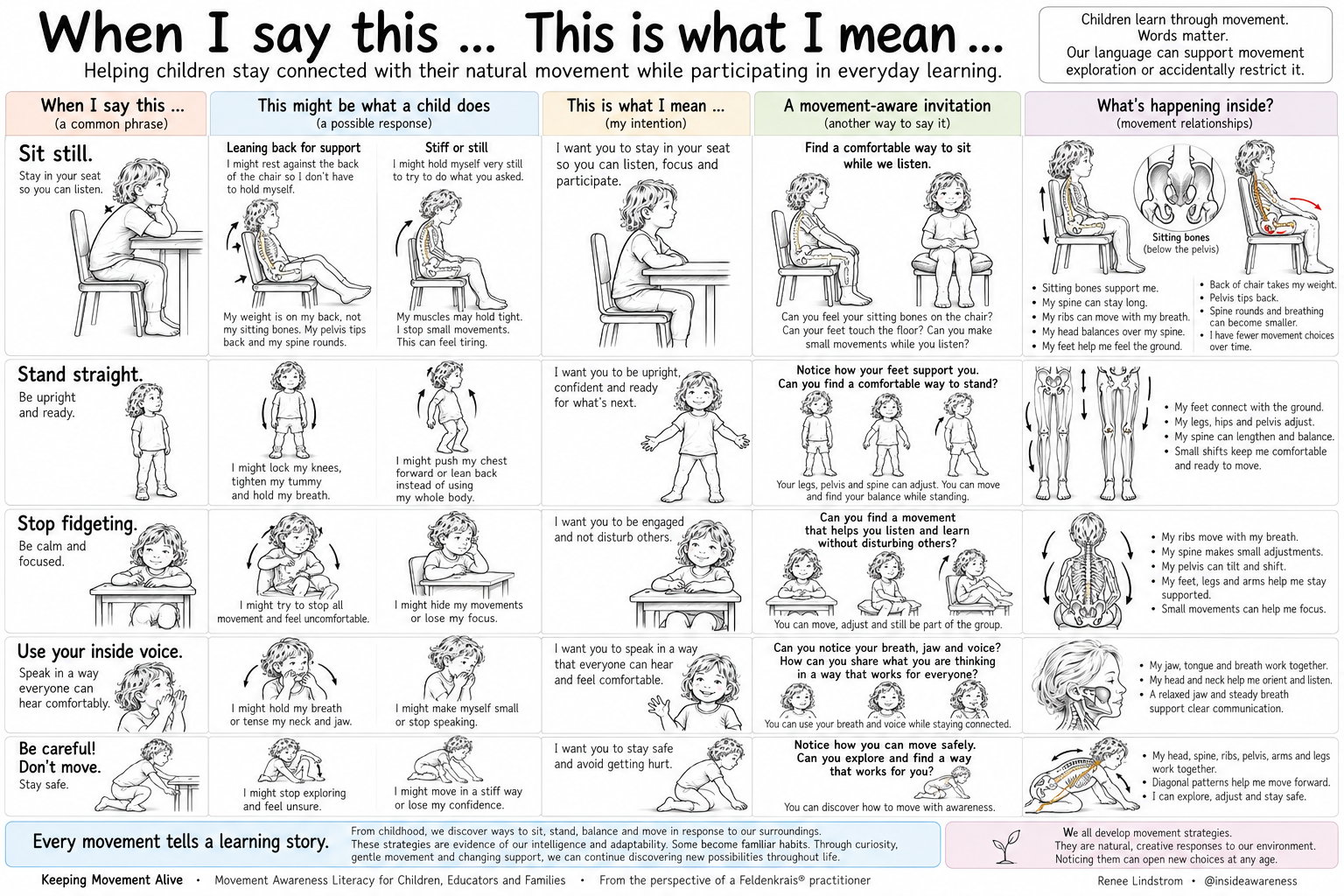
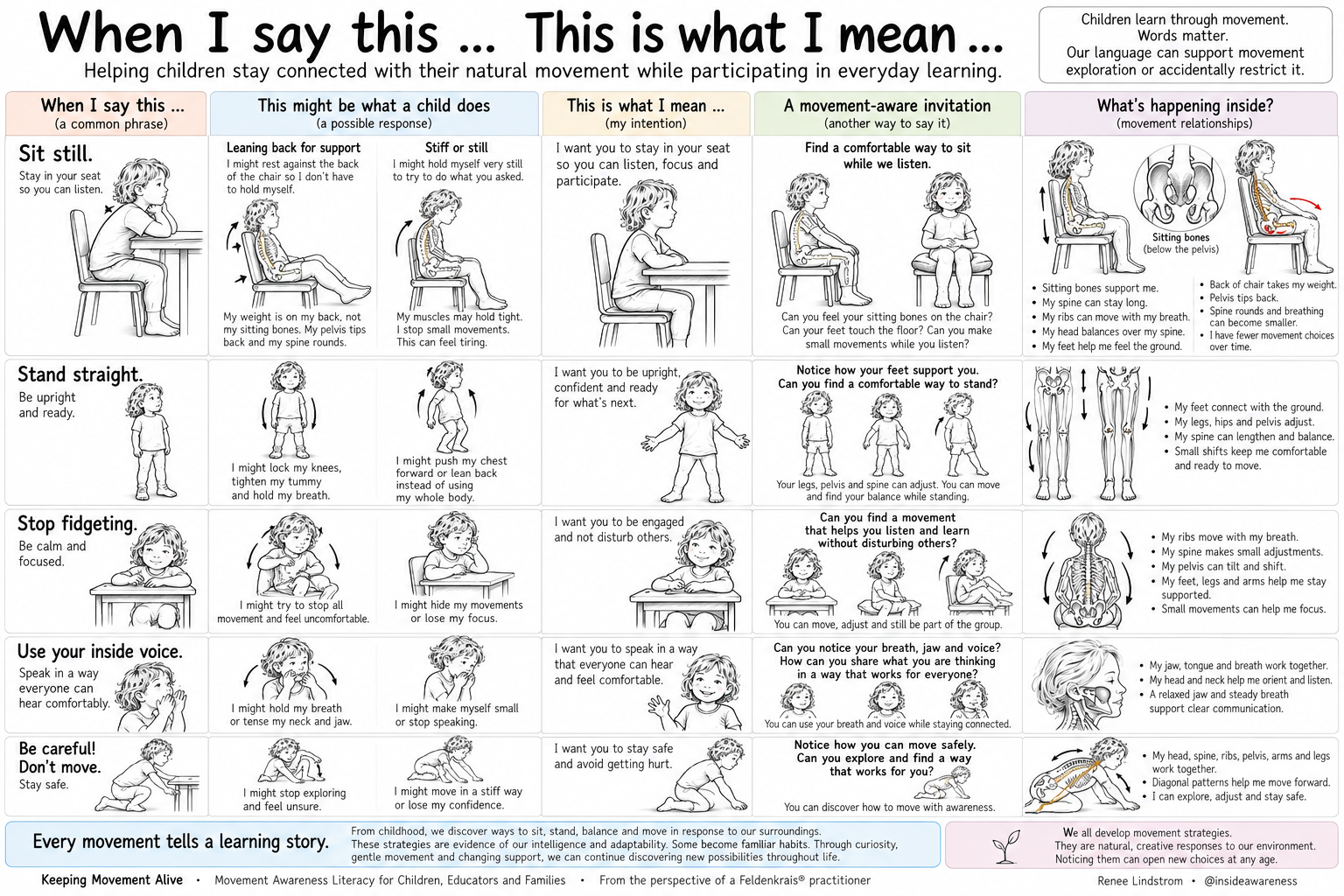
One of my favourites is titled “When I Say This… This Is What I Mean…”
This illustration brings attention to something that has connected so many of my observations over the years: the relationship between the words adults use and the movement strategies children may develop in response.
As children, we hear instructions such as “sit still,” “stand straight,” or “stop fidgeting.” We may not be shown what those words mean in terms of skeletal support or movement. Instead, we draw upon our developing experiences to find ways of responding.
Over time, some of these strategies can become familiar, habitual ways of organizing ourselves.
I have spent many years observing these patterns in adults—not as mistakes, but as expressions of learning and adaptation. My interest is in helping people recognize these relationships and discover that other movement possibilities may still be available.
Yesterday, partway through preparing this article, I paused to offer a small, boutique TMJ Jaw Release workshop to a group of women.
Once again, I encountered familiar patterns of restricted movement and witnessed moments when deeply held muscular effort began to soften, allowing different movement relationships to emerge.
Later in the day, as I reflected on the workshop and the many years of experiences that have contributed to this educational project, I felt an unexpected depth of gratitude.
Gratitude for the choices I have made to follow this inquiry. For the people who have participated in the learning with me. And for the opportunity to slow down, listen, and become familiar with aspects of human movement that can so easily go unrecognized.
Then I remembered. It was Thanksgiving.
Perhaps there could not have been a more fitting moment to recognize what has been growing all these years.
A legacy of conscious recognition, not simply a legacy of information.
I invite you to explore the article and its diagrams, and to share them with parents, educators, childcare providers, or others who may be interested in supporting children’s natural movement learning.
I also welcome conversations about workshops, mentoring, consulting, coaching, collaboration, and other ways of supporting the Legacy Education Project as it continues to develop.
Slideshow of illustrated workshop materials for parents and educators
I invite you to explore the program information and share these materials with parents, early childhood educators, teachers, and others who support children’s development.
The Legacy Education Project — Keeping Movement Alive
In January 2026, we announced our intention to develop a Legacy Education Project. The seeds of this initiative were planted in the autumn of 2025 and given time to rest and take shape through the early winter months. Spring and summer became a period of reflection, exploration, and planning. Now, as the project begins to take form, some of this work is reflected in the illustrated workshop materials for parents and educators shared below.
These materials introduce relationships between the natural movement patterns of early childhood development and the guided movement explorations offered throughout adulthood and aging.
Children develop through movement, sensory experience, and growing awareness, often long before they can articulate what they are learning. As we age, guided opportunities to explore these familiar relationships can help transform awareness into conscious recognition, expanding possibilities for movement, balance, and everyday function.
Our intention is to nurture continuity in this relationship with movement and learning throughout life.
We invite you to explore the program information and share these materials with parents, early childhood educators, teachers, and others who support children’s development.
We also welcome inquiries about bringing this educational perspective into your community through workshops, mentoring, consulting, or individual coaching. If you feel inspired to contribute in other ways—through collaboration, sharing resources, offering feedback, or supporting the project’s development—we would be delighted to hear from you.
A legacy of conscious recognition, not simply a legacy of information.
Renee Lindstrom · @insideawareness
Learn more through the Keeping Movement Alive Program picture descriptions below
Supporting the Continuity of Movement Awareness from Childhood Through Life
A legacy of awareness, not simply a legacy of information. 🌿
“Children are already learning through movement. Our opportunity is to help that awareness remain alive.” The Legacy Education Project is not about introducing children to something they lack. It is about recognizing and nurturing something they already possess. Legacy is reference to the intention to preserve a relationship with movement that children are already developing, so it can remain available as their learning environments change.
An Educational Resource for Parents and Educators created by Renee Lindstrom, a Feldenkrais® practitioner since 2007, whose approach is informed by Nonviolent Communication, Tibetan Buddhist meditation practices, and Buddhist-inspired Feng Shui philosophy emphasizing our relationship with nature.
Learning exploration patterns for integration becomes continuity through living
1. Integration through Movement (guided patterns)
Attention shifts toward felt experience.
The learner explores movement, recognizes differences, and discovers possibilities without needing to arrive at one predetermined response.
2. Integration through Communication and Relationships (recognition and exploring new patterns)
The same quality of attention becomes available in interaction.
The learner listens, notices responses, recognizes habitual interpretations, and explores possibilities without immediately imposing conclusions.
3. Continuity WITHIN LIVED FUNCTION @insideawareness
LegacyLived Function
The pattern of learning is no longer confined to the lesson. It becomes a way of participating in everyday experience.
Continuity of Awareness
Continuity of awareness is the capacity to remain connected to one’s sensory experience, curiosity, and capacity for learning while moving between different activities, relationships, and environments. continuity does not require uninterrupted awareness. Losing connection, recognizing it, and returning to inquiry can also be part of the learning.
The learning quality remains available as the context changes. Shown in the following life relationship experiences:
Environmental Experience
Noticing how stimulus influences sensation and response.
Movement Exploration
Recognizing changing relationships through felt experience.
Communication
Listening to words, responses, meanings, and differences.
Relationships
Maintaining curiosity while participating with another person
Group Learning
Allowing the learning environment itself to remain open to discovery.
Movement Awareness Literacy for Children, Educators and Families
Keeping Movement Alive 🌿
An educational perspective concerned with preserving the child’s natural capacity to learn through movement, while helping adults recognize and support that capacity.
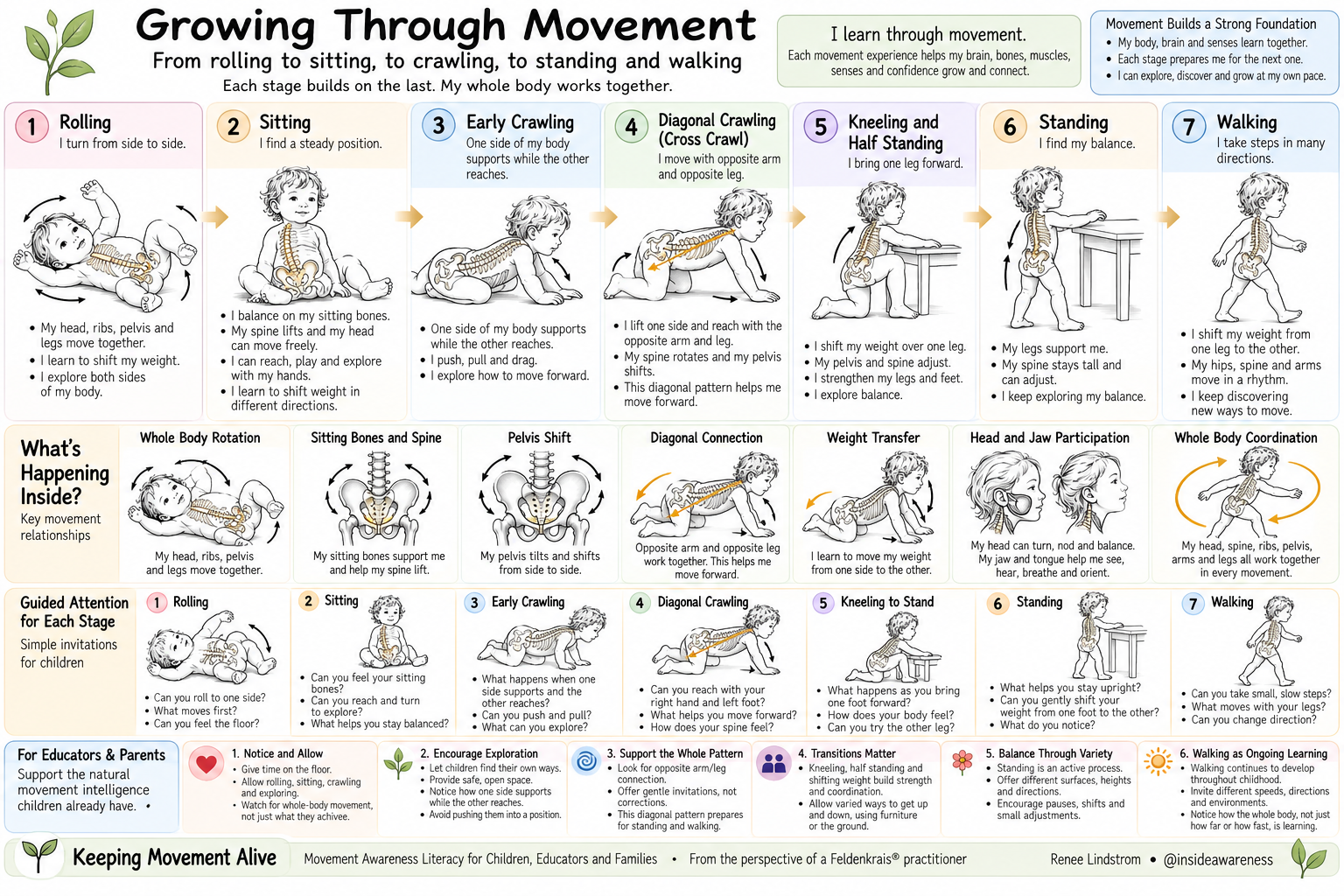
Movement possibilities of self learning are demonstrated in this poster
This illustration brings together the transition from rolling to crawling, diagonal coordination, standing, and walking, with guided attention for children and companion observations for adults.
Keep in mind that children discover mobility in different ways, and the intention is to preserve curiosity rather than introduce another standard of achievement.
For Parents and Educators – From the perspective of Renee Lindstrom, Feldenkrais® practitioner (2007), integrating insights from Nonviolent Communication, Tibetan Buddhist meditation, and nature-centered Feng Shui philosophy. @insideawareness
Listening to the Skeleton
The environment participates in movement learning.
Chairs, desks, instructions, expectations, and daily routines influence the movement strategies children develop. When these strategies are repeated without opportunities for exploration, some may become habitual.
Movement awareness literacy invites children and adults to recognize how the body receives support, changes position, and adapts to its surroundings.
The intention is not to prescribe ideal posture, but to preserve the ability to discover different ways of organizing movement throughout life.
Every movement tells a learning story.
The poster introduces the relationship between the words adults use, the movement strategies children develop in response, and the habits that may emerge through repetition
From childhood, we discover ways to sit, stand, balance, and move in response to our surroundings. Some strategies become familiar habits. Through curiosity, gentle movement, and changing support, we can continue discovering possibilities throughout life. The intention of exploring what we say…. This is what I mean…. is to help adults recognize that the words they use can influence the movement strategies children develop, while offering language that preserves exploration, choice, and sensory awareness.
For Parents and Educators – From the perspective of Renee Lindstrom, Feldenkrais® practitioner (2007), integrating insights from Nonviolent Communication, Tibetan Buddhist meditation, and nature-centered Feng Shui philosophy. @insideawareness
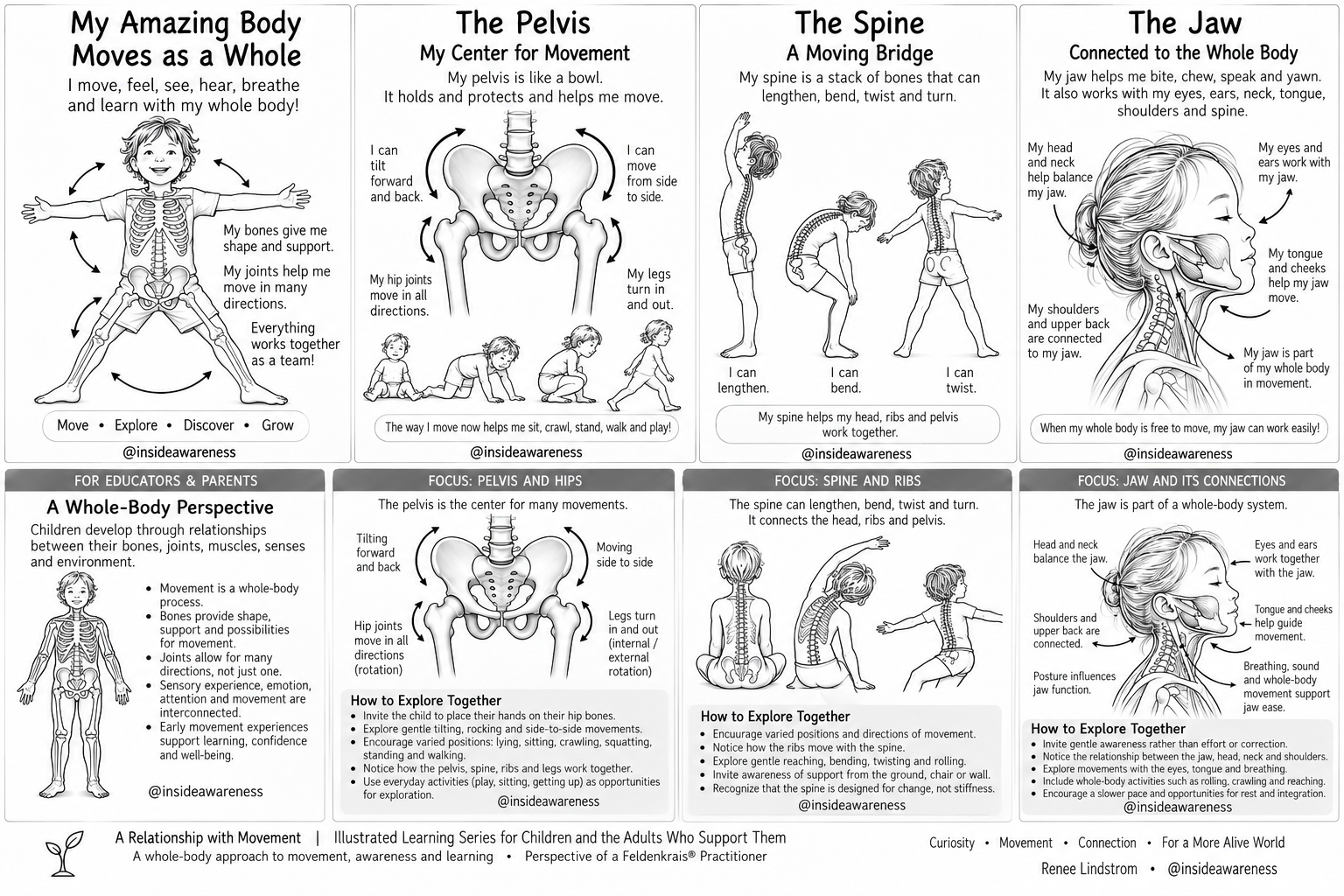
A Relationship with Movement – Illustrated Learning Series for Children and the Adults Who Support Them
A whole body approach to movement, awareness and learning
For Parents and Educators – From the perspective of Renee Lindstrom, Feldenkrais® practitioner (2007), integrating insights from Nonviolent Communication, Tibetan Buddhist meditation, and nature-centrred Feng Shui philosophy. @insideawareness
“We Learn to Move Through Experience — and We Can Keep Discovering New Ways.”
”Movement Awareness Supports Learning at Every Stage of Life
Legacy Learning is a beautiful thread through the lived experiences of all ages. The connection between intention, skeletal support, and finding a new direction is woven through the series.
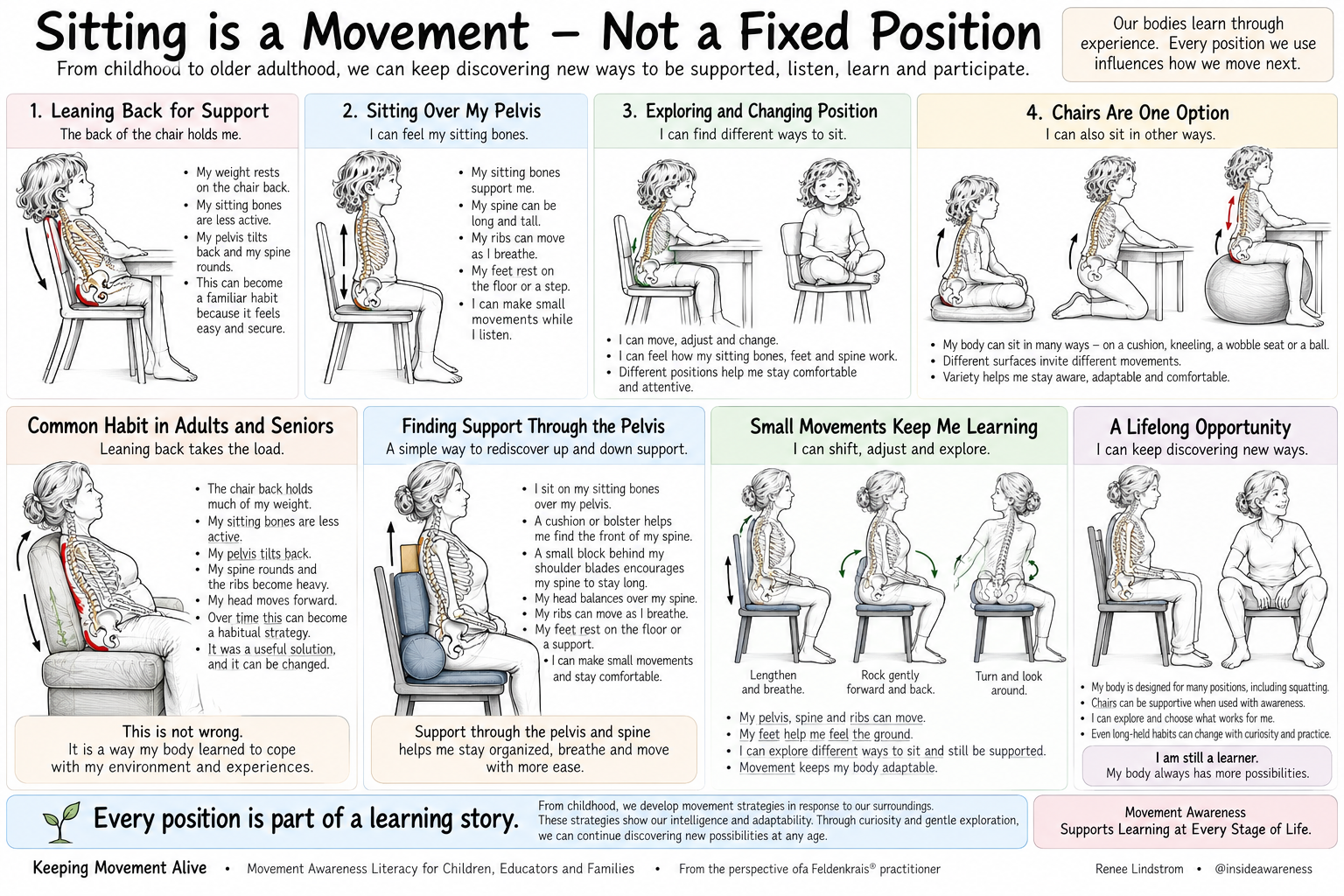
The relationship between furniture, adult expectations, and how a child learns to organize skeletal support. An eample:
The chair is not simply an object in the learning environment. It becomes part of the child’s movement experience.
What happens when one way of sitting becomes the dominant, unquestioned habit, particularly when a child is repeatedly asked to remain still. A child may learn to associate sitting with fixing the body in position, rather than discovering the many ways the skeleton can organize support.
The difference between sitting and being supported
When a child leans against the back of a chair, some of their trunk weight is transferred through the backrest rather than being managed entirely through the pelvis, sitting bones, feet, and active postural adjustments.
That is not inherently harmful. Backrests can provide useful support, and resting against one is a normal sitting option.
What happens when one way of sitting becomes the dominant, unquestioned habit, particularly when a child is repeatedly asked to remain still.
A child may learn to associate sitting with fixing the body in position, rather than discovering the many ways the skeleton can organize support.
The distinction is not between correct and incorrect sitting. It is between having movement choices and relying on one habitual organization without recognizing alternatives.
Every movement tells a learning story.
From childhood, we discover ways to sit, stand, balance, and move in response to our surroundings. Some strategies become familiar habits. Through curiosity, gentle movement, and changing support, we can continue discovering possibilities throughout life.
A habitual movement strategy in aging adults is evidence of earlier learning, not a failure to learn. What was useful or familiar in one circumstance may be worth exploring again as circumstances change. For example:
As one ages there may be a need to experience a different relationship between the shoulder girdle, spine, and pelvis that is relevant for support to discover something that may no longer recognize easily. The intention is not simply to sit straighter. It is to explore how one’s trunk can be organized over the pelvis, how support can pass through the sitting bones, and how small movements remain available.
For Parents and Educators – From the perspective of Renee Lindstrom, Feldenkrais® practitioner (2007), integrating insights from Nonviolent Communication, Tibetan Buddhist meditation, and nature-centred Feng Shui philosophy. @insideawareness
From Awareness to Recognition
Awareness invites us to notice how we are supported. Recognition grows as we explore these relationships through movement, discovering new possibilities for balance, choice, and everyday function.
“When we notice how we are supported, movement becomes an opportunity for discovery. Through exploration, awareness grows into recognition, opening possibilities for balance and everyday movement.”
Awareness: I notice where my weight rests.
Exploration: I discover how my pelvis, legs, and feet participate as I shift.
Recognition: I begin to understand and feel how these relationships support my movement, and recognize that I have choices.
Expanding capacity: I can explore and use these possibilities in standing, turning, and walking.
For Parents and Educators – From the perspective of Renee Lindstrom, Feldenkrais® practitioner (2007), integrating insights from Nonviolent Communication, Tibetan Buddhist meditation, and nature-centered Feng Shui philosophy. @insideawareness
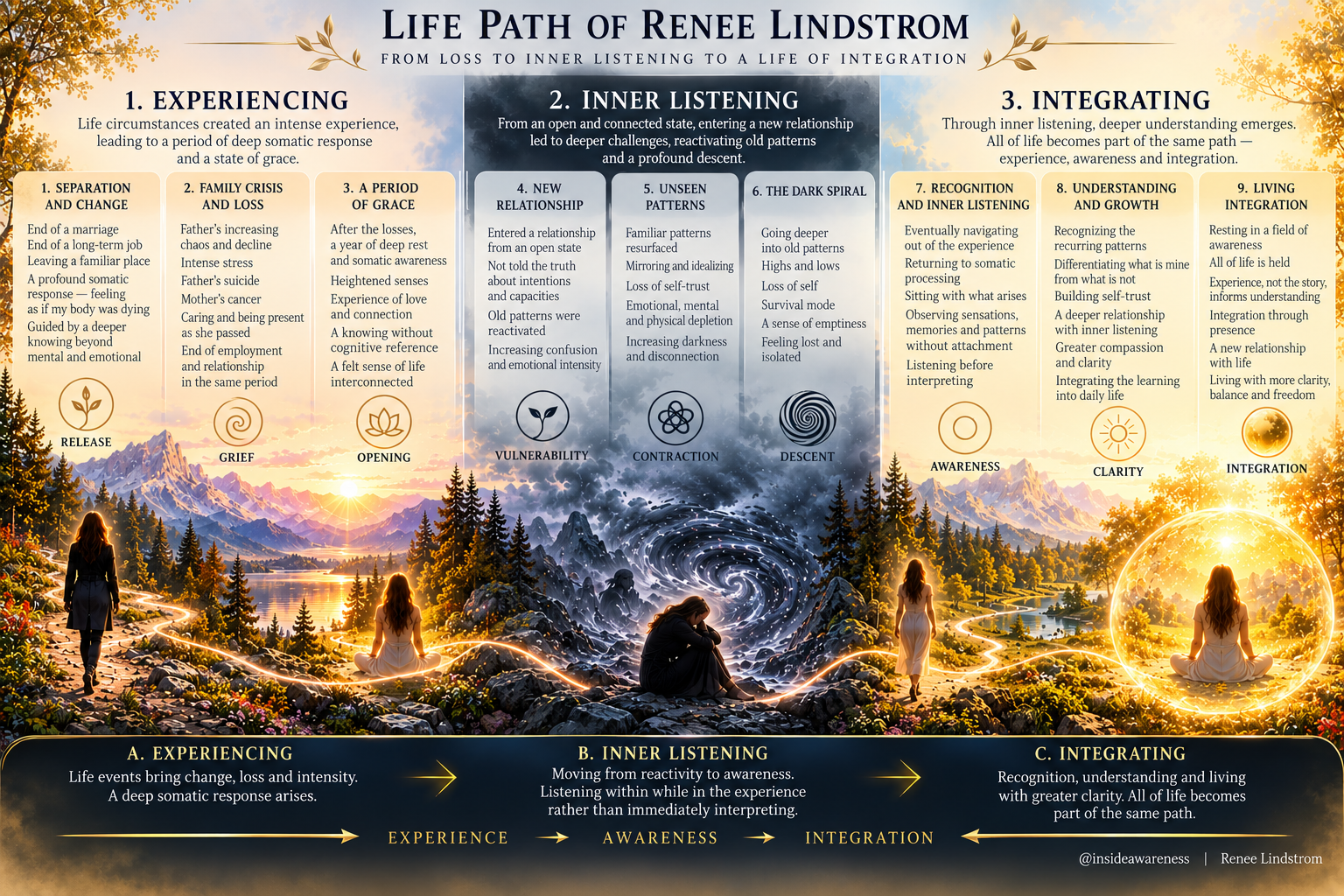
A pattern of inner listening to the experience has emerged through my own life path that has shaped the awareness integration sessions and classes for a number of years. The organic connections that emerged have been put into guided patterns that will be available through boutique group learning in early 2027.
Each human has a path forward that could be called their life path.
This path is influenced by experiences and choices. In turn, what has already been experienced and chosen influences how the present is encountered and how future possibilities are approached.
Much of a life path is walked without full awareness of where it is leading. Circumstances arise, we respond to them, and choices are made within them. Those choices become part of what shapes the next steps along the pathway.
Yet many of the influences shaping the path remain elusive. The walker’s attention is naturally drawn toward navigating what is immediately happening. Attention may become occupied with deciding what is right or wrong, solving problems, assigning blame, avoiding shame, or relying upon familiar strategies that have worked—or seemed to work—in the past.
Over time, these learned responses can become habitual ways of walking the path. New experiences may then be approached through patterns established by earlier ones. Attention can become absorbed in resolving the difficulties that arise, while the patterns influencing those difficulties remain largely unnoticed.
In this way, the patterns of one’s lifestyle become a core influence on the lived experience of the life path. They can be quiet, elusive, and outside conscious attention. What has become familiar may simply feel like the way life is.
What if the life path itself could become a place for cultivating awareness?
What if simple guided patterns could be integrated into ordinary life experiences—not to prescribe the path or determine where it should lead, but to make visible what has previously been elusive?
As patterns become recognizable, there is an opportunity to pause, sense what is present, and notice how an experience is being interpreted. What was once habitual can become available for inquiry.
Awareness creates the possibility for greater clarity.
And with greater clarity, choices along the life path can become more conscious.
The intention is not to interpret another person’s life path for them.
It is to cultivate the awareness through which they can begin to interpret their own.
Read initiation to Life Path in Octobers Newsletter
With respect and gratitude, this work acknowledges the ground provided by the teachings and practices of Moshe Feldenkrais, Marshall Rosenberg, Chögyam Trungpa Rinpoche, and Dyan Grant Francis. Their contributions are honoured as part of the learning from which Inside Awareness continues to grow.
by Renee Lindstrom, founder Inside Awareness Center for Integrative Somatic Learning
Embodied Mindfulness approach to personal change
Here is a life style map diagram of the the focus of attention in the learning topics at Inside Awareness. The intention of lifestyle learning patterns are for Human Flourishing.
Human Flourishing
Flourishing is a state of living optimally, in deep fulfillment and ongoing personal growth, beyond basic survival or simple happiness. Flourishing encompasses a sense of purpose, rich relationships, physical health, and resilience to adapt to challenges
The body reveals.
The mind interprets.
Awareness connects the two.
Recent Lifestyle Articles:
Goals: 2027 Manifesting through intention first before solutions
3. Article on Relationships: The fractals creating the words expressed from the speaker you are listening to suggests need to take caution before going into agreement with their perspective …
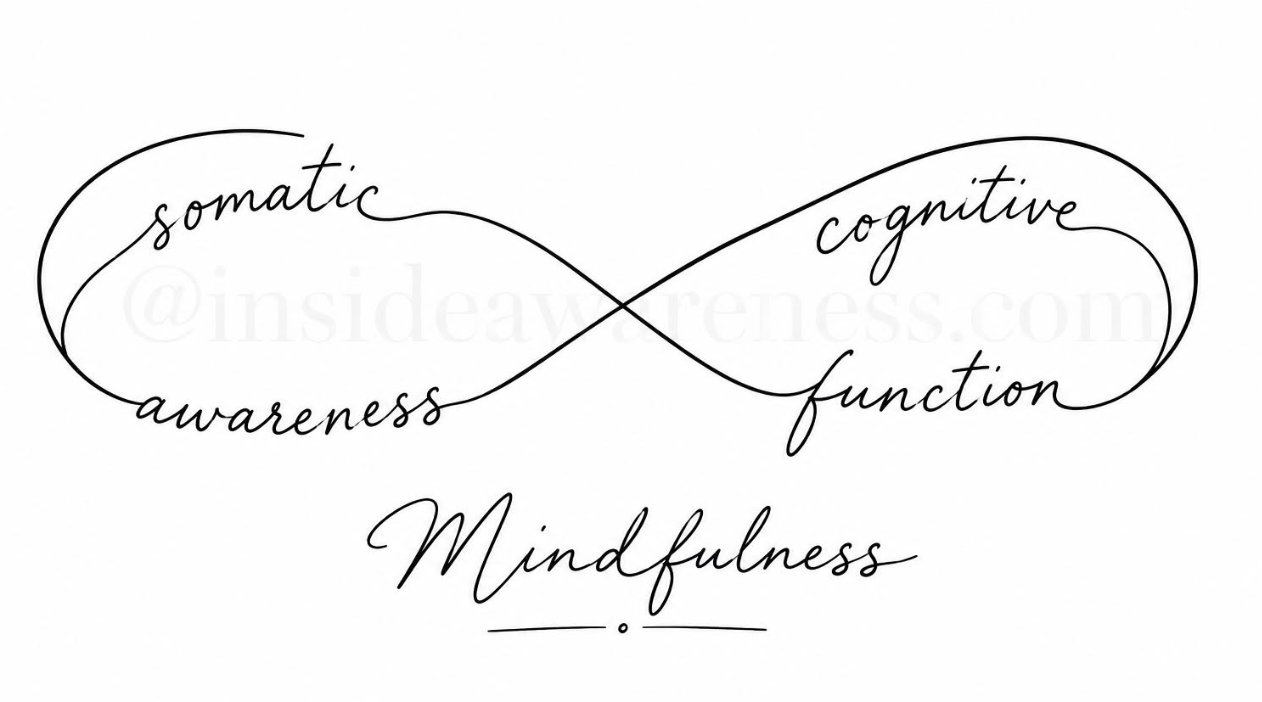
Minimalist line art emphasizing embodiment before strategy
Embodied somatic action harmonizes with cognitive focused strategies and increases conscious connection to motivation. It leads to clarity of motivation before action. This pattern increases the potential for successful outcomes in all life areas, and reduces inner and outer conflicted states. Leading with strategies indoctrinates self and others and reduces innovation, motivation and spontaneous outcomes. Embodiment cultivates awareness and increases possibilities for higher outcomes and experiences.
Cognitive StrategiesVs Somatic Awareness
Strategies are cognitive based upon beliefs, while somatic processing is a learning path of awareness. A cognitive based belief system can stunt a person’s perspective by its nature as it has a focus of attention in one or two life areas only. For example, if a person is only focused on wealth and its attainment, every action will be strategic to meet that need. Generally, there will be a lack of mindfulness through the experience. The experience will lack the balance and harmony that is born from lived mindful awareness. Without this mindfulness there can be perpetual states of conflict, inside and out. Conflicted states fanned by the flames of seeking ways to increase wealth. This can influence every aspect of living as this conflict is expressed through emotional behaviour, expression and physical action. It can extend to every relationship that begins with critiquing through the lens of how to use others to their advantage in growing greediness. Strategy focused actions usually led to winners and losers. Strategies born from beliefs lack conscious awareness of the intent in the present moment. Beliefs are the past, yet they control the present, the future. This pattern can lead to extreme actions and statements for justification, with the last attempt feeding the next.
The process of mindfully connecting to one’s inner motivation before strategies increases conscious awareness. This process is more likely to grow beyond a single minded focus such as in this example, to become wealthy. The isolation that comes with self perceived status can expand into a state of thriving, instead of striving, through the increased range of information that comes with inclusion. Achievement will not be at the cost of people, places and things and instead include consideration for them. Those who are strategy first decision makers are not eliminating somatic experiences, they simply have no control over it. Their focus on power and control is strategic and is without the abilities of self regulation. How can one self regulate an experience they are cognitively ignoring? Being led by uncontrollable somatic experiences can lead to conflict and harm, of self and to others. They may lack the discernment for recognizing they are living in a cycle of going from one catastrophic experience to the next. Often overlapping.
Embodiment before strategy is a learning pattern integrated into the program topics at Inside Awareness. Learn more about the lifestyle program topics.