Tag Archives: leadership

VIRTUAL – LONGING TO BE A BETTER VERSION OF YOURSELF IN RELATIONSHIPS

Sundays, January 13 – March 17,  2013 ~ 10:30 am to noon

Join Renee for a 10 Week Virtual Series designed as a  personal challenge for exploring how to become a better version of yourself in relationships.  Move beyond the pain and loneliness of disconnection.  Enjoy extraordinary connections and learn skills to stop experiencing guilt, resentment, obligation or trying to prove yourself.

COURSE OUTLINE:

Part one ~ Getting Started:
  • Welcome and Introductions
  • Relationships  – Types of Connecting
  • Types of Perception (Past, Present, Future)
  • Feelings and Emotional  Literacy
  • Taking responsibility for feelings
  • Culture of Needs

Part two

  • Enriching life and your relationships
  • Expressing honestly
  • Listening with Empathy
  • Self – Empathy
  • Empathy for Others

Part three

  • Empathy, Relationships and Behaviour
  • Staying connected in Conflict
  • Putting it together
  • Moving forward
  • Appreciation & Celebration
Includes course outline and reminders emailed in advance of course dates, practice suggestions for  in between classes and an on-line forum for discussion among participants and putting in questions for upcoming week.

10 Week Series – $200.00

REGISTRATION HERE 

________________________________________________________

http://www.insideawareness.com

The value of choice is one of human’s greatest needs

Life Area:  Autonomy

It is this need that could be the source of all moralistic judgments and passive and aggressive violence.  If there is no choice, the options are to fight or give in.  Imagine a moment what feelings arise for you when you consider not having a choice.  Do you sense a fight, flight or fright moment? Learning self-empathy steps and those for empathetic listening of others will shift those in the conversation into an experience of choice.

Practice your empathy skills this week. 

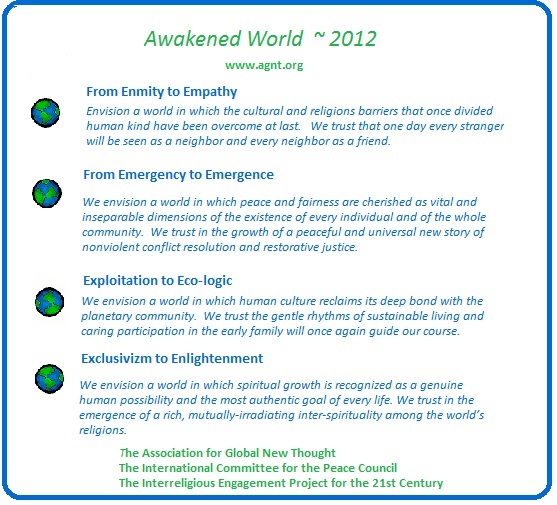
Visions worthy of our attention for shifting focus towards Global Unity

Click to enlarge

Poster supporting Global Visions created by Renee Lindstrom to feature and bring awareness to creating global change that begins with personal awareness.

Follow Renee on Facebook  & on Twitter

Embodiment of Abundance ~ Awareness in Thinking

Definition of Abundance: an extremely  plentiful over-sufficient quantity or supply, overflowing fullness, affluence; wealth.  Abundance is the noun of Abundant.

Embodiment of Abundance Consciousness:

  • Life is abundant
  • There is more than enough to go around.
  • I can have what I need and so can others.

Behavior of Abundance Consciousness:

  • Mutuality
  • Equal balance of giving and receiving,
  • Exclusivity of all regardless of age, rage, rank, male or female

How do you embody the qualities of Abundance?

Motivation:  Begin by considering your longing to live in a state of  abundance consciousness.  Connect to your original motivator to choose a shift towards abundant thinking.  What was the attraction?

Success:  If you have thought that by setting an intention for abundance with expectations of receiving it,  reflect on the success you have had of drawing abundance into your life and keeping it.

Integration:  Now consider how you have integrated the qualities of abundance into your experiences and relationships.  Has it been through ritual of writing out affirmations, gatherings for creating abundance visions or simply making statements to self and others.

We are hearing that we are what we think we are.  Simply replacing the story isn’t as easy as we would like it to be.  Thinking we are now going to be living a life of abundance doesn’t replace our earlier thoughts that we have learned since childhood, it simply adds more story.  It is the stories we have learned since childhood that we are habitually acting from.

The self reflection then becomes,  are you connecting and creating the same beauty in your relationships as what motivated you to set an intention to live as though life was abundant.  How are you and others  around you enjoying this world?

Some tips for checking in follow:

  • Thinking ~ Do your mind thoughts and their sentence structure  reflect abundance consciousness?
  • Behavior ~ Do you speak in sentences of abundance consciousness?
  • Action Beyond Self Image ~ Do you understand the relationship between thinking abundance and behaving abundance? (Behaving abundance in this sense it not    empathy of prayer, mediation and gathering together for a cause, it is about those praying, gathering and mediating and their ability to spontaneously  identify and shift their personal  judgement, blaming and demands in the moment while in every day one on one interactions.)

If you are interested in how to become more articulate in creating a shift of consciousness into an abundant one that starts with how to speak it to create the brain shift Renee offers personal coaching, private and organized group lessons.  Imagine if your partner, peers, employers/ees spoke from a place of abundance mentality.  Once of the greatest values that would be demonstrated would be respect for others and self!

Post by Renee Lindstrom, for Inside Awareness for Healthy Living October 30th, 2012

Follow Renee on Facebook  & on Twitter

‘Positions within relationships and the field you create ‘

I introduced a concept at yesterdays *workshop to bring awareness to the positions each of us hold in our  relationships.  Have you taken time to consider the unique individual  position you and yours have  and how these positions are separate and overlap to those around you?  After introducing this I led the participants through some awareness exercises to directly experience being in the center of their universe while in their conversations.  These exercises follow a  pattern  for both the speaker and listener to experience  and stay in the center of their universe.

In these dialogue exercises a field was created that was their direct experience and  felt by those around them.   Think about the following Rumi’s quote and consider,  if you are still in judgement thinking  of right and wrong what the field is that you are creating in your relationships.  What is your direct experience and that of others as they connect with you or share in the field around you?

 “Out beyond right doing and wrong doing there is a field, I will meet you there. ” 

*These workshops are designed with the intention  to  share how to turn disconnection into connection and to bring personal  awareness to how  ones personal communication habits impacts direct experiences.  For more information on how to take part go to link.

For a healthy society ~ Whats the missing link to a healthy society within an organization?

Society recognizes that the employers needs are different than those working for them.  Society also recognizes that patterns (structures or models) are valuable for progress within an operation.  Is society recognizing that the differences between employers, administrators and employees are equally as valuable?  If so, is there recognition of these differences?  Are employees hearing their needs identified and valued?   This does not mean an employer or administrator needs to give up their needs!  It simply is a basis for connection with the  most valuable asset to your operation, your employees.  Identifying their needs tells them  that they are being seen and heard therefore valued.  It does not mean an outcome.

Awareness Education against Bullying: My Perspective

I wanted to share my perspective on bullying with you.  I believe change can happen if we culturally begin to shift our long-term focus from first aid solutions for justice and begin to look at the root causes of bullying together with a  commitment to educate the parents and educators in our children’s lives.  
 
Our children learn through a process of observing what those around them are doing and mimic it.  We call this modelling.  Parents and educators do not teach a child how to roll over, sit up and come to stand as they develop movement which tells us that we (wo/man) have the ability to learn through experience and observation.  Speaking even begins with hearing those around them and babies first words are the most important ones to them like mommy or daddy.  Therefore the relationships they see around them are their sources for taking in information and learning.
 
As a parent myself and now sharing programs for educators and parents, what I know to be a commonly shared experience is in this statement, “We are not trained to be parents.”  I would like to add we are not trained in the art of honest expression and skills of listening.  Therefore it is my opinion that we aren’t developing healthy, understanding relationships.
 
Imagine for a moment a child who has met their own need for play together with a rushed parent who wants them to do something different from what they are doing, like go to bed.  How does the parent phrase it and how does the child receive the information from their parent?  Would the child hear what they are doing valued in any way?  This step is usually overlooked by busy parents, yet imagine what’s going on for the child who’s needs are not being recognized as being separate from the parents and who isn’t able to express it yet.  
 

As parents we may think children are demonstrating poor behavior when they are simply trying to  demonstrate and express their needs. Parents and educators have power over children in our current culture.  Power over simply means hierarchical.  Think about our organizations, business and western world in general ~ hierarchical models.

We are teaching our children dominance through existing structures without including the development of skills for understanding their own behavioral process.  Our culture lacks the speaking literacy for a developing child to understand and connect to what is being said in the way that they perceive information.  We receive information through our senses of feeling, seeing, touching, tasting and hearing sounds. Now imagine hearing the use of  feel in a sentence that does not accurately describe any feeling at all or misuses words to describe feelings.  Some simple examples:

  • I feel we need groceries.     (Replace, I think instead of I feel)
  • I feel you should go and play.   (Replace, I think instead of I feel)
  • I feel your brother needs to have a sleep.   (Replace, I think instead of I feel)
  • I am feeling unheard when you ignore me.  (unheard is not a feeling, replace with sad) 
  • I feel safe when you don’t run ahead.  (Safe is not a feeling, replace with calm) 
These are common sentences in our relationships.  Now imagine two or more people trying to have a conversation and not being able to connect.  First without true use of feeling words there are no words that creates an empathetic understanding (true sensory awareness words that the other person can connect to with ease).  Second, if there is not a common point of understanding such as a value that they can perceive without judgement, there will be confusion or they will take it personally resulting in a reaction.  For example: 
 
  • Bullying is bad. (Replace with ~ I believe if we are not sharing our common needs for kindness, consideration and acceptance that our relationships will be violent.  
  •  You’re a bully. ( Replace with ~ When I see you post pictures of bleach to Amanda’s RIP facebook pages,  I feel rage and disbelief as I have a need for kindness and consideration for Amanda’s family and friends.  
  • We have a rule of no bullying.  ~ We have a common need’s in our relationships for dialogue, listening, cooperation, consideration, understanding and have agreements for trying to meet these needs.
It is my perspective that by shifting our focus towards daily conversations that have individuals taking more personal responsibility for understanding their own reactive state it will shift the focus from taking it out on others in unconscious and habitual behaviors.  For adults, it more difficult to learn after years of learning how to run away and protect themselves.  For children, it’s easy.  It will take the adults learning it and practicing it in order for children to change.

Therefore it is adults committing to learning what it is they want their children to learn first:

  • How to express what is alive in them truthfully.
  • To become aware that their child is meeting their own needs and that those needs are different from the adults and to shift into valuing those needs mutually, simply by acknowledging them.  (Children do not want to be invisible and think about it: ~ adults discuss their process with their partner/friends, etc. who do children have to process it with ~ no one!  Therefore imagine what is going on inside the child – isolation, feelings of being alone, not seen, not heard, not valued, not cared about)
  • Value based communication and leadership
  • Feelings literacy
  • Needs/values literacy
  • Listening Skills (listening without trying to fix it, without interruption and how to reflect back that the child sees that regardless, they are beautiful)
  • Making concrete requests that have specifics that are doable – not vague.
Rather than talk about it, I hoped to give you some experience of what I believe is important for our culture of learning how to create kids that are mediators in the moment conflict first arises.  Imagine a child being able to understand what is going inside themselves while at the same time understanding what is going on for the other person who’s behavior is violent.  As soon as they have basic skills they will be able to identify that it is not about them at all and about what is going on in the person being violent.  This is the shift we want.  From there they will have choices in how they respond meeting their own needs and not that of the person being violent.  It will affect the balance of the victim/bully and the bully will have no power over them.  
Renee has been developing programs in Education for consideration by value based leadership organizations that are now being presented.  For a peek at this development go to link @   http://supportingnonviolentcultureineducation.wordpress.com/
Let’s keep the conversation going!