Tag Archives: Culture

How do you learn? Where do your emotions and thoughts come from?

#1.  You are borne into an environment

This is how a culture is formed!  

#2.  You have the INHERENT ability to learn INDEPENDENTLY stimulated and shaped by your environment

summer-620x349

First learning is inspired through movement! 

If your environment is safe, open and free your thoughts, emotions, movements and  behavior will reflect these qualities.  You will likely be more flexible in your actions.  However if your environment is a prison filled with hate and poverty your thoughts and behavior will reflect these qualities!  You will likely be more conservative and restricted in your actions.

The good news is you never stop learning!  You have the ability to change your own conditions through awareness techniques and skill building that will create the environment for your own future generations!  Change the future by shifting the past, now in conscious presence.

Make a difference.  It begins with you!  

Why?  836996

To go beyond the imposed constraints and false emotional realities,  

To support a healthier culture that cares for themselves, others and the planet equally.  

To live as though values matter, 

By speaking your values creating autonomy

and valuing others values equally creating interdependence!  

To use gravity effectively to attain balance, consider your bones as the structure of support in the design of your body, and values as the structure of support in your relationships.

Read more on Feldenkrais® Method 


Communication Workshops  – Deeper Integration Opportunities 

Movement Workshops

Lifescape Workshops

Coaching/Mentoring 


SUBSCRIBE TO INTOUCH LIFE TIPS 

Find Renee of Inside Awaerness on twitter,linkedin,facebook,pinterest, & instagram 

Renee Lindstrom, GCFP,
Feldenkrais® Practitioner since 2007, Value-Based Communication & Empathy Coach since 2004, Art of Placement  since 2000, Founder of Greater Victoria Peace & Intercultural Celebrations since 2010 & Greater Victoria Labyrinths since 2012, #yyj Peace Week Calendar Founder – 2014 & 2015

Cultural Comparisons poses a question: If we….would it be harder for hierarchical agencies to entrap or beguile us in their insidious planning?

A comparison of cultures came up in a recent group discussion. A member was integrating a system of thinking/talking that could begin to create equality for understanding differences and they compared their culture to ours and identified theirs as being  harder to work with (in this way of making changes).  

This member described the  hierarchical nature of their culture and I recognized that my (Western Canadian) culture does not wear its dominant nature on its sleeve.    I realized that some cultures have a strong hierarchical ancestral self-image that can be witnessed, identified and easily understood.  My culture on the other hand does not outwardly discuss this, nor do we usually have ancestors living in close proximity.

Generally speaking,  our family culture may only focus on the current generation, unlike some cultures that go back generations.  Never the less  our parents and older siblings hold a similar dominant power-over position.  It may be too close an experience with our first family and not identified as in these other cultures where the parents are still experiencing the same behavior as their children!  Therefore it is a shared and discussed more openly with a  developed intellectual understanding and acceptance.  For us,  it is not as easy to understand intellectually in the moment as we lack the shared experience with our parents therefore we do not have anyone to empathize with us. 

I believe that in my Western Canadian Culture it is not unlike a description of Gandhi’s to his grandson on acts of violence.  Gandhi explained that physical violence could be seen and witnessed, therefore addressed.  It was the hidden forms of violence that are insidious acts and harder to define and understand.

Are we as Canadians ready to openly observe and discuss our natures and be identified with more ease?  I am curious, that if we did open up and readily talk about these patterns without the blame, shame and embarrassment (feeling experiences that I don’t see in these other cultures),  if it would make it any harder for hierarchical agencies to entrap or beguile us in their insidious planning.

I love what I do!  Exploring with curiosity is an open door to learning beyond what I think I know!

Love & our Brian

“Eighty percent of life’s satisfaction comes from meaningful relationships.”  Brian Tracy

Check out my recommended video – on Love & our Brain!

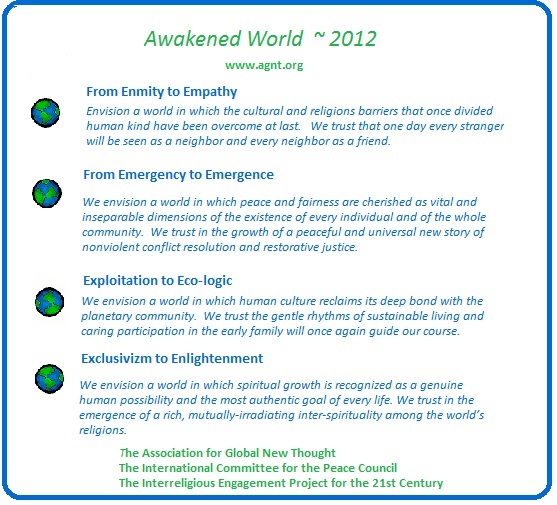
Visions worthy of our attention for shifting focus towards Global Unity

Click to enlarge

Poster supporting Global Visions created by Renee Lindstrom to feature and bring awareness to creating global change that begins with personal awareness.

Follow Renee on Facebook  & on Twitter

Understanding Ego mind through getting in touch with your own thinking and speaking

Our last workshop in a series of six and the individual workshops have  evolved into a deeper focus of  practice and understanding empathy.  The areas that came up for exploring included self-empathy, empathy in relationships and group empathy.  The purpose was to support group members to recognize their own  stories inside their mind that did not allow them to be present with what was actually happening in their relationship.  How we have done this it by developing skills for learning to recognize and identify their thoughts and behavior as a result of their thinking.

The last exercise involved having a volunteer demonstrate a process while sharing a personal life event and transforming what they had been telling themselves about it into a connection that included the rest of body functions,  outside of the frontal lobe of their brain!

At the beginning of the practice this participant shared their resistance at  connecting to another person in their life.  In the process ego dropped away as the mind stories became silent and what was real began to emerge.  As the stories of their mind became less interesting , what was real was their new self-connection to what was being experienced in the moment.  When the participant connected to what was real in them they expressed how they had a growing awareness of  what was going on for the other person that went beyond their original resistance.

You couldn’t ask for more!  The beauty that was visible in the participant and those in the group supporting this persons process was tangible through relaxed faces and the feelings of a group connection.    Through the practice other  participants began to recognizing their own stories and habits in experiencing how  they supported the process.  Did they become present to what they were hearing or did it stimulate their own stories or need to fix it by coming up with solutions.  If so, all these participants witnessed how this breaks the emphatic connection and experienced the effects of  disconnection of it becoming about them and their ego mind and no longer the person going through the exercise.

Beautiful! The participants having a practice of learning a language of connection demonstrated the ability to go beyond the disruption and carry the process back to the original speaker while holding empathy for the interrupter’s!

This brings up the question – Is empathy the absence (quieting) of ego?

For more information on these workshops with Renee Lindstrom go to relationships link

For a healthy society ~ on Bullying for teaching the teachers

Which came first the chicken or the egg?  Really? Does it matter?  Who cares about identifying who should be responsible for teaching children about bullying and the outcomes when each one of us is a bully!  Yes, you have read this correctly.  If  we cannot identify our own needs and give ourselves empathy, what happens when talking to another person?  Can you then hear and identify their needs and  respond back to them in a way to connect to what is important to them?  If not, in fact it is bullying them!  Why, well think about it, if you hear someone and begin trying to fix it based upon your opinions, do you think they feel witnessed and valued or do they feel invisible and lonely?  If you start to hear them, identify with their story and jump in to tell yours to let them know you know exactly how they feel, do you think they feel seen or heard or has the conversation become about you?   Therefore, if it is about you and what you know and your experience,  you cannot identify their needs and acknowledge them as having any value.  Why?, they do not have the same needs as you in that moment.  Frankly,  it is not about you when you are listening to someone else which brings up the question of, “How do you think they are going to respond?”

I would like to generalize and say that I believe we all do this  and it is these little incidents that we are not aware of that become big issues for others who then take it out on others that grows and grows.   Therefore in my opinion it is a societal issue and one that needs societal solutions that begin with acknowledgement and training.   Unlearning through learning new skills that begin with individuals in ALL communities, networks and families.  It’s not a parental issue in my opinion as parents need the support of educators.  Educators needs the support of administrators and administrators need the support of government and government need support of who? YOU!

Awareness Education against Bullying: My Perspective

I wanted to share my perspective on bullying with you.  I believe change can happen if we culturally begin to shift our long-term focus from first aid solutions for justice and begin to look at the root causes of bullying together with a  commitment to educate the parents and educators in our children’s lives.  
 
Our children learn through a process of observing what those around them are doing and mimic it.  We call this modelling.  Parents and educators do not teach a child how to roll over, sit up and come to stand as they develop movement which tells us that we (wo/man) have the ability to learn through experience and observation.  Speaking even begins with hearing those around them and babies first words are the most important ones to them like mommy or daddy.  Therefore the relationships they see around them are their sources for taking in information and learning.
 
As a parent myself and now sharing programs for educators and parents, what I know to be a commonly shared experience is in this statement, “We are not trained to be parents.”  I would like to add we are not trained in the art of honest expression and skills of listening.  Therefore it is my opinion that we aren’t developing healthy, understanding relationships.
 
Imagine for a moment a child who has met their own need for play together with a rushed parent who wants them to do something different from what they are doing, like go to bed.  How does the parent phrase it and how does the child receive the information from their parent?  Would the child hear what they are doing valued in any way?  This step is usually overlooked by busy parents, yet imagine what’s going on for the child who’s needs are not being recognized as being separate from the parents and who isn’t able to express it yet.  
 

As parents we may think children are demonstrating poor behavior when they are simply trying to  demonstrate and express their needs. Parents and educators have power over children in our current culture.  Power over simply means hierarchical.  Think about our organizations, business and western world in general ~ hierarchical models.

We are teaching our children dominance through existing structures without including the development of skills for understanding their own behavioral process.  Our culture lacks the speaking literacy for a developing child to understand and connect to what is being said in the way that they perceive information.  We receive information through our senses of feeling, seeing, touching, tasting and hearing sounds. Now imagine hearing the use of  feel in a sentence that does not accurately describe any feeling at all or misuses words to describe feelings.  Some simple examples:

  • I feel we need groceries.     (Replace, I think instead of I feel)
  • I feel you should go and play.   (Replace, I think instead of I feel)
  • I feel your brother needs to have a sleep.   (Replace, I think instead of I feel)
  • I am feeling unheard when you ignore me.  (unheard is not a feeling, replace with sad) 
  • I feel safe when you don’t run ahead.  (Safe is not a feeling, replace with calm) 
These are common sentences in our relationships.  Now imagine two or more people trying to have a conversation and not being able to connect.  First without true use of feeling words there are no words that creates an empathetic understanding (true sensory awareness words that the other person can connect to with ease).  Second, if there is not a common point of understanding such as a value that they can perceive without judgement, there will be confusion or they will take it personally resulting in a reaction.  For example: 
 
  • Bullying is bad. (Replace with ~ I believe if we are not sharing our common needs for kindness, consideration and acceptance that our relationships will be violent.  
  •  You’re a bully. ( Replace with ~ When I see you post pictures of bleach to Amanda’s RIP facebook pages,  I feel rage and disbelief as I have a need for kindness and consideration for Amanda’s family and friends.  
  • We have a rule of no bullying.  ~ We have a common need’s in our relationships for dialogue, listening, cooperation, consideration, understanding and have agreements for trying to meet these needs.
It is my perspective that by shifting our focus towards daily conversations that have individuals taking more personal responsibility for understanding their own reactive state it will shift the focus from taking it out on others in unconscious and habitual behaviors.  For adults, it more difficult to learn after years of learning how to run away and protect themselves.  For children, it’s easy.  It will take the adults learning it and practicing it in order for children to change.

Therefore it is adults committing to learning what it is they want their children to learn first:

  • How to express what is alive in them truthfully.
  • To become aware that their child is meeting their own needs and that those needs are different from the adults and to shift into valuing those needs mutually, simply by acknowledging them.  (Children do not want to be invisible and think about it: ~ adults discuss their process with their partner/friends, etc. who do children have to process it with ~ no one!  Therefore imagine what is going on inside the child – isolation, feelings of being alone, not seen, not heard, not valued, not cared about)
  • Value based communication and leadership
  • Feelings literacy
  • Needs/values literacy
  • Listening Skills (listening without trying to fix it, without interruption and how to reflect back that the child sees that regardless, they are beautiful)
  • Making concrete requests that have specifics that are doable – not vague.
Rather than talk about it, I hoped to give you some experience of what I believe is important for our culture of learning how to create kids that are mediators in the moment conflict first arises.  Imagine a child being able to understand what is going inside themselves while at the same time understanding what is going on for the other person who’s behavior is violent.  As soon as they have basic skills they will be able to identify that it is not about them at all and about what is going on in the person being violent.  This is the shift we want.  From there they will have choices in how they respond meeting their own needs and not that of the person being violent.  It will affect the balance of the victim/bully and the bully will have no power over them.  
Renee has been developing programs in Education for consideration by value based leadership organizations that are now being presented.  For a peek at this development go to link @   http://supportingnonviolentcultureineducation.wordpress.com/
Let’s keep the conversation going!