Embodiment of Abundance ~ Awareness in Thinking

Definition of Abundance: an extremely  plentiful over-sufficient quantity or supply, overflowing fullness, affluence; wealth.  Abundance is the noun of Abundant.

Embodiment of Abundance Consciousness:

  • Life is abundant
  • There is more than enough to go around.
  • I can have what I need and so can others.

Behavior of Abundance Consciousness:

  • Mutuality
  • Equal balance of giving and receiving,
  • Exclusivity of all regardless of age, rage, rank, male or female

How do you embody the qualities of Abundance?

Motivation:  Begin by considering your longing to live in a state of  abundance consciousness.  Connect to your original motivator to choose a shift towards abundant thinking.  What was the attraction?

Success:  If you have thought that by setting an intention for abundance with expectations of receiving it,  reflect on the success you have had of drawing abundance into your life and keeping it.

Integration:  Now consider how you have integrated the qualities of abundance into your experiences and relationships.  Has it been through ritual of writing out affirmations, gatherings for creating abundance visions or simply making statements to self and others.

We are hearing that we are what we think we are.  Simply replacing the story isn’t as easy as we would like it to be.  Thinking we are now going to be living a life of abundance doesn’t replace our earlier thoughts that we have learned since childhood, it simply adds more story.  It is the stories we have learned since childhood that we are habitually acting from.

The self reflection then becomes,  are you connecting and creating the same beauty in your relationships as what motivated you to set an intention to live as though life was abundant.  How are you and others  around you enjoying this world?

Some tips for checking in follow:

  • Thinking ~ Do your mind thoughts and their sentence structure  reflect abundance consciousness?
  • Behavior ~ Do you speak in sentences of abundance consciousness?
  • Action Beyond Self Image ~ Do you understand the relationship between thinking abundance and behaving abundance? (Behaving abundance in this sense it not    empathy of prayer, mediation and gathering together for a cause, it is about those praying, gathering and mediating and their ability to spontaneously  identify and shift their personal  judgement, blaming and demands in the moment while in every day one on one interactions.)

If you are interested in how to become more articulate in creating a shift of consciousness into an abundant one that starts with how to speak it to create the brain shift Renee offers personal coaching, private and organized group lessons.  Imagine if your partner, peers, employers/ees spoke from a place of abundance mentality.  Once of the greatest values that would be demonstrated would be respect for others and self!

Post by Renee Lindstrom, for Inside Awareness for Healthy Living October 30th, 2012

Follow Renee on Facebook  & on Twitter

Do you Embody Scarcity or Abundance?

“For to those who have, more will be given, and they will have an abundance; but from those who have nothing, even what they have will be taken away.”  Author unknown

For more on scarcity and for abundance

Follow Renee on Facebook  & on Twitter

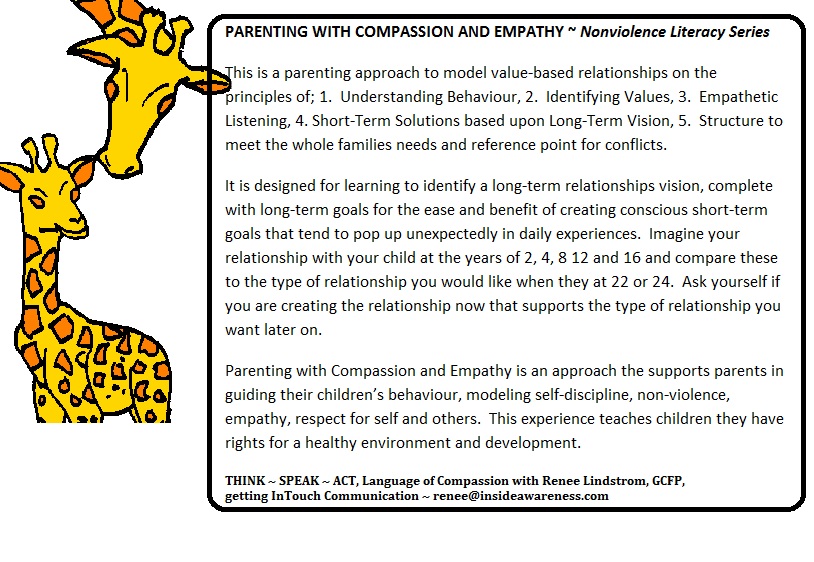
TOPIC’S IN PARENTING WITH COMPASSION AND EMPATHY ~ Nonviolence Literacy Series

Click to Enlarge

FOR MORE INFORMATION ON PARENTING APPROACH OF WORKSHOP/WORKBOOK SERIES go to  LINK

CONNECT ON FACEBOOK FOR MORE ON PARENTING @ LINK 

About Parenting Approach with Compassion and Empathy ~ Nonviolence Literacy Series

CLICK TO ENLARGE

Imagine a child’s world

That includes redirection and reassurance while being recognized versus, (you fill in the blanks)

  • You are,
  • Your doing,
  • You must,
  • Do!,
  • Go!,
  • Say your sorry!,

For example, Identify and acknowledge what is going on for them.  It takes as much time as it does to get angry and use force to get your own need met.  Hearing them takes less energy for all of you.  It does not mean you have to let them do what it is they are doing.  In fact you are teaching them to understand the feelings they are having.  They cannot teach this to themselves.   Such as,

“When you get angry about coming with us  I bet you are wanting to stay home and play and not come to another event with your brother and I.  Is that what’s going on for you?”

Now imagine the way you would habitually handle this type of situation.  You may not even be aware that they are meeting their own needs by their behavior and you may perceive this as resistance and label them as being __________.  Their resistance is a strategy for them to meet their needs in the only way they know how, which you may be taking personally and making it about them not listening to you.  If so, consider how your reaction impacts them.  How would your child process your reaction in a way that they stayed connected to their own value?  What might they be feeling and who would they go to for comfort?

Now consider the reasons you may have reacted that way?  Could it be the way you learned to behave based upon your experience or that you haven’t had any training on how to deal with multiple needs in the multiple relationships of your unique family?

Who do you go to to discuss your experiences of their reactions, their father perhaps?  Who do they go to to discuss your reactions?  Your behavior in their eyes may be exactly what they consider their behavior to be –  reactive.  How can their behavior be wrong and yours right?

For more info on Upcoming Parenting Workshops with Renee Lindstrom

‘Unity is beyond…..

‘Unity is a space of unison  beyond  comparing into being with another’s experience at the level of humanity each of you values’    Renee Lindstrom

Understanding Ego mind through getting in touch with your own thinking and speaking

Our last workshop in a series of six and the individual workshops have  evolved into a deeper focus of  practice and understanding empathy.  The areas that came up for exploring included self-empathy, empathy in relationships and group empathy.  The purpose was to support group members to recognize their own  stories inside their mind that did not allow them to be present with what was actually happening in their relationship.  How we have done this it by developing skills for learning to recognize and identify their thoughts and behavior as a result of their thinking.

The last exercise involved having a volunteer demonstrate a process while sharing a personal life event and transforming what they had been telling themselves about it into a connection that included the rest of body functions,  outside of the frontal lobe of their brain!

At the beginning of the practice this participant shared their resistance at  connecting to another person in their life.  In the process ego dropped away as the mind stories became silent and what was real began to emerge.  As the stories of their mind became less interesting , what was real was their new self-connection to what was being experienced in the moment.  When the participant connected to what was real in them they expressed how they had a growing awareness of  what was going on for the other person that went beyond their original resistance.

You couldn’t ask for more!  The beauty that was visible in the participant and those in the group supporting this persons process was tangible through relaxed faces and the feelings of a group connection.    Through the practice other  participants began to recognizing their own stories and habits in experiencing how  they supported the process.  Did they become present to what they were hearing or did it stimulate their own stories or need to fix it by coming up with solutions.  If so, all these participants witnessed how this breaks the emphatic connection and experienced the effects of  disconnection of it becoming about them and their ego mind and no longer the person going through the exercise.

Beautiful! The participants having a practice of learning a language of connection demonstrated the ability to go beyond the disruption and carry the process back to the original speaker while holding empathy for the interrupter’s!

This brings up the question – Is empathy the absence (quieting) of ego?

For more information on these workshops with Renee Lindstrom go to relationships link