Tag Archives: Balance

Body Balance: Inverted Foot

images (1)

Observing and exploring  an inverted foot posture I was told that due to a medical condition as a child the tendons in some of the toes had been cut.  With no opinions and continuing to investigate what movement was available, without any one particular focus, the lesson ended with new joint movement in the ankle.  There was also more contact between the foot and the floor  with less inversion.

Upon return for the following lesson the foot presented itself without being inverted!  The curling in was not present.

Renee’s notes:  When viewing the inverted foot the image of a baby who has not put any weight on their feet yet or developed their limb, ankle and foot muscles is what came to mind.  Exploring it from this perspective created a curiosity that led the lesson.

Recommendation:  Explore the facts with a curiosity and forget the labels!

____________________________________________________________________
©by Renee Lindstrom, GCFP, May, 2014
Feldenkrais® Practitioner since 2007, Communication & Empathy Coach since 2004, Art of Placement since 2000
Follow Inside on:

Facebook                      Twitter          

________________________________________________

How can one balance aspects of self?

Medicine wheel2Recently I enjoyed viewing a “Coles Notes” explanation of the a Medicine Wheel from a fellow Canadian in Alberta.  This Elder was connecting with a troubled youth through the act of  walking.  There was not a direct focus on any issues.  I observed through their discussion that the Elder was very aware of this youth and their needs through their behavior and unspoken expression.  Rather than being direct and  telling the youth anything, it was through guidance and modelling. The Elder began sharing the concept of  the Medicine Wheel and encouraged the youth  to walk, enter and stop in the center.  The  explanation of the Medicine Wheel was subtle and included the four directions, north, south, east and west.  There was also mention of the balance of the four aspects of self for connecting to ones center.  

Viewing this was a revelation and it was exciting to recognize the similarities to the core principles in the integrative centering and wellness tools offered in the getting InTouch programs at Inside.  These include levels of experiencing integration from the outside in.  These include

  • guidance versus telling,
  • mentoring versus teaching,
  • modeling versus telling and not walking it oneself in reality,
  • experiencing patterns versus fixing it.  

The wellness tools are for creating an open learning mindfulness versus a closed mind that knows everything.  The difference:

Becoming comfortable within oneself leads to acceptance and expansion beyond experiences into deeper relationships.  

Staying in the discomfort of always knowing the answer, in fear of feeling, leads to a *struggle.  Being right creates disconnection from all things. 

*The struggle is keeping the walls of power up that come from being right.

One way to experience balancing aspects of self with Inside is through sharing a Labyrinth Walk.  If you compare the following labyrinth design with the Medicine Wheel above you will see the similarities.  Listening to the Elder share his Medicine Wheel with the youth I was able to hear very similar guidance of sharing a labyrinth walk with others.  I was thrilled to experience the connectedness between these ancient patterns!
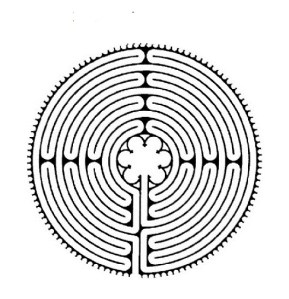
Chartres 11 Circuit Labyrinth

Chartres 11 Circuit Labyrinth


Other ways to experience balancing aspects of  self with Inside tools and techniques:

Subtle Inner Connecting

  • Awareness through Movement©
  • Conscious Movement
  • Sharing the Labyrinth (similarities  to a Medicine Wheel)
  • Nature Walking
  • Meditation/Contemplation 

Deepening Inner Connections

  • Guidance with  the Spoken Word
  • Functional Integration©

Read more on Balance:


__________________________________________________________________________
©by Renee Lindstrom, GCFP, May, 2014
Feldenkrais® Practitioner since 2007, Communication & Empathy Coach since 2004, Art of Placement since 2000

Facebook             Google Plus          Twitter          Pinterest

_______________________________________________________


Your Center Experience – Unbalanced

Infinity Flower ~ Personal Balance, Moment by Moment

Balance - 4 Steps out

Aspects of self out of balance creates Half Sided View

  • Have you ever heard belief statements from others only to witness that they are not practicing what they teach?
  • Have you noticed yourself making a statement based upon your viewpoint only to experience doing exactly the opposite?

If your physical, mental, emotional and spiritual  experiences are out of balance you may not be able to live them.  You may at those times then experience yourself as being dishonest or out of integrity.  It certainly will be others experience when with you.

In balance or our of balance, you can learn the tools to be aware of it and to move yourself towards balance!

Curious, find out more!

or

Read more on Balance:

__________________________________________________________________________
©by Renee Lindstrom, GCFP, May, 2014
Feldenkrais® Practitioner since 2007, Communication & Empathy Coach since 2004, Art of Placement since 2000

Facebook             Google Plus          Twitter          Pinterest

_______________________________________________________

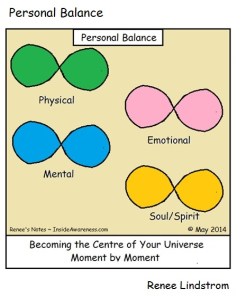
Four Aspects of Self

 Transition into balance is easier if there is conscious awareness of what aspect of self is out of balance.

  • This diagram shows four aspects of self  requiring balance for a better connections with others.   They are:

Balance P

Have you explored how your relationships may be affected when one or more of these area’s are not in balance?

For example:  if you are hungry are you as patient as you could be with others, especially those close to you?

Step One

Consider what it means to have  balance in each one of these areas individually:

  • Physical Body

Balance - Physical

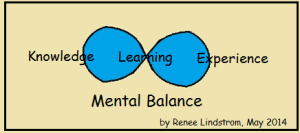
  • Mental

Balance - Mental

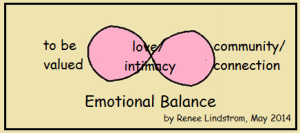
  • Emotional

Balance - Emotional

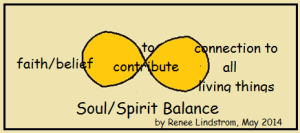
  • Spirit/Soul

Balance - Spirit

See:

_______________________________________________________

©by Renee Lindstrom, GCFP, May, 2014
Feldenkrais® Practitioner since 2007, Communication & Empathy Coach since 2004, Art of Placement since 2000
Facebook             Google Plus          Twitter          Pinterest

_______________________________________________________

Who would enjoy and benefit from a movement workshop with a focus on balance and fear?

Finishing up the second event in a 6 week workshop series with a focus upon movement awareness for decreasing fear and increasing balance,  the participants themselves ask me, “Why haven’t we learned this before?” “Why hasn’t this been apart of our learning background?”  I can only mention that it must not be in our awareness yet!

After only two classes participants are beginning to know themselves in a way that has never crossed their minds before.  They have a greater awareness of their feet, legs, knees, pelvis, spine, ribs, arms, hands and head.  They notice that they are very connected to their shoulders, neck, head and arms and not so much to anything else!  They also have a growing recognition to how they may feel pressure in one foot and none in the other.  Therefore the struggle for balance.

These classes are unlike a focus fitness class designed specifically to build  muscle and or yoga for stretching.  Building muscle and stretching are a benefit of the classes.  The focus is upon understanding  the movement and focused awareness of the movement itself.  That is when change happens!

Anyone who has limited movement and breathing patterns would benefit from these classes.  Anyone who is in pain or has fear of their own movement would benefit.  Anyone afraid of falling and tensing up would benefit.  Find out more!  There are four classes left in this series that you can register for, pro-rated.  Call 250-370-7300 to sign up or mark your calendars for the fall.  A new class begins September 16th, 2013, more info at – link 

“Relationships are not the cars, houses and house keeping”

Imagine facial expressions of anticipation and a long  moment of silence following this comment at our couples gathering.  The reason we had gathered was  to learn more on how to deepen our affectionate and intimate relationships.  I suggested that  these things represent our personal and joint material (physical) wants and needs.

So what is a *relationship?  This is going to be our exploration  over the next six weeks.  Everyone left curious and willing to do their home work for our next Friday night together.

 Can you sit down with your partner and discuss what is meaningful and important to you in your relationship without making it about them?

  • Example of what not to say if you want intimate connection:  I want you to be more……., I want you to do………

Can you then hear them share back what is meaningful and important to them in your relationship together without making it about you?  

  • Example of what not to say if you want more affection:  You want me to be more……..,  You say I am being………….

Can you both sit with these points, even the differences, and hold them equally as important?

  • Example of what not to say if you want to experience the same bedroom intimacy into real life time or keep experiencing bedroom intimacy!   Trust me if it is not in real life time that will be lost over time too!  What you want is more important than what I want……….., What I want is greater than what you want……

If this is a new concept and your curious, connect.  Ask about this gathering opportunity, upcoming possibilities or  private coaching.

_______________________________________________________

Wikipedia Definition of Intimate Relationships:

.

An intimate relationship is an interpersonal relationship that involves physical or emotional intimacy. Physical intimacy is characterized by romantic or passionate attachment or sexual activity. The term intimate relationship is also sometimes used euphemistically for a sexual relationship.

Intimate relationships play a central role in the overall human experience.  Humans have a general desire to belong and to love which is usually satisfied within an intimate relationship.  Intimate relationships involve physical and sexual attraction between people, liking and loving, romantic feelings, and sexual relationships, as well as the seeking of one or more mates and emotional and personal support for the members.  Intimate relationships provide a social network for people that provide strong emotional attachments, and fulfill our universal need of belonging and the need to be cared for.

_______________________________________________________

by:  Renee Lindstrom – getting InTouch – Relationship Wellness Series

“Gift of Movement for your favorite people”

Monterey Activity Centre

Or print:

Monterey Winter Program – Balance and Fear of Falling pdf