Signs of “Stress”

Stress results from physical, mental or emotional conditions that cause body or mental tension.    It can be caused from an illness, the environment, a social event or be  psychological . 

Body reactions to stress

  • Hyperventilation (rapid, shallow breathing)
  • Sweating
  • Rapid heartbeat
  • Dizziness
  • Light headed
  • Tired and fatigued
  • Backaches
  • Neck pains
  • Headaches
  • High blood pressure
  • Not sleeping
  • Heartburn and ulcers

Emotional Reactions to Stress

  • Irritability
  • Fear
  • Panic
  • Anxiety
  • Withdrawn
  • Lack of concentration
  • Forgetfulness
  • Biting fingernails
  • Grinding teeth

Mental Reactions to Stress:

  • Poor decision-making
  • Reactive 
  • Not thinking clearly 
  • Reacting from past events
  • Fear of the future

Tips for managing Stress over the holidays (other times too!)

_____________________________________________________

Renee Lindstrom, GCFP,
Feldenkrais® Practitioner since 2007, Communication,  Empathy,  Values Coach since 2004, Art of Placement  since 2000, Labyrinths of Victoria since 2012, #yyj Peace Week Grassroots Calendar Founder, Vice-Chair of World Children’s Summit on Peace & Nature in 2015

_______________________________________________________

Follow Inside on:
Facebook             Google Plus          Twitter          Pinterest

Integration or “embodying” personal change through self realization can be challenging for many!

Written by Renee Lindstrom, Nov 19, 2014 – Note from author:  I believe school warehousing of students was for simplifying group management to maximize numbers and group learning.  This author has noticed the  two other styles of learning mentioned in this article are being blended back into some educational systems.  Consider that the original intention of school was the bright idea of one person who thought it was the best way to go.  

The Western Linear learning style schools have adopted for warehousing students has dropped other learning style choices. Two of these other learning styles are: following natural cycles (turning of the seasons) and learning by listening and exploring the experience of those who have gone before us (elders). By only experiencing a linear style education there is a great need for trust and safety in exploring these other two choices.

In Inside’s movement awareness programs, learning is experienced by listening to talking points for references on where to focus and explore those movement patterns. The safety and trust then transfers from the speaker to the those experiencing the changes in themselves as they follow the patterns they hear.  (cannot be compared to yoga where you are shown and put into a pose, or therapy where you are fixed – something is happening to you)

In communication there is a blend of all three learning styles. Linear (for concepts), practice (experiencing the concepts), experience (storytelling).

In movement, the trust in the facilitator is generally readily available, while in communication there is skepticism and doubt until there is a connection to something personal and meaningful. This can happen much easier through experiencing the natural cycle of dialogue (conversations), yet appears to be the most challenging for many. This article has been written one day after leading  both movement and communication workshops by the author whereby this was observed.

It was observed that it was easier for participants to explore new movements than it is for them to practice new ways of talking. In movement there was acceptance and ease in going for it. In communication for many there was resistance and shyness. Yet, while watching others practice there was awe in the outcome of trying to speak with intention and consciousness.

Participants are challenged in the InTouch communication workshops by reduction of the linear learning style and increase in personal practice to encourage sharing for talking experiences and storytelling!

What this author believes from these two experiences of embodying personal change  have integrated as follows:

The participants have demonstrated a higher level of challenge in speaking responsibly and mindfully than those in mindful movement. This is interpreted that this due to the fact that relationships have had a tremendous impact and has the largest focus of a person’s attention, while movement is new territory for most. It reflects the cycle of learning here in the west. Up until school age, children learn through the turning of the seasons and from elders. Going to school the freedom of movement is limited and has a linear learning style, even in sports!

Message to workshop participants: so different, so courageous, so appreciative!

_____________________________________________________

Renee Lindstrom, GCFP,
Feldenkrais® Practitioner since 2007, Communication,  Empathy,  Values Coach since 2004, Art of Placement  since 2000, Labyrinths of Victoria since 2012, #yyj Peace Week Grassroots Calendar Founder, Vice-Chair of World Children’s Summit on Peace & Nature in 2015

_______________________________________________________

Follow Inside on:
Facebook             Google Plus          Twitter          Pinterest

Setting intentions for next year! Include the planet…….

big view goals

Plan for success now!    Explore Inside programs & workshops 

_____________________________________________

Renee Lindstrom, GCFP,
Feldenkrais® Practitioner since 2007, Communication,  Empathy,  Values Coach since 2004, Art of Placement  since 2000, Labyrinths of Victoria since 2012, #yyj Peace Week Grassroots Calendar Founder, Vice-Chair of World Children’s Summit on Peace & Nature in 2015

_______________________________________________________

Follow Inside on:
Facebook             Google Plus          Twitter          Pinterest

Three tips for success with setting your goals and keeping them:

  1. Include a balanced view of all your life areas while setting your goals:  heath, wealth, fame, love, creative, future, community, career, personal development, ecology

  2. Connect to the roots of your desire for a meaningful incentive to stick to them

  3. Create an environment for success

Plan for success now!    Explore Inside programs & workshops 

_____________________________________________

Renee Lindstrom, GCFP,
Feldenkrais® Practitioner since 2007, Communication,  Empathy,  Values Coach since 2004, Art of Placement  since 2000, Labyrinths of Victoria since 2012, #yyj Peace Week Grassroots Calendar Founder, Vice-Chair of World Children’s Summit on Peace & Nature in 2015

_______________________________________________________

Follow Inside on:
Facebook             Google Plus          Twitter          Pinterest

THERE IS TALKING GREEN AND THEN THERE IS WALKING GREEN 

Green relationshipsAn attitude of green is the commitment to practice listening to what is meaningful inside and the willingness to hear others before drawing conclusions. Green isn’t one side trumps the other..   Green is inclusive, it isn’t exclusive.  It holds everyone and everything equally.   Our values are not in conflict, our solutions are in conflict.

Green meets humanities needs. It is a space within that connects us to the value of life and the willingness for balance in giving back so everyone and everything thrive’s.  It is a natural cycle of giving and receiving that turns as the turning of night and day.  Imagine the moon and sun falling out of balance with one becoming dominate and one lesser than.

It requires tolerance and balanced lifestyles to increase mindfulness and patience to make better choices and find ways to resolve differences.  Some ways to consider achieving effective day to day balance and enrich life for those times that seem helpless follow:

Setting intentions for next year!

Three points for success with setting your goals and keeping them:

  • include a balanced view of all your life areas while setting your goals:  heath, wealth, fame, love, creative, future, community, career, personal development, ecology
  • connect to the roots of your desire for a meaningful incentive to stick to them
  • create an environment for success
How many times have you set goals on December 31st only to fail in the first week of January?  This year plan for success now!    Explore programs & workshops 

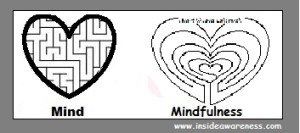
Balance between

mind (solving puzzles) &

mindfulness (spaciousness)

Maze Labyrinth Hearts

A maze is a puzzle and can be confusing. It reflects challenge and requires mind solving focus versus mindfulness! Have you considered how mindfulness supports and balances mind solving skills? Too much challenge can create limited focus and panic. A pathway that leads to mindfulness creates open space for increased brain power for meeting and navigating challenges!

Communication & Movement for Mindful Awareness for Adults

4 Personal Commitments for effective ‘Green Communication’

1.  Self Reflection:

  • identifying felt sensory awareness (sensing, feeling, emotions)  while noticing thoughts, opinions, believes and interpretations and letting them go

 2.  Speaking honestly:

  • about how you are affected and not what you think

 3.  Willingness to set aside differences:

  • hearing how others are affected  (conflict is at the level of  belief, thoughts, opinions and personal interpretations)

4.  Identifying and connecting to values before solutions:

  • After first three steps, then and only then,  develop solutions based on every-ones input and ideas.

  The Practice of Empathy Nature

Empathy Nature

will develop a state of mindfulness and increases conscious awareness
increase communication efficiency
reduce life draining experiences and increase productivity

What are your values

Explore a simple and insightful practice for integrating a personal culture of  values.  Using a traditional style circle of communication that nurtures mutual support, setting goals safely and respectfully.  Build skills for social change. NEW FOR 2015 Personal Calender & Agenda –  Integrating Values Daily!  Talk and Walk Values to get your needs met more easily!

Read more now
Children’s Educational Programs for Schools & Families @ www.cultureofvalues.com

The 4 Commitments of Green Movement

The goal in this style of movement is spontaneity.  This is achieved through these four commitments.

1.  Commitment to Stop and Check in

Commitment to slow down and stop

2.  Transition from thinking to sensing

Mindful focus on  your inner sensations from the inside out

3.  Exploring with curiosity

Curiously explore your movement actions and reactions

4.  Practice to integrate

This movement is a system that increases inner wisdom of all aspects of self.  It is not a first aid nor a philosophical path.  It is reuniting of whole movement interrupted through the generalized and institutionalized educational system.

Movement Options:

SOMATIC MOVEMENT

CONTEMPLATIVE MINDFUL MOVEMENT

  •  Labyrinth’s  – pathway in to heart center connection and back out

_____________________________________________

Renee Lindstrom, GCFP,
Feldenkrais® Practitioner since 2007, Communication,  Empathy,  Values Coach since 2004, Art of Placement  since 2000, Labyrinths of Victoria since 2012, #yyj Peace Week Grassroots Calendar Founder, Vice-Chair of World Children’s Summit on Peace & Nature in 2015

_______________________________________________________

Follow Inside on:
Facebook             Google Plus          Twitter          Pinterest

Balance between mind (solving puzzles) & mindfulness (spaciousness)

Maze Labyrinth Hearts

A maze is a puzzle and can be confusing. It reflects challenge and requires mind solving focus versus mindfulness! Have you considered how mindfulness supports and balances mind solving skills? Too much challenge can create limited focus and panic. A pathway that leads to mindfulness creates open space for increased brain power for meeting and navigating challenges!

_______________________________________________________

Renee Lindstrom, GCFP,
Feldenkrais® Practitioner since 2007, Communication,  Empathy,  Values Coach since 2004, Art of Placement  since 2000, Labyrinths of Victoria since 2012, #yyj Peace Week Grassroots Calendar Founder, Vice-Chair of World Children’s Summit on Peace & Nature in 2015

_______________________________________________________

Follow Inside on:
Facebook             Google Plus          Twitter          Pinterest

Educational Labyrinth Journey’s for Children & Teens

Teaching Labyrinth Workshop held at Brentwood Bay Elementary in Central Sannich followed by sharing at the World Children’s Summit on Peace and Nature Event held in Greater Victoria on Sept. 21, 2015

Somatic experience & a pathway to connection

Renee Lindstrom offers a somatic learning experience for leadership development for children and teens that includes mindfulness, logic, perception and movement patterns.  These tools can reflect the skills to connect  that begins inside while, at the same time, connecting with others in a respectful way regardless of differences. These techniques turn blocked and closed experiences into open expansive opportunities.
.
Sharing the Teaching Labyrinth at St. Andrew’s Regional High School was a powerful experience to observe a shift from being closed and guarded to open and receptive in a group of teenagers.   There was ease and simplicity using these tools that created a shift that was noticeable to view.  They were noticeably  acting with deeper qualities of inclusion, respect and connection.  Checking in with the students afterwards this was what they described. Their experience of this was tangible.
.
Maze Labyrinth Hearts
The purpose of the somatic exercises was to give these students a model and the opportunity to experience this shift using these integrative tools  so they could then duplicate it with ease and simplicity in the future.    After exploring personal and group movement patterns we moved on to exploring a labyrinth pathway.  A labyrinth has no barriers.  It is a pathway into the center (heart) and back out again.  It is not a maze which is confusing and a challenge requiring one to use their thinking.  A labyrinth shifts a walker from the chaos of their thinking into a calmer somatic experience.
 .
labyrinth thumbnail
.
The suggestion for walking a pathway in an inclusive and grounded way was it could be a more subtle and meaningful form of support in conflict resolution.  The concept is that everyone has differences and that if we include an opening shared experience for connecting deeper individually while walking together before talking,  this may open the space  to be more willing to hear these differences.
In communication practice I urge my students to stop and check in before reacting and speaking out.  The purpose is to pause and translate what they are thinking into a connection that the other person can hear.  This pathway reflects this process and together with some movement techniques for clarity and groundedness,  walking this pathway becomes a pattern reflecting this process.
I recommend these patterns as tools in organization and educational institutions:
  • as a preventative experience to cut conflict before it happens
  • as a way to connect before trying to resolve differences
  • to create respect and acceptance in a community experience
  • to bring together a community
  • to support making decisions
  • to cut anxiety before events, meetings, challenges

Support your school, business group or community organization to explore connection before solutions.  Cut thought the labels creating enemy images such as victim, perpetrator and bullying and support ways that are easy and simple. Move from the chaotic mind into mindfulness of acceptance and respect.

Inquire about school integrative labyrinth programs

← Back

Thank you for your response. ✨


Copyright 2014 – 2022 Renee Lindstrom, GCFP,
Feldenkrais® Practitioner since 2007, Value-Based Communication & Empathy Coach since 2004, Art of Placement  since 2000, Founder of Greater Victoria Peace & Intercultural Celebrations since 2010 & Greater Victoria Labyrinths since 2012, #yyj Peace Week Calendar Founder – 2014 & 2015

Follow Inside on:
Facebook             Twitter