
Click to Enlarge
FOR MORE INFORMATION ON PARENTING APPROACH OF WORKSHOP/WORKBOOK SERIES go to LINK
CONNECT ON FACEBOOK FOR MORE ON PARENTING @ LINK

FOR MORE INFORMATION ON PARENTING APPROACH OF WORKSHOP/WORKBOOK SERIES go to LINK
CONNECT ON FACEBOOK FOR MORE ON PARENTING @ LINK
Posted in Parenting
Tagged Behaviour, children's rights, Development, Education, Empathy, Environment, modeling self-discipline, non-violence, respect, society
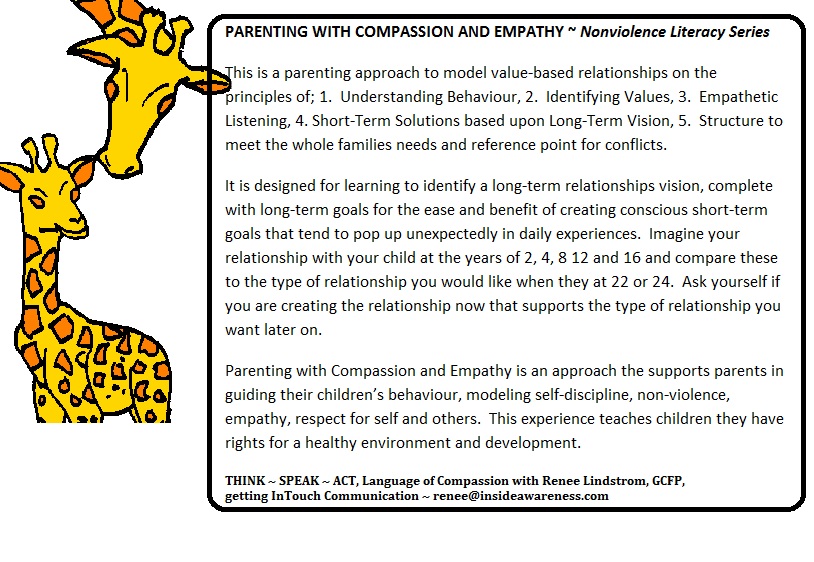 CLICK TO ENLARGE
Posted in Parenting
Tagged Behaviour, children's rights, Development, Empathy, Environment, modeling self-discipline, non-violence, respect, society
‘Unity is a space of unison beyond comparing into being with another’s experience at the level of humanity each of you values’ Renee Lindstrom
Posted in Quotes
Tagged Connection, getting InTouch, Humanity, quote, society, Unity, Value
Our last workshop in a series of six and the individual workshops have evolved into a deeper focus of practice and understanding empathy. The areas that came up for exploring included self-empathy, empathy in relationships and group empathy. The purpose was to support group members to recognize their own stories inside their mind that did not allow them to be present with what was actually happening in their relationship. How we have done this it by developing skills for learning to recognize and identify their thoughts and behavior as a result of their thinking.
The last exercise involved having a volunteer demonstrate a process while sharing a personal life event and transforming what they had been telling themselves about it into a connection that included the rest of body functions, outside of the frontal lobe of their brain!
At the beginning of the practice this participant shared their resistance at connecting to another person in their life. In the process ego dropped away as the mind stories became silent and what was real began to emerge. As the stories of their mind became less interesting , what was real was their new self-connection to what was being experienced in the moment. When the participant connected to what was real in them they expressed how they had a growing awareness of what was going on for the other person that went beyond their original resistance.
You couldn’t ask for more! The beauty that was visible in the participant and those in the group supporting this persons process was tangible through relaxed faces and the feelings of a group connection. Through the practice other participants began to recognizing their own stories and habits in experiencing how they supported the process. Did they become present to what they were hearing or did it stimulate their own stories or need to fix it by coming up with solutions. If so, all these participants witnessed how this breaks the emphatic connection and experienced the effects of disconnection of it becoming about them and their ego mind and no longer the person going through the exercise.
Beautiful! The participants having a practice of learning a language of connection demonstrated the ability to go beyond the disruption and carry the process back to the original speaker while holding empathy for the interrupter’s!
This brings up the question – Is empathy the absence (quieting) of ego?
For more information on these workshops with Renee Lindstrom go to relationships link
Posted in Uncategorized
Tagged Communication, Culture, Ego, Empathy, getting InTouch, Group Empathy, Health, Language of Empathy and Compassion, Mind, Mindfulness, Peace, Relationships, Self-Empathy, Unity, Values
Parents do you go and talk to your kids after they hear or see you fight and talk to them about how it was for them to have been in this experience? Do you help them with identifying their feelings and sharing what needs they had in the moments of the fight?
Do you try to tell them what the fight was about and get them to pick sides or do you tell them truthfully what you are feeling about them experiencing the fight with you? Such as regret and sadness that you didn’t met their needs for safety? Once you and the child connect to theirs and your needs about the fighting experience you simply might say that you and partner had needs that were not being met and that the frustration came out in the behavior that was demonstrated. Do children need to know adults stories or do they simply need to know you care about them and that it is normal to have frustration? What’s important might be how you model the process of dealing with the frustration and not the frustration itself. Be truthful about the behavior scaring you if in fact it did and begin teaching them the feelings that go with different behaviors without making the behaviors threatening. Normalizing the behavior through the process of coming to understand it begins to defuse the level of fear attached to it and its power, opening the door to future mediation skills in moments they may face anger.
Turn these moments into teachable experiences and explore it and not feed the fear.
Posted in Uncategorized
Tagged Anger, Behavior, Education, Language of Connection, Parenting, Relationships, society, Understanding Behaviour
Do understand your own behavior or is your behavior habitual therefore the same old reactions?
Child development is through their existing abilities of hearing, seeing, touching, smelling, taste and physical feeling. Mental development is a later development and learned in the process of absorbing what they witness others doing.
Therefore:
What behavior are you modelling to the children around you?
How are you engaging with the child/ren around you in order to support them in understanding their behavior reflecting back to them that they are still beautiful and wonderful? Warning, supporting a child’s development doesn’t come with labeling them and grouping them into a category – that only gives the adults a false understanding and reasoning that further disconnects the child from their behavior and only meets the adults needs for understanding. If an adult did not learn why they behave the way they do in their stages of development they may not understand why their child is behaving the way are are and they will seek answers that generally lead to a diagnosis. Adults will not see that the child is taking in the behavior around them and responding either by duplicating it or reacting to it. Adults generally will not recognize too that they are demonstrating the same behaviors.
An example, one of my son’s elementary teachers. Whenever I went by her class while in the school volunteering or coming to pick him up I would see her with her back to the class on a computer with the children left to work on their own. Her classroom was in a state of disarray with piles on top of piles in every available space. Paper, art and craft materials stacked so that if there was a breeze it would be like a deck of cards and come crashing down. Our experience was that this particular teacher was close to retirement and interested in art, yet she was still teaching a regular class. She spent most of the year outside of the class on big school projects leaving the children she was responsible for in the hands of others in the school who would come in to fill in periodically throughout the day and even part way through a subject. Arrangements also included switching classes so that other classes could be taught what she was interested in. Two weeks prior to the Christmas break or a school event her class room had a revolving door and many times no adult was in the class and they would be watching a Disney type movie.
The day came that we had an appointment with her to discuss our son’s behavior in her class room. Sitting with her was painful and I believe we all had trouble focusing on her as she attempted to find my son’s work. It was in a pile in front of her on her desk that was no less than three feet high. What we heard was that our son was not organized and able to complete a task. That he was not able to work on his own and was distracted easily. Therefore her recommendation was that he be tested as a candidate for medication. Medication that she herself had put her son on through his early years. I asked her if her child continued on this medication and she said no, at a later age he insisted that they stop and work differently on his tenancies She went on to say that he resented this strategy of medication as he couldn’t remember much of his earlier years.
Therefore are we aware of our own needs and how they affect those around us? Will we judge our children for duplicating what they are observing us do? Is it easier for us to fix it so our experience has more ease and if so is this a long term solution or a temporary fix?
The reason we went in to have a conversation with this teacher was that our son was going into a closet and shutting the door. She felt he was hiding and that he was a problem. What she did not recognize was that this was the only strategy he had to get away from the chaos of the environment she was unconsciously creating to meet her own needs!
Imagine if this teacher had learned a way to communicate with our child that would connect to the values rather than labeling him a problem. She would have understood her needs more, perhaps leading to change in the classroom for all the children.
Posted in Uncategorized
Tagged Behavior, Child Development, Education, Habits, Health, medicine, mental-health, Teachers


 Inside Awareness Center for Integrative Somatic Learning