Tag Archives: Balance

Recognizing a gap between a somatic newborn and a cognitive societies social conditioning

by Renee Lindstrom, founder Inside Awareness Center for Integrative Somatic Learning

Invert hierarchy titles: safety top, self-actualization bottom

This blog article below was written on this author’s personal website http://www.reneelindstrom.com recently. It is from a perspective of a somatic empath that carries the ability to identify the authentic somatic experience and the cognitive conceptualization that those not in their somatic experience believe it is. No judgement, simply a gap this author is bringing focus to. You can read this article by clicking the article link below or listen on You tube at link below it. I hope this content will be of interest in those sincerely interested in actively going beyond what they think they know from societies conditioning in accepting the stories attached to their mental, emotional and physical states of being. The first step to breaking free of acceptance to labels, assessments, and moral judgements, etc., is having clarity on the separation that supports it.

Below are two earlier articles from this authors personal web site on Maslow’s Hierarchy of Needs from an interesting perspective that may be interesting to read after digesting and integrating this perspective from a somatic empath. Understanding this first stage will support how society is perhaps being misguided by this lack of clarity by those who are seeking to meet their needs without compassion and empathy for others.

If you would like to connectย to learn moreย about educational opportunities, coaching, mentoring , consulting or functional integrations

Podcast

Please like and subscribe if you like this content.

Follow Socials:

Facebook,ย LinkedIn,ย Instagram,ย TikTok,ย Xย orย Pinterest,ย Tumblr

Feldenkraisยฎ, Feldenkrais Methodยฎ, Awareness Through Movementยฎ, and Functional Integrationยฎ,ย are registered service marks of theย Feldenkrais Guildยฎ of North America. Feldenkrais Methodยฎ

Copyrighted Property posted on Reneeโ€™s authentic accounts only:

Body Mindfulness Core Body Functional Breathing Audio

by Renee Lindstrom, founder, Inside Awareness Center for Integrative Somatic Learning

Functional Breathing Patterns sensed with somatic awareness

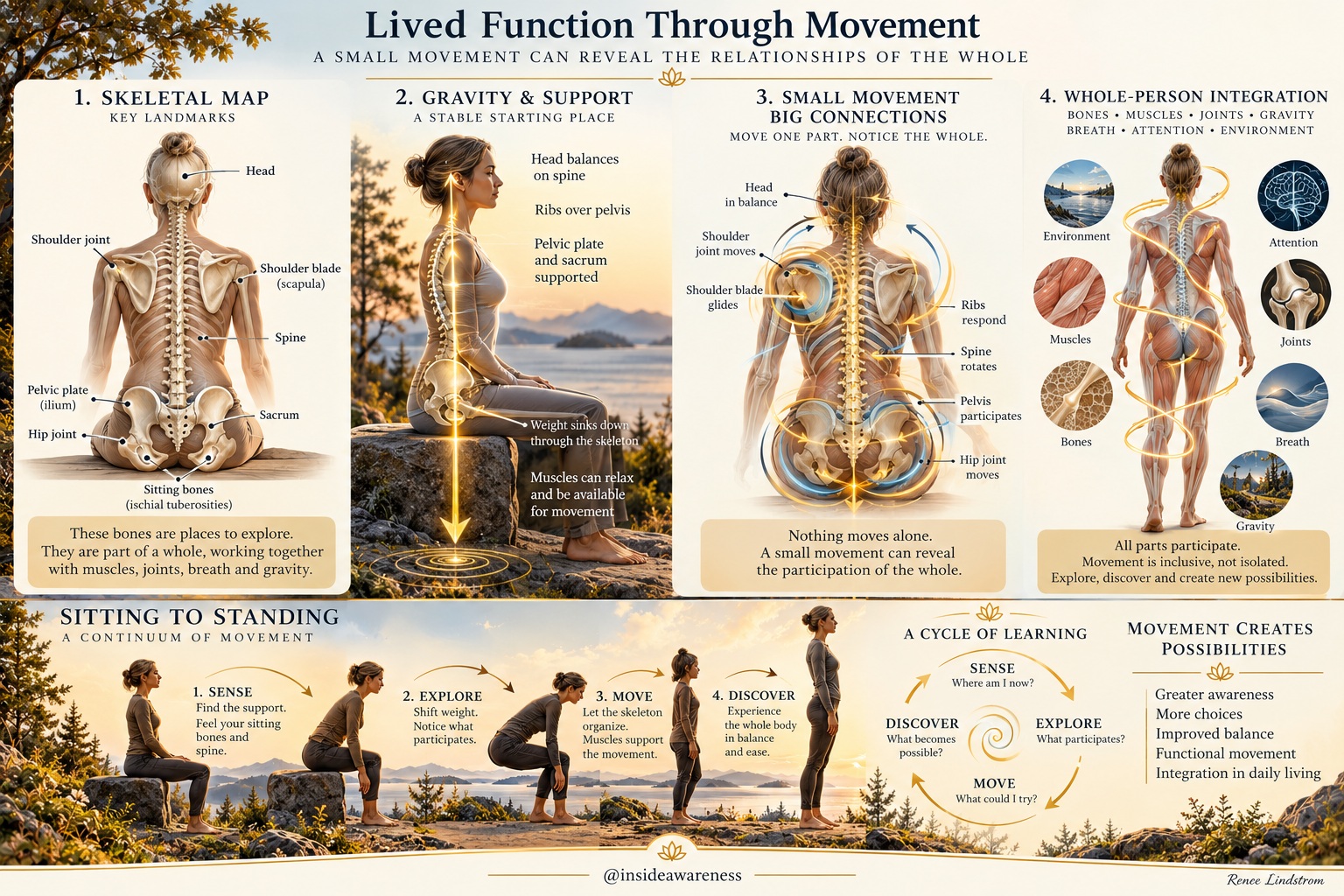
Often when observing the breath patterns of an individuals I will see that there is a lack of skeletal movements in their patterns of expansion and contraction in the moving parts that could be recruited for fuller body supported whole movement for drawing in air and expelling it.

The body parts I refer to are the bones and joints that create flexibility, balance, expansion and contraction, and counterbalance.

Shown here in this slideshow.

  • Posterior view of thoracic vertebrae with ribs and scapulae
  • Rear view of human rib cage with scapulae and spine bones
  • Human skeleton front view showing skull, rib cage, spine, arms, and pelvis bones
  • Anterior view of a human skeleton showing skull, rib cage, spine, pelvis, arms, and legs
  • Clearly include and define knee joints

The above slideshow demonstrates the moving parts of the skeleton that supports whole breath through core functional skeletal movement patterns.The focus of attention in these guided patterns is movement where the muscles, ligaments and soft tissue are spontaneously moving in response to the skeletal micromovements. These micromovements with a skeletal focus treats the muscle and soft tissue as partners that follow and hold the bones in alignment. This focus is on core bone strength and the resilience of the muscles that are not resistant to functional movement patterns. Muscle strength is separate from bone strength, yet often in cognitive intellectualization does not include the understanding of the bone movement in functional postural transitions.

The patterns in The Mindfulness Body Breath workshop and Audios focus attention on education of whole function through postural transitions to enhance and improve natural rhythms of breathing. The guided patterns balance the somatic experience with the cognitive conceptualizations for increasing mindfulness through function.

More on Body Mindfulness Audio plus added bonus below: Free Intro to expanding somatic sensing in video embedded down below

These guided patterns are from Feldenkrais workshop that Renee has held since 2007. The feedback after each workshop has been positive with appreciation expressed.

Core Body Functional Breathing Audio

The Audio for Core Body Functional Breathing will guide you through patterns of movement to explore breathing with the focus on micromovements to release bones held in rigid patterns to encourage fuller intake and expulsion of breath and that is a natural function and not forced through concepts. These guided patterns generate a conscious felt sense connection to contraction and expansion through movement. This increase in awareness can support consciously releasing the constraints to blocking the resilience through the patterns of opposites that initiate contraction and expansion through bone movement that is needed for organic fuller breath patterns.

Included in this audio lesson offer is an intro and outro for the intent to learn how to engage the sensory awareness using the five senses in harmony and partnership with cognitive function. It is this practitioners experience that integration and development of new neural pathways do not develop through thinking that is dependant on beliefs, opinions and evaluative thinking. Neural pathways are developed on new actions that engage growth through novelty, exploration and discovery.

Read more on the benefits of Somatic Body Mindfulness and research of Feldenkrais below


How to purchase and enjoy – Core Body Functional Breathing Audio


How can you move a body part through function when you don’t know what it is somatically or the ability to different it from your body mass?

Intro to how to use your senses of sight (visions) and sound to differentiate felt senses of individual body parts.

In this short video Renee introduces the potential of expanding the felt sense of the bones inside through vision and imagination. Using pictures of the bone parts through the sensory perception of sight and sound the listener can focus on integrating this knowledge into their somatic sensory perception that can create a connection to the bone through the sensory ability to feel them independently through *function.

*function – postural transitions such as lying to sitting and then to standing


Read more on the benefits of Somatic Body Mindfulness and research of Feldenkrais below:

Learn More about Body Mindfulness

Some of the conditions that SBM guided patterns that Renee has observed improve are:

  • Anxiety and Depression
  • Artheritis
  • Back and Neck Pain
  • Loss of Balance
  • Bell’s Palsy
  • High Blood Pressure
  • Shallow Breathing
  • Chronic Pain
  • Eating Disorders
  • Fibromyalgia
  • Lack of Flexibility
  • Hip, Knee and Ankle Joint Pain
  • Injuries
  • Insomnia
  • Pulled Muscles
  • Multiple Sclerosis
  • Parkinsons
  • Locked Shoulders
  • Stroke
  • TMJ

Some of the Benefits that Research has shown are:

  • Improved:
    • proprioception
    • coordination and ease of movement
    • posture and stability
    • well-being
    • feeling of confidence
    • breathing
  • Decreased
    • pain
    • spasm

Research Evidence:

  • Improves:
    • body awareness: ย Multiple sclerosis, pain, stroke, able-bodied ย 
    • ย mobility
    • ย stability
    • ย coordination
    • ย ease of movement
    • ย posture
    • ย balance confidence
    • ย mood
    • ย breathing
    • ย well-being and quality of life
    • ย sleep
    • ย self efficacy and health locus of control
    • ย self image
    • ย greater recruitment of the affected part of the motor cortex ย (stroke)
  • Reduces, decreases:
    • decreased pain
    • fatigue
    • anxiety and stress
    • medical costs

To learn more about this Research on the Benefits of Feldenkrais, go to the link in the description box and tap the link

Introduction: Grounding thru Body Mindfulness

Benefits:

  • reduce and reverse aging
  • increasing flexibility and resilience
  • develop body awareness
  • reduce body tension, pain, anxiety and effort
  • increase relaxation and windows of emotional tolerance and self-connection
  • improve sleep and sleep sounder
  • increase body functions, cognition and emotional responses of calm, mindfulness and joy

Exploring the body anatomy through the felt senses increases inner awareness โ€‹ and trust. This โ€‹body exploration is a different type of strength training. The difference โ€‹is theโ€‹ focus of attention on the body, mind and felt senses through guided patterns designed to expand conscious awareness of the body function. The strength of feeling oneโ€‹’s body through moving joints and bones deepens awareness of physical connections โ€‹as โ€‹postures change, like in the shifting transitions from sitting to standing and back to sitting. Movement is a series of shifting postures. The functioning healthy body is not stationary, nor poses. It is designed for a continuous flow of integrative movement patterns.


Feedback On Body Mindfulness Introduction

“I am excited!!! This is great! It is like you are there with me step by step. It’s what all of us are looking for, real Feldenkrais support” S
That was great, Renee! You have such a calm and lovely voice. I’m happy to add this to my calming strategies. Thank you.ย H
I really like this sort of thing and would welcome further โ€œinstallmentsโ€ in the series and/or a revised version of this one. I liked the pace at which you spoke, not too rushed and left enough time to do the exploration of the particular area of the body to which you were drawing attention.
I liked that you offered options re leg position (straight out or with bolster under knees) but wondered whether one position or the other is preferable. Or is it just that one would notice different things, depending on how the legs are positioned?” ย  K


Connect for Lifestyle Coaching and Learning Needs


Follow Socials:


Copyright 2014 โ€“ 2026 Renee Lindstrom, GCFP

Feldenkraisยฎ, Feldenkrais Methodยฎ, Awareness Through Movementยฎ, and Functional Integrationยฎ,ย are registered service marks of theย Feldenkrais Guildยฎ of North America

Cultivating core 2026 life area connection’s from the inside out

by Renee Lindstrom, founder, Inside Awareness Center for Integrative Somatic Learning

The nine life area goals identified in the poster above were painted as a creative personal connection to intentions in each area and framed last night as the calendar is about to shift into 2026. This poster is hung facing the door to my office/creative space as a visual reminder as I move about and sit at my desk. This interactive poster is placed prominently with the intention of manifesting life through creative expression in living and learning. It is a visual focus of intention for creative living in 2026 that expresses from a thoughtful core connection. It is my ‘Shining North Star’ guiding my 2026 experience. A Shining North Star that contains what is alive and meaningful in the present moment of reflection. Each year is a stepping stone on an elusive journey, and this poster identifies the present location of this North Star on this pathway. It creates groundedness in the spontaneity of living an interactive and innovative lifestyle.

Shining Star

by local #yyj artist from my children’s school in ’01/’02

In the center of the Shining Star, in the above drawing, one can imagine the burst of creation. Creation that creates form. This activity, shown in the poster above, demonstrates intentional action for creating an interactive board that connects to what is meaningful at a core level. It is the elusive structure that contains the form for bursts of spontaneous action in alignment with core intention.

The board replaces outside influences and realigns my decision-making focus to make independent choices in alignment with what is meaningful, rather than seeking outside advice and opinions. It has proven to be a strong support that eliminates the unnecessary projections of others that do not have the same inner patterns for processing information. Each of us has an inner pattern for processing information that is unique. No one can duplicate another person’s inner filter or processing patterns or tell someone what to do effectively, based on the separation between inner programming. Programming that I identify as social and cultural conditioning.

In simple terms, this means that the poster above reflects a lifestyle model where consideration was given to determine important next steps. These stepping stones guide the coming year at a core level and become the source for checking in for reassurance and guidance that outside actions are in balance with inner values. My yearly considerations go back to 2013 or thereabouts. Each year became a stepping stone on a journey that unlocked a natural and organic model of elevating conscious awareness. It is one of the pillars that has become an educational pattern for expanding beyond the constraints of learned social and cultural behavioural conditioning. How? It has replaced outside authorities with an inner one.

What does outside authority versus an inner one mean?

  • Outside

An outside authority is exactly how it is written. In this context, it means looking to others (false guru’s) for guidance on what is right and what is wrong based upon their opinions, belief systems and limited living experiences. Anyone with a closed mindset that looks outside themselves at status (what others have) and self-image (how things appear) has limitations in clarity and life experience. It’s all contained within a closed circuit and small-mindedness. If they have a title, it is even harder to discriminate, as the Indoctrination creates a false belief system of superiority.

Google writes: Indoctrination is teaching someone a specific set of beliefs or ideas, often political, religious, or ideological, in a way that discourages questioning or critical thinking, making them accept it as truth without examination, like brainwashing, but can also be a less harsh form of cultural teaching. It’s about instilling a doctrine or viewpoint repeatedly until it’s accepted uncritically, differing from general education which encourages independent thought. 

  • Inside

An inner authority means checking in mindfully or thoughtfully to tap into what is meaningful in the present moment. This suggests a structure for learning core values, and trusting them in a sea of outside opinions, perspectives and beliefs. It suggests owning one’s own power, instead of being in the habit of giving it away. This is an action of leadership that can be challenging. It means letting go of blame and shame to justify the action one is taking, or has taken.

An example of blaming others for personal actions. As a kid, I blamed a sibling for taking an action to shoplift. I was 7 years old. I told my dad …….made me do it. Only,………wasn’t there!

Not only is considering intentions for the coming year important for cultivating awareness of personal needs, its accountability training. It can be an elusive pattern with a spontaneous outcome. It shifts the blame and shame learned thinking behaviours into a focus on self-value and accomplishments.

Reading more posts on Cultivating with Goals on our Goal news webpages:

Please like and subscribe to stay connected

Follow socials:

PODCAST

Feldenkraisยฎ Practitioner 07, Communication & Empathy Coach, Art of Placement

Copyrighted Property posted on Reneeโ€™s authentic accounts only:

If found on other false accounts, please report to platform security

Facebook, Linkedin, YouTube, X, Instagram, Tik Tok and Tumblr

Mindfulness through the Somatic Senses

by Renee Lindstrom, founder of the Inside Awareness Center for Integrative Somatic Learning

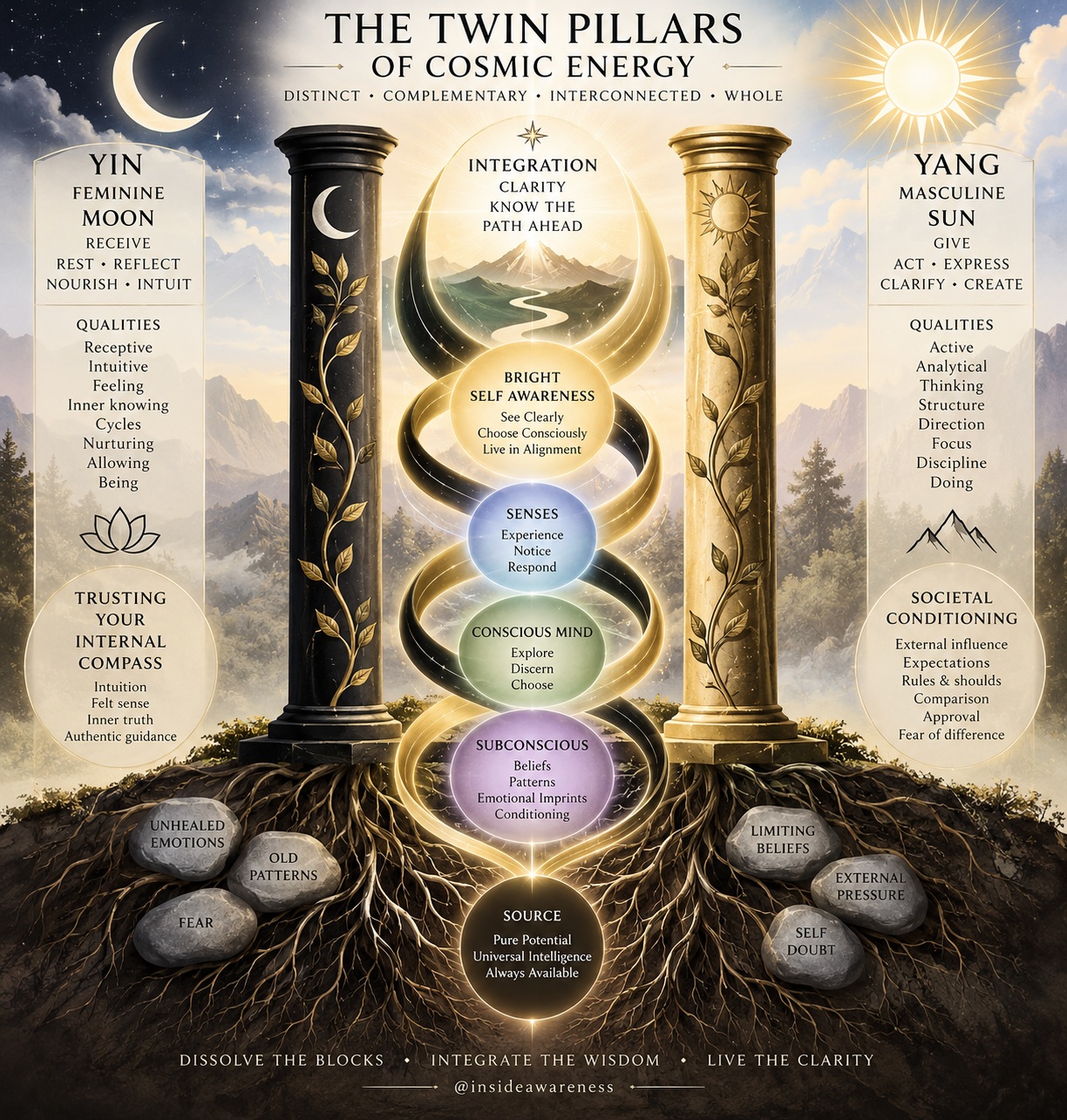
Identifying balance in the two streams of consciousness & there are available doable living patterns. It is a choice.

ย In the above post, Renee, founder of Inside Awareness Center for Integrative Somatic Learning, explains the origins of the seed intention at the core of the lifestyle learning programs. Since 1990, she has actively pursued clarity on the duality she was witnessing in people’s behaviour with themselves and others, and the influences of it in the environment and community. This behaviour has crossed all hierarchies and social conditioning. It expressed itself equally through opposing forces, for example, advocacy for environmental causes. The force of aggression was equal in the entitlement displayed on both sides of the table.

A choice to respond to life through the somatic sensory awareness while balancing thoughtful and mindful attention

In the personal post linked above, she shares a personal journey resulting from a year of transitioning through losses that triggered an activation in her stream of consciousness focus. Prior to that year of losses, there had been a heartbreak event called broken-heartedness in the Buddhist Teachings of the Shambhala Center. There is a heart opening in this state of being that is tender and soft. Combined with the shift into heightened levels of somatic sensory awareness and perception, there was an experience of expanded consciousness beyond the limitations of a socially conditioned and educated left-brain experience. She eventually identified this experience as the state of mindfulness one finds in a committed sitting meditation. The difference is that it was an active living experience, and not an organized practice of achievement. It was an obvious experience that could be defined as different than those around her. The shift into this somatic led state felt like spontaneous combustion was a four-year transitional period of little combustions leading up to the major eruption. The fifth year was dedicated to stepping back to fully immerse in the potential for understanding and finding answers. The answers didn’t come in a year, and it took years of commitment to tap into and explore patterns that could cultivate the awareness that was being sought out. This even meant entering educational programs where the mentors described themselves as having achieved what she was longing to learn, only to somatically discover they had not yet achieved it. The choice was always based upon the model of doable patterns that was being taught and integrated from someone else’s innovative teaching origins. The balance between the left brain and right brain had not been achieved yet, and they themselves didn’t know it. Why? They hadn’t experienced it yet. You can only know something when you have experienced it. This meant they were never offering their own system. It was only borrowed patterns where they assumed authority over with a sense of ownership. Even with many of these programs focused on somatic awareness and mindfulness, they did not recognize anything outside their closed perspectives. The only way she could know this is that for two years, she was in this creative connected state of being without any loss of her developed left-brain experience. The difference was that the left brain did not dominate in this experience and instead, collaborated.

They say all things happen for a reason, and now in hindsight, it may be fortunate that she experienced a mother’s emotional and mental absence, or abandonment, as a child. The basic physical needs were met, yet it lacked loving kindness. For her, it resulted in a continued state of early somatic learning that wasn’t corrupted by a shift in focus that didn’t encourage the same somatic awareness through the five senses. By corrupted, Renee is suggesting this means attention shifted to critical thinking and institutionalized learning.

Insight & recognition of the value in somatic sensory led mindfulness awareness for the aging process

Those early challenges now provide insight and recognition of their value. The clarity is a benefit for understanding the differences in socially conditioned behaviours. As a somatic empath experiencing the maturing students and their aged logical and analytical processors now, Renee finds they have difficult transitions into retirement and old age. They have long lost their connection to early somatic senses and continue trying to navigate through their focus of attention placed on outside strategies to fix their physical, mental and emotional functional losses. In their disconnection from engaging with their felt senses, she recognizes the loss in their abilities, mentally, emotionally and physically, for supporting themselves. They lack trust in their mental and physical abilities to support themselves. Without a connection to their five senses, they do not trust themselves and are fearful of their own bodies. As a practitioner who engages them in learning to connect through their five senses, Renee observes a shift in their levels of confidence and fear where their trust in themselves increases.

Learning gap in education is creating inner combat between critical thinking consciousness & felt sense consciousness

When a child enters into an adult-generated learning model, it becomes the dominant educational conditioning pattern, and the loss of connection to the five senses begins. The aging process lacks the conscious awareness of the five senses. At some point in early learning, the child is redirected from their inherent spontaneous early learning patterns using the five senses and into a focused structure of organized learning. Renee stresses that this is a significant challenge in the aging process. It also shows up as a challenge in processing emotions and throughout childhood development. If a lifetime is lived with no self-directed learning choices in behaviour, reactions will be childlike with no logic. When acting out it will be through the trigger of the somatic senses without control of it. The gap in learning from the adult-designed educational patterns is eliminating the maturation that comes from processing through the five senses and understanding how to process them. Instead of processing them through the stream of consciousness that is activated, those children are being spoken at from another stream of consciousness. effectively forcing the felt senses to be stymied and judged from a perspective of right and wrong thinking. Imagine for a moment having one stream of consciousness in conflict with the other within one’s operating system. Our education is setting individuals up to do battle within themselves, critical thinking versus somatic felt senses. Incredible!

Anger tantrums at 55, 65, 75, 85, 92……

Imagine being sixty-five and still reacting from the age of five somatically while in reaction. Imagine feeling so out of control at 65 and not being able to differentiate feeling reactions. This is serious at sixty-five, as one is considerably stronger physically than at five. If not outer aggression, consider the inner fear, panic and anger. By sixty five the smallest event will trigger survival. Remember, the logical left brain doesn’t feel emotions, and it is not spontaneous.

Perceiving through the five senses and using the left brain with more efficiency for cultivating mindfulness & awareness in the present moment

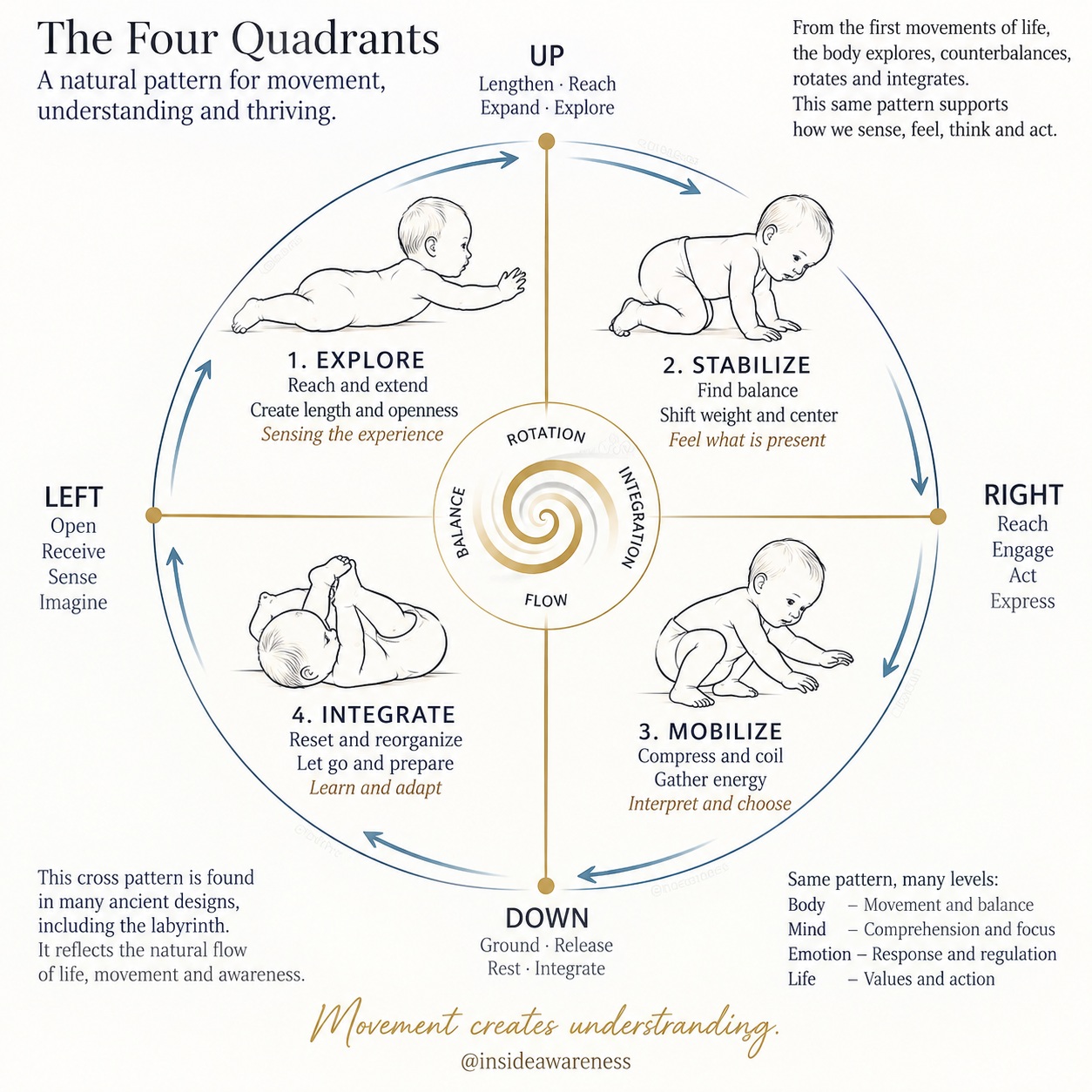
From a living experience and a focus as a somatic functional integration practitioner, Renee considers how a baby is born with the ability to learn somatically through the five senses and no verbal input. A baby has all the tools they need to begin shifting their weight to physically roll over, get up and function through walking, thinking and talking. There is a name in Buddhist Meditation that is called “Beginners mind.” This name is a pattern of someone starting a mindfulness meditation. This meditation is for engaging somatically in the environment while focusing the left brain abilities to calm down and become quiet enough to follow the somatic sensing. This pattern is not maintained by Western culture, and the pattern is reversed. The mind controls the somatic experience

Summary

Renee has recognized two streams of consciousness. She once differentiated it as left-brain and right-brain dominance. Expanding her programs to include the somatic five senses has increased her willingness to begin to articulate the two streams of confidence she observes. This ability to engage from the origins of the five senses first, as in early childhood, while harnessing cognitive function to follow the sensory input, versus leading from socially conditioned learned patterns, has been a game-changer in student abilities. This suggests increased mindfulness and empathic states of being are valuable qualities for supporting students through physical, mental and emotional constraints that are limiting. These limiting experiences often translate into pain, anger, sadness and an inability to support themselves. The student will have to choose which side of the fence they are going to lead with. There are three choices, believe it or not.

  1. Perceive through socially conditioned critical thinking.
  2. Perceive through the five senses, sight, sound, taste, smell and touch, in the filter of power and control of critical thinking.
  3. Perceive through the five senses, sight, sound, taste, smell and touch and harness the thinking function beyond trained critical thinking, for balance and collaboration that creates living mindfulness.

Stay InTouch

If you would like to connect

Please like and subscribe if you like this content.

Follow on Facebook, LinkedInInstagram, TikTok, X or Pinterest, Tumblr

PODCAST

Feldenkraisยฎ, Feldenkrais Methodยฎ, Awareness Through Movementยฎ, and Functional Integrationยฎ, are registered service marks of the Feldenkrais Guildยฎ of North America. Feldenkrais Methodยฎ

Copyrighted Property posted on Reneeโ€™s authentic accounts only:

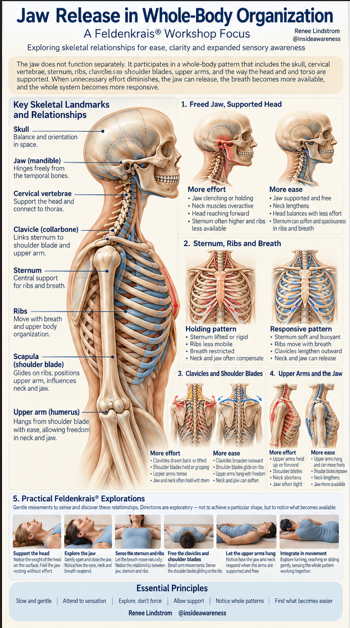
Expansive body awareness of jaw, skull, vertebrae, clavicles, shoulder blades, ribs and shoulder joints through verbal guidance

by Renee Lindstrom, Certified Feldenkrais Practitioner,’07

Cultivting awareness through felt sense movement guidance

Before an Awareness through Movement workshop yesterday that had a focus on the jaw joints, I wrote a short blog post to put myself into the mindset of the intention for the upcoming lesson being introduced. I write spontaneously as though through some elusive inner direction. This simply means I do not have an outcome in mind when in free writing mode.

Arriving at the workshop space and while setting up the room, I was approached by someone ahead of time who inquired if this workshop would benefit them. They mentioned their jaw experiences that I was able to confirm it would be, all the while thanking whatever inspiration it was to have me free write on it before coming. It seems the statement from that post about creating a safe environment was going to be the dominant theme of the workshop! It was the intention, only I didn’t know it at the time of writing that statement. I did my best to create a deeper opportunity for the experience of safety so that the participants could release their habitual holding behaviour in their jaws they have patterned to protect themselves and their jaws. By this point, it is their protection!

I slowed my roll down (flow of words) and began to guide participants with more words than usual to give functional reassurance. Needless to say, it was a powerful workshop for many. I wondered partway through if everyone was benefitting, or not, due to the wordiness in the verbal guidance. Remember that the guidance is not focused on cognitive strategy thinking patterns. Rather, it is all practical micro movements, yet the focus is on the somatic senses. Basically, it is helping people to tap into their felt sense awareness using some of the five somatic senses we all have, yet ignore.

While I was focusing on creating a safe environment and the patterns, the participants did experience something as beneficial takeaways. I heard about this after that reassured me that everyone benefited from my decision to use words to support a deeper inner reassurance for them to test out the patterns I was talking them through. It was a reminder that Awareness through Movement is just that, ‘awareness.’ It is not rule-oriented, which shuts the door on one’s expanding conscious awareness, no matter what way you look at it. It is open exploration with a curious mind. That is what I heard as feedback. Many responses of how much people took in that they had no connection with before the workshop. That is what brings me joy. To hear the feedback that the participants discovered something new within, increasing their potential. It’s called self-discovery. In a nutshell, that’s what I facilitate, a practice of self-discovery.

For information on the next class series or workshop, hit link below.

Awareness through Movement link to Playlist on our learning center’s YouTube Channel:

Visit web pages dedicated to Awareness through Movement news posts, tips and articles link below

Please like and subscribe socials to learn more with new learning opportunities.

Follow on Facebook, LinkedInInstagram, TikTok, X Pinterest,  Tumblr

Renee’s Podcast

Feldenkraisยฎ Practitioner ’07, Communication & Empathy Coach , Art of Placement

Announcement for 2026

Center for Inside Awareness Channel on YouTube

I sent this news out to my students today.

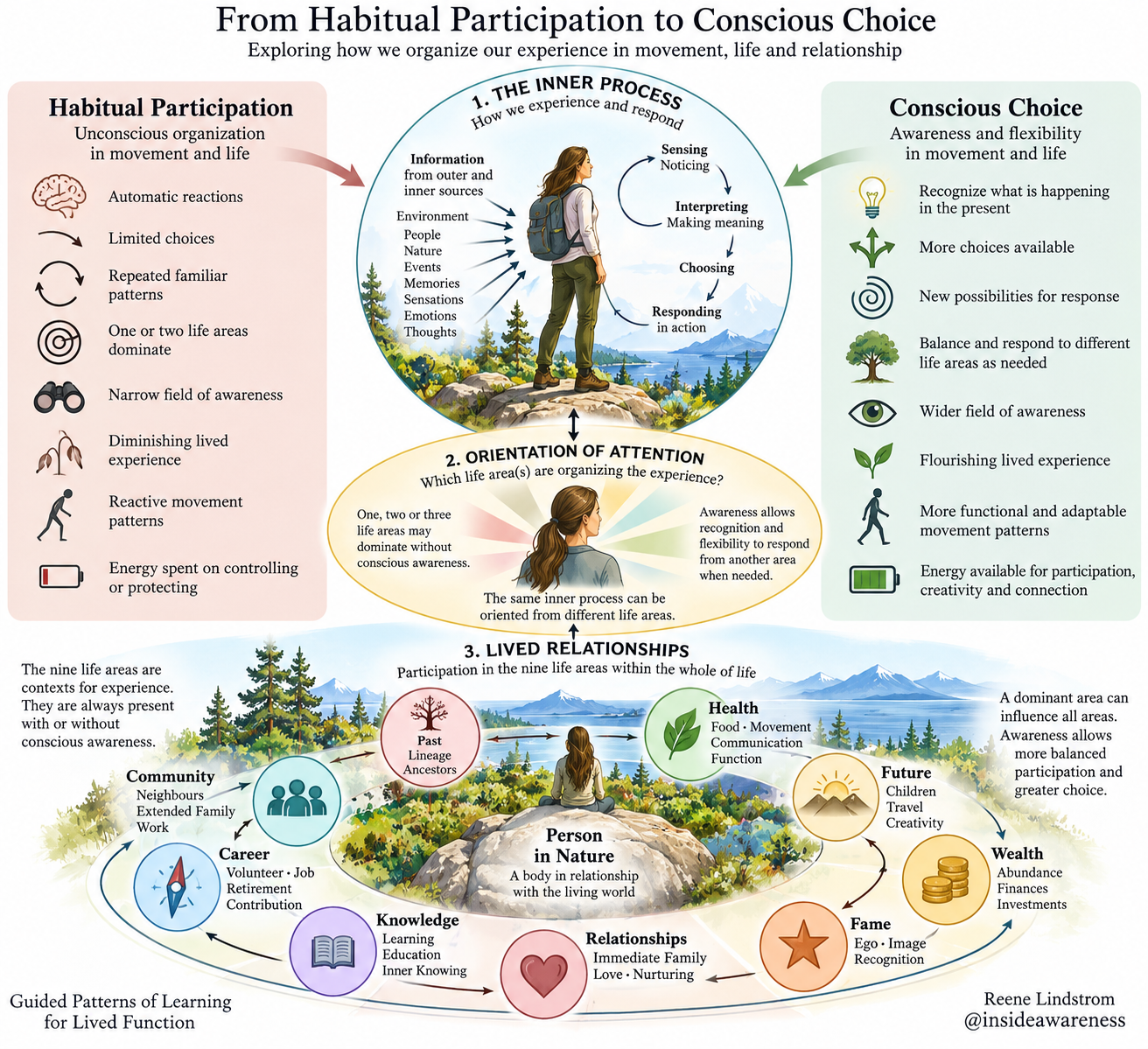
I wanted to share some updates with you that I may not have brought up outside of our focused integrations sessions, whether in movement, communication/relationships or spatialย awareness and placements.ย  For the past ten to 15 years years I have been integrating the interplay between these areas with a deeper focus on habitual or automatic behaviours and choices.ย  For the pastย two year’s this has shifted to writing it out in an organized way.ย  Beginning with the Learning Center Topics, starting with separatingย the nine life areas with an eye on behaviour and interactions.ย  There are somatic programs in each of these nine life areas to support the topic they are categorized under. Many of you may have participated in.

In 2026,  I will be launching a new system of interactive patterns in expressive communication where this separation of life areas will be a core focal point in the model.  These practical and actional patterns support an authentic somatic and empathic perspective.  As written by an actual somatic empath living within their interactive experiences 24/7.  Trust me, somatic and empathic expression in behaviour is not based upon the outside strategies of someone trying to describe them.  It is one of the influences towards developing a somatic learning system that goes beyond what is being described in current social conditioning trends. 

A companion book titled  ‘Somatic Archetypes’ will be available.  This will be a foundation pattern to support a practical reference to core reactive responses.  Practical in that they will focus on actionable somatic understanding and not have any focus on evaluative expressions or right or wrong thinking.  The intention is to marry this understanding in active interactions in the moment.  The shift includes somatic engagement, versus old thinking patterns of social conditioning that shifted focus away from it in organized institutionalized education.

A new understanding of social conditioning has emerged with a powerful influence to cut through a term I learned in meditation, spiritual materialism. This is a result of the practices of functional integration and mentoring in how to speak authentically and with integrity that began in 2002. Spiritual materialism is an evaluative expression for the ego self-image.  In Feldenkrais, there is an understanding of an inner felt self-image that supports a new defining inner experience of it that isn’t built up through socially conditioned learned reactions that are focused on materialism through strategies.  Rather, it has a focus on being present from within and sensing from the inside first before outward actions of functional movement or spoken words. This means leading through the felt senses consciously to replace leading through thinking.   

Renee Lindstrom @somaticlifestyleinnovator Channel on YouTube

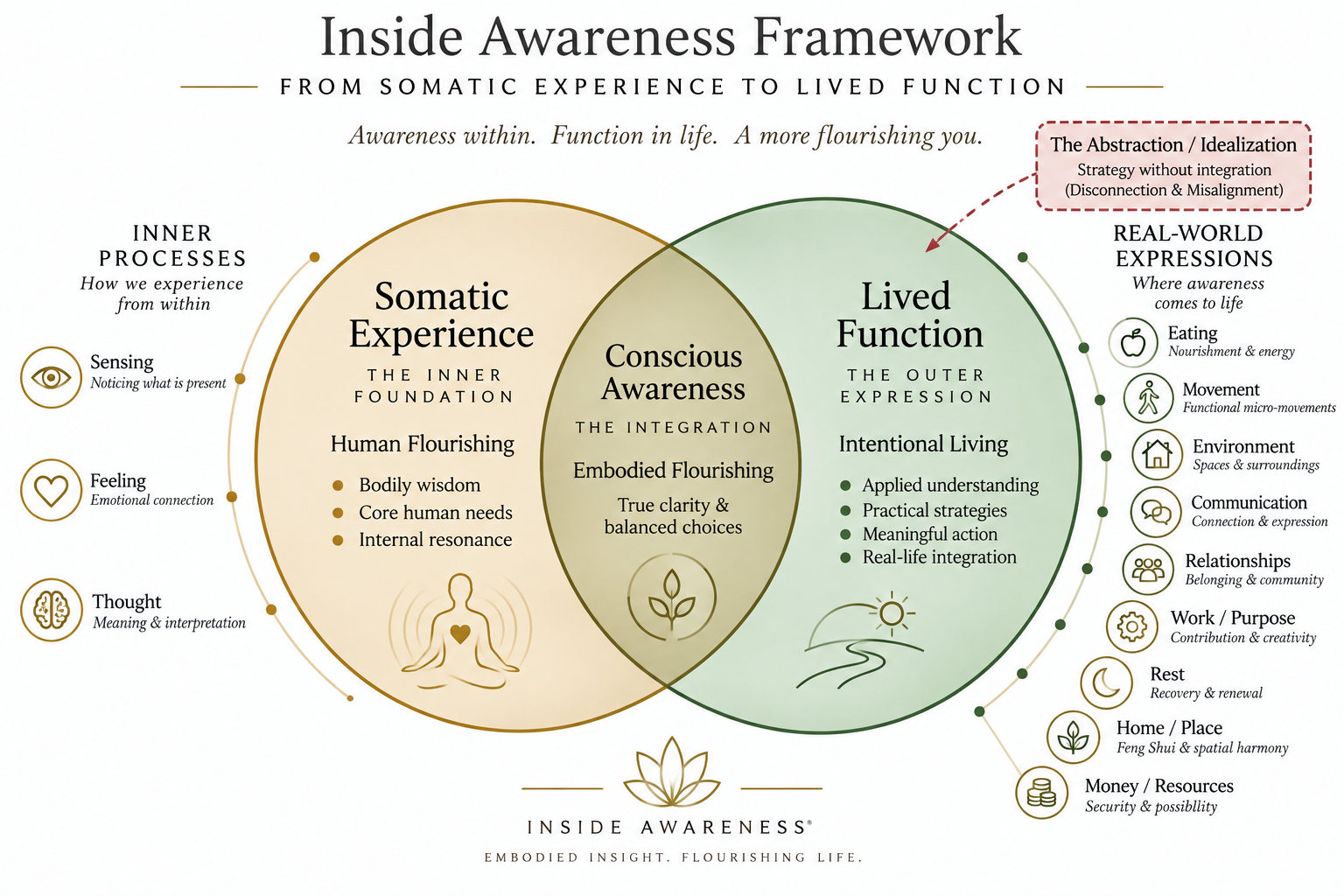
To support this upcoming launch, I have put my YouTube playlists in order. I have three channels. One has playlists to support the topics of the Inside Awareness Center for Integrative Somatic Learning. (Pictured above).  This includes the nine life areas broken into separate playlists. ie. Feldenkrais is in the Health Center. It is joined by Communication and Eating Plans. In these playlists, you will see early attempts to engage people to shift their focus of attention. For example, the #yyj Nature Walks, which is under the playlist of knowledge. There is also the Culture of Value program for early childhood development in that playlist that demonstrates the first stages of its development. The other channel is in my name, and it is for somatic innovation. The focus was to connect to the environmental triggers that stimulate types of behaviour to educate. 

Podcast

Finally, the third just started this past summer and fall, is my podcast.  Currently, it is voice audios of articles I have written to lay a foundation.  It will evolve and expand to include lives and interviews.  

As a dominant somatic empathic learner myself, I have first-hand experience in the alienation of children and adults with these learning styles. There is very little consideration given to the value of these learning styles and in fact, they are categorized, labelled and diagnosed as conditions, with an aim to drug and eradicate the differences they display to the expectation in the tightly defined patterns of Institutionalized education. Patterns that were designed for learning concepts with ease and little variance in the organized structure. This cognitive focus included debate-style communication development that lacked empathy training. In this context, empathy training is the skill development for good listening patterns where the core inner response is an interactive, flexible, and open-minded process, versus the closed-mindedness that results from judging the context of what is being heard as right and wrong based upon personal judgment and understanding.  


The programs at the Inside Awareness Center for Integrative Somatic Learning are focused on a mindfulness that balances both sets of needs of the cognitive style interpretation, and the somatic and empathic. It harnesses all components through functional integration of the physical body working in partnership with the emotional responses that generate the filter for thinking.

The intention for these YouTube platforms is to build an audience and to develop financial opportunities that will support this focus on somatic education.. Until now, I have funded it with my time and energy. I look forward to taking it to the next level. I am hoping you will consider viewing my channels, liking and subscribing to help build this lofty goal. If the content appeals to you, I hope you will share it to support getting a buzz going on these topics.

The following are the links to the YouTube channels. Please keep in mind, these are early developments that have been a learning process and for the process to grow a level of comfort and ease in being on stage. The last link is to a page on the Inside Awareness Center for Integrative Somatic learning explaining the nine life areas that are the core foundation in my perspective of functional integration, somatic dialogue and spatial awareness.

Center for Inside Awareness @ https://www.youtube.com/@somaticlifestyleinfluencer/playlists

Article of explanation @ https://wp.me/p17H3e-h6I

Renee Lindstrom – somatic lifestyle innovator @ https://www.youtube.com/@somaticlifestyleinfluencer/playlists

Renee Lindstrom – Podcast @ https://www.youtube.com/@somaticlifestyleinfluencer/playlists


Feldenkraisยฎ Practitioner ’07, Communication & Empathy Coach, Art of Placement

Mastery of Fear & Anxiety stimulated by the physical environment of pain, from memories of past pain somatically

by Renee Lindstrom, GCFP, Author of Somatic Archetypes

On Podcast – @ReneeLindstromofficial

Since 2007, this author has had the opportunity to work with people who have had long-term chronic physical pain. In these cases, the body has been the environmental stimulus to inner messages and emotional responsive reactions. Usually, in Canada, people in these circumstances will seek out acute care to resolve the pain complaints. In some cases, the results of seeking solutions can backfire. The backfire comes from the interactive seeds of socially conditioned language. In this health wellness area, physical constraints from pain, the evaluative assessments by practitioners are conceptual and focused on fixing strategies. Sometimes this works, and other times it doesn’t. It only works with certain personalities. In some personalities, it increases anxiety. The current socially conditioned language is such that some people take it personally, which essentially means internalizing it. Others brush it off. Both responses have their peculiar consequences.

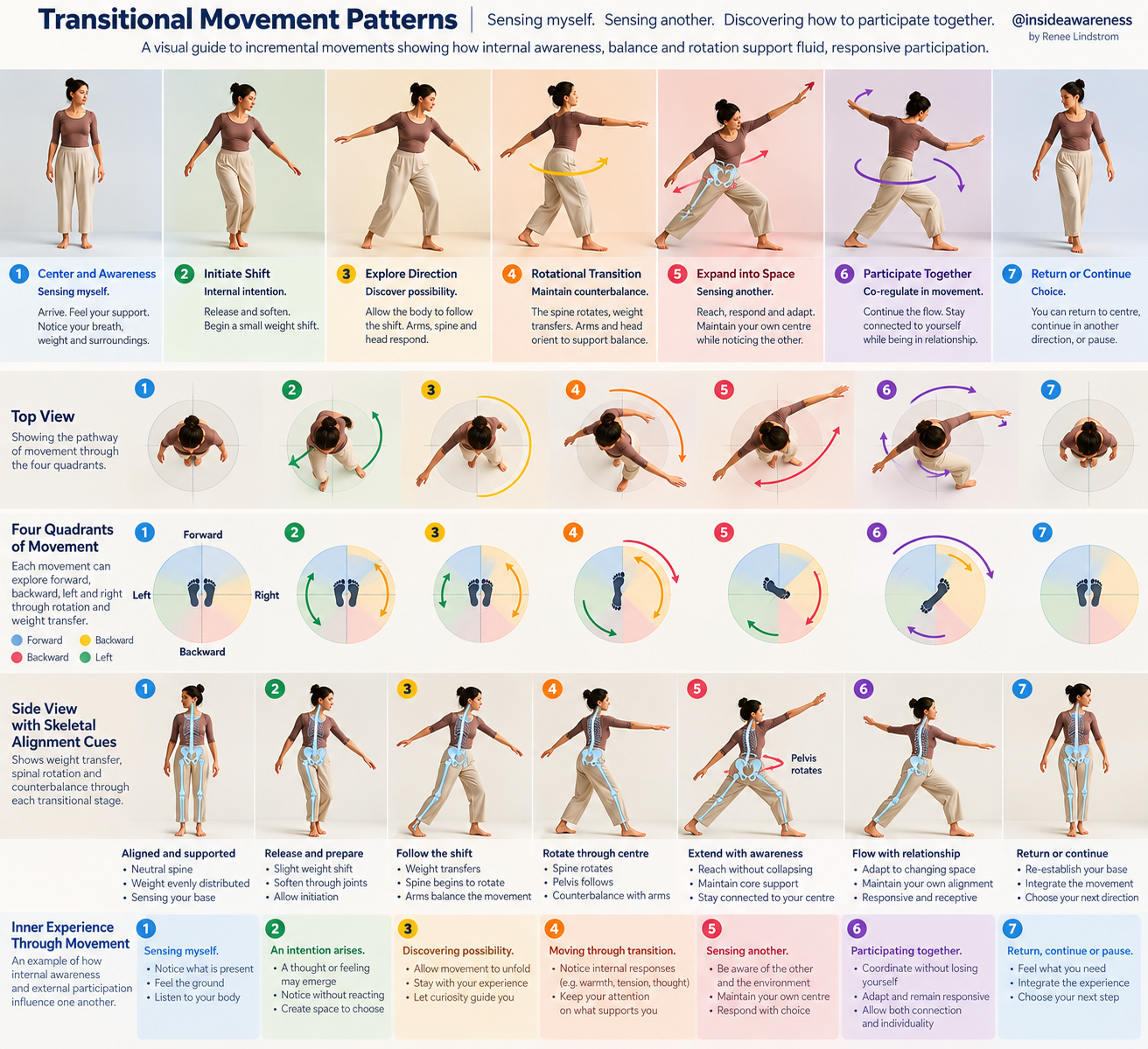
There is another communication perspective that is grounded in somatic awareness. In this form of communication, it starts where you are in the moment. It is not conceptual. This means the first focus is not on labelling and diagnosing, it is on the behaviour. Yes, physical function has a behaviour! It’s called one’s posture and postural transitions.

Here is an example I have created to demonstrate what a somatic response might be. It’s not based upon anyone in particular. In this example, someone is seeking understanding, support and reassurance after the disillusionment of conceptual assessments and labelling………

Here is my written response:

  • Nerve pain assessment:

With regards to the nerves in these circumstances, they were the last to be ignited from the environmental stimulus contributing to their flare-up.  Stands to reason, if the environment calms down, they will as well.

  • Somatic perspective of integration between mental, emotional and physical:

I am going to respond from a meditative mindfulness perspective.

You’re triggered. Something has happened that has stimulated past reactions to old injuries and events in your life that have come forward into the present.  Perhaps not with conscious awareness in a way to catch yourself, however, somatically.  It’s a somatic response directing your focus of attention through reactive conditioning.  A reaction that is familiar and shaped by past events (muscle, mental and emotional memory).  Does it present in the way that has been suggested?  Perhaps to someone who has learned to diagnose and label living experiences as conditions.  

So, let’s look at the past.  Yes, you have acute situations that have created a familiar pattern of response that has reared its ugly head due to the many factors all playing out at the same time.   Unfortunately, this means your physical body constraints in your movement patterns are similar to ones that have given you grief in the past.  Your responsive reaction is conditioned by those old experiences.  

How to engage your focus of attention differently? 

  • By shifting your focus of attention. 

Easy for me to write as I am not feeling the pain you’re having.  However, the hyper focus on it can increase the levels of discomfort more than 10-fold. 

How to shift your focus of attention? 

  • By changing the thought sentence structure in your inner mental pattern of thinking.  

Shift what if, or ……(whatever you’re saying to yourself), to, I have been here before and moved forward out of it. 

Your new mantra, “I have been here before and moved forward out of it.  I have been……..”

Micro Movements to shift focus of attention for calming the nervous system

The hyper focus is an aspect of your brain that is an alarm.  It is a warning system of the brain, and right now, yours is in a glitch as all sorts of events have hit all at once.  In meditation, we would focus on our breath.  This is the absolute hardest when experiencing this glitch.  

2.  So, move your body in the breathing patterns I have shown you.  This is where the body’s micro movement abilities can come in differently and play a big part in calming this glitch down.  Right now, the glitch is telling you an elusive story that your body is letting you down, and it’s not your safe haven in the moment.  So let’s change it.  The body can be fluid or it can be rigid through the constraints conditioning it.  Your body has gone into constraint due to circumstances.  That’s all. 

  • What do we know from past interactions? 

The physical function is not isolated from the emotional reactions and thought stories in our mental process.  It’s all one process,  all stimulated together and interplaying off one another.  Your glitch is your emotions reacting to the stories you are telling yourself.  What you’re telling yourself is stimulated by the real felt patterns you are somatically aware of.  The mantra above is what you tell yourself immediately upon catching yourself having these thought patterns that are not based upon the felt senses in the moment. 
  • Why?

You can take care of yourself.  You’ve done it before and have a historical pattern of it.  You are identifying the past and what didn’t work, now identify what did.  Balance it out. See number 3.

3.  In meditation, we learn to create gaps between our thoughts to calm our thoughts that run together and create havoc in our emotional responses.  We learn that thoughts in our mind run through in patterns that are not logical.

So we focus on our breath in sitting and watch these damn thoughts while attempting to become present in the moment.  Soon, we notice that the thoughts slow down.  I mean they, ….slooooowwwwwww down to the point of having significant spaces between them.  That’s when the magic happens.  That’s when somatically, the connection to what is really happening can be experienced.  This is when you learn, the thoughts are the illusion.  They have you spinning in circles, trying to catch your tail.  In these gaps you see, hear, touch, smell and taste batter.  All of a sudden, you can begin observing and taking in so much more information that is restricted by the thinking patterns you have learned.  That all thinking is – learned patterns of thought.  They are not real!  They are your perspective based on old information and learning. 

  • Let’s look at what’s real. 

Your skeleton is real.  It’s the strongest part in your body and lasts centuries after everything else is gone.  Begin to adjust through the skeleton.  However, if the pain and fear are too great, begin by focusing on your out breath. 

  • As you breathe out, count, starting at one. 

Each exhale will be different.  Redirect your mental function by giving it this job.  Count your breath. 

  • Get a straw and exhale through the straw.  Get your mental function to set a time for one minute and count the number of out breaths in that one minute. 
  • Then continue to exhale through the straw without counting for another 2 minutes. 
  • Come back and exhale while counting again, and notice if the number has changed from the first time.  Notice if the breath out is slower, longer and if there are spaces in between.

Come back to it many, many times to train your brain with this pattern.  Integrate it.  Do it in times of non-fear to have it as a tool in your kit for when you are. 

When you are in fear, focus on the exhalation, not the in breath. 

Recap

We have a mantra, a perspective and a pattern of breathing.  This will calm your nervous system and the glitch to create a new starting point.  In this new starting point, your constraints,  physically, mentally, and emotionally, can begin to limber up, increasing your windows of tolerance.  

We have been through these cycles together before.  You have this somatic experience, yet right now you are in a moment of old thinking that there is an acute care that will resolve this outside of you. It is an old pattern seeking relief and reassurance.   That’s just one focus of attention that is decreasing the window of tolerance.  Start by building the window of tolerance from inside.  You’ve got this.  I have witnessed it. 

You’ve got a few people to sit in this with you to begin to build up your levels of tolerance.  Recently, you’re strategies in bringing new people on board while in the acute stages didn’t support you rather added to deconstructing it.  

Follow Renee’s podcast and stay up to date on somatic learning, from the inside out.

@ReneeLindstromofficial

Please like and subscribe

Follow on socials:

Follow on Facebook, LinkedInInstagram, TikTok, X Pinterest,  Tumblr

Feldenkraisยฎ Practitioner since 2007, Communication & Empathy Coach since 2004, Art of Placement since 2001