
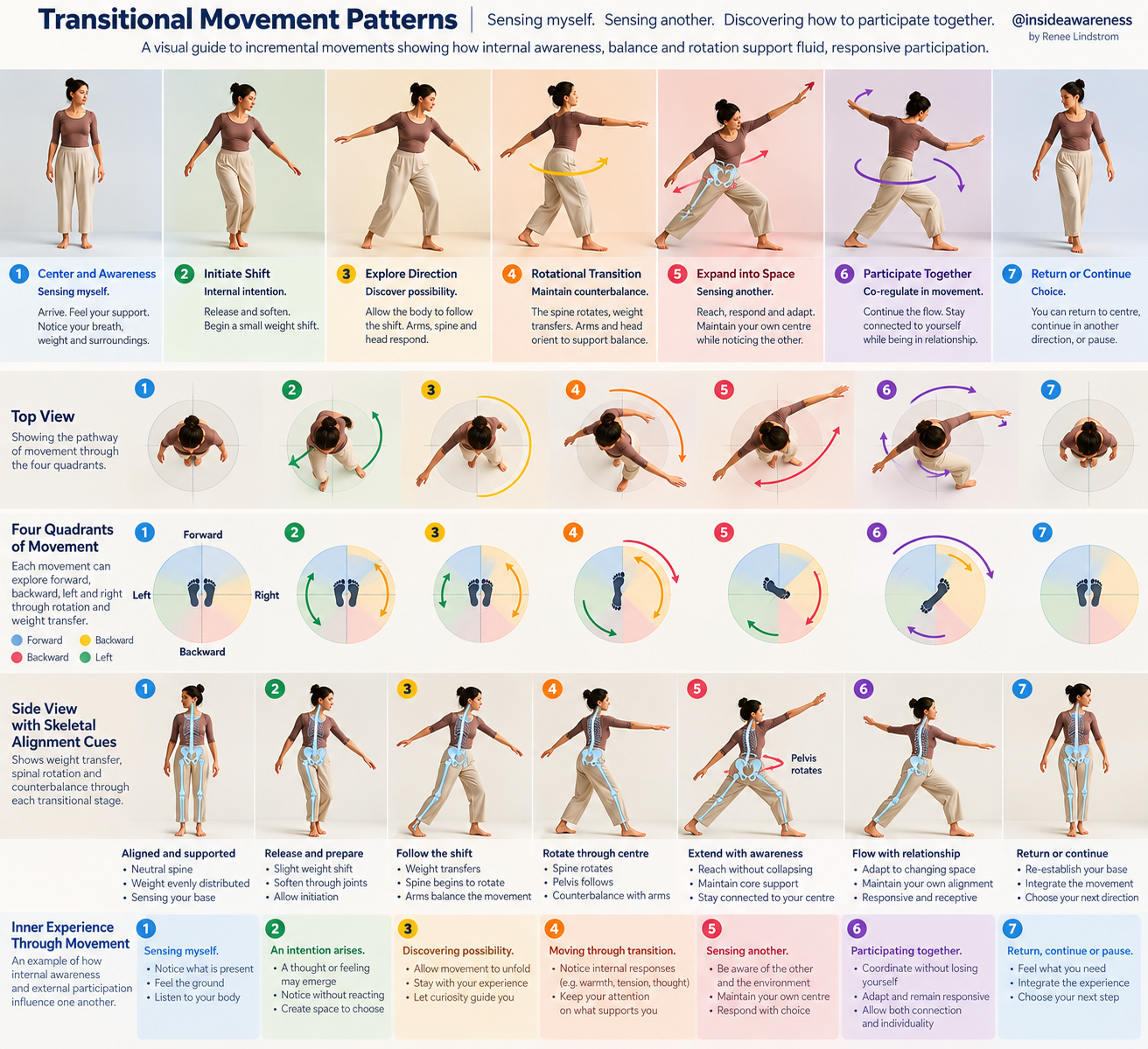
Transitional Movement Patterns
Guided Patterns of Learning for Lived Function
Sensing myself. Sensing another. Discovering how to participate together.
For nearly twenty years, my exploration of balance has developed through teaching, observing, and listening to the unique ways individuals organize themselves in movement.
Throughout these years, I have become increasingly interested in the transitions between movements rather than the completion of individual exercises or postures.
How does the skeleton organize itself to transfer weight? What happens as we change direction, rotate, reach, or shift from one supporting leg to another? How can an awareness of gravity, skeletal support, and counterbalance offer new possibilities for movement with less unnecessary muscular effort?
These questions have gradually influenced the development of Guided Patterns of Learning for Lived Function.
More recently, I have begun recognizing something unexpected within my own spontaneous movement. As the relationships between skeletal support, rotation, and counterbalance become increasingly familiar, movement can begin to flow creatively, almost like a dance.
This expression is not intended to reproduce an established dance form, yoga posture, or tai chi sequence. Rather, recognizable shapes may emerge naturally through the exploration of functional movement relationships.
The accompanying diagram, Transitional Movement Patterns, introduces some of these possibilities through incremental illustrations of movement, including side-view skeletal relationships.
For participants in my Balance classes, these images may offer an alternative to remembering a list of exercises. They can become visual invitations to recognize how the body organizes itself through movement, allowing each person to explore within their own abilities and circumstances.
An additional direction is emerging through this work: the relationship between internal sensory awareness, the surrounding environment, and participation with others.
What happens to our spontaneous movement when another person enters our experience? How do our internal interpretations influence the way we move, respond, or choose to act?
These questions are beginning to connect the movement patterns with my developing explorations of inner language, listening, and conscious recognition.
I am also considering how these foundational movement relationships might be introduced in early childhood education, supporting opportunities to develop sensory awareness, movement choice, and participation in relationships from an early age.
This is an evolving exploration rather than a completed system.
My intention is to create accessible learning experiences that invite curiosity, encourage individual discovery, and support the integration of awareness into ordinary lived function.
The focus is not on achieving a particular movement. It is on discovering the relationships that make movement possible.
Renee Lindstrom
@insideawareness
Read more on:
Follow socials:
Copyright 2014 – 2026
Feldenkrais®, Feldenkrais Method®, Awareness Through Movement®, and Functional Integration®, are registered service marks of North America. Feldenkrais Method®
Discover more from Inside Awareness Center for Integrative Somatic Learning
Subscribe to get the latest posts sent to your email.




Pingback: Thanksgiving’s News — A Harvest of Conscious Recognition | Inside Awareness Center for Integrative Somatic Learning
Pingback: Temporomandibular joint syndrome: Jaw Release in whole body organization | Inside Awareness Center for Integrative Somatic Learning