
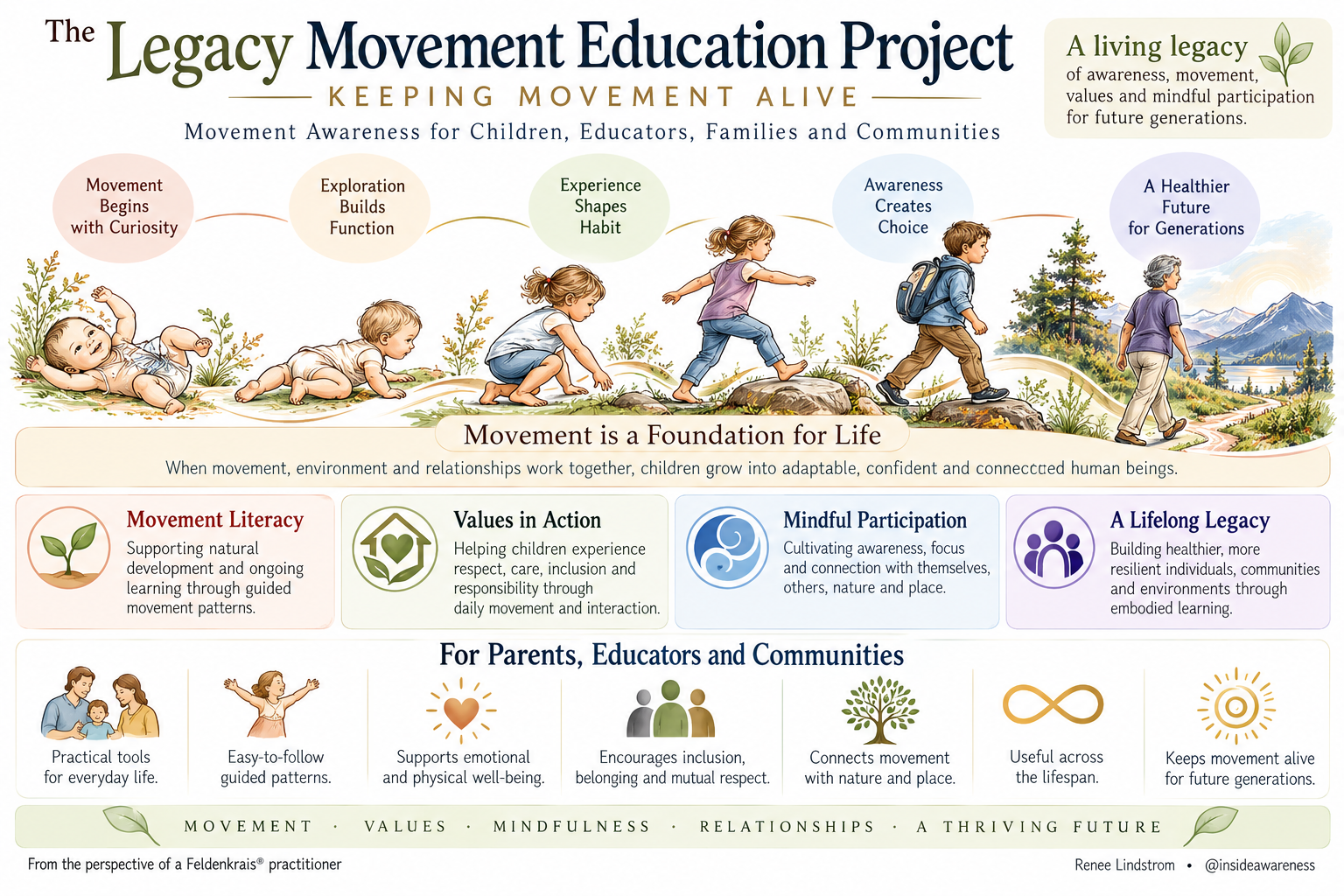
The Legacy Education Project — Keeping Movement Alive
In January 2026, we announced our intention to develop a Legacy Education Project. The seeds of this initiative were planted in the autumn of 2025 and given time to rest and take shape through the early winter months. Spring and summer became a period of reflection, exploration, and planning. Now, as the project begins to take form, some of this work is reflected in the illustrated workshop materials for parents and educators shared below.
These materials introduce relationships between the natural movement patterns of early childhood development and the guided movement explorations offered throughout adulthood and aging.
Children develop through movement, sensory experience, and growing awareness, often long before they can articulate what they are learning. As we age, guided opportunities to explore these familiar relationships can help transform awareness into conscious recognition, expanding possibilities for movement, balance, and everyday function.
Our intention is to nurture continuity in this relationship with movement and learning throughout life.
We invite you to explore the program information and share these materials with parents, early childhood educators, teachers, and others who support children’s development.
We also welcome inquiries about bringing this educational perspective into your community through workshops, mentoring, consulting, or individual coaching. If you feel inspired to contribute in other ways—through collaboration, sharing resources, offering feedback, or supporting the project’s development—we would be delighted to hear from you.
A legacy of conscious recognition, not simply a legacy of information.
Renee Lindstrom · @insideawareness
Learn more through the Keeping Movement Alive Program picture descriptions below
Supporting the Continuity of Movement Awareness from Childhood Through Life
A legacy of awareness, not simply a legacy of information. 🌿
“Children are already learning through movement. Our opportunity is to help that awareness remain alive.” The Legacy Education Project is not about introducing children to something they lack. It is about recognizing and nurturing something they already possess. Legacy is reference to the intention to preserve a relationship with movement that children are already developing, so it can remain available as their learning environments change.
An Educational Resource for Parents and Educators created by Renee Lindstrom, a Feldenkrais® practitioner since 2007, whose approach is informed by Nonviolent Communication, Tibetan Buddhist meditation practices, and Buddhist-inspired Feng Shui philosophy emphasizing our relationship with nature.
Learning exploration patterns for integration becomes continuity through living
1. Integration through Movement (guided patterns)
- Attention shifts toward felt experience.
The learner explores movement, recognizes differences, and discovers possibilities without needing to arrive at one predetermined response.
2. Integration through Communication and Relationships (recognition and exploring new patterns)
- The same quality of attention becomes available in interaction.
The learner listens, notices responses, recognizes habitual interpretations, and explores possibilities without immediately imposing conclusions.
3. Continuity WITHIN LIVED FUNCTION @insideawareness
- LegacyLived Function
The pattern of learning is no longer confined to the lesson. It becomes a way of participating in everyday experience.
Continuity of Awareness
Continuity of awareness is the capacity to remain connected to one’s sensory experience, curiosity, and capacity for learning while moving between different activities, relationships, and environments. continuity does not require uninterrupted awareness. Losing connection, recognizing it, and returning to inquiry can also be part of the learning.
The learning quality remains available as the context changes. Shown in the following life relationship experiences:
Environmental Experience
- Noticing how stimulus influences sensation and response.
Movement Exploration
- Recognizing changing relationships through felt experience.
Communication
- Listening to words, responses, meanings, and differences.
Relationships
- Maintaining curiosity while participating with another person
Group Learning
- Allowing the learning environment itself to remain open to discovery.
Movement Awareness Literacy for Children, Educators and Families
Keeping Movement Alive 🌿
An educational perspective concerned with preserving the child’s natural capacity to learn through movement, while helping adults recognize and support that capacity.
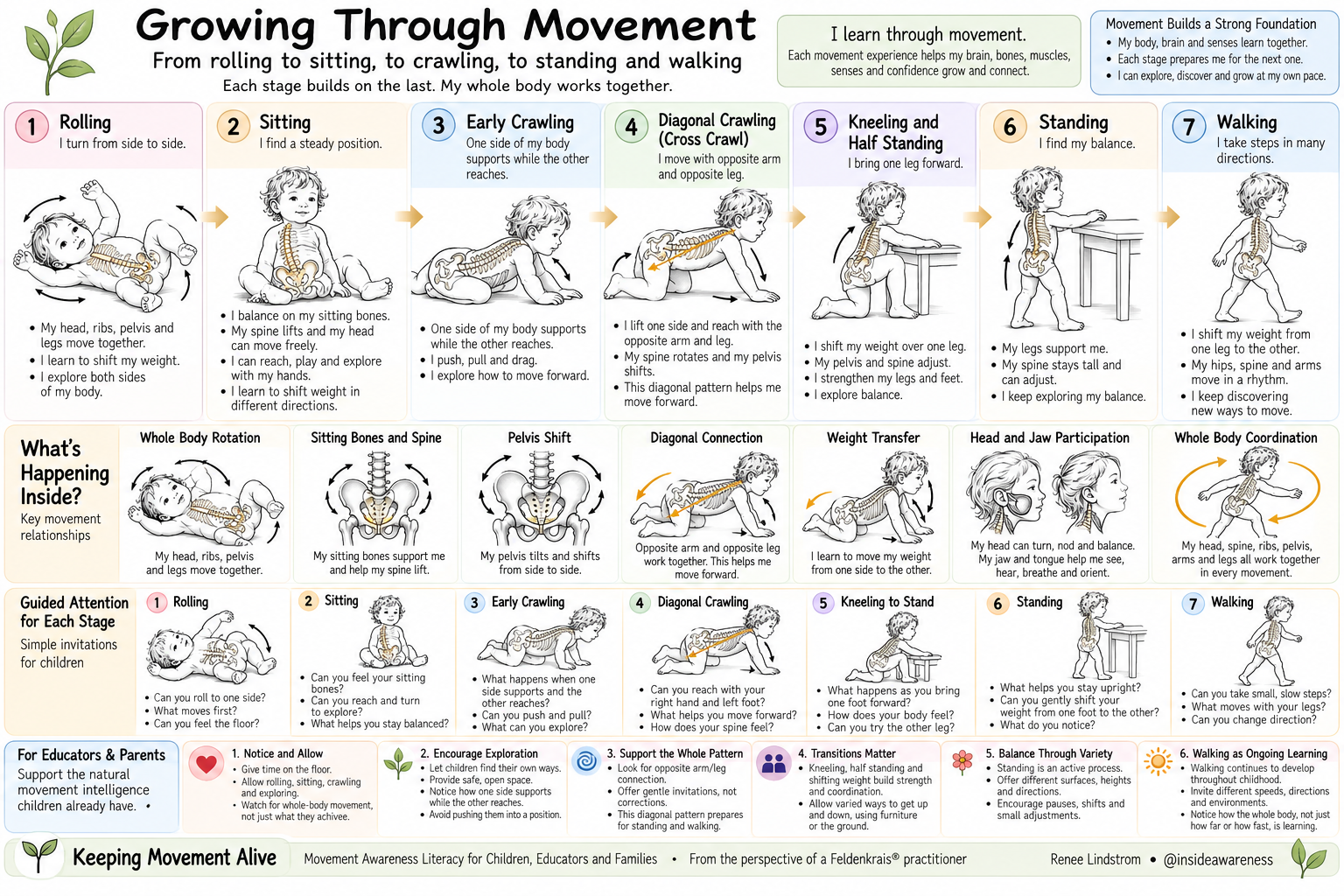
Movement possibilities of self learning are demonstrated in this poster
This illustration brings together the transition from rolling to crawling, diagonal coordination, standing, and walking, with guided attention for children and companion observations for adults.
Keep in mind that children discover mobility in different ways, and the intention is to preserve curiosity rather than introduce another standard of achievement.
For Parents and Educators – From the perspective of Renee Lindstrom, Feldenkrais® practitioner (2007), integrating insights from Nonviolent Communication, Tibetan Buddhist meditation, and nature-centered Feng Shui philosophy. @insideawareness
Listening to the Skeleton
- The environment participates in movement learning.
Chairs, desks, instructions, expectations, and daily routines influence the movement strategies children develop. When these strategies are repeated without opportunities for exploration, some may become habitual.
Movement awareness literacy invites children and adults to recognize how the body receives support, changes position, and adapts to its surroundings.
The intention is not to prescribe ideal posture, but to preserve the ability to discover different ways of organizing movement throughout life.
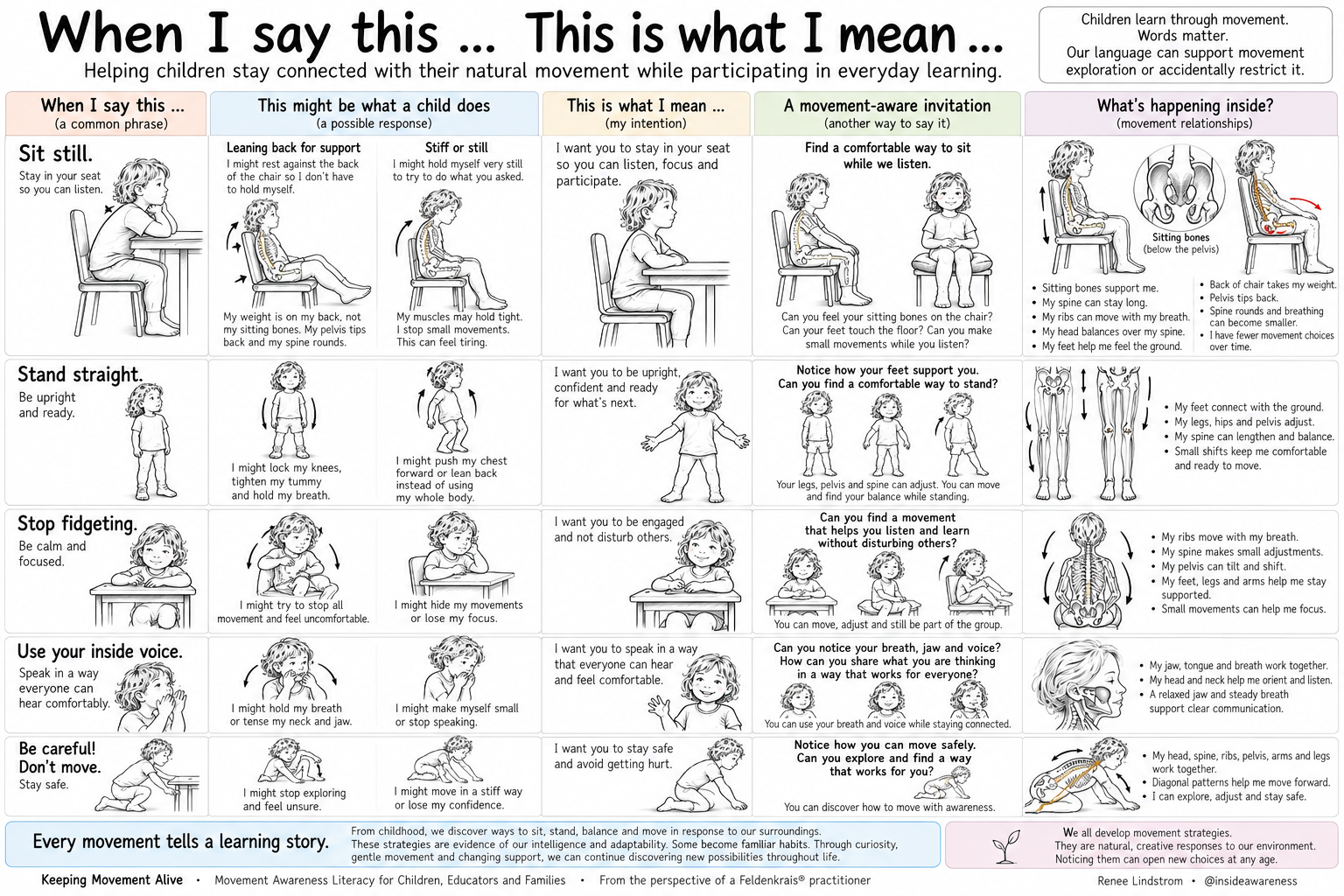
- Every movement tells a learning story.
The poster introduces the relationship between the words adults use, the movement strategies children develop in response, and the habits that may emerge through repetition
From childhood, we discover ways to sit, stand, balance, and move in response to our surroundings. Some strategies become familiar habits. Through curiosity, gentle movement, and changing support, we can continue discovering possibilities throughout life. The intention of exploring what we say…. This is what I mean…. is to help adults recognize that the words they use can influence the movement strategies children develop, while offering language that preserves exploration, choice, and sensory awareness.
For Parents and Educators – From the perspective of Renee Lindstrom, Feldenkrais® practitioner (2007), integrating insights from Nonviolent Communication, Tibetan Buddhist meditation, and nature-centered Feng Shui philosophy. @insideawareness
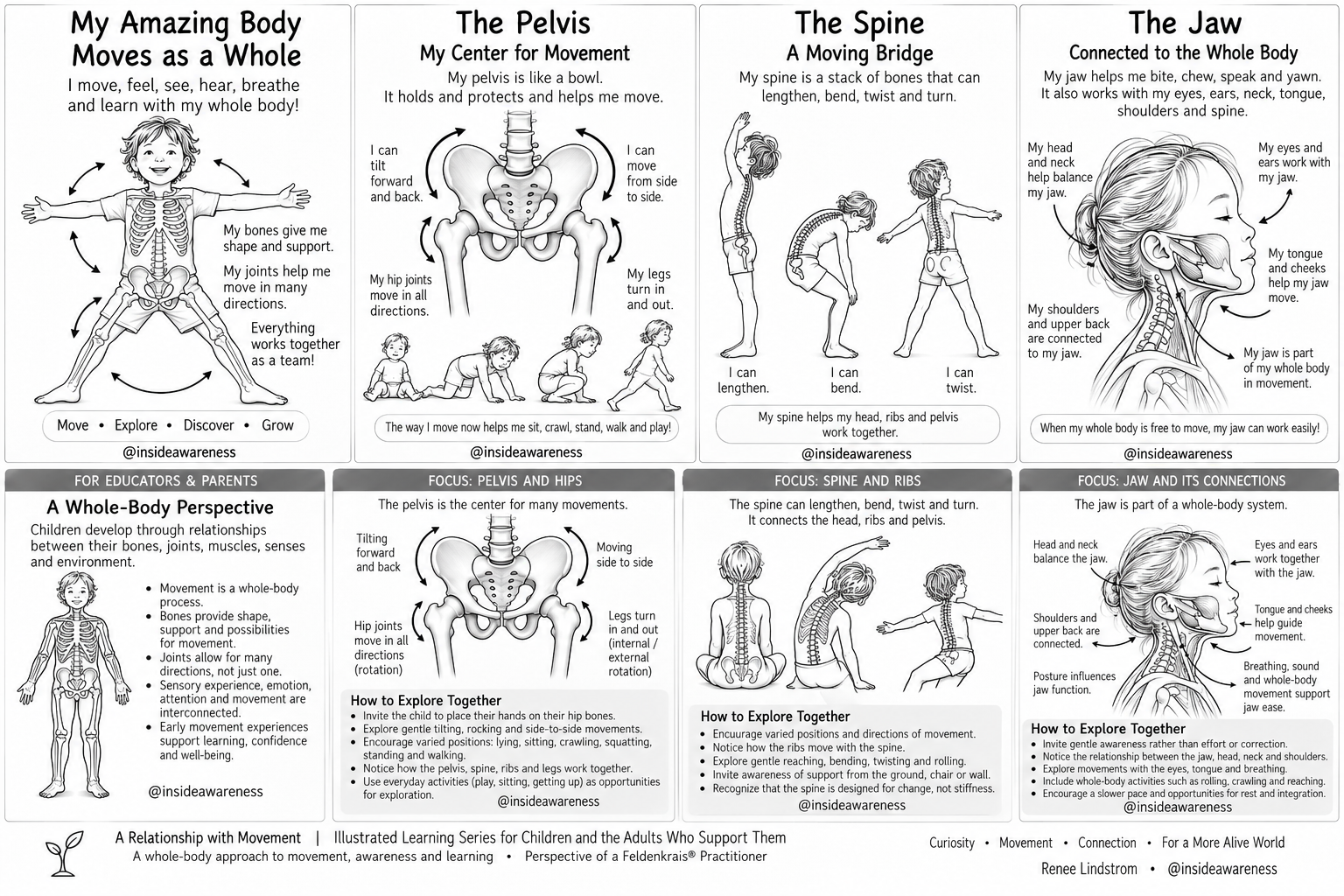
A Relationship with Movement – Illustrated Learning Series for Children and the Adults Who Support Them
A whole body approach to movement, awareness and learning
For Parents and Educators – From the perspective of Renee Lindstrom, Feldenkrais® practitioner (2007), integrating insights from Nonviolent Communication, Tibetan Buddhist meditation, and nature-centrred Feng Shui philosophy. @insideawareness
“We Learn to Move Through Experience — and We Can Keep Discovering New Ways.”
”Movement Awareness Supports Learning at Every Stage of Life
Legacy Learning is a beautiful thread through the lived experiences of all ages. The connection between intention, skeletal support, and finding a new direction is woven through the series.
The relationship between furniture, adult expectations, and how a child learns to organize skeletal support. An eample:
The chair is not simply an object in the learning environment. It becomes part of the child’s movement experience.
What happens when one way of sitting becomes the dominant, unquestioned habit, particularly when a child is repeatedly asked to remain still. A child may learn to associate sitting with fixing the body in position, rather than discovering the many ways the skeleton can organize support.
The difference between sitting and being supported
When a child leans against the back of a chair, some of their trunk weight is transferred through the backrest rather than being managed entirely through the pelvis, sitting bones, feet, and active postural adjustments.
That is not inherently harmful. Backrests can provide useful support, and resting against one is a normal sitting option.
What happens when one way of sitting becomes the dominant, unquestioned habit, particularly when a child is repeatedly asked to remain still.
A child may learn to associate sitting with fixing the body in position, rather than discovering the many ways the skeleton can organize support.
The distinction is not between correct and incorrect sitting. It is between having movement choices and relying on one habitual organization without recognizing alternatives.
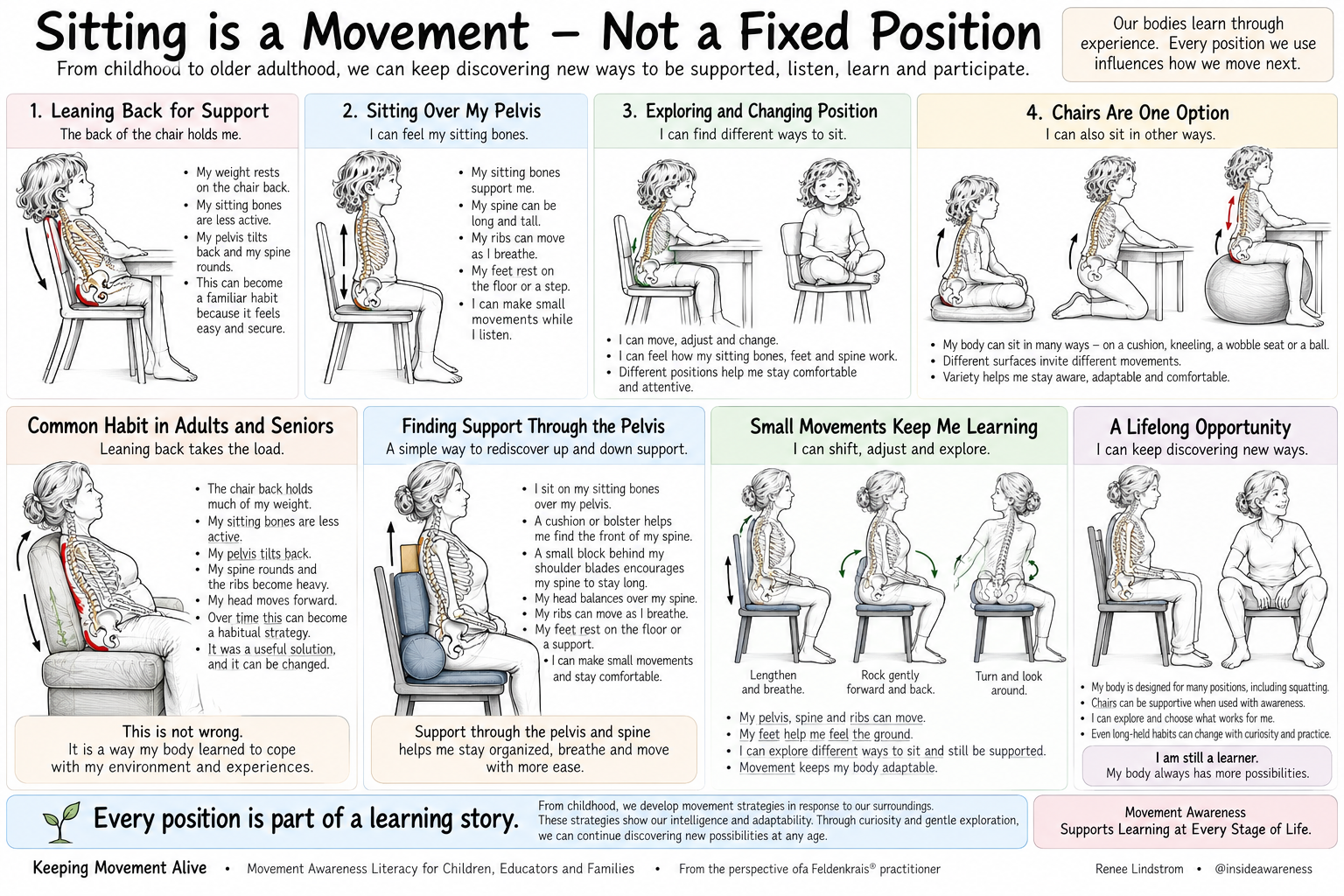
Every movement tells a learning story.
From childhood, we discover ways to sit, stand, balance, and move in response to our surroundings. Some strategies become familiar habits. Through curiosity, gentle movement, and changing support, we can continue discovering possibilities throughout life.
A habitual movement strategy in aging adults is evidence of earlier learning, not a failure to learn. What was useful or familiar in one circumstance may be worth exploring again as circumstances change. For example:
As one ages there may be a need to experience a different relationship between the shoulder girdle, spine, and pelvis that is relevant for support to discover something that may no longer recognize easily. The intention is not simply to sit straighter. It is to explore how one’s trunk can be organized over the pelvis, how support can pass through the sitting bones, and how small movements remain available.
For Parents and Educators – From the perspective of Renee Lindstrom, Feldenkrais® practitioner (2007), integrating insights from Nonviolent Communication, Tibetan Buddhist meditation, and nature-centred Feng Shui philosophy. @insideawareness
From Awareness to Recognition
Awareness invites us to notice how we are supported. Recognition grows as we explore these relationships through movement, discovering new possibilities for balance, choice, and everyday function.
“When we notice how we are supported, movement becomes an opportunity for discovery. Through exploration, awareness grows into recognition, opening possibilities for balance and everyday movement.”
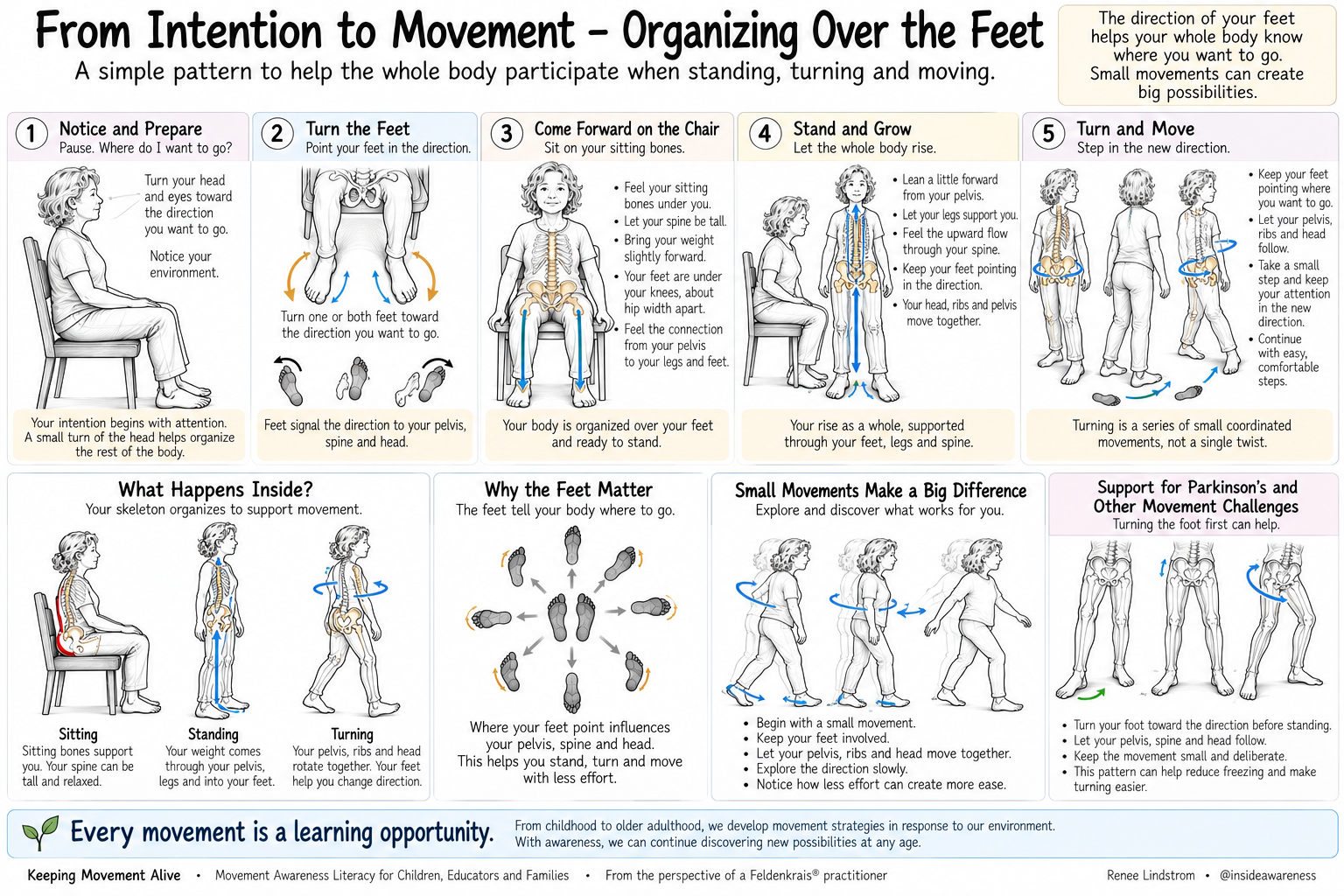
Awareness: I notice where my weight rests.
Exploration: I discover how my pelvis, legs, and feet participate as I shift.
Recognition: I begin to understand and feel how these relationships support my movement, and recognize that I have choices.
Expanding capacity: I can explore and use these possibilities in standing, turning, and walking.
For Parents and Educators – From the perspective of Renee Lindstrom, Feldenkrais® practitioner (2007), integrating insights from Nonviolent Communication, Tibetan Buddhist meditation, and nature-centered Feng Shui philosophy. @insideawareness
Follow socials:
Copyright 2014 – 2026 Renee Lindstrom, GCFP
Discover more from Inside Awareness Center for Integrative Somatic Learning
Subscribe to get the latest posts sent to your email.




Pingback: Motivation for the Legacy Movement Project | Inside Awareness Center for Integrative Somatic Learning
Pingback: Inside Awareness Legacy Project for balancing transition in early childhood somatic learning to conceptualized intellectualized learning | Inside Awareness Center for Integrative Somatic Learning