Discovering the pause between hearing and responding
Have you ever noticed how quickly a conversation can change direction?
Someone begins speaking, and before they have finished, we may already be forming a response. Perhaps something they say reminds us of an earlier experience. We may feel misunderstood, challenged or eager to explain our own perspective.
We begin responding to what we think the person means, sometimes without discovering what they were actually trying to communicate.
I have come to recognize how much of our listening can be influenced by what is already happening within us.
We don’t enter relationships without experiences of our own. We bring memories, expectations, values, feelings and familiar patterns of responding.
These inner experiences can influence what we hear, how we interpret it and what we choose to say next.
But what happens when we begin by listening to ourselves?
Discovering What Is Alive Within Us
Through my years of facilitating communication and Awareness Through Movement® learning, I have become increasingly interested in the relationship between our inner experience and our interactions with others.
I have observed that people can respond emotionally to what they hear before recognizing the meaning they have given it.
Sometimes our bodies are already responding.
Our breathing may change. We may notice tension in our jaw, chest or stomach. Our thoughts may begin moving toward explanation, correction or defense.
At other times, we may not recognize any particular sensation. We may simply notice an impulse to interrupt, withdraw or make ourselves understood.
These are opportunities for awareness.
The invitation is not to judge the response, suppress it or try to become calm.
It is to begin recognizing what is happening.
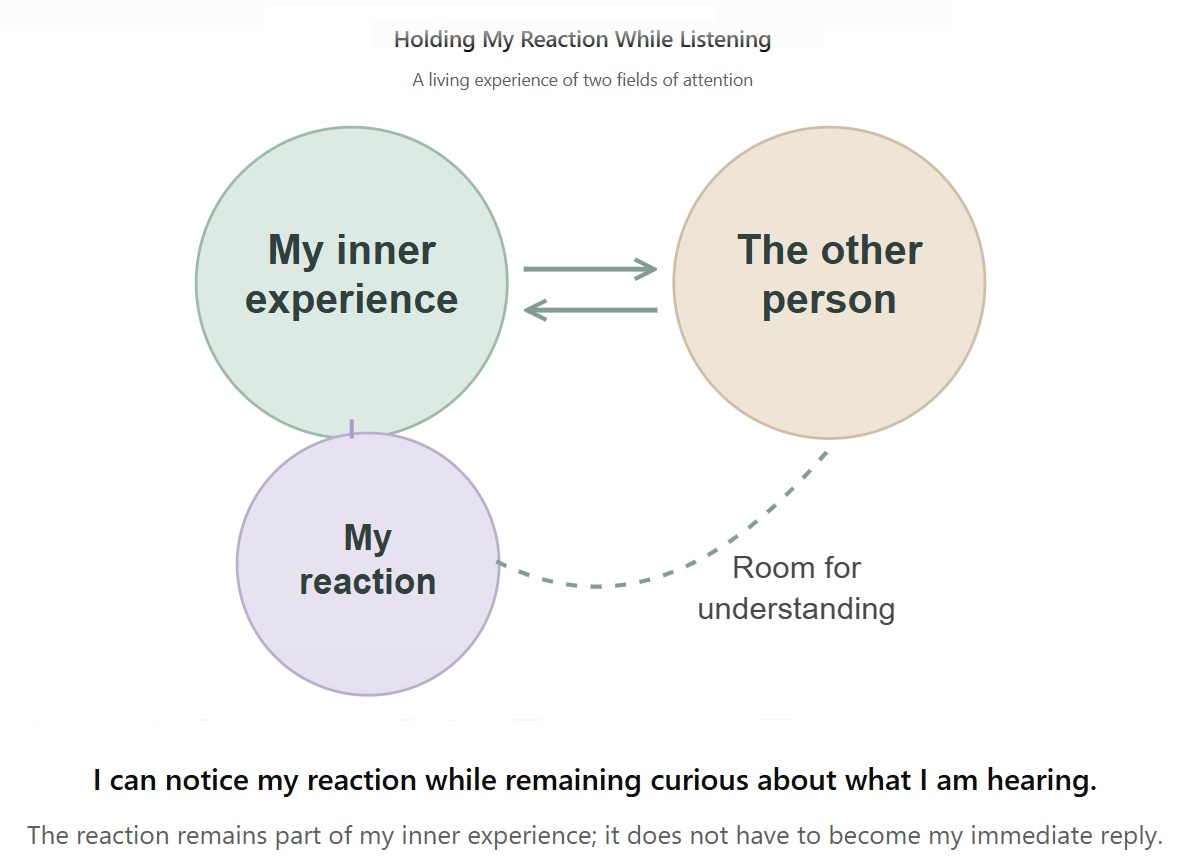
Can I notice my own reaction without immediately responding from it?
And might this recognition allow me to remain curious about what another person is communicating?
The Pause That Creates Possibility
In everyday conversations, we are rarely encouraged to notice the space between hearing something and responding to it.
We may be listening through an interpretation that feels so familiar and convincing that we assume it is what the other person intended.
Yet our interpretation and another person’s intention are not necessarily the same.
A pause gives us an opportunity to recognize the difference.
We might begin to wonder:
What did I actually hear?
What am I noticing within myself?
What meaning am I giving these words?
Have I checked whether I understood the other person?
The pause does not require us to abandon our own feelings, needs or values.
Instead, it can create room for both experiences.
We can recognize what is happening within ourselves while becoming curious about what is alive for another person.
Sometimes the most meaningful response is a question rather than an explanation.
And sometimes the pause helps us recognize that we need more time, support or distance before continuing.
Introducing The Listening Field
The Listening Field is a guided exploration of inner awareness and meaningful relationships.
It begins with self-connection.
Through sensory awareness, reflection and practical listening patterns, participants are invited to discover how their inner experiences influence their attention and responses.
The learning gradually moves from recognizing our own sensations, thoughts and reactions toward discovering how to remain connected to ourselves while listening to another person.
The guided journal provides opportunities for writing, drawing, sensing and reflecting. Simple diagrams and familiar patterns support the discoveries made through lived experience.
The program explores three interconnected areas:
Discovering Self-Connection
Recognizing what is happening within us, what has our attention and what supports our availability to listen.
Discovering Shared Listening
Recognizing our initial reactions and interpretations, reflecting what we hear and checking our understanding before responding.
Living Integration
Bringing awareness into meaningful conversations, recognizing what matters to each person and discovering new possibilities for participating together.
The intention is not to become a perfect listener or to eliminate emotional responses.
It is to develop a living relationship with our own inner experience and discover that we may have more choice in how we participate than our familiar reactions initially suggest.
Listening Without Losing Ourselves
One of the most meaningful discoveries in my own learning has been recognizing that I can experience an emotional response without needing to express it immediately.
I can acknowledge what is happening within me while continuing to hear another person.
Neither experience needs to cancel out the other.
This doesn’t mean that every conversation should continue. Safety, personal boundaries and the freedom to pause remain essential.
It means there is an opportunity to develop greater awareness of when and how we are available to listen.
When we begin recognizing our own inner process, we may discover that listening is more than hearing words.
It is a living relationship between sensing, thinking, interpreting and responding.
And it is through this relationship that new possibilities for understanding can emerge.
An Invitation to Explore
The Listening Field is part of the Inside Awareness guided learning programs.
It draws upon my years of experience integrating the Feldenkrais Method, Nonviolent Communication and contemplative practices into everyday learning and relationships.
The journal and facilitated explorations offer a supportive structure for discovering self-connection, listening and meaningful participation.
The patterns can be revisited in personal reflection, family relationships, partnerships and other everyday interactions.
They also provide a foundation for the next area of exploration: Listening and Speaking, where attention expands toward what leads our expressions and how we communicate what matters to us.
The invitation begins with a simple inquiry:
Can I recognize what is happening within me before responding to what is happening between us?
Perhaps this is where a new experience of listening begins.
I acknowledge the practices and teachings that have contributed to the ground from which this work has grown: Moshe Feldenkrais and the Feldenkrais Method® of somatic education; Marshall Rosenberg and Nonviolent Communication; Chögyam Trungpa Rinpoche and the Shambhala teachings; and Dyan Grant Francis, Subtle Energy Solutions and Black Sect Feng Shui.
These influences are acknowledged with appreciation for the learning they made possible, while the patterns and interpretations presented here reflect my own continuing inquiry, lived experience and educational development.