Cognitive – Somatic – Cognitive VS Somatic Cognitive (Adult leering versus early child development)
Recognition
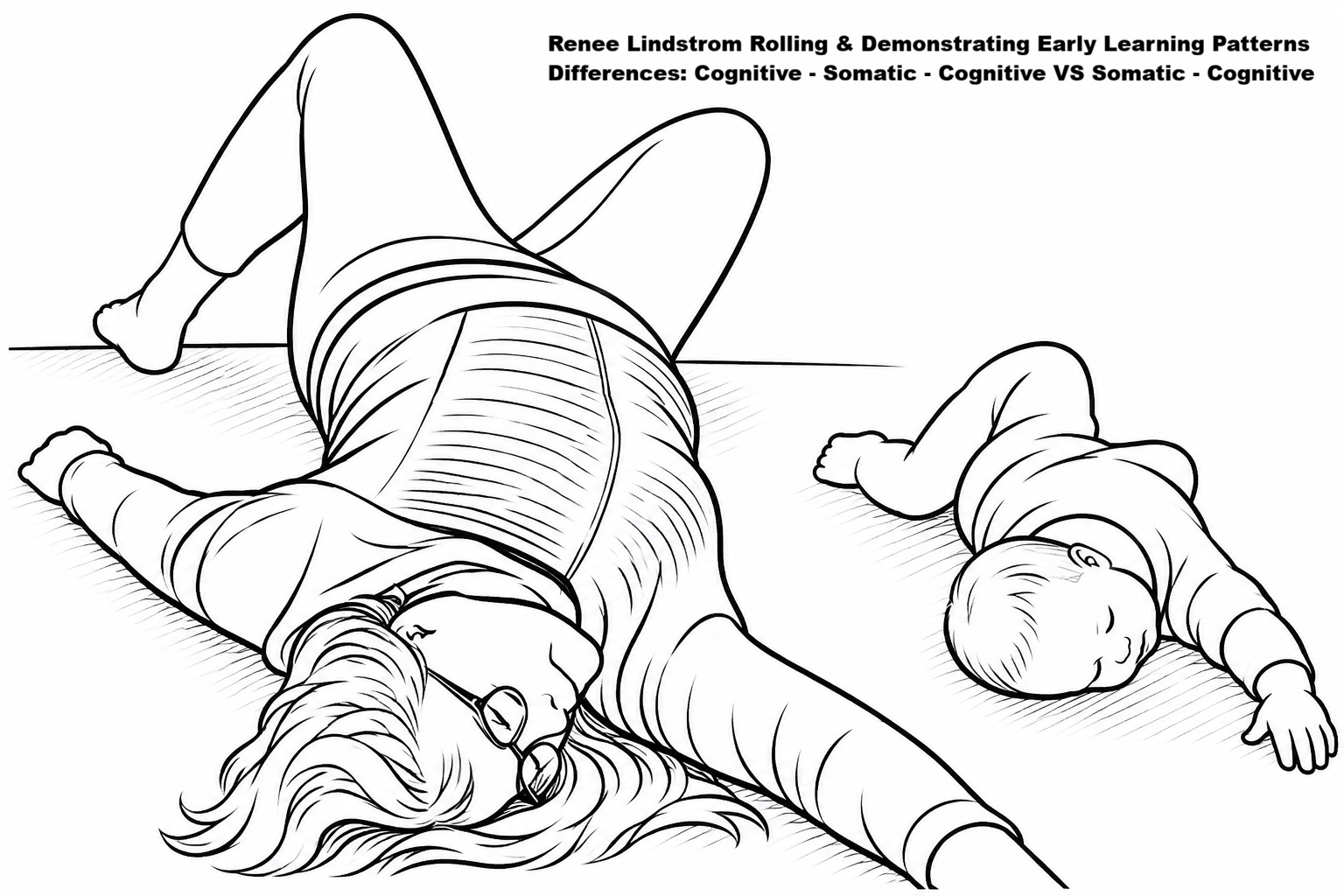
During a recent Balance and A Fear of Falling class, participants asked how to get out of bed with greater ease. This led to an exploration of one of our earliest movement-learning patterns: rolling.
We began lying on mats, noticing small transfers of weight through the feet and pelvis as the bent knees moved gently from side to side. We then explored the weight of the shoulders, allowing the arms to move softly from side to side, followed by the head and eyes. Gradually, these separate relationships came together as a coordinated rolling movement.
From Spontaneous Movement to Conscious
Afterward, I demonstrated how the same rotational relationships could contribute to getting out of bed, with the legs providing counterbalance and the arms offering support.
Then I demonstrated rolling across the floor without interrupting the continuity of movement. Watching this brought back memories among participants of rolling down hills as children, and we began talking about the pleasure and joy that can accompany movement.
This experience brought me back to a distinction I have been exploring in my educational work.
Babies discover rolling through spontaneous movement, long before they have the words to describe what they are doing. Movement becomes part of their learning through direct experience.
Adults may begin with a question, an instruction or a desired outcome. Guided exploration can then provide an opportunity to experience movement before returning to conscious recognition of how its different parts relate.
What interests me is the distinction between movement emerging naturally and trying to create movement. As adults, we can become focused on performing a function correctly, sometimes overlooking the relationships of weight, gravity, support and rotation that make movement possible.
My growing interest is in how conscious recognition can help us revisit and integrate our lived experiences, rediscover movement possibilities and bring curiosity, pleasure and choice into everyday function.
Perhaps learning is not always about acquiring something new. Sometimes it begins with recognizing something we have already experienced.
How am I participating in creating balance in my daily life?
In a post called, “Lost connection with our feet,” I introduced the concept of people often referring to their body parts as a third party in our conversation. Our cultural conditioning leaves the majority of us disconnected from having a focused felt sense of the body parts that keep us upright to stand, walk, run, sit and get up from standing or out of bed. Pain will be felt immediately and that will be the focus of the conversation. People will point to an area where they feel pain usually without the ability to identify the body part, or they will give an incorrect label of the body part they want checked out.
The education that has been a part of our cultural conditioning has lacked focus on the integration of the connected experience through the body. I have found that the focus is on memorizing the names of the muscles, bones and organs rather than focusing attention on the experience of those part’s from a felt sense ability through the transitions of movement. Even suggesting the focus of attention on ones felt senses will be received with varying degrees of experiential understanding and thoughtfulness. The response is usually related to yoga, tai chi, kinesiology, physical therapy or some other exercise patterns versus the actual ability to either visualize the movement or feel the functional aspects of it. There is a blank in understanding and clarity. The mind goes to association with other outside possibilities. As an empathic responder to the environment inside and out this was the hardest gap to bring clarity to for myself and others.
As a Feldenkrais Practitioner this tells me that the person responding back with these comparisons is unable to quiet the mind of memories and analysis long enough to go into feeling the actual functional connected movement patterns inside their body. The mind is actively seeking answers and concepts versus sensing. This is an important concept to distinguish as the two abilities are used for different outcomes. In my experience the analytical comparisons will not support a new pattern of movement that integrates into the brain and body connection via neural pathways. Rather, it will became an artificial strategy creating rigidity and blocking an increase in a range of motion. The expectation created by the thinking and need to know will increase the level of pain, anxiety and pain which will increase the contraction in the muscles and soft tissue intensifying the pain. It will create a contrived pattern of movement that is memorized with the concept of being the right way to do it versus organic spontaneous movement. The rigidity will significantly increase the levels of pain even more and reduce all function due to the levels of fear associated with the pain.
People seek answers and will even ask, is this the right way to….. walk, balance breath, etc., forgetting that as a baby they couldn’t ask anyone. Their movement was free range and more efficient than any current day concept.
This lack of mindful clarity and understanding to the interconnectedness of the physical body creates a disconnect to the skeleton and it’s available core micro movements. In the post mentioned in the first sentence called, “Lost connection with our feet,” the focus was on the functional physical balance. In Chinese medicine the 6 meridians that are focused upon in acupuncture begin in the mouth and end in the feet. This training suggests that the energy is released from the body through the feet into the earth’s gravity. The feet connect the bodies energy to the earth’s gravity. In Feldenkrais the functional perspective of the skeleton is viewed as architectural engineering and the view is how the feet connect with the earth’s gravity by pushing off it. When pushing off the earth the force of the earth’s gravity translates from the feet through the core of the skeleton all the way to the skull. However to experience this efficiently the focus of core movement is through the skeleton, not concepts, muscles, or flow of energy in patterns. These add value to movement, however they cannot create the experience of pushing off from the earth’s gravity.
The dominant force of movement pushing off the earth using the skeleton with the micro movements through the bones and joints tones the muscles. (Not the same as yoga stretches or massage) Muscle development is of value, however not the central core of whole and spontaneous healthy movement. Dominant muscle focus lifts the feet away from the earth that translates into walking separately from, or against, the earth instead of with it. The bones create connection with the earth while the muscles create disconnection.
When someone is walking through the force of the earth’s gravity through the skeleton there is less effort, more flexibility and an increase in resilience. If there is pain in one’s feet there are higher levels of anxiety, irritability, anger and panic. As one limbers up through miro movements, the pain subsides along with irritability, anger and panic.
This Feldenkrais Practitioners perspective of balance begins in the micro movement availability of the skeleton as it responds to the environment. This includes pushing off the earth’s gravity through the bones. As an ex Shoe Store Manager there is some understanding of the cultural conditioning that has evolved through the generations of shoe development.
Feldenkrais®, Feldenkrais Method®, Awareness Through Movement®, Functional Integration®, are registered service marks of the Feldenkrais Guild® of North America. Feldenkrais Method®
As a Feldenkrais Practitioner the lost connection of mankind with their feet is observable in every student’s posture that attends my Awareness through Movement Lessons. One series is called, “Balance and a Fear of Falling.” In one-on-one Functional Integration sessions, it is felt through the movement patterns themselves. After the first lesson in the focused movement class series there will usually be such a huge shift in the individual participants abilities to balance that some students will report this back in the second class. They also seem happy in sharing that there is a drop in their fear levels. I will witness class participants leave their canes behind at the end of the second and third classes which I have to remind them to take with them. By the fourth class they are coming without them.
So, what is the secret? The simplest answer is that Feldenkrais doesn’t focus on the strategy to fix a perceived problem. Most Practitioners don’t get caught up in the ego of philosophies where it becomes about the label, appearance, or fame by being in competition with other modalities. It can be corrupted by those Practitioners that do though who are trying to capture it’s elusive nature and fit it into the preexisting knowledge base of human concepts. Organic learning is not containable in the precepts of the human mind. Moshe was a scientist with a mind that loved to explore learning like an adventure. This is a key element that has been passed down in a good practitioner.
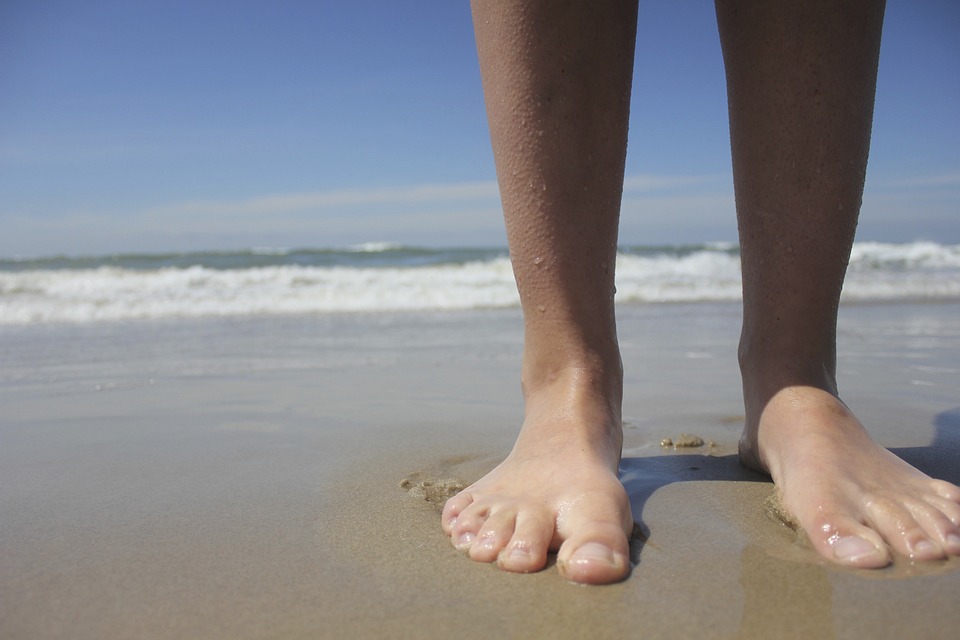
In the Balance class mentioned above our first focus in on feet. The cultural conditioning in our society has caused a lost connection with one and their feet. Time and time again I hear this disconnection in the stories I am told and that I visually see in one’s response to their own feet. Usually, the speaker addresses their feet as a separate part of themselves. They have no whole connection to them as being a whole part of themselves. This is typical of an analytical process thinker in my experience. Their body parts and functions will be expressed with an outside view in the manner of it being a third party and no attachment. Imagine standing on one’s feet with no attachment to their felt sense.
These cultural conditioning habits of our society are points brought to the surface of attention in our movement lessons, however the emphasis as a Practitioner is on aligning one’s felt senses to the micromovements in the bones associated with the feet. The emphasis is on cultivating awareness, not memorizing one pattern, as one needs many patterns when it comes to balancing.
Currently live group classes happen at #yyj’s Monterey Recreation Centre in Oak Bay. I also work with people privately in person, online, over the phone and yes even by text and email depending upon the needs and travel of students.
Past career segways into understanding the social and cultural conditioning of feet
After a challenging year and a half that ended with the loss of my father, my mother, my lover and letting go of the strong hold of my career, I entered into a year of grace. I landed in #yyj’s Greater Victoria Communities and began living on a sailboat at Fisherman’s Wharf after finally taking a career break never explored previously. This began a journey to reintegrate into my empathic nature and to understand it, Re-emerging into society from a year of retreats and learning with a focus on a new career direction as a store manager ended up being with a shoe chain. Working for Naturalizer as store manager for stores at both Hillside and Mayfair Malls became quite an opportunity to explore the human conditioning with one’s feet. In a deep empathetic state while viewing the shape of people’s feet had a giant impact. This experience is a key foundational understanding I tap into when working on balance and cultural conditioning with my students. I am not a salesperson by nature and couldn’t consciously sell to people something through manipulation, so it was a short career. Even the carrot of taking on Regional Manager for B.C. wasn’t far enough removed from that behavioural conditioning.
Feldenkrais®, Feldenkrais Method®, Awareness Through Movement®, Functional Integration®, are registered service marks of the Feldenkrais Guild® of North America. Feldenkrais Method®