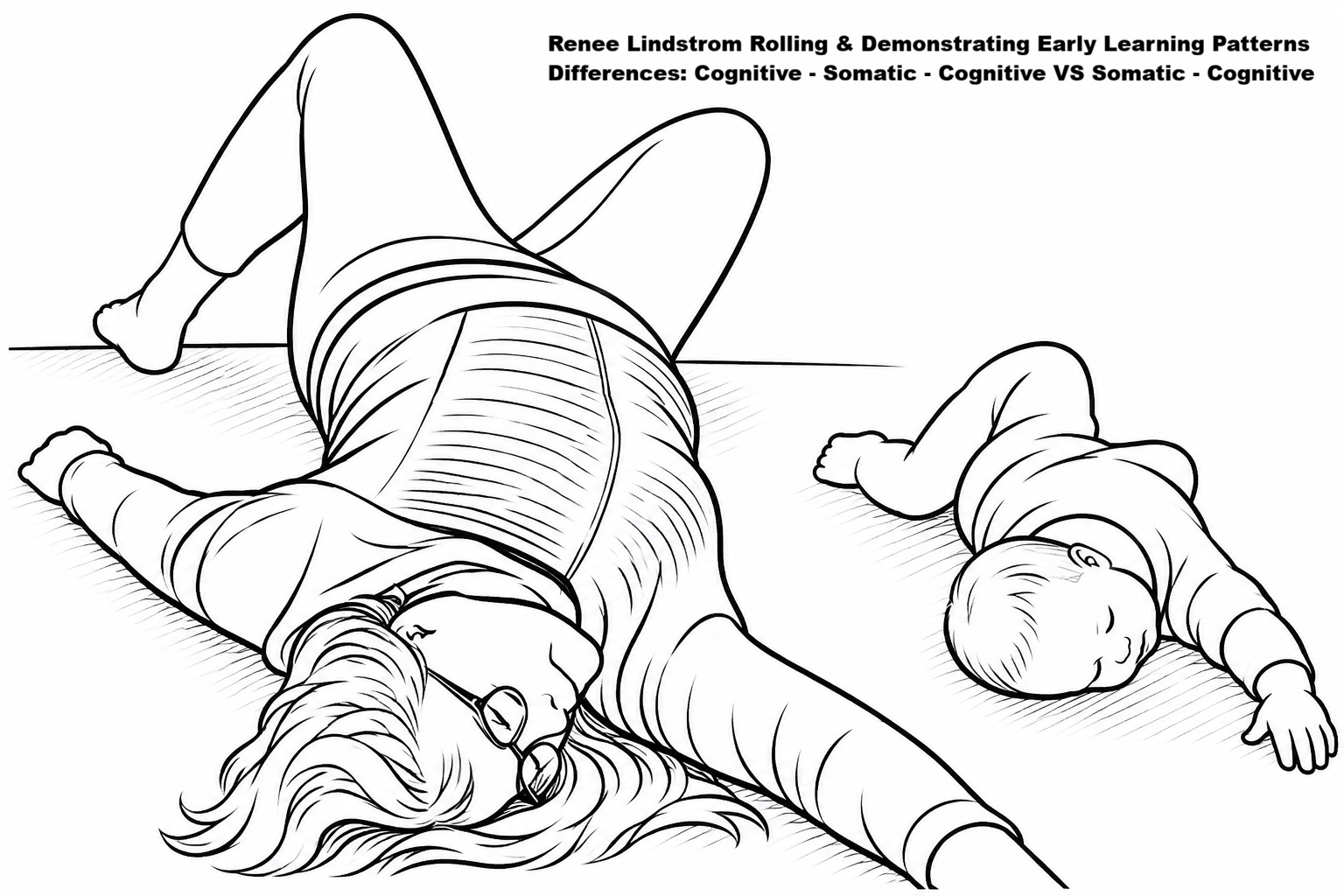
Cognitive – Somatic – Cognitive VS Somatic Cognitive (Adult leering versus early child development)
Recognition
During a recent Balance and A Fear of Falling class, participants asked how to get out of bed with greater ease. This led to an exploration of one of our earliest movement-learning patterns: rolling.
We began lying on mats, noticing small transfers of weight through the feet and pelvis as the bent knees moved gently from side to side. We then explored the weight of the shoulders, allowing the arms to move softly from side to side, followed by the head and eyes. Gradually, these separate relationships came together as a coordinated rolling movement.
From Spontaneous Movement to Conscious
Afterward, I demonstrated how the same rotational relationships could contribute to getting out of bed, with the legs providing counterbalance and the arms offering support.
Then I demonstrated rolling across the floor without interrupting the continuity of movement. Watching this brought back memories among participants of rolling down hills as children, and we began talking about the pleasure and joy that can accompany movement.
This experience brought me back to a distinction I have been exploring in my educational work.
Children: Somatic Experience → Cognitive Recognition
Babies discover rolling through spontaneous movement, long before they have the words to describe what they are doing. Movement becomes part of their learning through direct experience.
Adults: Cognitive Orientation → Somatic Experience → Cognitive Recognition
Adults may begin with a question, an instruction or a desired outcome. Guided exploration can then provide an opportunity to experience movement before returning to conscious recognition of how its different parts relate.
What interests me is the distinction between movement emerging naturally and trying to create movement. As adults, we can become focused on performing a function correctly, sometimes overlooking the relationships of weight, gravity, support and rotation that make movement possible.
My growing interest is in how conscious recognition can help us revisit and integrate our lived experiences, rediscover movement possibilities and bring curiosity, pleasure and choice into everyday function.
Perhaps learning is not always about acquiring something new. Sometimes it begins with recognizing something we have already experienced.
How am I participating in creating balance in my daily life?
Guided Movement Patterns of Learning for Lived Function – Renee Lindstrom | @insideawareness
Discover more from Inside Awareness Center for Integrative Somatic Learning
Subscribe to get the latest posts sent to your email.