Category Archives: Uncategorized

Awareness Education against Bullying: My Perspective

I wanted to share my perspective on bullying with you.  I believe change can happen if we culturally begin to shift our long-term focus from first aid solutions for justice and begin to look at the root causes of bullying together with a  commitment to educate the parents and educators in our children’s lives.  
 
Our children learn through a process of observing what those around them are doing and mimic it.  We call this modelling.  Parents and educators do not teach a child how to roll over, sit up and come to stand as they develop movement which tells us that we (wo/man) have the ability to learn through experience and observation.  Speaking even begins with hearing those around them and babies first words are the most important ones to them like mommy or daddy.  Therefore the relationships they see around them are their sources for taking in information and learning.
 
As a parent myself and now sharing programs for educators and parents, what I know to be a commonly shared experience is in this statement, “We are not trained to be parents.”  I would like to add we are not trained in the art of honest expression and skills of listening.  Therefore it is my opinion that we aren’t developing healthy, understanding relationships.
 
Imagine for a moment a child who has met their own need for play together with a rushed parent who wants them to do something different from what they are doing, like go to bed.  How does the parent phrase it and how does the child receive the information from their parent?  Would the child hear what they are doing valued in any way?  This step is usually overlooked by busy parents, yet imagine what’s going on for the child who’s needs are not being recognized as being separate from the parents and who isn’t able to express it yet.  
 

As parents we may think children are demonstrating poor behavior when they are simply trying to  demonstrate and express their needs. Parents and educators have power over children in our current culture.  Power over simply means hierarchical.  Think about our organizations, business and western world in general ~ hierarchical models.

We are teaching our children dominance through existing structures without including the development of skills for understanding their own behavioral process.  Our culture lacks the speaking literacy for a developing child to understand and connect to what is being said in the way that they perceive information.  We receive information through our senses of feeling, seeing, touching, tasting and hearing sounds. Now imagine hearing the use of  feel in a sentence that does not accurately describe any feeling at all or misuses words to describe feelings.  Some simple examples:

  • I feel we need groceries.     (Replace, I think instead of I feel)
  • I feel you should go and play.   (Replace, I think instead of I feel)
  • I feel your brother needs to have a sleep.   (Replace, I think instead of I feel)
  • I am feeling unheard when you ignore me.  (unheard is not a feeling, replace with sad) 
  • I feel safe when you don’t run ahead.  (Safe is not a feeling, replace with calm) 
These are common sentences in our relationships.  Now imagine two or more people trying to have a conversation and not being able to connect.  First without true use of feeling words there are no words that creates an empathetic understanding (true sensory awareness words that the other person can connect to with ease).  Second, if there is not a common point of understanding such as a value that they can perceive without judgement, there will be confusion or they will take it personally resulting in a reaction.  For example: 
 
  • Bullying is bad. (Replace with ~ I believe if we are not sharing our common needs for kindness, consideration and acceptance that our relationships will be violent.  
  •  You’re a bully. ( Replace with ~ When I see you post pictures of bleach to Amanda’s RIP facebook pages,  I feel rage and disbelief as I have a need for kindness and consideration for Amanda’s family and friends.  
  • We have a rule of no bullying.  ~ We have a common need’s in our relationships for dialogue, listening, cooperation, consideration, understanding and have agreements for trying to meet these needs.
It is my perspective that by shifting our focus towards daily conversations that have individuals taking more personal responsibility for understanding their own reactive state it will shift the focus from taking it out on others in unconscious and habitual behaviors.  For adults, it more difficult to learn after years of learning how to run away and protect themselves.  For children, it’s easy.  It will take the adults learning it and practicing it in order for children to change.

Therefore it is adults committing to learning what it is they want their children to learn first:

  • How to express what is alive in them truthfully.
  • To become aware that their child is meeting their own needs and that those needs are different from the adults and to shift into valuing those needs mutually, simply by acknowledging them.  (Children do not want to be invisible and think about it: ~ adults discuss their process with their partner/friends, etc. who do children have to process it with ~ no one!  Therefore imagine what is going on inside the child – isolation, feelings of being alone, not seen, not heard, not valued, not cared about)
  • Value based communication and leadership
  • Feelings literacy
  • Needs/values literacy
  • Listening Skills (listening without trying to fix it, without interruption and how to reflect back that the child sees that regardless, they are beautiful)
  • Making concrete requests that have specifics that are doable – not vague.
Rather than talk about it, I hoped to give you some experience of what I believe is important for our culture of learning how to create kids that are mediators in the moment conflict first arises.  Imagine a child being able to understand what is going inside themselves while at the same time understanding what is going on for the other person who’s behavior is violent.  As soon as they have basic skills they will be able to identify that it is not about them at all and about what is going on in the person being violent.  This is the shift we want.  From there they will have choices in how they respond meeting their own needs and not that of the person being violent.  It will affect the balance of the victim/bully and the bully will have no power over them.  
Renee has been developing programs in Education for consideration by value based leadership organizations that are now being presented.  For a peek at this development go to link @   http://supportingnonviolentcultureineducation.wordpress.com/
Let’s keep the conversation going!

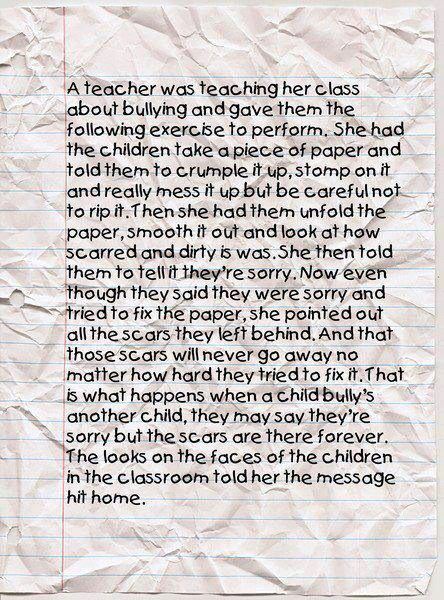
Exercise for developing empathy resulting from bullying

This exercised was emailed to me from Carla Munro ~ a fellow contributor to sharing value-based empathy conscious communication methods.  It will be useful to the teacher in all of us.

Image

‘First Steps to Changing Habitual Reactions in Relationships’

scan 003

Quote

Any perception can connec…

Any perception can connect us to reality, properly and fully.
What we see doesn’t have to be pretty, particularly; we can appreciate anything that exists.
There is some principle of magic in everything, some living quality.
Something living, something real, is taking place in everything,

Chogyam Trungpa

Views of Anger from different vantage points

In a group dialogue I listened to a secondhand  viewpoint on anger from someone who had attended a workshop.  This view was  that anger could be focused in a way that wasn’t from a source of ego, yet simply to cut through it (ego).

Reflecting,  I had  memories of reading this message in Rinpoches dharma teachings and  witnessing  this skillfully in action, by Dr. Marshall Rosenberg,  and experiencing it unskillfully from another teacher.

The person sharing in our current group seems to  attracted to this topic and that it was relevant to her in the general topic we had been asked to discuss.  This filled me with  curiosity on how to marry these two together.

Coming back, what about anger?  I shared above how one person used skillful means in the process of cutting through the anger with no ego and one who had not achieved this skill, yet thought they had.  I believe the difference in these two experiences is that one person had the skills of empathetic listening (of themselves and for others) and one did not.  The second person carried an authority of knowing something and was not interested in others perspectives.  My experiences was their only interest was being their teacher.   Both these teachers had their own journey of experiencing and learning therefore, in my opinion, neither were right or wrong.  It was simply them!

What is the key to healthy anger?  The hint in the last paragraph – empathetic listening!  My perspective is that developing the ability to listen to your anger and go through it’s protective layer to what is alive underneath will release the current charge or grip of it.

The beauty of it is this experience is can  become a new skill to resolve anger issues of the past and for new issues.  You may even begin to recognize that you are NOT triggered by the same old events.

Another key lesson is  soon as you are honest with yourself and accept your anger without judgement it becomes the basic skill for hearing anger in others with deepened empathy!

I understand anger as   being an emotion to notice some action needs to be taken. Anger, therefore in this sense, is the protective use of force.  An example could be a child crossing the street.  It is anger that will increase adrenalin and provide the force to get there in time and out of harms way!

I wonder if skillful use of anger without ego then is anger without being attached to an outcome and therefore it is spontaneous (not a result of old issues and aggression.  A flash in the frying pan action, if you will, that will release the tension of the moment and result in a healthier outcome when combined with the right techniques to process and move forward with mutuality of all sides!

Pit falls of Empathy for Practitioners, Facilitators and those receiving empathy

Have you ever given empathy and the resulting emphatic connection is misunderstood by the receiver?

These questions and more are now being considered and shared in learning Empathy for Self and others in getting InTouch Relationship series of           Think, Speak and Act!

  • If the receiver isn’t clear on the differences between compassion and the love they long for, how do they interpret their experience of an empathetic connection?
  • Do they mistake this sexual attraction?
  • Do the receivers of empathy mistake this as being in love with the listener?
  • Do they become addicted to the feelings therefore demand empathy?
  • If a person received empathy in a gathering with a purpose was for learning, how do they and the listener move forward through the disappointment of not having the full focus of the groups empathy another time?
  • If you receive empathy does this mean your wish is fulfilled?

And questions for the empathy listener:

  • What is the listener modelling?
  • Is  there balance between giving and receiving so that when the sessions is over the receiver of empathy  leaves it with a solid sense of their own support and not in awe (in debt) to the empathetic listener?
  • How much nice is too nice? How does the listener detach themselves  to balance the connection?
  • What is the presence and contact of the listener?  Is the expression of their emphatic eyes and presence self-contained demonstrating  and modelling how to balance their own inner needs while holding the connection of the receivers ?
  • Is the listener able to follow the receivers lead when wanting to receive empathy and noticing the cues to stop?

Difficult questions with answers now included in learning and experiencing  empathy in getting InTouch Think, Speak and Act series.

Connecting with stranger led to surprises

Walking up a hill along a favorite trail of ours for the first time since losing the other half of our in my walks, my long time  friend, “Frosty, ” I was stopped by a fellow walker.   An older gentleman I imagined to be in their 70’s who told me they had to stop half way up the hill to catch their breath.    I laughed and said I too felt like stopping .  My intention was to pass by and keep walking.

He got my attention when he went on to say he was 94 and had walked the full 2 mile course the day before.  Today he thought he wouldn’t go the complete course.  He started walking with me and part of me was wanting to carry on alone  as I had remembered Frosty and was feeling some emotions.

Rather than feel any resentment I decided to share the loss with him and not feel blocked by him in joining me in this inaugural walk without my pooch.  To my surprise he shared back with me he just lost his wife a few months before.  She was 94 and they had been together 69 years. She had begun to experience dementia, fell and broke her hip and decided that this wasn’t the way she wanted to live.  She took matters into her own hands and stopped eating.  Seven days later she passed away.  He downsized, bought a new condo and only the day before bought  a new Nissan and planned a drive to Campbell River to see his daughter for her 65th birthday.   He missed his wife and went on to say the evenings were difficult with no one to sit and talk with.

By this time we had walked a quarter of the trail and came to a row of benches and he decided to sit down for a while.  We both had smiles and wished each other well and I was able to speed my walk up.  I would like to say only a fraction though.  Imagine if I had simply walked by quickly as was my habit and had not connected.  It would have been a loss of what seemed an important moment of connection, inspiration and wonder!

Take a moment for this: