Discovering Movement Within Everyday Activities
An Emerging Educational Focus | Inside Awareness
As our daily activities increasingly involve computers, tablets, phones, reading, and other tasks requiring sustained attention, I have become interested in how these familiar activities influence our patterns of functional movement.
Ergonomic education has brought valuable attention to workplace design, physical support, posture, and the importance of changing positions.
I am interested in exploring another dimension of this relationship.
What happens to our natural skeletal movement patterns when we concentrate?
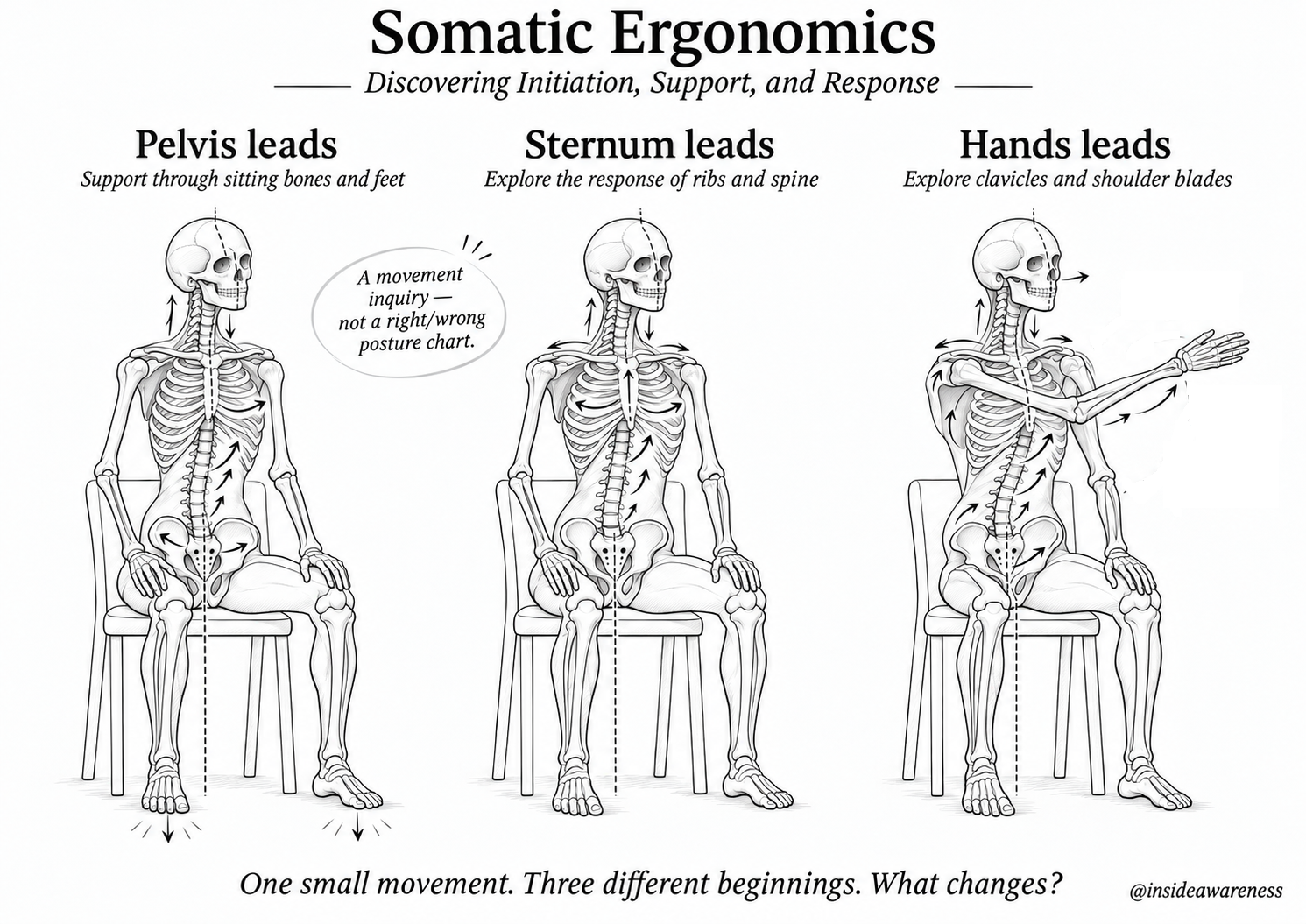
Even while sitting, which we often perceive as a stationary position, the body has the potential for subtle movement through the feet, pelvis, spine, ribs, clavicles, shoulder blades, neck, and head.
The individual vertebrae participate in small movements. The pelvis provides a foundation for shifting weight. The rib cage responds to breathing. The shoulders and arms can participate in rotational movement rather than remaining fixed in one position.
These relationships extend into standing, walking, reading, writing, and using our electronic devices.
Through years of facilitating Balance and A Fear of Falling and other Guided Patterns for Lived Function lessons at Inside Awareness, I have been exploring how natural rotational counterbalance and skeletal transitions influence our experience of support, mobility, and ease.
An emerging focus I am calling Somatic Ergonomics brings these movement relationships into everyday living.
Rather than emphasizing a correct posture to maintain, the invitation is to discover the small skeletal movements that may remain available within an activity.
Could recognizing these movements support greater flexibility, more responsive skeletal support, and freedom to shift between positions without unnecessary effort?
A Consideration for Adults and Early Childhood Learning
As children encounter increasingly structured learning environments and activities involving screens, books, and sustained attention, I wonder how we can support their developing relationship with natural movement.
Children begin life exploring movement through spontaneous shifts of weight, rotation, reaching, rolling, and discovering support.
How might we continue to recognize and encourage this curiosity as learning environments and daily activities change?
For adults, the inquiry may be one of rediscovery.
Can we remain engaged in thought and focused activities without unnecessarily holding our bodies still?
Somatic Ergonomics is an emerging focus within Inside Awareness Guided Patterns for Lived Function, with opportunities for dedicated ergonomic movement lessons exploring subtle skeletal transitions in sitting, standing, walking, and everyday activities.
It is also a developing consideration for The Legacy Educational Project, connecting movement awareness with lifelong experiential learning.
The intention is not to replace established ergonomic recommendations, but to complement them by introducing another relationship to explore: how we participate in movement from within.
What might become available when we begin to recognize movement where we previously perceived stillness?
Movement does not have to stop when attention begins
Somatic Ergonomics – Renee Lindstrom @insideawareness
– Copyright 2014 – 2026 –
With respect and gratitude,
I acknowledge the practices and teachings that have contributed to the ground from which this work has grown: Moshe Feldenkrais and the Feldenkrais Method® of somatic education; Marshall Rosenberg and Nonviolent Communication; Chögyam Trungpa Rinpoche and the Shambhala teachings; and Dyan Grant Francis, Subtle Energy Solutions and Black Sect Feng Shui.
These influences are acknowledged with appreciation for the learning they made possible, while the patterns and interpretations presented here reflect my own continuing inquiry, lived experience and educational development.
Inside Awareness | Renee Lindstrom | @insideawareness
Original concepts, lived experiences, educational approaches, and program development by Renee Lindstrom.
Written and developed in collaboration with ChatGPT by OpenAI, providing editorial, organizational, and creative assistance.
Illustrations created using OpenAI’s image-generation tools, guided by the educational themes and creative direction of Inside Awareness.