Creating Space for Conscious Recognition Through Lived Experience
By Renee Lindstrom founder of Inside Awareness Center of Integrative Somatic Learning
What becomes possible when we listen to another person’s experience without immediately interpreting it through our own?
This question has been part of my educational exploration, coaching and teaching for many years.
Through my work with somatic awareness, communication, relationships and the influences of our environment, I have been exploring how guided patterns of learning can support conscious recognition and expand our possibilities for participation in everyday life.
One particularly meaningful part of this exploration began through a sacred circle I hosted for four years.
The Experience of Empathy
The circle initially focused on Nonviolent Communication (NVC). I prepared the physical environment with intention, including an altar and arrangements traditionally associated with sacred gatherings.
Although our intention was to develop communication and connection, I began recognizing how readily interpretation entered our listening experiences.
During this period, I attended a residential learning gathering with Marshall Rosenberg, the founder of Nonviolent Communication.
Each day began and ended in a listening circle. Participants could express what was alive in them in the moment, while others listened. Throughout the day, Marshall offered opportunities for learning through direct interaction and stories drawn from lived experience.
As the days passed, I began sensing a deepening quality of empathy within the group.
It was not simply something being described or demonstrated. It was becoming recognizable through participation.
During personal interactions, I experienced Marshall’s capacity to listen with an attentiveness that allowed deeply painful experiences to be expressed without needing to be corrected, interpreted or immediately resolved.
That experience offered an important recognition.
Empathy could be experienced through the quality of listening itself.
When I returned to the circle I was hosting, the participants began recognizing a difference in how we were engaging. Over the following three years, our exploration moved increasingly toward the lived experience of empathy.
We were not simply learning what empathy meant. We were exploring what happened when we participated in it.
Recognizing the Environment of Listening
At the same time, I had been exploring the influences of environment through Feng Shui.
My understanding of environment was expanding beyond the arrangement of physical spaces.
I was recognizing that our surroundings include people, their words, the ways they engage with us, and the internal conversations we have with ourselves.
Our experiences are influenced by what surrounds us, what takes place within us, and the relationships between them.
Through my environmental studies, I had been exploring entrainment: how patterns and conditions within an environment may influence the experiences of those participating in it.
As my listening work developed, I began recognizing something related.
The listening pattern itself could hold the space.
The quality of the gathering did not depend entirely upon the arrangement of the room or the objects placed within it.
It could emerge through the shared intention, attention, listening and participation of the people present.
This opened another direction in my educational work.
Bringing Universal Values Into Lived Experience
I began recognizing that people could be familiar with the names of universal values without necessarily having an inner, experiential understanding of what those words meant to them.
A word such as respect, autonomy, kindness, consideration or belonging might be understood conceptually, yet not be consciously connected to a particular lived experience.
Without that personal connection, the value might not be readily available in someone’s inner dialogue or everyday responses.
I began introducing a guided pattern in which participants explored one universal value each week.
We gathered in a talking circle, with opportunities for each person to express their own understanding of the value through their lived experience.
The intention was not to establish one correct definition.
It was to invite participants to recognize where and how that value had been experienced in their lives.
As people listened to one another, they could encounter different expressions of the same value without needing to replace their own understanding.
The word could gradually become more meaningful through conscious recognition.
This was another way of integrating values into lived function.
Rather than expecting someone to demonstrate respect because they had been told what respect meant, the learning experience encouraged recognition of what respect actually felt like, how it was received, and how it might be expressed through one’s own actions.
When the Pattern Becomes the Environment
One experience during these gatherings brought another recognition.
A new participant suggested introducing candles and other ritual elements to give the gathering a more recognizable sacred quality.
I listened to the suggestion and began considering what was already happening within our circle.
Unlike my earlier sacred-circle gatherings, I had not arranged the room with ceremonial adornments. This was not intended to exclude ritual or diminish its value.
It simply wasn’t our focus of attention.
Our attention was directed toward listening, recognizing and expressing the meaning of universal values through lived experience.
As I listened to the suggestion, I recognized that something I had previously associated with the preparation of sacred space was already being experienced through our participation.
The quality of space we were seeking was becoming available within us and between us.
The talking circle itself offered a pattern through which presence, respect, consideration and connection could be experienced.
The experience did not require participants to adopt a spiritual or ceremonial interpretation.
I believe Marshall’s modelling of empathy influenced an important development in my understanding of the environment of listening. Through his presence and participation, I witnessed empathy becoming a lived experience rather than remaining a concept or technique. I had previously encountered profound qualities of presence through Tibetan Buddhist teachers, where devotion and spiritual practice provided an important context. With Marshall, I encountered something related through the ordinary human experience of being heard. I began recognizing that the qualities I had associated with sacred space could also emerge through the way people listened and participated together. This recognition later became increasingly visible in my own talking circles, where the pattern of listening itself began to provide the shared environment.
It emerged through how we listened, how we expressed ourselves and how we participated together.
This became another important relationship in my understanding of environment.
An environment can be influenced by physical arrangements, yet it can also be shaped by the patterns of attention and interaction taking place within it.
And through repeated lived experience, some of the qualities initially supported by an external environment may become more available within ourselves.
Returning to Listening
Recently, I hosted a gathering between two people experiencing different stages of regret and pain within their relationship.
The listening pattern I introduced was not new to my teaching or coaching practice. However, this particular experience helped me recognize its potential for more clearly organized educational programs.
The intention was not to negotiate an outcome, determine who was right or wrong, offer therapy or prescribe reconciliation.
It was to provide a shared environment in which both individuals could express their own experiences and have an opportunity to be heard.
The gathering revealed moments of recognition, emotional expression and greater understanding. It also revealed how easily established patterns of interpretation can return.
This contrast brought greater clarity to the distinction between listening to recognize another person’s experience and listening while preparing our own interpretation of it.
Interpretation is a natural part of human understanding. The invitation is not to eliminate it.
Rather, it is to recognize when our interpretation begins replacing our attention to what another person is actually communicating.
That recognition may create an opportunity to pause, become curious, clarify what we have heard and respond with greater awareness.
An Invitation to Listening
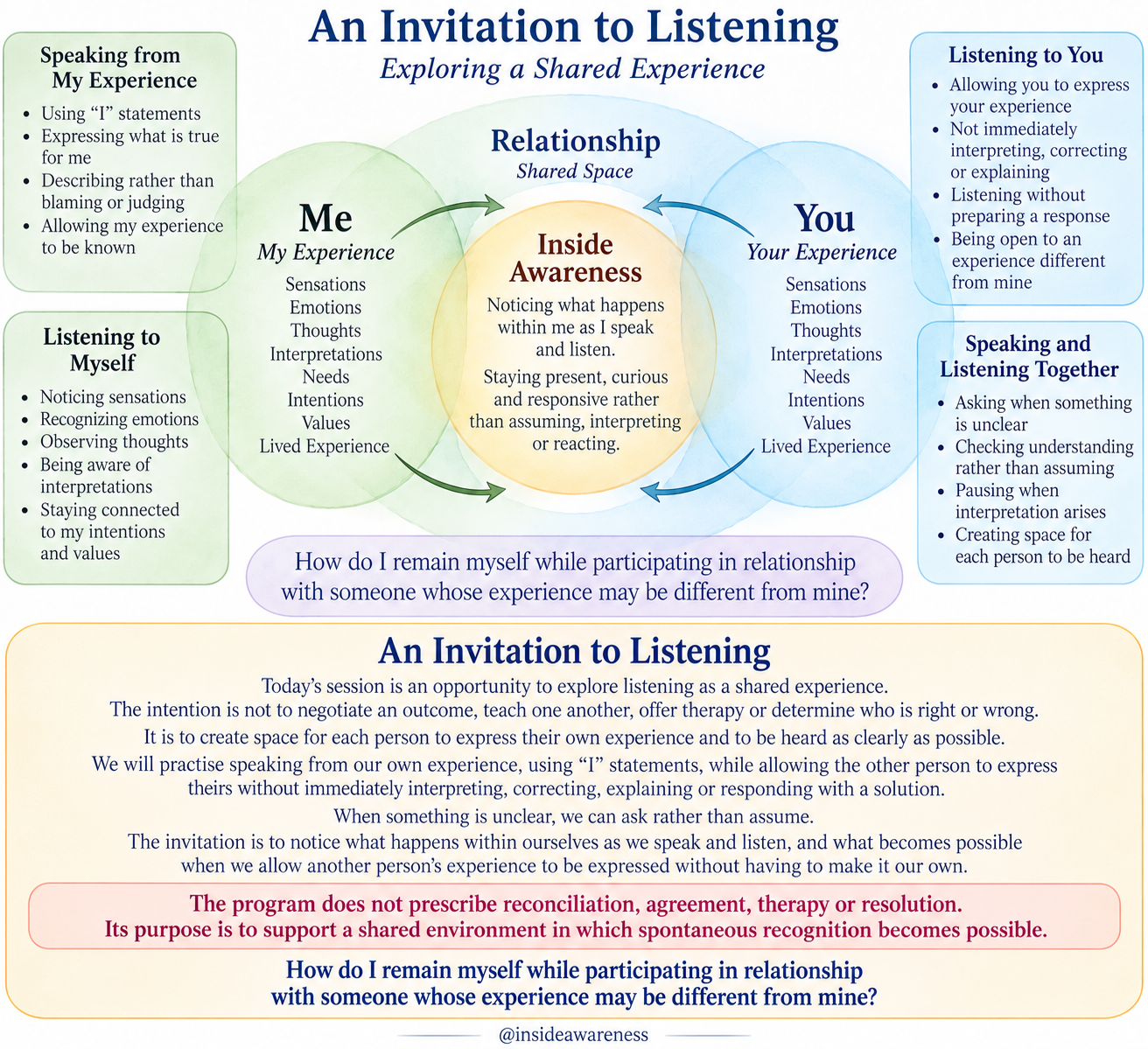
The accompanying diagram illustrates relationships that are present whenever two people communicate.
Listening to myself: Recognizing the sensations, emotions, memories, thoughts, interpretations and values arising within my own experience.
Listening to another: Allowing another person’s experience to be expressed without immediately correcting, analyzing or replacing it with my own.
Listening within relationship: Participating in a shared environment in which clarification, curiosity and reciprocal recognition become possible.
At the centre is Inside Awareness—recognizing what is happening within ourselves as we participate in an experience beyond ourselves.
The intention is not to teach someone the correct way to feel, think or respond.
It is to create conditions in which conscious recognition may become possible.
From Guided Patterns to Lived Function
These explorations have been part of my educational work across several subjects, including movement, communication, personal values and environmental awareness.
The learning environments may differ, but an underlying principle remains:
A guided pattern can direct attention without prescribing what the learner must discover.
In movement, we may explore unfamiliar possibilities through relationships with gravity, skeletal support and the surrounding environment.
In communication, we may explore unfamiliar possibilities by recognizing our inner experience while listening and responding to another person.
In both, the learning begins through participation.
I now see opportunities to organize these longstanding practices into listening programs suited to different environments, including personal reflection, families, educational settings, workplaces and community groups.
Each setting may require different considerations for safety, participation, clarity and consent.
The intention remains consistent.
The program does not prescribe reconciliation, agreement, therapy or resolution. Its purpose is to support a shared environment in which spontaneous recognition becomes possible.
At the heart of this exploration is an inquiry that continues to guide my work:
How do I remain myself while participating in relationship with someone whose experience may be different from mine?
Perhaps the possibility begins with recognizing that listening is more than receiving someone’s words.
It is also a lived experience of relationship—within ourselves, with one another, and with the environment we create through our participation.
An Invitation to Listening
Guided Patterns of Learning for Lived Function
Renee Lindstrom
@insideawareness
Follow socials: