Tag Archives: Education

Funny and informative

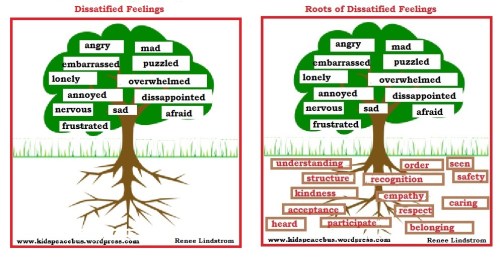
Dissatisfied Feelings and their root source

Dissatisfied Feelings & Roots


TOPIC’S IN PARENTING WITH COMPASSION AND EMPATHY ~ Nonviolence Literacy Series

Click to Enlarge

FOR MORE INFORMATION ON PARENTING APPROACH OF WORKSHOP/WORKBOOK SERIES go to Ā LINK

CONNECT ON FACEBOOK FOR MORE ON PARENTING @ LINKĀ 

Parents, when you fight with your partner, what do you tell the kids?

Parents do you go and talk to your kids after they hear or see you fight and talk to them about how it was for them to have been in this experience? Ā Do you help them with identifying their feelings and sharing what needs they had in the moments of the fight?

Do you try to tell them what the fight was about and get them to pick sides or do you tell them truthfully what you are feeling about them experiencing the fight with you? Ā  Such as regret and sadnessĀ that you didn’t met their needs for safety? Ā Once you and the child connect to theirs and your needs about the fighting experience you simply might say that you and partner had needs that were not being met and that the frustration came out in theĀ behaviorĀ that wasĀ demonstrated. Ā  Do children need to know adults stories or do they simply need to know you care about them and that it is normal to have frustration? Ā What’s important might be how you model the process of dealing with the frustration and not the frustration itself. Ā Be truthful about theĀ behaviorĀ scaring you if in fact it did and begin teaching them the feelings that go with differentĀ behaviorsĀ without making theĀ behaviorsĀ threatening. Ā Normalizing the behavior through the process of coming Ā to understand it begins to defuse the level of fear attached to it and its power, opening the door to future mediation skills in moments they may face anger.

Turn these moments into teachable experiences and explore it and not feed the fear.

Are you teaching children to understand why they are behaving the way they do or are you telling them what is appropriate and inappropriate behavior?

Do understand your own behavior or is your behavior habitual therefore the same old reactions?

Child development is through their existing abilities of hearing, seeing, touching, smelling, taste and physical feeling. Ā Mental development is a later development and learned in the process of absorbing what they witness others doing.

Therefore:

WhatĀ behaviorĀ are you modelling to the children around you?

How are you engaging with the child/ren around you in order to support them in understanding theirĀ behaviorĀ reflecting back to them that they are still beautiful and wonderful? Ā Warning, supporting a child’s development doesn’t come withĀ labelingĀ them and grouping them into a Ā category – that only gives the adults a false understanding and reasoning that further disconnects the child from theirĀ behaviorĀ and only meets the adults needs for understanding. Ā  Ā If an adult did not learn why they behave the way they do in their stages of development they may not Ā understand why their child is behaving the way are are and they will seek answers that generally lead to aĀ diagnosis. Ā Ā  Adults will not see that the child is taking in theĀ behaviorĀ around them and responding either by duplicating it or reacting to it. Ā Adults generally will not recognize too that they are demonstrating the sameĀ behaviors.

An example, one of my son’sĀ elementaryĀ teachers. Ā Whenever I went by her class while in the school volunteering or coming to pick him up I would see her with her back to the class on a computer Ā with the children left to work on their own. Ā  Ā  Her classroom was in a state of disarray with piles on top of Ā piles Ā in every available space. Ā Paper, art and craft materials stacked so that if there was a breeze it would be like a deck of cards and come crashing down. Ā Our experience was that this particular teacher was close to retirement and interested in art, yet she was still teaching a regular class. Ā She spent most of the year outside of the class on big school projects leaving the children she wasĀ responsibleĀ for in the hands of Ā others in the school who would come in to fill in periodically throughout the day and even part way through a subject. Ā Arrangements also included switching classes so that other classes could be taught what she was interested in. Ā  Two weeks prior to the Christmas break or a school event her class room had a revolving door and many times no adult was in the class and they would be watching aĀ Disney typeĀ movie.

The day came that we had an appointment with her to discuss our son’s behavior in her class room. Ā Sitting with her was painful and I believe we all had Ā trouble focusing on her as she attempted to find my son’s work. Ā It Ā was in a pile in front of her on her desk that was no less than three feet high. Ā What we heard was that our son was notĀ organizedĀ and able to complete a task. Ā That he was not able to work on his own and was distracted easily. Ā Therefore her recommendation was that he be tested as a candidate for medication. Ā Medication that she herself had put her son on through his early years. Ā I asked her if her child continued on this medication and she said no, at a later age he insisted that they stop and work differently on hisĀ tenanciesĀ  Ā She went on to say that he resented this strategy of medication Ā as he couldn’t remember much of his earlier years.

Therefore are we aware of our own needs and how they affect those around us? Ā Will we judge our children for duplicating Ā what they are observing us do? Ā Is it easier for us to fix it so our experience has more ease and if so is this a long term solution or a temporary fix?

The reason we went in to have a conversation with this teacher was that our son was going into a closet and shutting the door. Ā She felt he was hiding and that he was a problem. Ā What she did notĀ recognizeĀ was that this was the only strategy he had to get away from theĀ chaos of the environment she wasĀ unconsciouslyĀ creating to meet her own needs!

Imagine if this teacher had learned a way to communicate with our child that would connect to the values rather thanĀ labelingĀ him a problem. Ā She would have understood her needs more, perhaps leading to change in the classroom for all the children.

For a healthy society ~ on Bullying for teaching the teachers

Which came first the chicken or the egg? Ā Really? Does it matter? Ā Who cares about identifying who should be responsible for teaching children about bullying and the outcomes when each one of us is a bully! Ā Yes, you have read this correctly. Ā If Ā we cannot identify our own needs and give ourselves empathy, what happens when talking to another person? Ā Can you then hear and identify their needs and Ā respond back to them in a way to connect to what is important to them? Ā If not, in fact it is bullying them! Ā Why, well think about it, if you hear someone and begin trying to fix it based upon your opinions, do you think they feel witnessed and valued or do they feel invisible and lonely? Ā If you start to hear them, identify with their story and jump in to tell yours to let them know you know exactly how they feel, do you think they feel seen or heard or has the conversation become about you? Ā  Therefore, if it is about you and what you know and your experience, Ā you cannot identify their needs and acknowledge them as having any value. Ā Why?, they do not have the same needs as you in that moment. Ā Frankly, Ā it is not about you when you are listening to someone else which brings up the question of, “How do you think they are going to respond?”

I would like to generalize and say that I believe we all do this Ā and it is these little incidents that we are not aware of that become big issues for others who then take it out on others that grows and grows. Ā  Therefore in my opinion it is a societal issue and one that needs societal solutions that begin with acknowledgement and training. Ā  Unlearning through learning new skills that begin with individuals in ALL communities, networks andĀ families. Ā It’s not a parental issue in my opinion as parents need the support of educators. Ā Educators needs the support of administrators and administrators need the support of government and government need support of who? YOU!

For a healthy society ~ on Parenting

News for parents on parenting is that their needs are not the same need as their child. Ā  Awareness is recognizing the needs of the child. Ā The relationship is taking the time to pause, connect and recognize their needs as having value. Ā  It doesn’t mean you give your parenting needs up, it means your children are not invisible and that they are valued, seen and heard! Ā This starts pre-verbal and begins with parents having skills to identify their own needs.