Category Archives: Uncategorized

Nov 4 ’18 News: Learn to make no-cost cream cheese & whey for the holidays

Learn how to make cream cheese, whey & fermented foods, and about 5 Ways to enhance your focus of attention, improve somatic movement & communication skills

movement, communication, diet, environment, intentions into goals 

1  Take a class  @ Monterey Center:

Somatic Movement Series
  • ​Balance and A Fear of Falling – starts Mon, Nov 5 @ 1:00 pm

Read more or still time to register @ 250-370-7300
  • Awareness through Movement – starts Mon, Nov 5 @ 2:30 pm

Read more or still time to register @ 250-370-7300
Nonviolent Communication
  • Removing Obstacles to Love – starts Fri, Nov 9th @ 1 pm

Read more or still time to register @ 250-370-7300

2.  Personal Function Integration

Book a personalized Feldenkrais Somatic Movement session
250-0361-7508

3.  Take individual or plan group Coaching/Mentoring

  • Turn Intentions into goals following pattern that increases self-esteem and confidence replacing self judgements.
  • Begin Planning now for 2019 using a model of integration where your vision can become reality.
  • Celebrate your commitment to yourself with monthly organized labyrinth walks to reflect and check in.
Book a personalized Coaching session for self, work, group or create a retreat
250-361-7508

4.  Improve outcomes with Home & Work Audits

Explore how your environment is contributing to any blocks you are experiencing in your ability to transform your personal goals.  Create a supportive environment to help you integrate your dreams.
Book a personalized Coaching session
250-361-7508

5.  Educational:  Healthy emotional eating!

Did you know that food can create a shift in your emotions?

Check out these 7 clip-art pictures of certain emotions & feelings that can be shifted with food!  Yes with food.  Food can increase our levels of tolerance by creating a healthier gut and communicating with the body via biological systems, such as the endocrine glands and nervous system – read more  or pick out group that represents you dominate emotions and go to link of healthy emotional foods for that group.

Healthy gut, flexible brain

#1

Click to link to foods for balancing these emotions with diet:   to link


#2


Click link to foods for balancing these emotions with diet – to link


#3

Click link to foods for balancing these emotions with diet – to link


#4


Click picture to link to foods for balancing these emotions with diet or go to link


#5


Click  link to foods for balancing these emotions with diet or –  to link


#6
Click link to foods for balancing these emotions with diet – to link


#7

Click  link to foods for balancing these emotions with diet – to link


Making no-cost cream cheese & whey (whole protein)

 Making yogurt with two ingredients led to making home-made cream cheese.  What is so wonderful about this is that I am left with 2 cups of   whey.

Whey is a whole protein that has 9 essential amino acids and is low in lactose content.  Starting with home-made yogurt means no additives.  Simple ingredients with no preservatives or sugars.  Clean food!

   Make your own yogurt, cream cheese and whey for the holidays!
Start with simple yogurt recipe
or with simple cream cheese recipe
use whey in:
Bone Broth
Fermented Food Recipes
Soups, Stews, Shakes

fermented Foods are fun & healthy living foods for the holidays:

Here is a link to pdf download or to view some great recipes to increase gut health with the bonus of increasing brain health:
Follow on TwitterInstagram or Facebook

Feldenkrais in the Pool?

by Renee Lindstrom, GCFP

Pic by Pixaby

Recently a client asked if I would come into the pool for our Feldenkrais session.  I couldn’t see any reason not to and was curious about the upcoming experience.

The day arrives and this clients physio and I are at the outdoor pool with them.  I begin with listening and observing what their routine is in the pool before sharing any possible movement patterns.  What I recognize is simple and doable movements are missing.  Movements such as rotating leg in a circle to loosen hip-joint and create a brains connection to using this rotation in future patterns of movement.  A movement the client can successful do in the pool without strain or pain.  I suggested this pattern and then added ankle joint circles.  In the water this movement was more available and the client had more ease in turning one foot in a circle once again increasing the connection between the brain and the action.  Finally going to their knees and to explore bending them to bring them up one at a time to mimic walking which is doable in the water.

After a few minutes of creating these easy patterns that are difficult on dry land I suggest that the client stretch out in the water face down and begin to bring knees towards chest to mimic crawling.  Beautiful precursor to walking!

Feldenkrais in the water?  YES!

One take-a-way was what happened when a stretching exercise created a leg cramp.  In explaining it the physio said to the client, …. “this is the same cramp that you have had since last year.”  I waited a for a time and said that cramps come with movements that are happening in the moment.  I asked the client what movement they  did that resulted in the cramp.  Both the physio and the client identified immediately that it was the stretching exercise.  The function of being able to associate with the real action is imperative if there is to be effective change.  Generalization, association and storytelling has no therapeutic value in my opinion.  Why?  There is no connection or awareness of the action to be able to replace it with a new action.

Another take-a-way is that rotating the limb was called, “range of motion” by the physio versus a movement the client can make to increase their functional ability to increase the way they move.   Generalizing this movement by labeling it “range of motion” creates a degree of separation in the clients conscious awareness of it’s intended function.  It’s time to get back to the basics and focus on real function.  Lets stop talking a language of separation and start speaking  a language of connection to functions.


Renee Lindstrom, GCFP,
Feldenkrais® Practitioner since 2007, Communication,  Empathy,  Values Coach since 2004, Art of Placement  since 2000, Labyrinths of Victoria since 2012, #yyj Peace Week Grassroots Calendar Founder, Vice-Chair of World Children’s Summit on Peace & Nature in 2015

Follow Inside on:
Facebook                   Twitter


Active Grounding Exercise

Culture of values Program

Active Grounding Exercise

kids peace bus

This active grounding exercise is a wonderful way to explore transforming an individual’s experience from disconnection into a connection.  It includes; mindfulness, movement, imagination, sensing and how to harness and expand ones focus of attention.

These patterns of movement direct the participants through  guided actions that integrates their thinking, sensing and movement.  These patterns free one up to be more present while growing their inner awareness and sense of themselves.

This group exercise is a valuable way to settle an individual for the purpose of being more present and able to engage into the topic being discussed or for learning.

If one is experiencing a state of flight, fright or fight it is a somatic movement pattern that can be beneficial to support re-connection or settling without the effort of talking.  Talking can become easier after this somatic experience.

  • Step one uses imagination to suggest that the participants can separate from the mental chatter in their head to refocus their attention.
  • Step two guides’ participants towards how they can sense themselves somatically harnessing their thought process. 
  • Step three starts them on exploring a felt sensory experience that will eventually differentiate being grounded or ungrounded.
  • Step four is designed to increase their own sensory awareness through a somatic exercises designed to slowly integrate body, mind and felt experiences. 
  • Step five is for noticing the changes and letting the brain and mind connect to these changes. 

Active Grounding Exercise in 5 Easy Steps

Step #1

To begin, walk around the group of participants with a bag, purse or box that has a lid.  Ask each participant to put their baggage thoughts  into the container.  Let them know that they can pick them up on their way out. 

Step #2

Ask your participants what their experience is to be ‘grounded.’ Feel free to add questions to encourage answers, such as:  “How does it feel in your body? and where do you feel it in your body?”

Step #3

If they are seated in a chair or standing ask them how they feel their feet on the floor. 

After giving them a moment to check in and sense their feet, ask them how they feel their legs? 

After another moment to check in then ask them how they feel in their upper body sitting on the chair or if in standing how they sense from the waist up? 

Step #4

Now ask them to begin lifting their feet one at a time and softly put them back onto floor several times, alternating first one side and then the other.  Suggest they focus on the feeling of it. 

After 4 or so times, ask them to speed up the movement a bit while increasing the pressure slightly. Once again, ask them to focus on the feeling of it.

Then after a few more times, ask them to speed it up even more while increasing the pressure.  Ask them if they are noticing the feeling of it. 

One last time ask them to now put a lot of effort into it.  Encourage them to pound their feet into the floor while going as fast as they can.  After a few seconds have them stop. 

Step #5

Sitting or standing quietly ask them the following 5 questions:   

  • Ask if they sense their feet differently?
  • Ask if they sense their knees differently?
  • Ask if they sense their hips differently?
  • Ask how they sense their upper body in sitting?
  • Now ask them where their focus of attention is?

Active Grounding Exercise


Renee Lindstrom, GCFP,
Feldenkrais® Practitioner since 2007, Communication,  Empathy,  Values Coach since 2004, Art of Placement  since 2000, Labyrinths of Victoria since 2012, #yyj Peace Week Grassroots Calendar Founder, Vice-Chair of World Children’s Summit on Peace & Nature in 2015

Follow Inside on:
Facebook                   Twitter

16 Reasons why to explore Body, Mind & Heart Connection @ Inside Awareness?

INTEGRATION, LEARNING & DEVELOPMENT

  1. Experience a deeper connection to self.
  2. Improve your posture! Walk, sit, stand, sleep, breathe, think and feel better.
  3. Understand the influences of your environment; external and internal!
  4. Increase self-value and  deepen inner trust and know you are doing what is right for you.
  5. Connect to your boundaries and learn how to voice them in a safe way without conflict!
  6. Stop compromising, learn how to have  choice.
  7. Increase your understanding of your self-image and how it is holding your back from success!
  8. Stop feeling alone & lonely?
  9. Turn abusive relationships into empowering experiences!
  10. Stop doubting yourself when it comes to decision-making.
  11. Learn how to transition from taking things personally by developing skills to translate difficult messages.
  12. Move through fear to build relationships and find love.
  13. Understand how to resolve differences.
  14. Improve your odds of finding partnerships where you are  valued.
  15. End your relationships with more ease, respect and  move forward with less attachment!
  16. Become aware of the culture you are creating in your parenting style (or of your parents and their’s before them).

Read more:

about Inside Awareness 

Upcoming local Classes & Workshops

Upcoming Calendar

What does your Relationship Corner say about you?

by Renee Lindstrom, GCFP

Relationship Corner

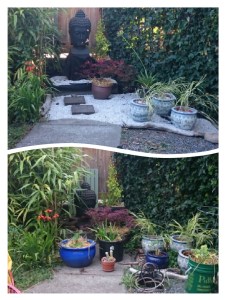
I finally was able to get to my relationship corner this past weekend!  Here is a before and after picture.  This year it became the storage corner of  all the things I intended to get back too! Stopping to take a look at it last week I noticed it was a visual of what was happening in my head with regards to my own relationships – cluttered chaos!   Overgrown with ivy and tree branches from the neighbours and bamboo from along my back fence line, storage of pots, shutters and electrical items.  It was time to do something about it!  Believe it or not my environment affects my brain, emotions, physical and mental well-being! As open space emerged there was a shift from overwhelm and feelings of being choked, to relief  and a peaceful calm and I knew what to do with the white stone that had been gifted to me the week earlier! I had been wondering where to put it and standing in this corner I was reminded  of two things;  white is one of the colors representing relationships and it brightens dark corners! I am more than pleased with the results!  For me, I am now feeling spaciousness and calm!

Have you considered how you respond to your environment?  


3 Tips for your Relationship Corner

  1.  Reduce the clutter and create spaciousness.
  2.  Look at the lighting in this corner.  If it is too dark, lighten it up, or  if too light, darken it to ground the space.
  3. Check to see what you have in this corner that symbolized your relationships with a significant other or in the community.  For me, this corner is outdoors, in my back garden where the door to my office is.  It therefore not only represents relationships with my community, it reflects that with my students and clients too!  I have chosen it to reflect a zen like quality which is the element of metal . There are two silver stars in the ivy and two hearts in the white stone, both which symbolize fire, and reflect engaged relationships!

 Where is your relationships corner?

Imagine a nine square grid overlaying your property.  Three rows of three, equal in size.  Now stand on the street facing your property.  The relationship corner is the last square to the right in the farthest row of three.  Now walk back into your garden as though for the first time and observe this area and what story it may share.

Consider a consult with me, in person, face-time or by phone!


Read how 2021 in numerology is a number 5

Learn how to find the meaning of your house number

The only way to change is action

Ways for exploring mindfulness in active function rooted in the practical integration of Tibetan Buddhist Meditation
Awareness through Communication – Western Mind integrating Eastern Mindful Practice
Awareness through Movement – Retraining Brain beyond western & eastern mind
Awareness through Space  – Landscape and emotional, mental and physical function

by Renee Lindstrom

Effective Movement Posture and Awareness with Life  Mentoring Programs Available:←

 1st Phase of Integration – Getting Started (Introduction & Pattern)
 2nd Phase of Integration – Getting Intouch (Experiencing & Connection)
 3rd Phase of Integration – Integration (Embodiment)

Follow the journey on TwitterInstagram or Facebook

by Renee Lindstrom, GCFP @ Inside Awareness,  Living in Natures Love Blog
Renee Lindstrom Live
Copyright 2014 – 2021 Renee Lindstrom, GCFP
Feldenkrais®, Feldenkrais Method®, Awareness Through Movement®, Functional Integration®, are registered service marks of Feldenkrais Guild® of North America. Feldenkrais Method®

Empathy quote by Dr. Marshall Rosenberg

sunset-538286_960_720“Tragically one of the rarest commodities in our culture is empathy.  People are hungry for empathy.  They don’t know how to ask for it.”  Dr. Marshall Rosenberg


Transitioning from Language of Conflict into Language of Connection (based on Nonviolent Communication)

Recent Comment:  I love your cogent analysis of emotions = energy + story. So, emotions – story = energy freed. Yeh! thx, pat zzz

Renee Lindstrom, GCFP,
Jaw Release Program since 2007, Authored  Achieving your Goals  31 Day Program, Sleep Sweet Sleep, Kid’s Peace Bus Calendar of Values  Educational Program & InTouch with Your Values Self-Actualization Program.  Feldenkrais® Practitioner since 2007, Communication & Empathy Coach since 2004, Art of Placement  since 2000, Labyrinths of Victoria since 2012, #yyj Peace Week Grassroots Calendar Founder, Vice-Chair of World Children

Happy Feet: What folk remedies do you use for corns on your feet?

by Renee Lindstrom, GCFP

toes

I have become all to familiar with how corns can disturb a person’s walking pattern.  If not treated properly one corn can destroy it!  Have you ever felt a constant pain in one spot as you did something as simply as stand or walk?  A corn can cause a person to try and not put pressure on that one spot thereby changing how they balance their own weight, stand and walk!

Besides helping those suffering from corns to re-learning how to improve their gait I have been researching on-line for home remedies to soften and reduce these culprits that can eventually lead to canes.  I  have come across this home remedy one more than once.  Have you tried it?

Toes 1

Softening corns using Crushed Aspirins and Lemon Juice 

You will need:

  • 5 Aspirins crushed
  • 1/2 – 1 teaspoon of Lemon Juice
  • Water
  • Plastic for a wrap
  • heated damp towel

Mix the crushed aspirin and lemon juice together first.  Add only enough water if needed remembering to make the ingredients a paste that is thick enough to apply to your corn and have it stick.

Use your fingers or butter knife to apply the paste to the corn and wrap your foot with plastic wrap or bag.  Take your warm damp towel and wrap your foot over the plastic. Let sit for 15 minutes.

Once you remove the foot wrappings remove the dried past and gentle scrub with a rough piece of lava or pumice stone.

Take time to notice how the corn feels to the touch now after your home treatment. Check in to observe how it has changed.  For example:  Is it any softer?  

Each time you put pressure on this area it is rubbing against something so the corn will be building a layer of tissue to protect this spot.  To get ahead of it you will want to repeat this treatment as many times as you can during the week.  Beside the poultice and more obvious concerns like tight shoes, you may wish to investigate your walking gait and how you balance your body weight.  The feedback I am getting from teaching Feldenkrais® to those suffering from poor balance and walking gait has been,  “It has never been explained like this by anyone!” this may be a learning method worth your while to investigate!

Feldenkrais Method® of Somatic Movement Education

Recent Comment:  Thank you for the amazing session which helped me to better understand the pain and anxiety issues I’ve been dealing with. Very insightful experience. I felt way more relaxed Friday evening and I’m monitoring myself to help ensure I’m releasing tension and breathing properly. Am impressed by it and by your skills. D

Traditional uses and properties of herbs are for educational purposes only.  This information is not intended to diagnose, treat, cure, or prevent any disease.  Every attempt has been made for accuracy, but none is guaranteed. Any serious health concerns or if you are pregnant, you should always check with your health care practitioner before self-administering herbs.