Category Archives: Cultivating Awareness

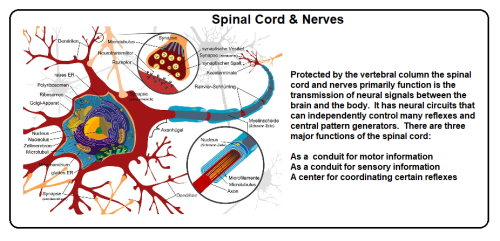
Thoracic Spine Function

Spinal cord & nerve functions in Thoracic Spine

  • Flexes wrist
  • Supply small muscles of the hand
  • Intercostal and trunk above the waist
  • Abdominal muscles
  • Thigh flexion
  • Thigh adduction

If for any reason you are experiencing a deficit in any of these functions two ways to increase the quality are: 


Investigate the micro – movements of Feldenkrais

The only way to change is action

Food for the Lumbar Spinal Cord and Nerve Functions

Learn more on  Lumbar Spinal Cord and Nerve functions


by Renee Lindstrom

Effective Movement Posture Mentoring Programs Available:

 1st Level – Getting Started (Introduction & Pattern)
 2nd Level – Getting Intouch (Experiencing & Connection)
 3rd Level – Integration (Embodiment)

Follow the journey on TwitterInstagram or Facebook

by Renee Lindstrom, GCFP @ Inside Awareness,  Living in Natures Love Blog
Renee Lindstrom Live
Copyright 2014 – 2021 Renee Lindstrom, GCFP
Feldenkrais®, Feldenkrais Method®, Awareness Through Movement®, Functional Integration®, are registered service marks of the Feldenkrais Guild® of North America. Feldenkrais Method®

Dropping irrelevant words to improve focus on event being shared

I have found that our education has focused upon proper rules of grammar versus focusing upon how each person has a different perception of incoming information.  This translates  into writing, reading and speaking that leads to misunderstandings.

Five ways that humanity perceives information from their environment is through sight, sound, taste, smell and, touch.   Incoming information from the environment will travel through the physical body processing the information before reaching thoughts.  A process so fast it’s unrecognizable.

You can recognize people’s dominant senses through their choice of words in speaking and writing.  For example:

  • Visual –    “I see……”
  • Sound –    “I hear…..’
  • Smell –      “I smell…..”
  • Taste –      “I taste……”
  • Touch –     “I feel……”

Translation & simplicity are needed in the ways that these interactions are used

I will use an example of my own predominant sense and its usage.  This is,   “I feel……”  I use this statement in a way that isn’t understandable to anyone outside myself.  Others will be triggered by it,  unknowingly,  before taking in the information I am trying to convey. Here’s  how I may use touch to describe an experience that may be familiar to you where you would accept it as being normal, however may be having inner thoughts that stimulate irritability or annoyance.  You may even shut out what you are hearing.

 I feel like I have gone one step forward and one step backward.

I did want to I feel in the following post to describe my interpretation instead of an actual feeling.  Something like

I felt like I had one foot in the future and one foot in the past after a new router was installed yesterday.

Had I used it, it would have added confusion and extraneous words to describe it.  I chose words to describe exactly what happened without my interpretation.  The event was shared in a way that more people could take in the information and understand the point of it.  That is my intention – to be understood and for a connection.  If you look through the sentence for feeling words there are none.  If you analysis the statement you will note there isn’t any information pertaining to a felt sense.  One foot in the past and one foot in the future is an evaluative experience which precludes any felt sensations.

At yesterday’s installation of a fiber optic wireless router the technician gave me the option to go back to a hard line for my laptop versus wavelength. In addition,  I was told I could install an app that would turn the wireless off when others left for the day making the house wave free from my own router. I am thrilled for these choices!

Sight, sound, touch, taste, smell

  • What is your predominant receptor?  
  • How does translate into your dialogues?
  • Does being received by others in the way you intend matter enough to you to slow down and consider how you share?


About Renee Lindstrom, GCFP

One  part of her practice is to refine and translate dialogue so that one can settle their emotional fears, pain and anger, or improve their needs to be seen, heard and valued in relationships.  This is important in improving physical function too.  Unresloved needs can restrict movement causing one to have less flexibility.

Learn more

The only way to change is action

Coaching available in person, by phone or on-line chat

Classes 

Book Appointment

Coaching using Awareness through Spoken Word techniques introduces a new way of understanding differences and compassion that comes from empathy. Empathy for self and others that is more than listening or touch. It is in the quality of the spoken word patterns. The focus is to expand the awareness of the stimulus of spoken word and go beyond its restrictions in habitual ways of speaking. The intention is to create inner peace and expand outer harmony for better choice making and resolving differences.

by Renee Lindstrom

Awareness Through Living Mentoring Programs Available:

 1st Level – Getting Started (Introduction & Pattern)
 2nd Level – Getting Intouch (Experiencing & Connection)
 3rd Level – Integration (Embodiment)

Follow the journey on TwitterInstagram or Facebook

by Renee Lindstrom, GCFP @ Inside Awareness
Copyright 2014 – 2023 Renee Lindstrom, GCFP

More for you to check in for increasing awareness of your home experience

Pic by Renee Lindstrom

Language of Environment & Landscape

Read more on:


Renee Lindstrom offers:  Indoor & Outdoor Landscape Life & Wellness Consulting & Coaching  enhancing relationship skills, emotions and flexible movement awareness!


Sage responses for when the pain of break up is increased by thinking over past events

Being the one who is broken up with can be the most challenging and chaotic as the minds condition has no choice but to go into what it has been trained to do.  Such as:

  • Blaming & Shaming
  • Right & Wrong Thinking
  • Make moral judgments
  • and more…..

I have been there myself.  I have experienced the open darkness of pain where it feels like there is a tear in the fabric of my reality.  When I sought out support and empathy whether it was professional or in my personal friend group I wasn’t thrown the kind of lifeline for  my grief and regret that steered me through the depth of emotions.  Rather it added to the chaotic thinking emotions and increased the effort to sort out.  Recently in the midst of supporting someone else’s break up I had a moment where  I considered how much I would have benefited to have someone  support me with this type of feedback, while recognizing this will have to be repeated until the chaos of the mind training settles and one can enter more permanently into the experience of sadness and forgiveness that is the letting go process.


When I listen to  you I am taken into your story of regret and grief. I hear that you are replaying events in your mind thru the lens of pain you’re feeling now stimulated by this break up. Replaying events is part of the grieving process, however I encourage you to be aware that the need in the moment you made those choices then is far different than the one now. The present need is based on this current event and it cannot go back and preside over past events.

The current event is stimulating your pain body and your memories are surfacing. Putting attachment to them by going into assessing and criticizing yourself is feeding the pain your feeling. These thoughts are false realities. The truth is that in this moment you’re a feeling deep sorrow and pain as you experience this loss.


by Renee Lindstrom

Awareness Through Communication

 1st Level – Getting Started (Introduction & Pattern)
 2nd Level – Getting Intouch (Experiencing & Connection)
 3rd Level – Integration (Embodiment)

Follow the journey on TwitterInstagram or Facebook

by Renee Lindstrom, GCFP @ Inside Awareness,  Living in Natures Love Blog Renee Lindstrom Live
Copyright 2007 – 2020 Renee Lindstrom, GCFP

I was reminded of how sympathy can influence not being seen or heard

For me it is an experience of one merging their pain with an others.
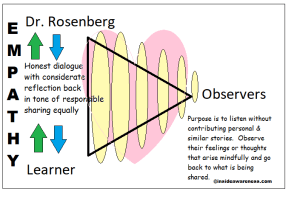
Going into sympathy reflects merging old pain together with an others circumstances.

Let me explain.

In a circle with Dr. Marshall Rosenberg in 2004, he began demonstrating a deepened empathy pattern and I found myself curious about how some of us in the circle were independently holding the space and others where crying in sorrow.  I asked an advanced trainer who had worked with Dr. Rosenberg for many years about the differences in experience.  I was told that those who were not sobbing  didn’t have a similar pain as the person who was receiving empathy.  Those who were  had that same abuse in their lifetime that stimulated old pain.   Fortunately this intensive was to transition from moral judgments and right and wrong thinking.  This explanation was shared with clarity and as a matter of fact.  What I learned was that those identifying with the pain had an opportunity to heal themselves in witnessing the resolution in the person who was receiving empathy from Dr. Rosenberg.  The key was to feel their pain rise up and let their thoughts rest.  The skill was to resist  going into their own story that would hijack the circumstances away from the speaker.  I call this the ultimate witnessing ability.  (This is when you can stop yourself from hijacking someones story away from them and making it about you.)

Empathy practice, the NVC way, is to fully hear what someone is saying without interpreting it back through your past experiences and personal perspectives.  The only way someone is going to feel seen and heard is if you are able to listen to their words while being attentive to what you are hearing.  The following ways of habitually listening are not empathetic, instead they challenge the speaker.

  • Comparisons – telling your perspective or someone elses
  • Being an authority
  • Moral Judgments – no right and wrong, not speaking to what’s wrong with someone
  • Assessments
  • Diagnosis
  • Labeling
  • Criticizing
  • Coming up with solutions
  • Asking questions – your job is to listen, not understand

Dr. Marshall Rosenberg, Author or Nonviolent Communication
NVC – Nonviolent Communication

Book a personalized  session for self, work or group
250-361-7508

Awareness Through Communication

 1st Level – Getting Started (Introduction & Pattern)
 2nd Level – Getting Intouch (Experiencing & Connection)
 3rd Level – Integration (Embodiment)

Follow the journey on TwitterInstagram or Facebook

by Renee Lindstrom, GCFP @ Inside Awareness,  Living in Natures Love Blog Renee Lindstrom Live
Copyright 2007 – 2020 Renee Lindstrom, GCFP

Introducing the Cerebellum

Cerebellum is a Latin word that when translated into English it means little brain.  The circled part of brain pictured here is the Cerebellum.  It is located behind the brain stem just under the two lobes of the brain.

Early in my Feldenkrais training a video was shown of Dr. Moshe Feldenkrais working with an infant who was borne without a Cerebellum.  Her name was Elizabeth.  Elizabeth’s parents had been told by numerous Doctors after her birth that she would never be able to learn, walk, talk or think.  Their predictions and recommendations were dismal.  In their first meeting Dr. Feldenkrais told Elizabeth’s parents that she was far more intelligent than her earlier Doctors had predicted.  As it turns out Elizabeth did grow up and attend University and had the ability to walk independently.  Thankfully her parents didn’t listen to all the earlier diagnoses and continued their pursuit of supporting their young child to reach her potential!

Why am I writing about the Cerebellum today? 

This body part became a dominate focus of attention in meditation this morning.  While sitting I guide my focus of attention through my body parts for a sensory check in, especially if I feel agitated. My intention is to discover  where the agitation is located.  Having a strong Kinesthetic sense means that if one part of body function is agitated balance is off. This sitting and scanning pattern allows for awareness of what is out of balance and gives the opportunity to pause and observe the agitation.

Usually recognizing it without going into story or strategies is enough to clear it.  If not, this recognition cultivates awareness of how this imbalance may influence the days functional abilities giving more choices of how to respond versus reacting.

It’s important to increase understanding of the impact the Cerebellum has in our moment to moment living experiences.  It governs key functions such as speech, mood, fear and pleasure response, balance and posture, mental function, movement, motor learning, and vision.  ​It receives information  from other regions of the  brain and body to coordinate and control voluntary movements.  Recognizing the world events is influencing  my cerebellum gives me pause to consider that it will be a major influence in others current experiences as well.

The Cerebellum is known as the fear and anger center which communicates with the pre-frontal cortex.  Five tangible ways you can choose to increase the window of tolerance in the fear and stress responses of in the cerebellum region:

Read More on Physical Reactions to Fear

Watch Video of Elizabeth receiving Functional Integration as young adult


Read more on Mental & Emotional Responses to Fear

#3 & 4

Read more on Pre-frontal Cortex Responses

Awareness Through Living

1st Level – Getting Started (Introduction & Pattern)
 2nd Level – Getting Intouch (Experiencing & Connection)
 3rd Level – Integration (Embodiment)
Read more on Cultivating Awareness through Living

Book a personalized  session for self, work or group
250-361-7508

by Renee Lindstrom

Follow the journey on TwitterInstagram or Facebook

by Renee Lindstrom, GCFP @ Inside Awareness,  Living in Natures Love Blog
Renee Lindstrom Live

Your focus is where your attention goes…….

Your focus stimulates your connection physically, ethereally, perceptually, emotionally, mentally and ultimately your connection and contribution to life, environment and planet.


One of the physical areas that is a hit right now in my Feldenkrais work is  eye focus.  It seems that those spending time using Zoom have been getting coaching on how to appear through facial expression and eye contact.  It seems that the focus has gone from full body expression to facial with this current medium for staying in touch!

This leads to a question for consideration.  Do you focus on the world and take aim with your eyes or do you let the world come to you?  If you had to guess, which action would be intense and which action would be soft?

What I am hearing as a need from those on the receiving end of a Zoom connection is for empathy expressions.  Those who haven’t accomplished slowing down and softening their eyes are unable to mask their lack of empathy over Zoom.

If you would be interested in discovering more about ways to cultivate this skill through simple micro-moves connect and arrange a Zoom  session.   This is not a trend for healing yourself or others, it is simply increasing your functional facial expressions that increases your accessibility.

Book a personalized  session for self, work or group
250-361-7508

by Renee Lindstrom

Awareness Through Movement® Programs Available:

1st Level – Getting Started (Introduction & Pattern)
 2nd Level – Getting Intouch (Experiencing & Connection)
 3rd Level – Integration (Embodiment)

Follow the journey on TwitterInstagram or Facebook

by Renee Lindstrom, GCFP @ Inside Awareness,  Living in Natures Love Blog
Renee Lindstrom Live