
Living Relationships with Place
Where Life Path Meets Place
Our surroundings continually participate in our everyday experiences.
The rooms we enter, the furniture we use, the colours we encounter, and the pathways we follow all contribute to how we experience ourselves within an environment.
Many of these relationships become so familiar that we rarely consider their influence.
We may feel comfortable in one space and unsettled in another without immediately recognizing what contributes to the difference.
The Inside Awareness Place & Design explorations introduce opportunities to become curious about these experiences.
Through embodied Feng Shui, sensory awareness, movement, observation, and personal inquiry, we can begin discovering how our environments influence our participation in everyday life.
The intention is not to begin by identifying what needs fixing. It is to recognize what is already happening within our relationship with a place.
As these influences become consciously recognizable, new possibilities for arranging, designing, and participating within our environments may emerge.
01 — Home & Office
Recognizing How Our Surroundings Participate in Everyday Living
Our homes and workplaces provide the physical environments in which many of our daily experiences unfold.
Furniture, windows, entrances, pathways, colours, lighting, and architectural features influence how we move, orient ourselves, work, rest, and engage with others.
Yet we may become so familiar with these surroundings that we stop consciously noticing them.
Inside Awareness introduces an experiential approach to recognizing these relationships.
Rather than beginning with a prescribed arrangement, we can begin by entering a space with curiosity.
What do I notice as I enter?
Where does my attention naturally travel?
How do I experience the relationship between indoor and outdoor spaces?
Where do I feel comfortable working, resting, or participating with others?
Discovering the Influence of Arrangement
A room offers many possibilities for participation.
The position of a desk can influence what someone sees while working.
A chair may invite an experience of openness or enclosure.
The placement of furniture can influence movement through a room, opportunities for interaction, and the relationship between different activities.
These arrangements can become familiar without their influences being consciously recognized.
Through guided observation, participants can explore these relationships before considering whether anything needs to change.
Colour, Nature, and the Spaces Between
Colour, light, and natural features introduce another dimension of environmental awareness.
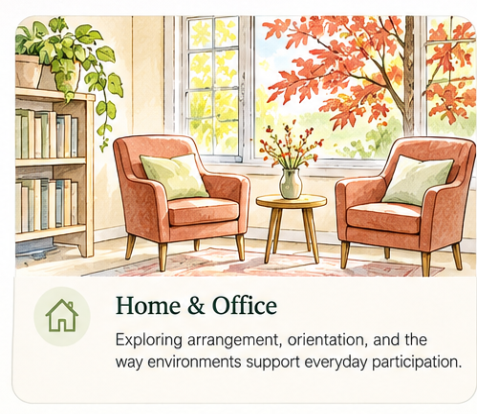
During one property exploration, I noticed two red chairs positioned near a large window. Beyond the window stood a beautiful red maple tree.
The relationship between the chairs and the tree created an unexpected continuity between the indoor and outdoor environments.
The arrangement had not been consciously recognized in that way before.
Nothing needed to be changed to discover it.
The experience simply offered another opportunity to appreciate how colour, nature, and design were already participating together.
Sometimes the first meaningful change is not in the environment, but in our recognition of it.
02 — Buying & Selling Property
Discovering Our Relationship with Place During Life Transitions
Buying or selling a property often involves more than a financial or practical decision.
A home may hold memories, relationships, familiar routines, personal achievements, and experiences accumulated over many years.
Moving from one place to another may introduce feelings of anticipation, uncertainty, grief, relief, or excitement.
The Inside Awareness approach invites recognition of these experiences while exploring the physical qualities of a property.
Listening Before Deciding
A person may enter a property with an established list of expectations.
Location, size, layout, appearance, and practical function may all influence their interest.
Yet the experience of being within a place can introduce information that was not apparent through descriptions or photographs.
How do I experience entering this property?
What captures my attention?
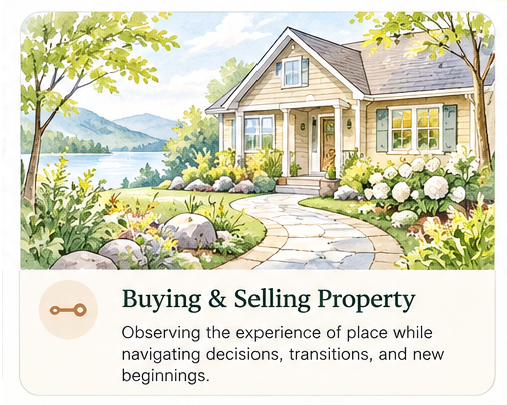
How do the rooms, windows, pathways, and surrounding landscape relate to one another?
What possibilities can I recognize for participating in daily life here?
These inquiries do not replace practical considerations, professional property advice, or financial decisions.
They offer another dimension of personal awareness within the decision-making experience.
Past, Present, and Future
A property transition may also invite recognition of our relationship with time.
The past may be present through memories and the experiences associated with a familiar home.
Our present circumstances influence what is meaningful and possible now.
The future introduces hopes, expectations, and possibilities for new beginnings.
The Nine Life Areas can offer an additional map for exploring these relationships and recognizing where attention is being drawn.
Rather than prescribing what a property should provide, this orientation invites people to consider how the place relates to their own life experiences, values, and intentions.
A property is not simply a physical structure. It can become part of the living relationship between where we have been, how we are participating now, and what we hope to create.
03 — Fashion & Design
Recognizing the Relationship Between Colour, Form, and Embodied Experience
Design participates in our lives through more than the arrangements of buildings and rooms.
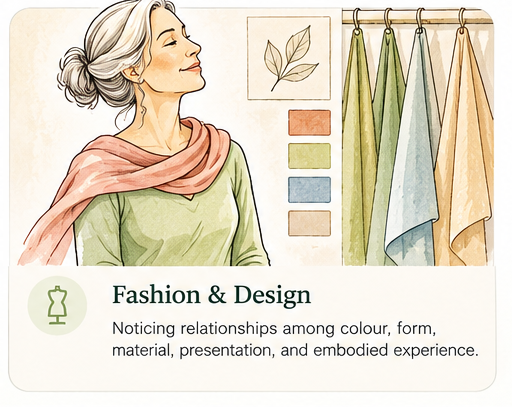
Clothing, colour, texture, materials, shape, and personal presentation also influence how we experience ourselves and participate in our surroundings.
We may be drawn toward particular colours, forms, or materials without consciously recognizing what is meaningful about them.
Fashion and design explorations introduce opportunities to become curious about these relationships.
Discovering Personal Responses
A colour may create a sense of familiarity or pleasure.
A fabric may invite a particular sensory response.
The shape of a garment may influence our experience of movement, comfort, or expression.
A design feature may feel meaningful because of a memory, personal association, or relationship with the surrounding environment.
These experiences are individual.
The intention is not to establish which colours, styles, or designs are correct for someone.
It is to develop conscious recognition of personal responses and discover how those responses relate to self-expression and choice.
Inner and Outer Design Relationships
Our personal presentation and the environments around us continually interact.
The colours of a room, surrounding landscape, clothing, furnishings, and natural light may create relationships that influence our experiences.
A design decision can therefore be explored through both its outward appearance and its inward meaning.
What attracts my attention?
How do I experience this colour, shape, or material?
What feels personally meaningful?
How does this choice participate in the environment or activity?
These inquiries invite a more conscious relationship with design without requiring prescribed standards of beauty, fashion, or personal expression.
Design becomes an opportunity to recognize how inner experience and outward expression participate together.
Place as a Living Relationship
Home & Office, Buying & Selling Property, and Fashion & Design offer different entry points into discovering our relationships with the environments we inhabit.
Each introduces opportunities to recognize influences before deciding what action may be meaningful.
The approach is informed by embodied Feng Shui, somatic awareness, personal values, and the observation of relationships between people and their surroundings.
Traditional Feng Shui maps, including the Nine Life Areas, may provide references for exploring orientation and personal meaning.
These references do not replace individual sensory experience or determine what someone must discover.
The intention is to nurture curiosity, conscious recognition, and greater choice within everyday living.
A place is not simply something we occupy or arrange. It is an environment with which we develop an ongoing living relationship.
Related Explorations
- Movement in Lived Function — Somatic Ergonomics
- Walking with Inner Awareness — Living Relationships with Nature
- Culture of Values — Recognizing What Is Meaningful
- Intention in Lived Experience
- Orientation of Communication
Guided Patterns for Lived Function — Renee Lindstrom – Inside Awareness
I acknowledge the practices and teachings that have contributed to the ground from which this work has grown: Moshe Feldenkrais and the Feldenkrais Method® of somatic education; Marshall Rosenberg and Nonviolent Communication; Chögyam Trungpa Rinpoche and the Shambhala teachings; and Dyan Grant Francis, Subtle Energy Solutions and Black Sect Feng Shui.

