Minimalist line art emphasizing embodiment before strategy
Embodied somatic action harmonizes with cognitive focused strategies and increases conscious connection to motivation. It leads to clarity of motivation before action. This pattern increases the potential for successful outcomes in all life areas, and reduces inner and outer conflicted states. Leading with strategies indoctrinates self and others and reduces innovation, motivation and spontaneous outcomes. Embodiment cultivates awareness and increases possibilities for higher outcomes and experiences.
Cognitive StrategiesVs Somatic Awareness
Strategies are cognitive based upon beliefs, while somatic processing is a learning path of awareness. A cognitive based belief system can stunt a person’s perspective by its nature as it has a focus of attention in one or two life areas only. For example, if a person is only focused on wealth and its attainment, every action will be strategic to meet that need. Generally, there will be a lack of mindfulness through the experience. The experience will lack the balance and harmony that is born from lived mindful awareness. Without this mindfulness there can be perpetual states of conflict, inside and out. Conflicted states fanned by the flames of seeking ways to increase wealth. This can influence every aspect of living as this conflict is expressed through emotional behaviour, expression and physical action. It can extend to every relationship that begins with critiquing through the lens of how to use others to their advantage in growing greediness. Strategy focused actions usually led to winners and losers. Strategies born from beliefs lack conscious awareness of the intent in the present moment. Beliefs are the past, yet they control the present, the future. This pattern can lead to extreme actions and statements for justification, with the last attempt feeding the next.
The process of mindfully connecting to one’s inner motivation before strategies increases conscious awareness. This process is more likely to grow beyond a single minded focus such as in this example, to become wealthy. The isolation that comes with self perceived status can expand into a state of thriving, instead of striving, through the increased range of information that comes with inclusion. Achievement will not be at the cost of people, places and things and instead include consideration for them. Those who are strategy first decision makers are not eliminating somatic experiences, they simply have no control over it. Their focus on power and control is strategic and is without the abilities of self regulation. How can one self regulate an experience they are cognitively ignoring? Being led by uncontrollable somatic experiences can lead to conflict and harm, of self and to others. They may lack the discernment for recognizing they are living in a cycle of going from one catastrophic experience to the next. Often overlapping.
Embodiment before strategy is a learning pattern integrated into the program topics at Inside Awareness. Learn more about the lifestyle program topics.
by Renee Lindstrom, founder, Inside Awareness Center for Integrative Somatic Learning
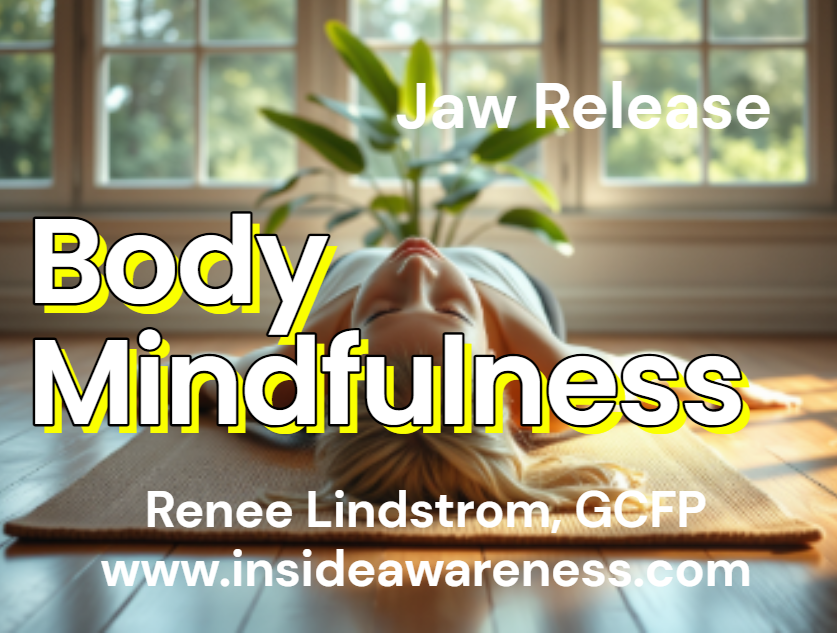
Launching TMJ – Jaw Release #1 – Side to Side
TMJ Jaw Release Guided Pattern Audio #1/3
These guided patterns are from Feldenkrais workshop that Renee has held since 2007. The feedback after each workshop has been positive with appreciation expressed. Here is a recent comment from a ’26 workshop.
I always appreciate my sessions with you and the learning. The focus on the tongue, back of throat and head hinging as part of the jaw release has really made a difference. Some of what you shared was new for me so it is taking me awhile to get the hang of it but I’ve been exploring those movements further at home and it’s been good. J
These somatic patterns are called Awareness through Movement Lessons and this workshop series is the integration of of moving parts that enhance ease in the jaw function. The patterns cutivate awareness of the joint movement through micro movements that increase efficiency.
A student may become consciously aware of the individual parts inside their mouth and in their facial features, neck, and further down the torso. It is a wonderful way to find a deeper inner peacefulness, and experience the calming influence of mindfulness.
These lesson contribute to:
Reducing jaw and neck pain
Headache support through pain reduction
Increased jaw function
Lessen scienty, tension and stress
Improve Jaw Function
Enhance sleep and relaxation
Read more on the benefits of Somatic Body Mindfulness and research of Feldenkrais below
How to purchase and enjoy TJM Jaw Release – Side to Side
TMJ – Jaw Release Side to Side #1of 3
Explore the anatomy of the jaw using guided patterns and mindful exploration for cultivating awareness through the felt senses and the skeleton.
increase relaxation and windows of emotional tolerance and self-connection
improve sleep and sleep sounder
increase body functions, cognition and emotional responses of calm, mindfulness and joy
Exploring the body anatomy through the felt senses increases inner awareness and trust. This body exploration is a different type of strength training. The difference is the focus of attention on the body, mind and felt senses through guided patterns designed to expand conscious awareness of the body function. The strength of feeling one’s body through moving joints and bones deepens awareness of physical connections as postures change, like in the shifting transitions from sitting to standing and back to sitting. Movement is a series of shifting postures. The functioning healthy body is not stationary, nor poses. It is designed for a continuous flow of integrative movement patterns.
Feedback On Body Mindfulness Introduction
“I am excited!!! This is great! It is like you are there with me step by step. It’s what all of us are looking for, real Feldenkrais support” S
“That was great, Renee! You have such a calm and lovely voice. I’m happy to add this to my calming strategies.Thank you. ” H
“I really like this sort of thing and would welcome further “installments” in the series and/or a revised version of this one. I liked the pace at which you spoke, not too rushed and left enough time to do the exploration of the particular area of the body to which you were drawing attention.
I liked that you offered options re leg position (straight out or with bolster under knees) but wondered whether one position or the other is preferable. Or is it just that one would notice different things, depending on how the legs are positioned?” K
Feldenkrais®, Feldenkrais Method®, Awareness Through Movement®, and Functional Integration®, are registered service marks of the Feldenkrais Guild® of NorthAmerica
Inside Awareness Legacy Project for balancing transition in early childhood somatic learning to conceptualized intellectualized learning
While continuing to expand the Learning Center’s objectives for continued consulting, teaching, coaching and mentoring Mindful Lifestyle choices through education, a new goal was announced in late 2025 for creating a legacy impact through education for balancing the two learning streams of consciousness.
One way you can support this legacy project is by visiting and shopping at one or more of these creators. Each one of these online marketers offer products that align with the lifestyle area learning opportunities offered by Inside Awareness.
Please support the Educational Legacy Project at Inside Awareness
Remember, the only place to donate is on the Inside Awareness website – www.insideawareness.com under the legacy tab. This website will demonstrate years of work in blog posts and pages to confirm its authenticity. Authenticity can further be explored at http://www.reneelindstrom.com.
Feldenkrais®, Feldenkrais Method®, Awareness Through Movement®, and Functional Integration®, are registered service marks of the Feldenkrais Guild® of North
Here are the YouTube channels for Inside Awareness with playlists you can like and subscribe to if you are interested in supporting the Legacy Project of Inside Awareness. Each playlist has individual videos you can listen to, like and support. This objective is to monetize the channels and playlists to help finance this legacy.
Renee also has a podcast with interesting topics. For example, one that is relevant and has been discussed in mainstream media recently is on the incorrect use of Maslow’s Hierarchy of Needs. The label of Maslow’s Hierarchy of Needs isn’t used, yet the points made in the article are the same. It identifies and demonstrates the inverted use of this pyramid to block and stop people from moving forward in their lives. This is currently playing out in the global experience that encourages us to develop the consciousness we need to change these behaviours, or at the very least call them out as we recognize them.
This Legacy project educational focus aligns with organic somatic learning in early childhood and can transition these early learning patterns to counterbalance socially conditioned ones. There are many lifestyle benefits to this objective, like aging well.
Remember, the only place to donate is on the Inside Awareness website – www.insideawareness.com under the legacy tab. This website will demonstrate years of work in blog posts and pages to confirm its authenticity. Authenticity can further be explored at http://www.reneelindstrom.com.
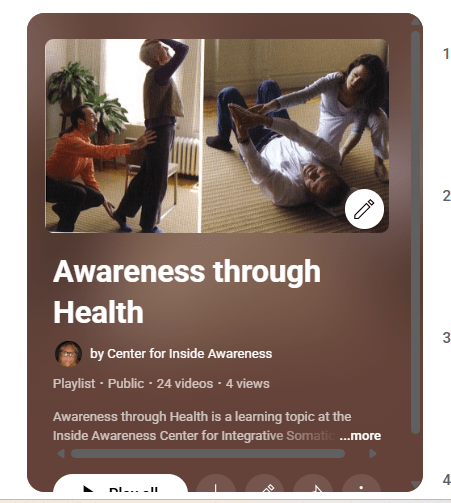
Here are the playlists on YouTube channel for Inside Awareness Center for Integrative Somatic Learning – Click individual pics to link to plalist
Here are the playlists on YouTube channel for Somatic Influencer
Here are some examples of podcasts on Renee’s YouTube channel
Feldenkrais®, Feldenkrais Method®, Awareness Through Movement®, and Functional Integration®, are registered service marks of the Feldenkrais Guild® of North
by Renee Lindstrom, founder, Inside Awareness Center for Integrative Somatic Learning
Launching Somatic Body Mindfulness Series on Audio Video
Guided Somatic Patterns for Centering
Listen on Youtube audio – Authors Voice
Cultivating Awareness & Grounding through Body Mindfulness
Somatic Body Mindfulness is a series of guided movement patterns based upon the Feldenkrais® Method of Somatic Education through the perspective of Renee Lindstrom, GCFP ’07 . Renee has been teaching Lifestyle Models in the community since the mid-nineties, which has expanded her perspective, clarity and understanding of learning and aging.
These Somatic Body Mindfulness audio videos will align body, mind and emotions. These patterns will calm the nervous system and increase inner peace. With an increase in the felt sense of inner quiet, there is an increase of clarity in the felt sense movement patterns in the shifting body parts as they transition postures. This mindful connection to the movement and physical response in transition increases conscious awareness and organically integrates the pattern into movement behaviours.
Somatic Body Mindful guided patterns reduce tension, stress, anxiety, fear, frustration and anger and increase inner calm, peace and relaxation. SBM guided patterns support an increase in the range of motion and can reduce constraints that restrict movement.
The positive mental and physical functional outcomes of these SBM guided patterns increase clarity, focus, inner calm, mindfulness, stability and physical balance. These patterns will create a balanced alignment between the mental, emotional and physical functions. This alignment improves flexibility and spontaneity. The positive emotional outcomes are an increase of inner peacefulness, contentment, groundedness, connection and belonging.
Some of the conditions that SBM guided patterns that Renee has observed improve are:
Anxiety and Depression
Artheritis
Back and Neck Pain
Loss of Balance
Bell’s Palsy
High Blood Pressure
Shallow Breathing
Chronic Pain
Eating Disorders
Fibromyalgia
Lack of Flexibility
Hip, Knee and Ankle Joint Pain
Injuries
Insomnia
Pulled Muscles
Multiple Sclerosis
Parkinsons
Locked Shoulders
Stroke
TMJ
Some of the Benefits that Research has shown are:
Improved:
proprioception
coordination and ease of movement
posture and stability
well-being
feeling of confidence
breathing
Decreased
pain
spasm
Research Evidence:
Improves:
body awareness: Multiple sclerosis, pain, stroke, able-bodied
mobility
stability
coordination
ease of movement
posture
balance confidence
mood
breathing
well-being and quality of life
sleep
self efficacy and health locus of control
self image
greater recruitment of the affected part of the motor cortex (stroke)
Reduces, decreases:
decreased pain
fatigue
anxiety and stress
medical costs
To learn more about this Research on the Benefits of Feldenkrais, go to the link in the description box and tap the link
How to purchase and enjoy this introduction to a grounding and centering somatic experience:
Introduction: Grounding thru Body Mindfulness
Experience Somatic Body Mindfulness by aligning felt sense observation and anatomy
Introduction to the anatomy using guided patterns and mindful exploration for cultivating awareness through the felt senses and the skeleton.
Use QR Code to Purchase or go below
Benefits:
reduce and reverse aging
increasing flexibility and resilience
develop body awareness
reduce body tension, pain, anxiety and effort
increase relaxation and windows of emotional tolerance and self-connection
improve sleep and sleep sounder
increase body functions, cognition and emotional responses of calm, mindfulness and joy
Exploring the body anatomy through the felt senses increases inner awareness and trust. This body exploration is a different type of strength training. The difference is the focus of attention on the body, mind and felt senses through guided patterns designed to expand conscious awareness of the body function. The strength of feeling one’s body through moving joints and bones deepens awareness of physical connections as postures change, like in the shifting transitions from sitting to standing and back to sitting. Movement is a series of shifting postures. The functioning healthy body is not stationary, nor poses. It is designed for a continuous flow of integrative movement patterns.
Feedback On Body Mindfulness Introduction
“I am excited!!! This is great! It is like you are there with me step by step. It’s what all of us are looking for, real Feldenkrais support” S
“That was great, Renee! You have such a calm and lovely voice. I’m happy to add this to my calming strategies.Thank you. ” H
“I really like this sort of thing and would welcome further “installments” in the series and/or a revised version of this one. I liked the pace at which you spoke, not too rushed and left enough time to do the exploration of the particular area of the body to which you were drawing attention.
I liked that you offered options re leg position (straight out or with bolster under knees) but wondered whether one position or the other is preferable. Or is it just that one would notice different things, depending on how the legs are positioned?” K
Feldenkrais®, Feldenkrais Method®, Awareness Through Movement®, and Functional Integration®, are registered service marks of the Feldenkrais Guild® of NorthAmerica
In the above post, Renee, founder of Inside Awareness Center for Integrative Somatic Learning, explains the origins of the seed intention at the core of the lifestyle learning programs. Since 1990, she has actively pursued clarity on the duality she was witnessing in people’s behaviour with themselves and others, and the influences of it in the environment and community. This behaviour has crossed all hierarchies and social conditioning. It expressed itself equally through opposing forces, for example, advocacy for environmental causes. The force of aggression was equal in the entitlement displayed on both sides of the table.
A choice to respond to life through the somatic sensory awareness while balancing thoughtful and mindful attention
In the personal post linked above, she shares a personal journey resulting from a year of transitioning through losses that triggered an activation in her stream of consciousness focus. Prior to that year of losses, there had been a heartbreak event called broken-heartedness in the Buddhist Teachings of the Shambhala Center. There is a heart opening in this state of being that is tender and soft. Combined with the shift into heightened levels of somatic sensory awareness and perception, there was an experience of expanded consciousness beyond the limitations of a socially conditioned and educated left-brain experience. She eventually identified this experience as the state of mindfulness one finds in a committed sitting meditation. The difference is that it was an active living experience, and not an organized practice of achievement. It was an obvious experience that could be defined as different than those around her. The shift into this somatic led state felt like spontaneous combustion was a four-year transitional period of little combustions leading up to the major eruption. The fifth year was dedicated to stepping back to fully immerse in the potential for understanding and finding answers. The answers didn’t come in a year, and it took years of commitment to tap into and explore patterns that could cultivate the awareness that was being sought out. This even meant entering educational programs where the mentors described themselves as having achieved what she was longing to learn, only to somatically discover they had not yet achieved it. The choice was always based upon the model of doable patterns that was being taught and integrated from someone else’s innovative teaching origins. The balance between the left brain and right brain had not been achieved yet, and they themselves didn’t know it. Why? They hadn’t experienced it yet. You can only know something when you have experienced it. This meant they were never offering their own system. It was only borrowed patterns where they assumed authority over with a sense of ownership. Even with many of these programs focused on somatic awareness and mindfulness, they did not recognize anything outside their closed perspectives. The only way she could know this is that for two years, she was in this creative connected state of being without any loss of her developed left-brain experience. The difference was that the left brain did not dominate in this experience and instead, collaborated.
They say all things happen for a reason, and now in hindsight, it may be fortunate that she experienced a mother’s emotional and mental absence, or abandonment, as a child. The basic physical needs were met, yet it lacked loving kindness. For her, it resulted in a continued state of early somatic learning that wasn’t corrupted by a shift in focus that didn’t encourage the same somatic awareness through the five senses. By corrupted, Renee is suggesting this means attention shifted to critical thinking and institutionalized learning.
Insight & recognition of the value in somatic sensory led mindfulness awareness for the aging process
Those early challenges now provide insight and recognition of their value. The clarity is a benefit for understanding the differences in socially conditioned behaviours. As a somatic empath experiencing the maturing students and their aged logical and analytical processors now, Renee finds they have difficult transitions into retirement and old age. They have long lost their connection to early somatic senses and continue trying to navigate through their focus of attention placed on outside strategies to fix their physical, mental and emotional functional losses. In their disconnection from engaging with their felt senses, she recognizes the loss in their abilities, mentally, emotionally and physically, for supporting themselves. They lack trust in their mental and physical abilities to support themselves. Without a connection to their five senses, they do not trust themselves and are fearful of their own bodies. As a practitioner who engages them in learning to connect through their five senses, Renee observes a shift in their levels of confidence and fear where their trust in themselves increases.
Learning gap in education is creating inner combat between critical thinking consciousness & felt sense consciousness
When a child enters into an adult-generated learning model, it becomes the dominant educational conditioning pattern, and the loss of connection to the five senses begins. The aging process lacks the conscious awareness of the five senses. At some point in early learning, the child is redirected from their inherent spontaneous early learning patterns using the five senses and into a focused structure of organized learning. Renee stresses that this is a significant challenge in the aging process. It also shows up as a challenge in processing emotions and throughout childhood development. If a lifetime is lived with no self-directed learning choices in behaviour, reactions will be childlike with no logic. When acting out it will be through the trigger of the somatic senses without control of it. The gap in learning from the adult-designed educational patterns is eliminating the maturation that comes from processing through the five senses and understanding how to process them. Instead of processing them through the stream of consciousness that is activated, those children are being spoken at from another stream of consciousness. effectively forcing the felt senses to be stymied and judged from a perspective of right and wrong thinking. Imagine for a moment having one stream of consciousness in conflict with the other within one’s operating system. Our education is setting individuals up to do battle within themselves, critical thinking versus somatic felt senses. Incredible!
Anger tantrums at 55, 65, 75, 85, 92……
Imagine being sixty-five and still reacting from the age of five somatically while in reaction. Imagine feeling so out of control at 65 and not being able to differentiate feeling reactions. This is serious at sixty-five, as one is considerably stronger physically than at five. If not outer aggression, consider the inner fear, panic and anger. By sixty five the smallest event will trigger survival. Remember, the logical left brain doesn’t feel emotions, and it is not spontaneous.
Perceiving through the five senses and using the left brain with more efficiency for cultivating mindfulness & awareness in the present moment
From a living experience and a focus as a somatic functional integration practitioner, Renee considers how a baby is born with the ability to learn somatically through the five senses and no verbal input. A baby has all the tools they need to begin shifting their weight to physically roll over, get up and function through walking, thinking and talking. There is a name in Buddhist Meditation that is called “Beginners mind.” This name is a pattern of someone starting a mindfulness meditation. This meditation is for engaging somatically in the environment while focusing the left brain abilities to calm down and become quiet enough to follow the somatic sensing. This pattern is not maintained by Western culture, and the pattern is reversed. The mind controls the somatic experience
Summary
Renee has recognized two streams of consciousness. She once differentiated it as left-brain and right-brain dominance. Expanding her programs to include the somatic five senses has increased her willingness to begin to articulate the two streams of confidence she observes. This ability to engage from the origins of the five senses first, as in early childhood, while harnessing cognitive function to follow the sensory input, versus leading from socially conditioned learned patterns, has been a game-changer in student abilities. This suggests increased mindfulness and empathic states of being are valuable qualities for supporting students through physical, mental and emotional constraints that are limiting. These limiting experiences often translate into pain, anger, sadness and an inability to support themselves. The student will have to choose which side of the fence they are going to lead with. There are three choices, believe it or not.
Perceive through socially conditioned critical thinking.
Perceive through the five senses, sight, sound, taste, smell and touch, in the filter of power and control of critical thinking.
Perceive through the five senses, sight, sound, taste, smell and touch and harness the thinking function beyond trained critical thinking, for balance and collaboration that creates living mindfulness.
Feldenkrais®, Feldenkrais Method®, Awareness Through Movement®, and Functional Integration®, are registered service marks of the Feldenkrais Guild® of North America. Feldenkrais Method®
Copyrighted Property posted on Renee’s authentic accounts only:
A focus I have, as a somatic empathic practitioner, is the power and control through function. The lens or viewpoint is through functional movement, functional processing of information internally of the environment that stimulates action, reactions and expression.
This lens includes the past, present and future potential. It is also not exclusive to one function or another as my view is on the effects and potential for whole functional integration learned through social conditioning. The conditioning of the functioning movement, language process and relationships to emotions that are responses to thinking patterns and the felt senses that are spontaneous to actual experiences happening in the moment. The patterns I use are to retrain the brain through functional guidance that easily expands the conditions holding someone in a belief system constraining their potential for increasing mobility and flexibility. This includes the thinking constraints in functional movement or relationship interactions, internal or external.
A core function that is the power and control system of human function is breathing. This morning I have a workshop introducing movement patterns through the skeleton to expand the individual consciousness of each participant. They will all be starting from their own unique social conditioned experience. This suggests there isn’t a set pattern that will integrate a full range of functional movement that will be the exact same. Often, I will run into comments like, ‘that’s not the way I was taught in …………. ‘ You can fill in the blanks from your own experience. It seems other modalities focus on telling students that there is only one way you can breathe, meaning I hear it from those who have gone into agreement with that limited clarity of facilitators who believe what they are sharing with their students, until they themselves advance their functional body awareness of full mobility. Our social conditioning is such a right and wrong culture. I had a Pilates instructor participate as a student in a class, sit up from the lesson and began to have a disagreement. Four years later, they advertised the same workshop from my perspective and patterns. They were not ready to take in the patterns to explore and expand their consciousness at the time of my workshop, yet 100 percent believed they were right and I was wrong. This is a pattern that I now recognize as social conditioning. Each modality is locked into a belief system of right or wrong ways of functioning until challenged. Unfortunately, it’s also the instructor’s ability to integrate what they are hearing and how they interpret it that shifts the original clarity of the method and conforms it into a lesser consciousness.
This is on my mind as I enter the workshop today. I recently did a series on rolling with the ribs, and I ran into someone whose fear skyrocketed with the shift in how they were breathing. It interfered with an activity they had been doing that was locked in. The fear was so great and behaviour so locked in, they couldn’t be spontaneous. Instead of self-reflection to question their limiting belief to free up their fear, they believed any other movement patterns had to be wrong. They wanted to tell me that twenty years of practical application of Feldenkrais was wrong, as they had a Yoga instructor teach them that this was the way to breathe, and from what I heard is they believed it to be the only way in every activity. Breathing is life. Literally. There is no one way. It depends upon the activity. It also depends upon available skeletal movement function. This person was hyper-focused on the diaphragm and lacked internal felt sense, or image of the skeleton, nor the relationship to the other bones in the body that counterbalance the rib movements. Afterall, the diaphragm could not possibly counterbalance the weight of the skull nor support the mild fluctuations through the vertebra. Let’s get real here for a moment. So here’s my answer. Back to the basics and begin with the skeleton. That’s a joke, as that’s the only thing I do.
I will focus on the connection between the skull and pelvis, which is: the spine, rib cage, shoulder blades, breast bone and clavicles. I asked Ai for an image, and they can’t provide an accurate one. Even the earlier anatomy images are disappearing online and being replaced with terrible ones that aren’t necessarily correct. This is not a good sign for future learning.
Renee is a Certified Feldenkrais Practitioner – since 2007