This short video shares some of my ongoing explorations of transitional movement, counterbalance, and the relationship between skeletal support, gravity, and muscular effort.
The focus is on the ankle and foot joints and how movement changes when unnecessary muscular effort is reduced.
Rather than lifting and holding the body upright through muscular effort, the exploration begins with the relationship between the bones, joints, and the supporting floor.
As the knees bend and straighten, weight shifts through the feet. The ankles, heels, balls of the feet, and toe joints have opportunities to participate in subtle changes of balance. These small movements influence the organization of the knees, pelvis, spine, and head.
The inquiry is not about eliminating muscular activity. It is about discovering how muscles can participate without unnecessary holding or bracing.
As weight transfers through the skeletal structure, counterbalance becomes a changing relationship between the moving parts of the body and the supporting surface.
The head does not need to remain fixed in position while the body moves beneath it. Instead, it can follow the changing movement relationships through the spine.
In these explorations, the feet are leading and the rest of the body is responding.
Movement as a process of discovery
Over many years of guiding balance classes, I have observed that participants often arrive with limited awareness of the movement possibilities within their feet and ankles. Some experience numbness, restricted joint movement, or fear about their ability to support themselves.
Rather than beginning with an expectation that participants can already sense these relationships, the guided patterns introduce small opportunities for joint movement and changing skeletal support.
Through their own explorations, participants frequently discover sensations and movement possibilities they had not previously recognized.
They may say, “I didn’t know that,” or “I’ve never felt that before.”
The movement itself becomes an opportunity for developing felt sense, recognition, and trust in their own functional possibilities.
The intention behind these transitions
These are not fitness exercises or demonstrations of positions to achieve.
The interest is in the transitions themselves: the subtle movements through which weight shifts, joints articulate, muscles respond, and the skeleton reorganizes in relationship with gravity and the ground.
The larger muscles are still participating, but they need not always be leading through effort.
They can become quieter participants in an ongoing relationship of movement and support.
My inquiry continues to be how guided patterns of movement can make these relationships available for conscious discovery, particularly for people who have never considered their bodies from this perspective.
The intention is not to prescribe a correct movement, but to create opportunities for learning through one’s own lived experience.
An ongoing exploration influenced by the Feldenkrais Method® and developed through years of teaching, observation, and lived inquiry.
Discovering a More Conscious Relationship with Nourishment and Daily Living
By Renee Lindstrom | Inside Awareness Guided Patterns of Learning for Lived Function
How am I participating in creating balance in my daily life?
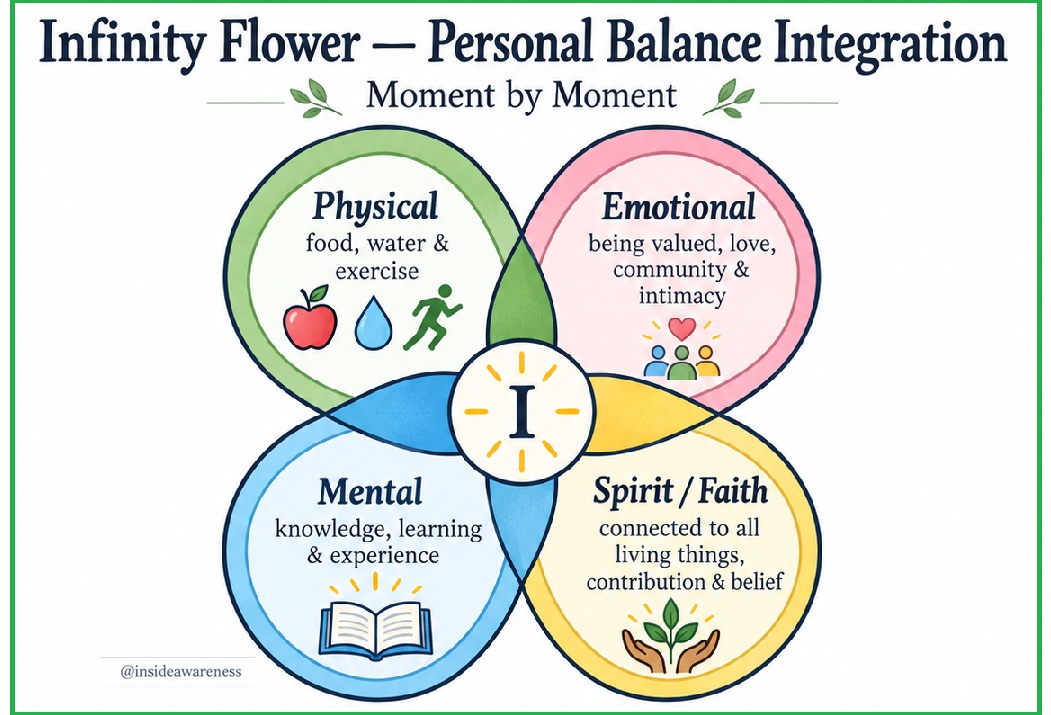
The Infinity Flower reflects four interconnected aspects of lived experience—physical, mental, emotional and spirit/faith—with the “I” at the centre. It offers a simple invitation to explore nourishment, inner awareness and the relationships that shape daily life.
This question has become an invitation within my educational work, particularly when exploring our relationships with food, movement, rest and the living environment.
Food is essential to our lives, yet the experience of nourishment can become overshadowed by routines, responsibilities, dietary expectations and the many opinions about what we should or should not eat.
For some, eating becomes another task to complete in a busy day. For others, food becomes a subject of considerable planning, measurement and self-evaluation.
There are many valuable approaches to nutritional education. My interest through Food Inspires is to introduce another dimension of learning: becoming more consciously connected to our own lived experience of nourishment.
From Food Rules to Food Curiosity
What happens when our attention shifts from what we believe we should eat toward becoming curious about our relationship with food?
We might begin noticing what attracts our senses, what we enjoy preparing, how we experience meals, or the relationships between nourishment and our daily activities.
Perhaps inspiration arises through an unfamiliar ingredient, the scent of fresh herbs, a seasonal harvest or the discovery of a new way to prepare a familiar food.
A simple experience can invite curiosity.
Curiosity can lead to exploration.
Exploration may bring recognition of something we had not previously considered.
This is one of the foundations of Food Inspires.
The intention is not to replace nutritional understanding or individual health considerations. It is to expand our relationship with nourishment beyond instructions and expectations alone.
Nourishment and the Whole Person
My educational work has long explored the relationships between physical, mental, emotional and spirit/faith aspects of lived experience.
These are not isolated parts of ourselves.
Our physical experiences may influence how we feel and think. Our emotions and daily responsibilities may influence the attention we give to rest and nourishment. Our relationships with nature, community and personal values may shape what gives meaning to our experiences.
Food participates in all these relationships.
It supports physical function, but it can also offer opportunities for learning, pleasure, creativity, connection and appreciation.
A meal might nourish the body while inviting conversation, recalling a meaningful experience or connecting us with the season in which its ingredients were grown.
Through this wider perspective, nourishment becomes more than an individual food choice.
It becomes part of our participation in everyday life.
Listening to Our Lived Experience
Much of my work has been influenced by Feldenkrais movement education, where guided attention offers opportunities to recognize familiar habits and explore possibilities through direct experience.
Over the years, I have brought this orientation into communication, environmental awareness, personal values and daily living.
Rather than beginning with a prescribed answer, I invite curiosity about what is already happening.
This includes recognizing how expectations, learned beliefs, inner dialogue and familiar routines may influence our experiences.
The intention is not to judge these patterns or determine that they are right or wrong.
It is to become more conscious of them.
When something becomes recognizable, there may be an opportunity for another choice.
In Food Inspires, this same educational orientation is brought into our relationships with nourishment, daily activity and self-care.
Nature, Seasons and the Living Environment
My relationship with food has also been influenced by an interest in the natural environment and the changing seasons.
Living in the Pacific Northwest offers many opportunities to explore the relationships between locally available foods, plants, seasonal rhythms and the experience of preparing meals.
I enjoy experimenting with cultured foods, including kefir, as well as exploring ingredients and seasonal possibilities through curiosity rather than a need to become an accomplished cook.
Some experiments turn out beautifully. Others simply become part of the learning.
What matters to me is the experience of exploration and discovery.
Food offers an opportunity to recognize our participation in a much larger living environment.
The land, water, plants, growing seasons, people who produce food and communities in which we live all contribute to the nourishment available to us.
Becoming more conscious of these relationships can invite appreciation, curiosity and a different quality of engagement with everyday eating.
Making Room for Nourishment
Our relationship with food is also influenced by how we organize our days.
Do we make time for meals?
What space is available for rest, movement, preparation and enjoyment?
How do familiar responsibilities influence the attention we give to ourselves?
These inquiries bring nourishment into the wider experience of daily living.
Food Inspires is being developed through guided patterns of learning that explore these relationships in accessible stages.
The early experiences focus on daily awareness, comfortable movement, rest, sensory curiosity and our relationship with the whole self.
Further explorations introduce seasonal nourishment, symbolic qualities of lived experience, personal values and the relationship between inner awareness, intention and everyday action.
The purpose is not to prescribe what each participant must discover.
It is to create an educational environment in which recognition, curiosity and possibilities for conscious choice can develop through personal experience.
An Invitation to Discover
I have come to appreciate that meaningful changes in daily living do not always begin with greater effort.
Sometimes they begin with curiosity.
An experience becomes interesting. Something previously overlooked becomes recognizable. A familiar activity begins to offer a different possibility.
Food can become an invitation into that experience.
What might I discover when I begin exploring nourishment through curiosity rather than judgment?
And perhaps, through that exploration, another question becomes meaningful:
How am I participating in my own nourishment and balance?
These are the inquiries at the heart of Food Inspires.
Not a destination to achieve, but an invitation to explore a more conscious, enjoyable and personally meaningful relationship with nourishment and daily living.
Explore Food Inspires
Food Inspires is part of Guided Patterns of Learning for Lived Function through Inside Awareness.
The approach is being developed for individual coaching and experiential educational programs, with opportunities to explore nourishment, inner awareness, movement, seasonal relationships and self-care.
If this perspective interests you—whether for your own learning, professional curiosity or an educational group—I welcome your inquiry.
Food Inspires is part of a developing body of work through Inside Awareness that brings together nourishment, movement, rest, curiosity and self-reflection through lived experience. If you are interested in learning more about this approach, individual coaching, or future educational offerings, I welcome your inquiry.
Food Inspires is an experiential educational approach and does not replace individualized medical or nutritional care.
Contact Inside Awareness to ask about individual coaching, educational sessions or future Food Inspires programs.
Creating Space for Conscious Recognition Through Lived Experience
By Renee Lindstrom founder of Inside Awareness Center of Integrative Somatic Learning
What becomes possible when we listen to another person’s experience without immediately interpreting it through our own?
This question has been part of my educational exploration, coaching and teaching for many years.
Through my work with somatic awareness, communication, relationships and the influences of our environment, I have been exploring how guided patterns of learning can support conscious recognition and expand our possibilities for participation in everyday life.
One particularly meaningful part of this exploration began through a sacred circle I hosted for four years.
The Experience of Empathy
The circle initially focused on Nonviolent Communication (NVC). I prepared the physical environment with intention, including an altar and arrangements traditionally associated with sacred gatherings.
Although our intention was to develop communication and connection, I began recognizing how readily interpretation entered our listening experiences.
During this period, I attended a residential learning gathering with Marshall Rosenberg, the founder of Nonviolent Communication.
Each day began and ended in a listening circle. Participants could express what was alive in them in the moment, while others listened. Throughout the day, Marshall offered opportunities for learning through direct interaction and stories drawn from lived experience.
As the days passed, I began sensing a deepening quality of empathy within the group.
It was not simply something being described or demonstrated. It was becoming recognizable through participation.
During personal interactions, I experienced Marshall’s capacity to listen with an attentiveness that allowed deeply painful experiences to be expressed without needing to be corrected, interpreted or immediately resolved.
That experience offered an important recognition.
Empathy could be experienced through the quality of listening itself.
When I returned to the circle I was hosting, the participants began recognizing a difference in how we were engaging. Over the following three years, our exploration moved increasingly toward the lived experience of empathy.
We were not simply learning what empathy meant. We were exploring what happened when we participated in it.
Recognizing the Environment of Listening
At the same time, I had been exploring the influences of environment through Feng Shui.
My understanding of environment was expanding beyond the arrangement of physical spaces.
I was recognizing that our surroundings include people, their words, the ways they engage with us, and the internal conversations we have with ourselves.
Our experiences are influenced by what surrounds us, what takes place within us, and the relationships between them.
Through my environmental studies, I had been exploring entrainment: how patterns and conditions within an environment may influence the experiences of those participating in it.
As my listening work developed, I began recognizing something related.
The listening pattern itself could hold the space.
The quality of the gathering did not depend entirely upon the arrangement of the room or the objects placed within it.
It could emerge through the shared intention, attention, listening and participation of the people present.
This opened another direction in my educational work.
Bringing Universal Values Into Lived Experience
I began recognizing that people could be familiar with the names of universal values without necessarily having an inner, experiential understanding of what those words meant to them.
A word such as respect, autonomy, kindness, consideration or belonging might be understood conceptually, yet not be consciously connected to a particular lived experience.
Without that personal connection, the value might not be readily available in someone’s inner dialogue or everyday responses.
I began introducing a guided pattern in which participants explored one universal value each week.
We gathered in a talking circle, with opportunities for each person to express their own understanding of the value through their lived experience.
The intention was not to establish one correct definition.
It was to invite participants to recognize where and how that value had been experienced in their lives.
As people listened to one another, they could encounter different expressions of the same value without needing to replace their own understanding.
The word could gradually become more meaningful through conscious recognition.
This was another way of integrating values into lived function.
Rather than expecting someone to demonstrate respect because they had been told what respect meant, the learning experience encouraged recognition of what respect actually felt like, how it was received, and how it might be expressed through one’s own actions.
When the Pattern Becomes the Environment
One experience during these gatherings brought another recognition.
A new participant suggested introducing candles and other ritual elements to give the gathering a more recognizable sacred quality.
I listened to the suggestion and began considering what was already happening within our circle.
Unlike my earlier sacred-circle gatherings, I had not arranged the room with ceremonial adornments. This was not intended to exclude ritual or diminish its value.
It simply wasn’t our focus of attention.
Our attention was directed toward listening, recognizing and expressing the meaning of universal values through lived experience.
As I listened to the suggestion, I recognized that something I had previously associated with the preparation of sacred space was already being experienced through our participation.
The quality of space we were seeking was becoming available within us and between us.
The talking circle itself offered a pattern through which presence, respect, consideration and connection could be experienced.
The experience did not require participants to adopt a spiritual or ceremonial interpretation.
I believe Marshall’s modelling of empathy influenced an important development in my understanding of the environment of listening. Through his presence and participation, I witnessed empathy becoming a lived experience rather than remaining a concept or technique. I had previously encountered profound qualities of presence through Tibetan Buddhist teachers, where devotion and spiritual practice provided an important context. With Marshall, I encountered something related through the ordinary human experience of being heard. I began recognizing that the qualities I had associated with sacred space could also emerge through the way people listened and participated together. This recognition later became increasingly visible in my own talking circles, where the pattern of listening itself began to provide the shared environment.
It emerged through how we listened, how we expressed ourselves and how we participated together.
This became another important relationship in my understanding of environment.
An environment can be influenced by physical arrangements, yet it can also be shaped by the patterns of attention and interaction taking place within it.
And through repeated lived experience, some of the qualities initially supported by an external environment may become more available within ourselves.
Returning to Listening
Recently, I hosted a gathering between two people experiencing different stages of regret and pain within their relationship.
The listening pattern I introduced was not new to my teaching or coaching practice. However, this particular experience helped me recognize its potential for more clearly organized educational programs.
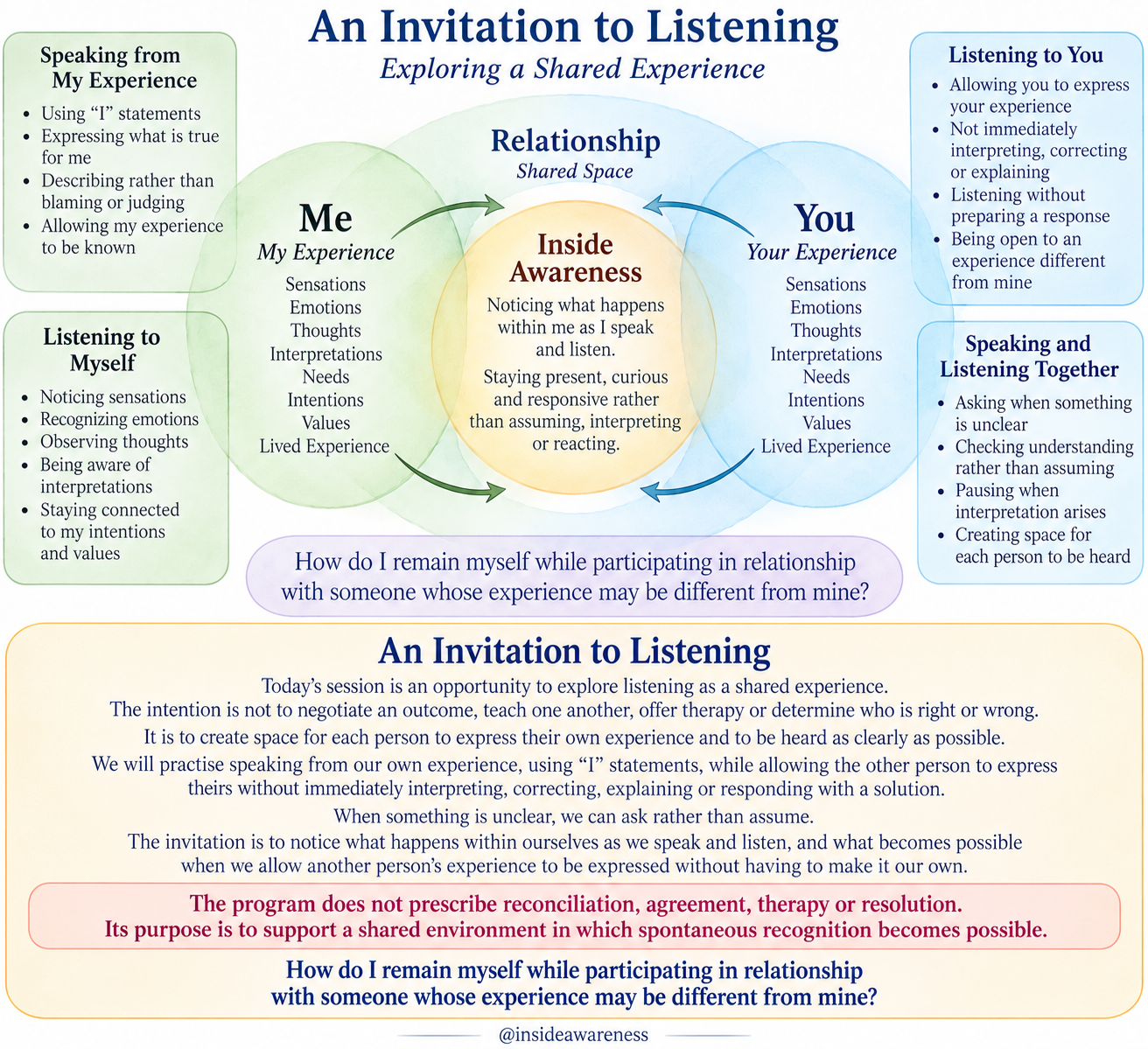
The intention was not to negotiate an outcome, determine who was right or wrong, offer therapy or prescribe reconciliation.
It was to provide a shared environment in which both individuals could express their own experiences and have an opportunity to be heard.
The gathering revealed moments of recognition, emotional expression and greater understanding. It also revealed how easily established patterns of interpretation can return.
This contrast brought greater clarity to the distinction between listening to recognize another person’s experience and listening while preparing our own interpretation of it.
Interpretation is a natural part of human understanding. The invitation is not to eliminate it.
Rather, it is to recognize when our interpretation begins replacing our attention to what another person is actually communicating.
That recognition may create an opportunity to pause, become curious, clarify what we have heard and respond with greater awareness.
An Invitation to Listening
The accompanying diagram illustrates relationships that are present whenever two people communicate.
Listening to myself: Recognizing the sensations, emotions, memories, thoughts, interpretations and values arising within my own experience.
Listening to another: Allowing another person’s experience to be expressed without immediately correcting, analyzing or replacing it with my own.
Listening within relationship: Participating in a shared environment in which clarification, curiosity and reciprocal recognition become possible.
At the centre is Inside Awareness—recognizing what is happening within ourselves as we participate in an experience beyond ourselves.
The intention is not to teach someone the correct way to feel, think or respond.
It is to create conditions in which conscious recognition may become possible.
From Guided Patterns to Lived Function
These explorations have been part of my educational work across several subjects, including movement, communication, personal values and environmental awareness.
The learning environments may differ, but an underlying principle remains:
A guided pattern can direct attention without prescribing what the learner must discover.
In movement, we may explore unfamiliar possibilities through relationships with gravity, skeletal support and the surrounding environment.
In communication, we may explore unfamiliar possibilities by recognizing our inner experience while listening and responding to another person.
In both, the learning begins through participation.
I now see opportunities to organize these longstanding practices into listening programs suited to different environments, including personal reflection, families, educational settings, workplaces and community groups.
Each setting may require different considerations for safety, participation, clarity and consent.
The intention remains consistent.
The program does not prescribe reconciliation, agreement, therapy or resolution. Its purpose is to support a shared environment in which spontaneous recognition becomes possible.
At the heart of this exploration is an inquiry that continues to guide my work:
How do I remain myself while participating in relationship with someone whose experience may be different from mine?
Perhaps the possibility begins with recognizing that listening is more than receiving someone’s words.
It is also a lived experience of relationship—within ourselves, with one another, and with the environment we create through our participation.
An Invitation to Listening Guided Patterns of Learning for Lived Function
Guided Patterns of Learning for Lived Function — A New Area of Exploration
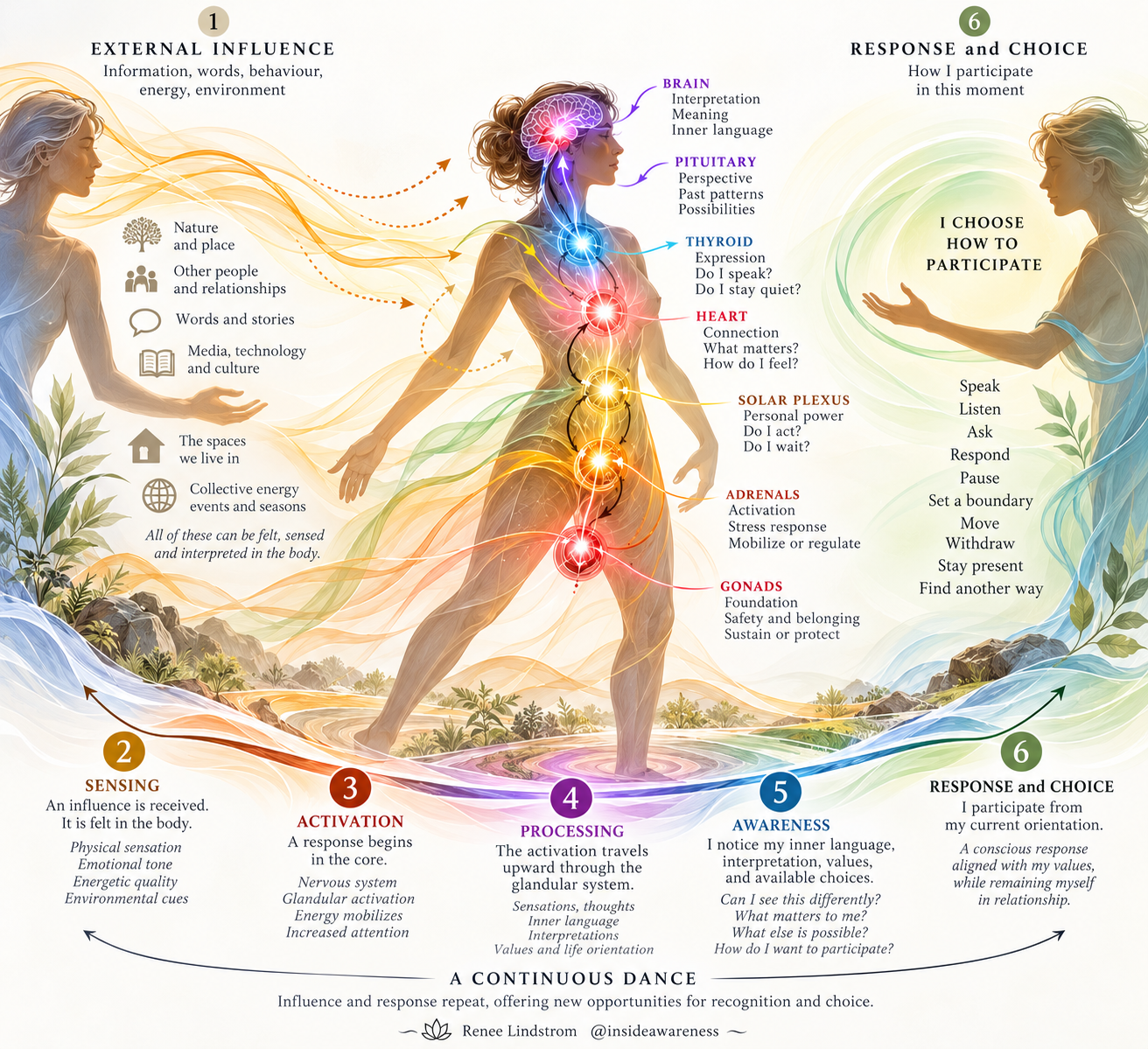
How am I participating in the process of my own experience, and can I discover another way?
For many years, my attention has been drawn to the processes through which people organize their lived experiences.
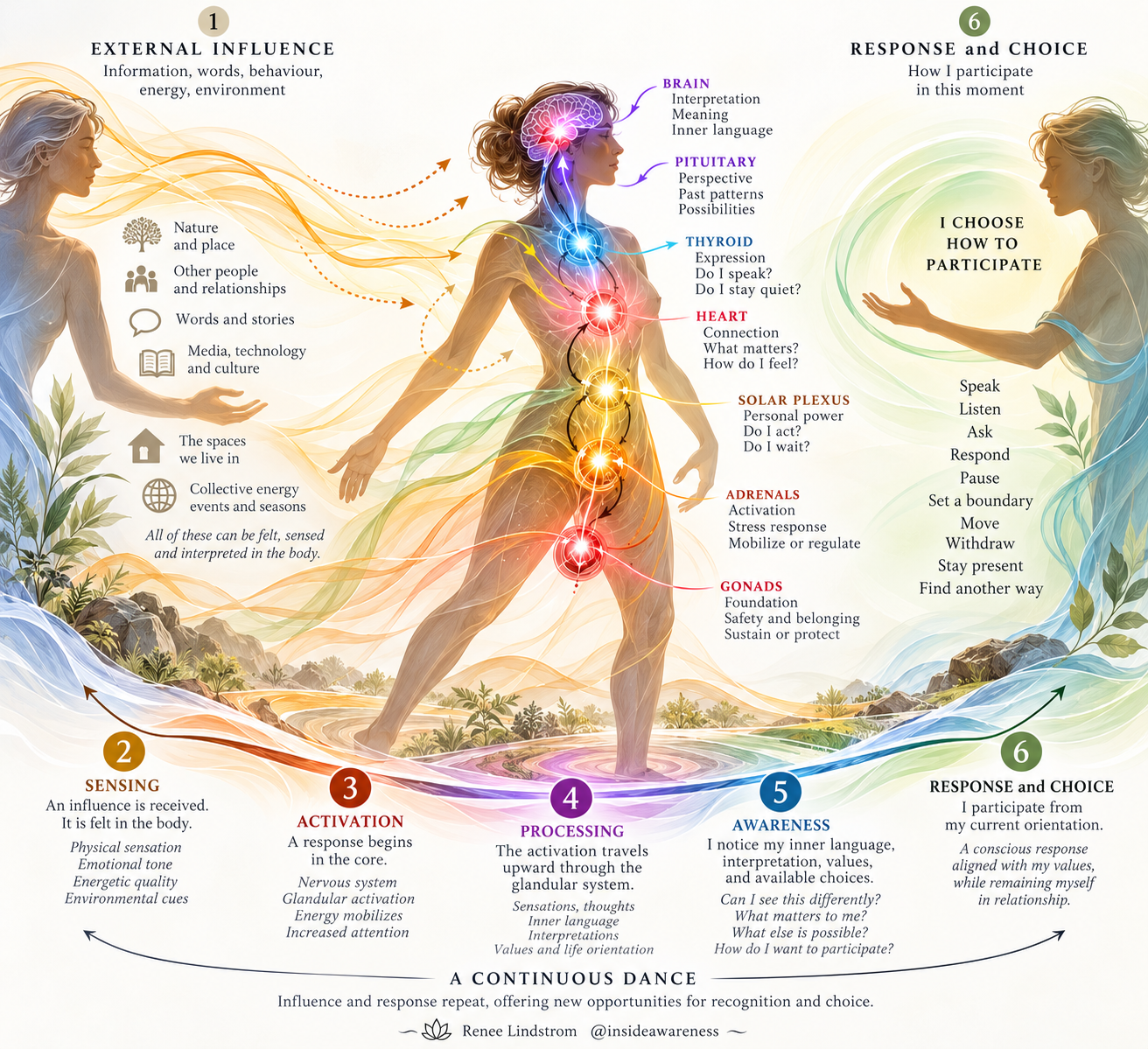
Not simply what we think, say, feel, or do, but how we arrive at those thoughts, interpretations, responses, and actions.
This focus has been familiar to me throughout my life, although I have often found that the language available to describe it has not reflected what I was recognizing.
Through years of teaching functional movement, exploring communication, and listening to the experiences of others, I have continued to observe how early-learned patterns can become automatic ways of participating in life.
These patterns are not limited to physical movement. They are also expressed through inner language, listening, relationships, values, and the choices we recognize as available.
In movement education, I invite learners to notice how they shift their weight, how they organize themselves, and whether another movement possibility can be discovered.
I am now bringing that same educational attention more consciously into communication and inner language.
It is not only what we do. It is how we do it, what we notice while doing it, and whether another possibility becomes available.
One simple inquiry I would like to introduce in early childhood learning is:
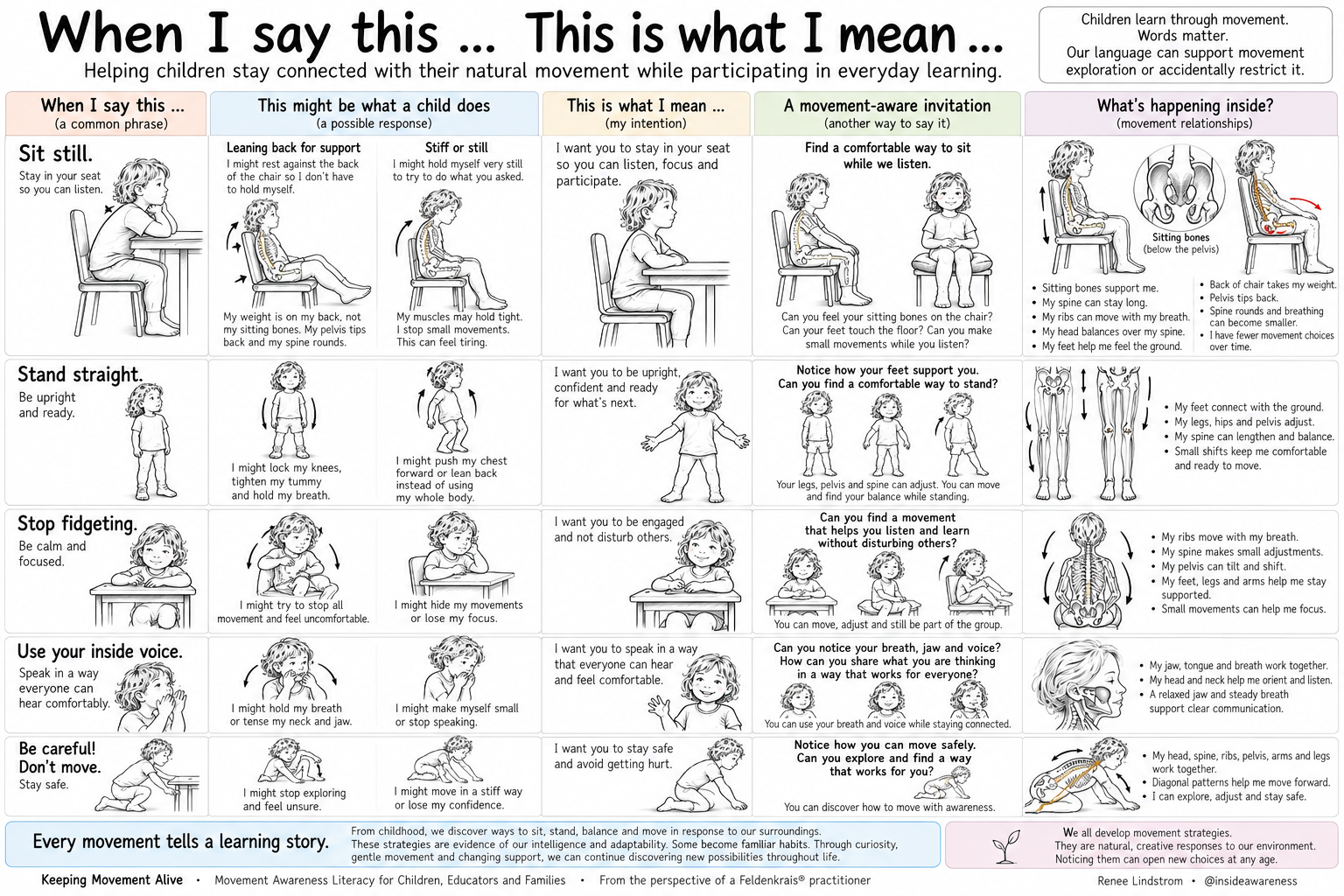
“When I say this … this is what I mean …”
Imagine children having regular opportunities to recognize and express their own meaning, while adults learn to listen without immediately interpreting their experience for them.
Imagine learning environments where curiosity about a child’s process accompanies attention to their behaviour.
My hope is to develop guided patterns that nurture recognition, autonomy, inclusion, fairness, kindness, and reciprocal participation.
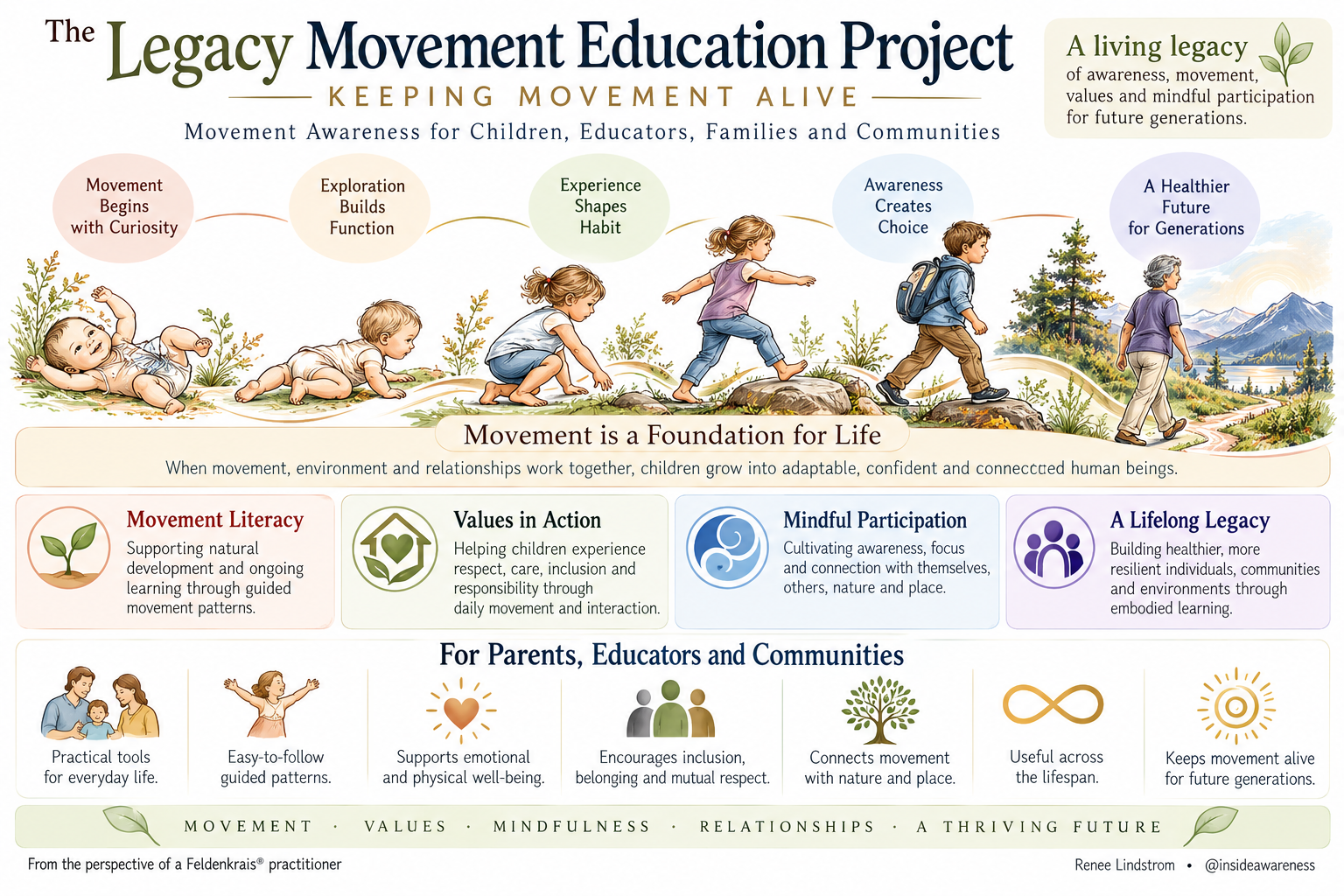
The early childhood material will become part of my Legacy Movement Educational Project, while related adult learning patterns will develop alongside it through Inside Awareness.
These are not intended as prescribed ways to think, feel, or communicate. They are invitations to explore how we participate in our own experience and discover a greater range of possibilities.
As autumn arrives, I am recognizing how several areas of my life’s work are beginning to come together within a familiar foundation.
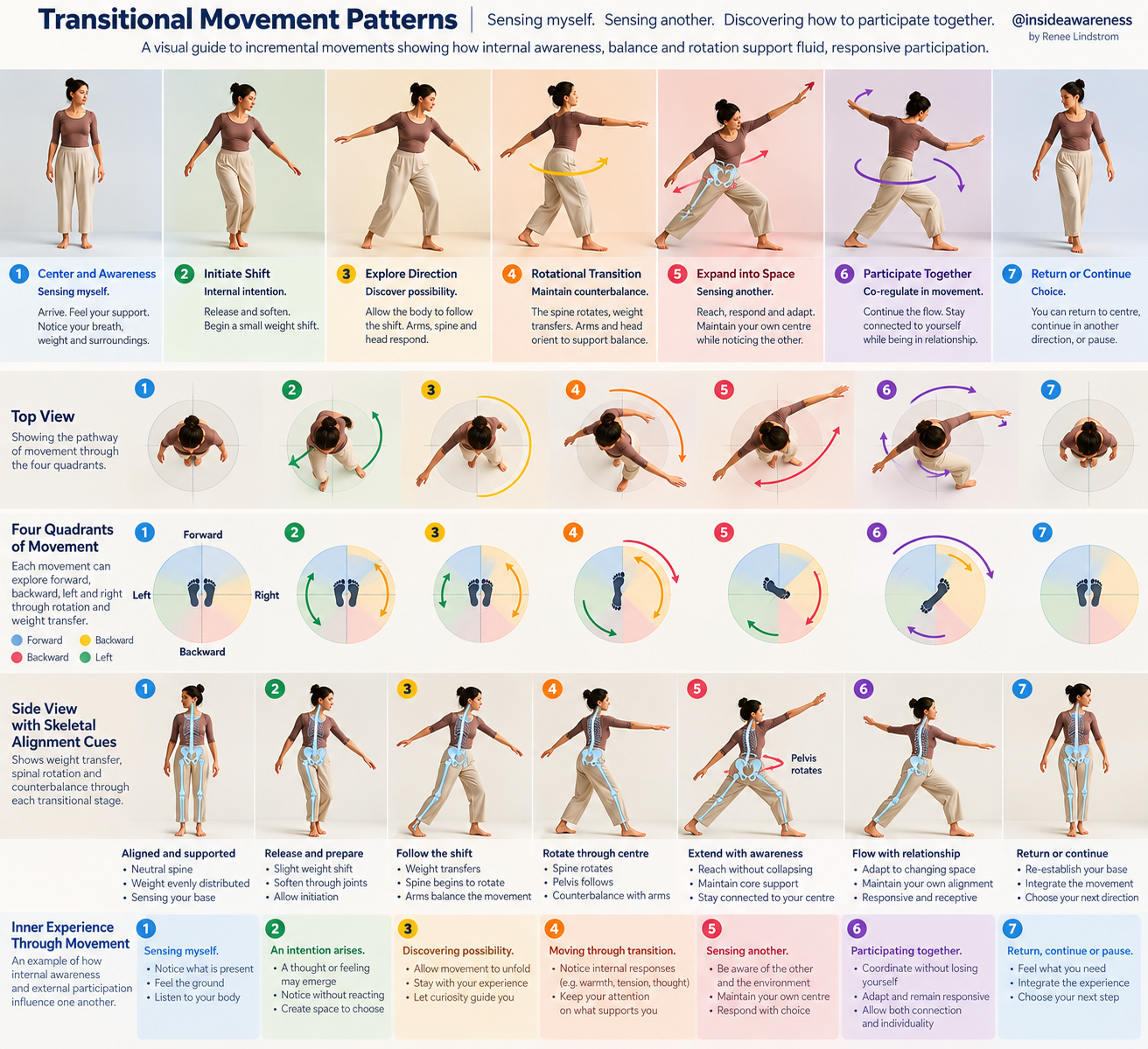
Sensing myself. Sensing another. Discovering how to participate together.
For nearly twenty years, my exploration of balance has developed through teaching, observing, and listening to the unique ways individuals organize themselves in movement.
Throughout these years, I have become increasingly interested in the transitions between movements rather than the completion of individual exercises or postures.
How does the skeleton organize itself to transfer weight? What happens as we change direction, rotate, reach, or shift from one supporting leg to another? How can an awareness of gravity, skeletal support, and counterbalance offer new possibilities for movement with less unnecessary muscular effort?
These questions have gradually influenced the development of Guided Patterns of Learning for Lived Function.
More recently, I have begun recognizing something unexpected within my own spontaneous movement. As the relationships between skeletal support, rotation, and counterbalance become increasingly familiar, movement can begin to flow creatively, almost like a dance.
This expression is not intended to reproduce an established dance form, yoga posture, or tai chi sequence. Rather, recognizable shapes may emerge naturally through the exploration of functional movement relationships.
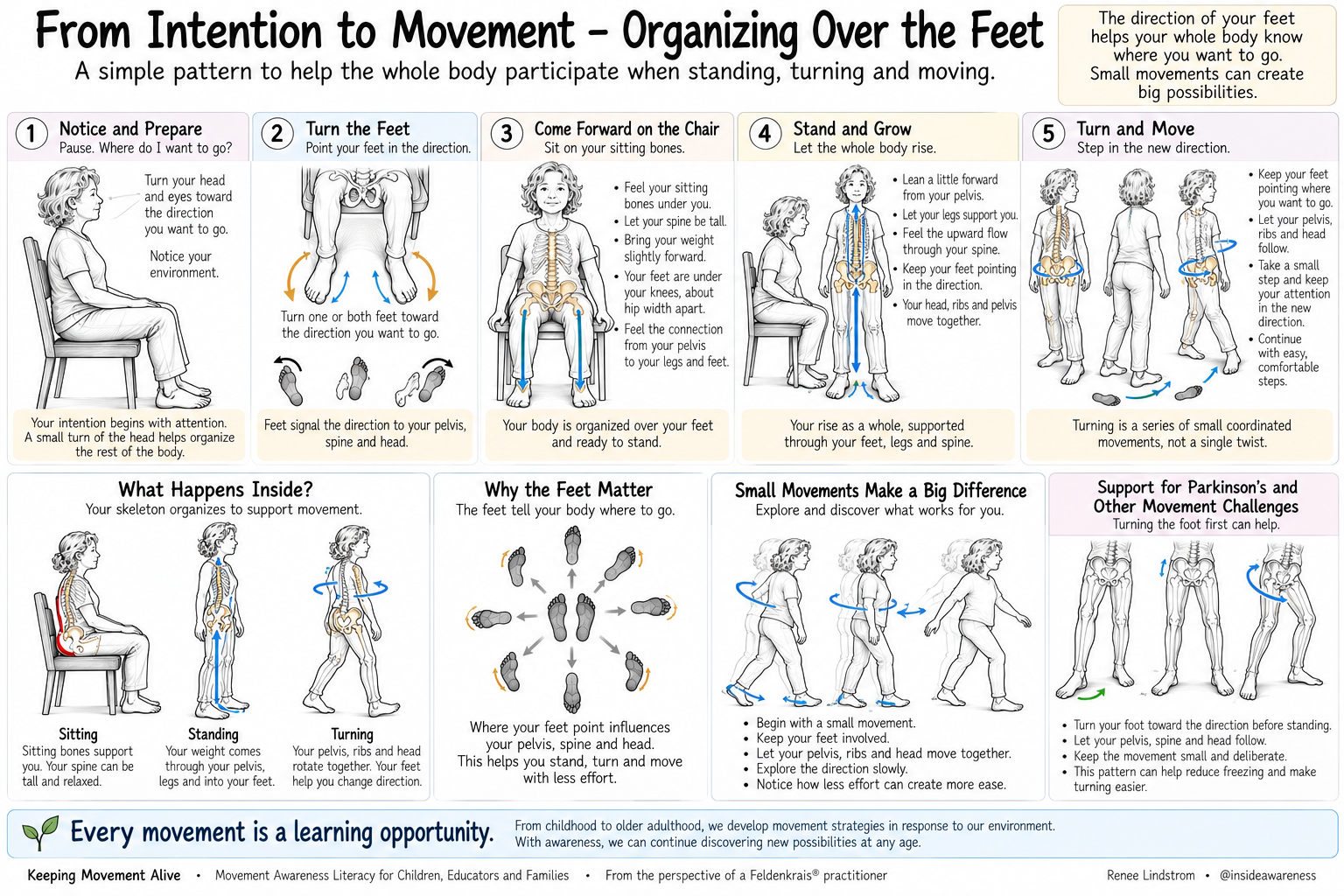
The accompanying diagram, Transitional Movement Patterns, introduces some of these possibilities through incremental illustrations of movement, including side-view skeletal relationships.
For participants in my Balance classes, these images may offer an alternative to remembering a list of exercises. They can become visual invitations to recognize how the body organizes itself through movement, allowing each person to explore within their own abilities and circumstances.
An additional direction is emerging through this work: the relationship between internal sensory awareness, the surrounding environment, and participation with others.
What happens to our spontaneous movement when another person enters our experience? How do our internal interpretations influence the way we move, respond, or choose to act?
These questions are beginning to connect the movement patterns with my developing explorations of inner language, listening, and conscious recognition.
I am also considering how these foundational movement relationships might be introduced in early childhood education, supporting opportunities to develop sensory awareness, movement choice, and participation in relationships from an early age.
This is an evolving exploration rather than a completed system.
My intention is to create accessible learning experiences that invite curiosity, encourage individual discovery, and support the integration of awareness into ordinary lived function.
The focus is not on achieving a particular movement. It is on discovering the relationships that make movement possible.
Feldenkrais®, Feldenkrais Method®, Awareness Through Movement®, and Functional Integration®, are registered service marks of North America. Feldenkrais Method®
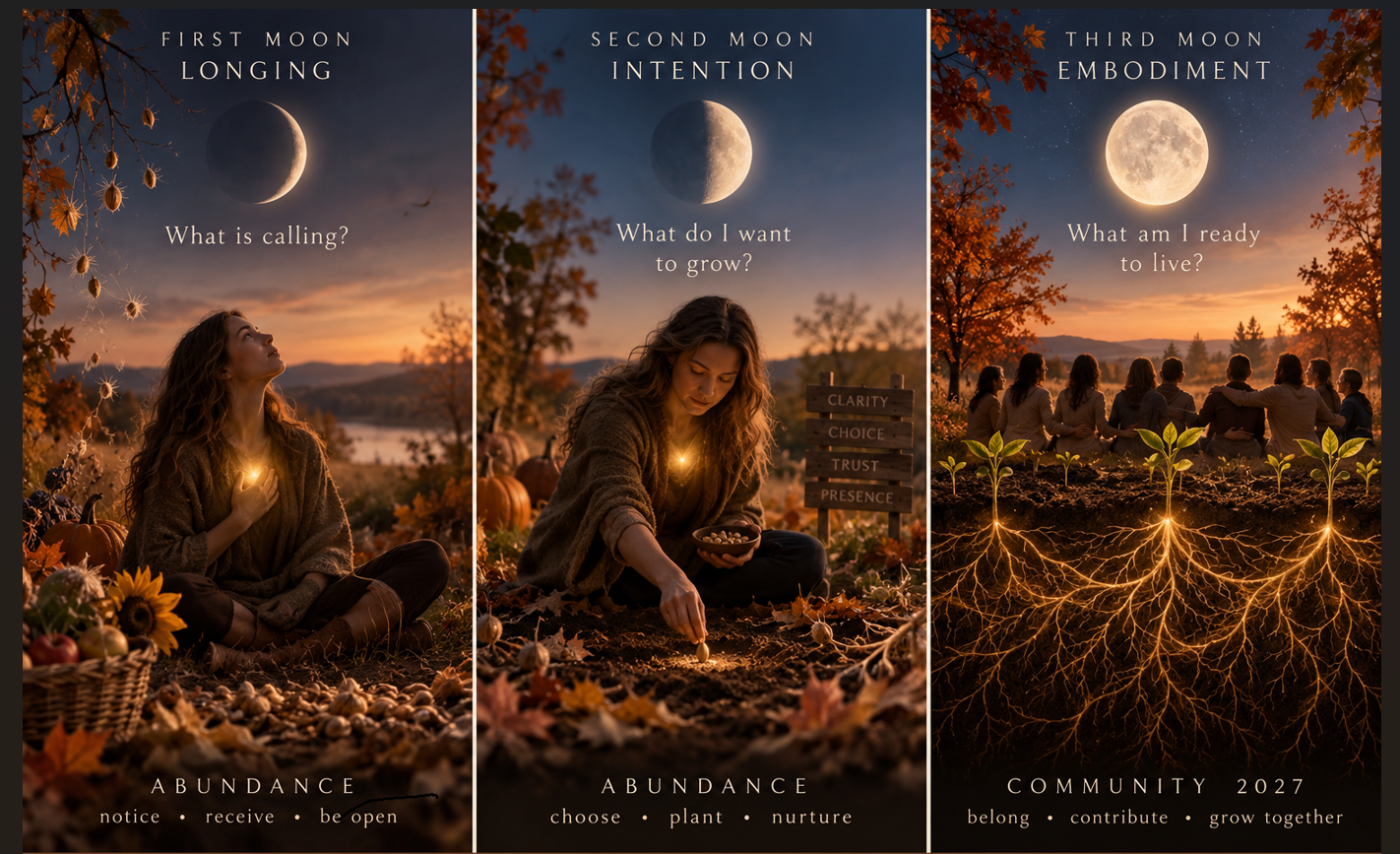
“Before planting new seeds, take time to recognize what has already grown.”
Gratitude begins with recognizing what is already present.
As we become conscious of the intentions woven through our lived experiences, we discover the relationships, choices, and actions that have shaped our lives.
In recognition, we find appreciation.
In appreciation, we nurture awareness.
Through awareness, new possibilities for conscious participation emerge.
Embodying Intention · Oct 10/11, ’26
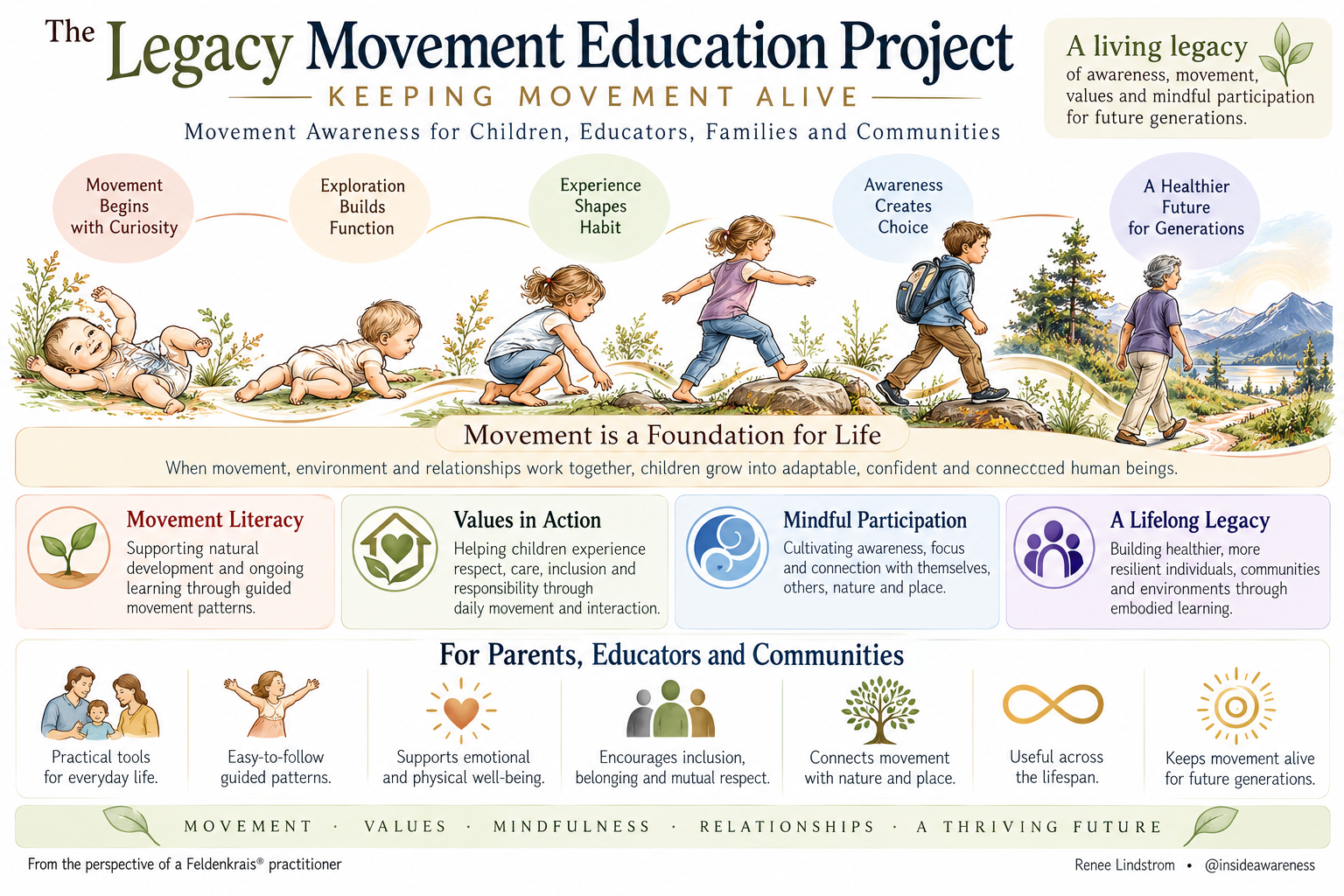
The Legacy Education Project — Keeping Movement Alive
The Legacy Education Project — Keeping Movement Alive
I would like to share an update on the Legacy Education Project, which I began writing about on my personal page earlier this year.
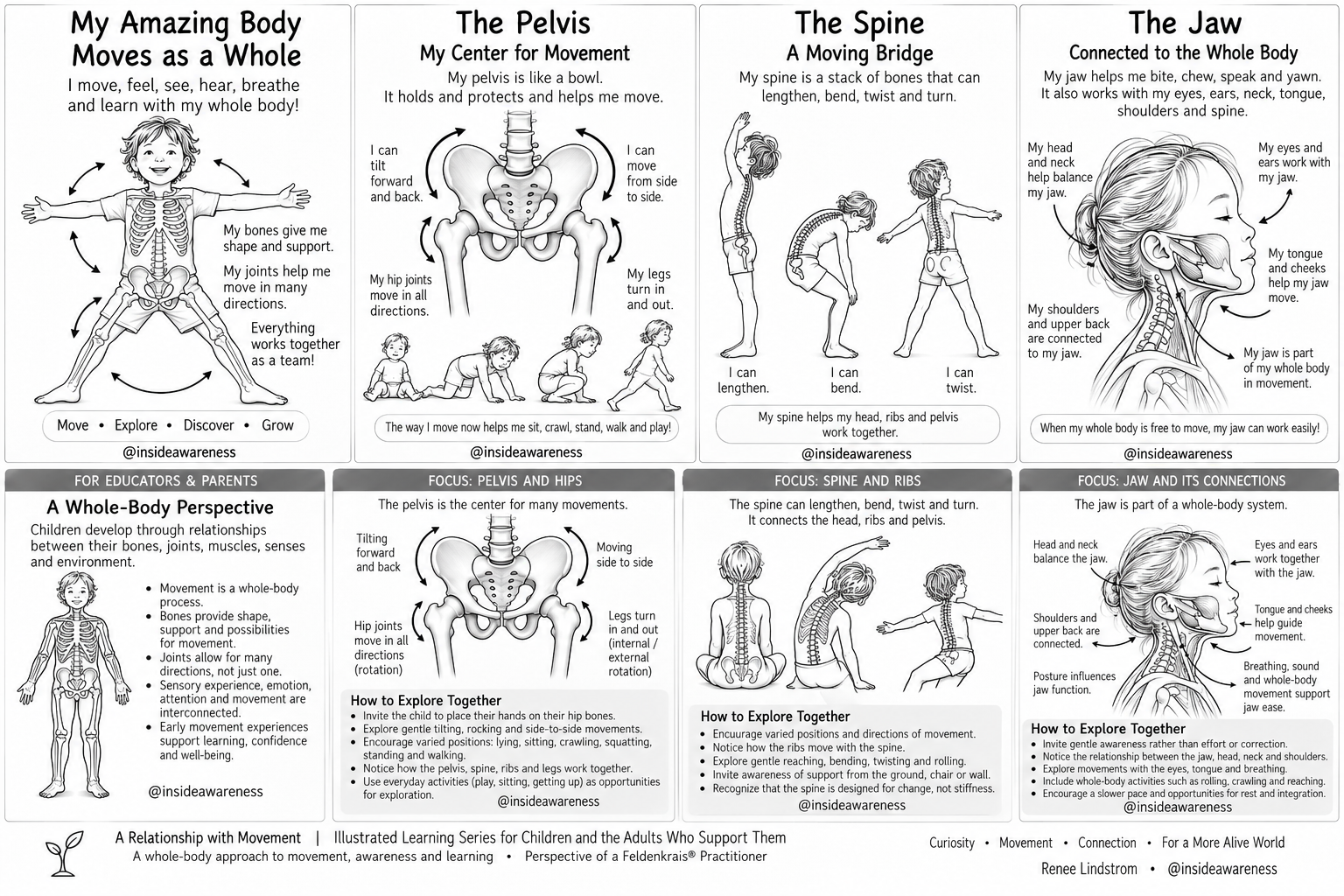
The accompanying article introduces the developing project and includes illustrated diagrams exploring skeletal relationships and the transitions that take place within everyday movement.
The seeds of this project were planted somewhere along the way during my years of teaching *Balance*, a guided functional movement workshop I began offering around 2007. For nearly two decades, these classes have continued for approximately 40 weeks each year. That represents hundreds of weeks—perhaps close to 800—of listening, observing, exploring, and learning alongside adults ranging in age from their mid-forties to over ninety.
Throughout these years, I have encountered remarkably individual patterns of movement and mobility. I have listened to how people understand their bodies, observed the strategies they have developed, and explored the relationships between skeletal support, movement, and everyday function.
At some point, an intention began to emerge.
I wondered whether some of the movement relationships I was helping adults rediscover could be consciously recognized and nurtured much earlier in life, particularly during the transition from a child’s natural movement exploration into organized education.
What if children could retain a conscious relationship with the movement intelligence they are already developing?
This is not an exercise or fitness program. Those approaches have their own value in developing physical capacity and maintaining health.
The focus here is different. It is an invitation to recognize how weight shifts through the skeleton, how one part of the body participates with another, and how these relationships support our everyday movements.
I hope the diagrams accompanying the article begin to communicate this intention.
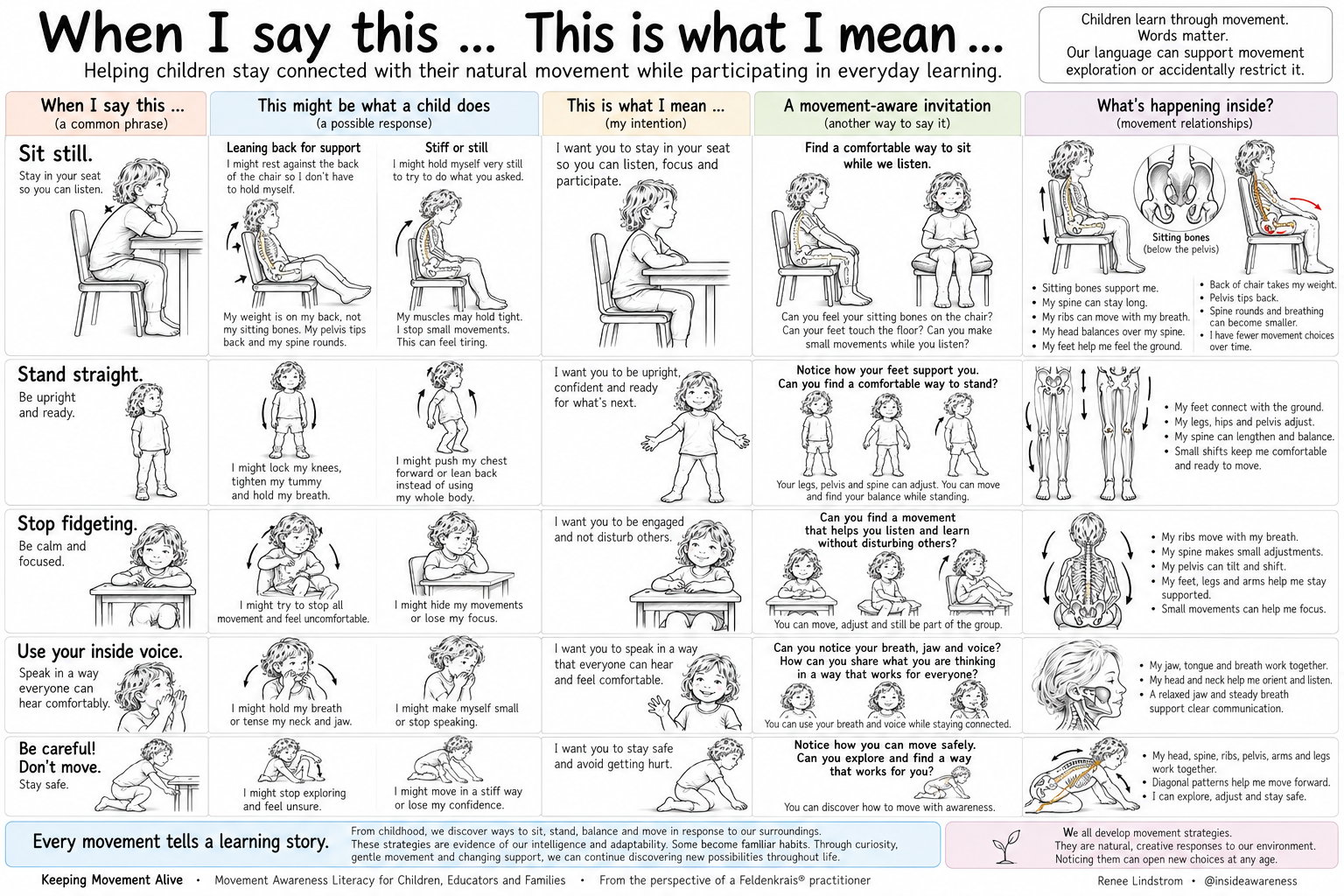
One of my favourites is titled “When I Say This… This Is What I Mean…”
This illustration brings attention to something that has connected so many of my observations over the years: the relationship between the words adults use and the movement strategies children may develop in response.
As children, we hear instructions such as “sit still,” “stand straight,” or “stop fidgeting.” We may not be shown what those words mean in terms of skeletal support or movement. Instead, we draw upon our developing experiences to find ways of responding.
Over time, some of these strategies can become familiar, habitual ways of organizing ourselves.
I have spent many years observing these patterns in adults—not as mistakes, but as expressions of learning and adaptation. My interest is in helping people recognize these relationships and discover that other movement possibilities may still be available.
Yesterday, partway through preparing this article, I paused to offer a small, boutique TMJ Jaw Release workshop to a group of women.
Once again, I encountered familiar patterns of restricted movement and witnessed moments when deeply held muscular effort began to soften, allowing different movement relationships to emerge.
Later in the day, as I reflected on the workshop and the many years of experiences that have contributed to this educational project, I felt an unexpected depth of gratitude.
Gratitude for the choices I have made to follow this inquiry. For the people who have participated in the learning with me. And for the opportunity to slow down, listen, and become familiar with aspects of human movement that can so easily go unrecognized.
Then I remembered. It was Thanksgiving.
Perhaps there could not have been a more fitting moment to recognize what has been growing all these years.
A legacy of conscious recognition, not simply a legacy of information.
I invite you to explore the article and its diagrams, and to share them with parents, educators, childcare providers, or others who may be interested in supporting children’s natural movement learning.
I also welcome conversations about workshops, mentoring, consulting, coaching, collaboration, and other ways of supporting the Legacy Education Project as it continues to develop.
Slideshow of illustrated workshop materials for parents and educators
I invite you to explore the program information and share these materials with parents, early childhood educators, teachers, and others who support children’s development.
The Legacy Education Project — Keeping Movement Alive
In January 2026, we announced our intention to develop a Legacy Education Project. The seeds of this initiative were planted in the autumn of 2025 and given time to rest and take shape through the early winter months. Spring and summer became a period of reflection, exploration, and planning. Now, as the project begins to take form, some of this work is reflected in the illustrated workshop materials for parents and educators shared below.
These materials introduce relationships between the natural movement patterns of early childhood development and the guided movement explorations offered throughout adulthood and aging.
Children develop through movement, sensory experience, and growing awareness, often long before they can articulate what they are learning. As we age, guided opportunities to explore these familiar relationships can help transform awareness into conscious recognition, expanding possibilities for movement, balance, and everyday function.
Our intention is to nurture continuity in this relationship with movement and learning throughout life.
We invite you to explore the program information and share these materials with parents, early childhood educators, teachers, and others who support children’s development.
We also welcome inquiries about bringing this educational perspective into your community through workshops, mentoring, consulting, or individual coaching. If you feel inspired to contribute in other ways—through collaboration, sharing resources, offering feedback, or supporting the project’s development—we would be delighted to hear from you.
A legacy of conscious recognition, not simply a legacy of information.
Renee Lindstrom · @insideawareness
Learn more through the Keeping Movement Alive Program picture descriptions below
Supporting the Continuity of Movement Awareness from Childhood Through Life
A legacy of awareness, not simply a legacy of information. 🌿
“Children are already learning through movement. Our opportunity is to help that awareness remain alive.” The Legacy Education Project is not about introducing children to something they lack. It is about recognizing and nurturing something they already possess. Legacy is reference to the intention to preserve a relationship with movement that children are already developing, so it can remain available as their learning environments change.
An Educational Resource for Parents and Educators created by Renee Lindstrom, a Feldenkrais® practitioner since 2007, whose approach is informed by Nonviolent Communication, Tibetan Buddhist meditation practices, and Buddhist-inspired Feng Shui philosophy emphasizing our relationship with nature.
Learning exploration patterns for integration becomes continuity through living
1. Integration through Movement (guided patterns)
Attention shifts toward felt experience.
The learner explores movement, recognizes differences, and discovers possibilities without needing to arrive at one predetermined response.
2. Integration through Communication and Relationships (recognition and exploring new patterns)
The same quality of attention becomes available in interaction.
The learner listens, notices responses, recognizes habitual interpretations, and explores possibilities without immediately imposing conclusions.
3. Continuity WITHIN LIVED FUNCTION @insideawareness
LegacyLived Function
The pattern of learning is no longer confined to the lesson. It becomes a way of participating in everyday experience.
Continuity of Awareness
Continuity of awareness is the capacity to remain connected to one’s sensory experience, curiosity, and capacity for learning while moving between different activities, relationships, and environments. continuity does not require uninterrupted awareness. Losing connection, recognizing it, and returning to inquiry can also be part of the learning.
The learning quality remains available as the context changes. Shown in the following life relationship experiences:
Environmental Experience
Noticing how stimulus influences sensation and response.
Movement Exploration
Recognizing changing relationships through felt experience.
Communication
Listening to words, responses, meanings, and differences.
Relationships
Maintaining curiosity while participating with another person
Group Learning
Allowing the learning environment itself to remain open to discovery.
Movement Awareness Literacy for Children, Educators and Families
Keeping Movement Alive 🌿
An educational perspective concerned with preserving the child’s natural capacity to learn through movement, while helping adults recognize and support that capacity.
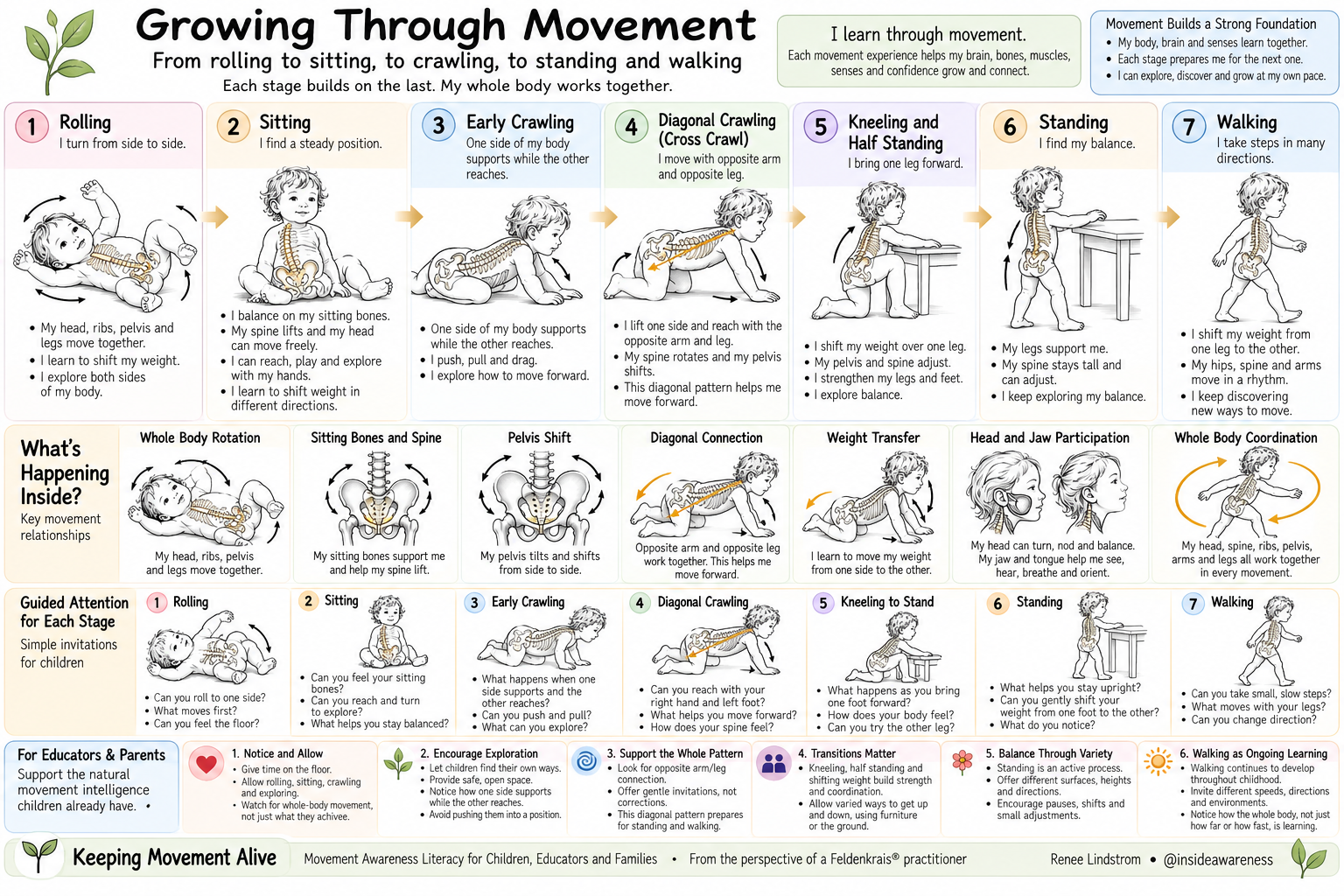
Movement possibilities of self learning are demonstrated in this poster
This illustration brings together the transition from rolling to crawling, diagonal coordination, standing, and walking, with guided attention for children and companion observations for adults.
Keep in mind that children discover mobility in different ways, and the intention is to preserve curiosity rather than introduce another standard of achievement.
For Parents and Educators – From the perspective of Renee Lindstrom, Feldenkrais® practitioner (2007), integrating insights from Nonviolent Communication, Tibetan Buddhist meditation, and nature-centered Feng Shui philosophy. @insideawareness
Listening to the Skeleton
The environment participates in movement learning.
Chairs, desks, instructions, expectations, and daily routines influence the movement strategies children develop. When these strategies are repeated without opportunities for exploration, some may become habitual.
Movement awareness literacy invites children and adults to recognize how the body receives support, changes position, and adapts to its surroundings.
The intention is not to prescribe ideal posture, but to preserve the ability to discover different ways of organizing movement throughout life.
Every movement tells a learning story.
The poster introduces the relationship between the words adults use, the movement strategies children develop in response, and the habits that may emerge through repetition
From childhood, we discover ways to sit, stand, balance, and move in response to our surroundings. Some strategies become familiar habits. Through curiosity, gentle movement, and changing support, we can continue discovering possibilities throughout life. The intention of exploring what we say…. This is what I mean…. is to help adults recognize that the words they use can influence the movement strategies children develop, while offering language that preserves exploration, choice, and sensory awareness.
For Parents and Educators – From the perspective of Renee Lindstrom, Feldenkrais® practitioner (2007), integrating insights from Nonviolent Communication, Tibetan Buddhist meditation, and nature-centered Feng Shui philosophy. @insideawareness
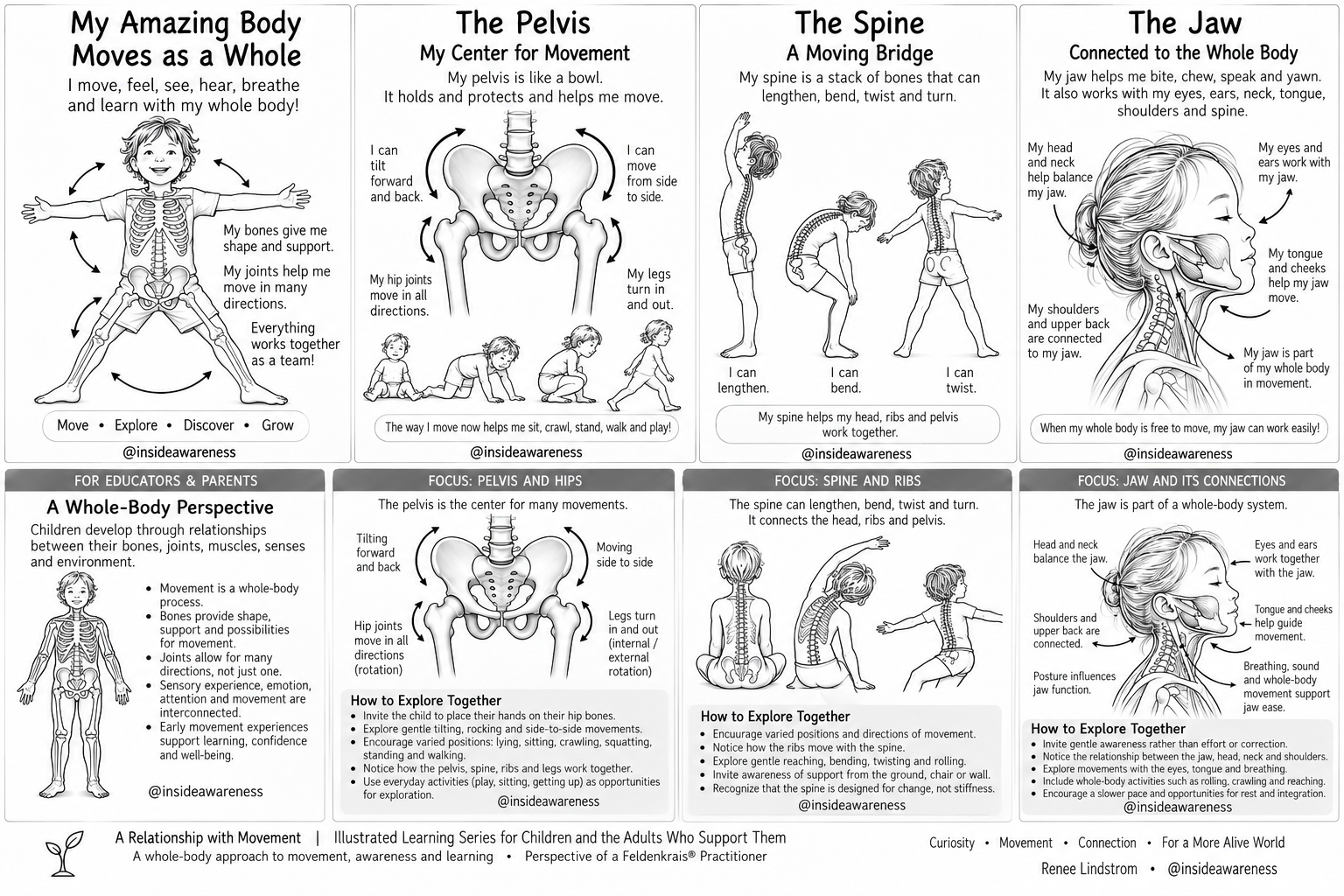
A Relationship with Movement – Illustrated Learning Series for Children and the Adults Who Support Them
A whole body approach to movement, awareness and learning
For Parents and Educators – From the perspective of Renee Lindstrom, Feldenkrais® practitioner (2007), integrating insights from Nonviolent Communication, Tibetan Buddhist meditation, and nature-centrred Feng Shui philosophy. @insideawareness
“We Learn to Move Through Experience — and We Can Keep Discovering New Ways.”
”Movement Awareness Supports Learning at Every Stage of Life
Legacy Learning is a beautiful thread through the lived experiences of all ages. The connection between intention, skeletal support, and finding a new direction is woven through the series.
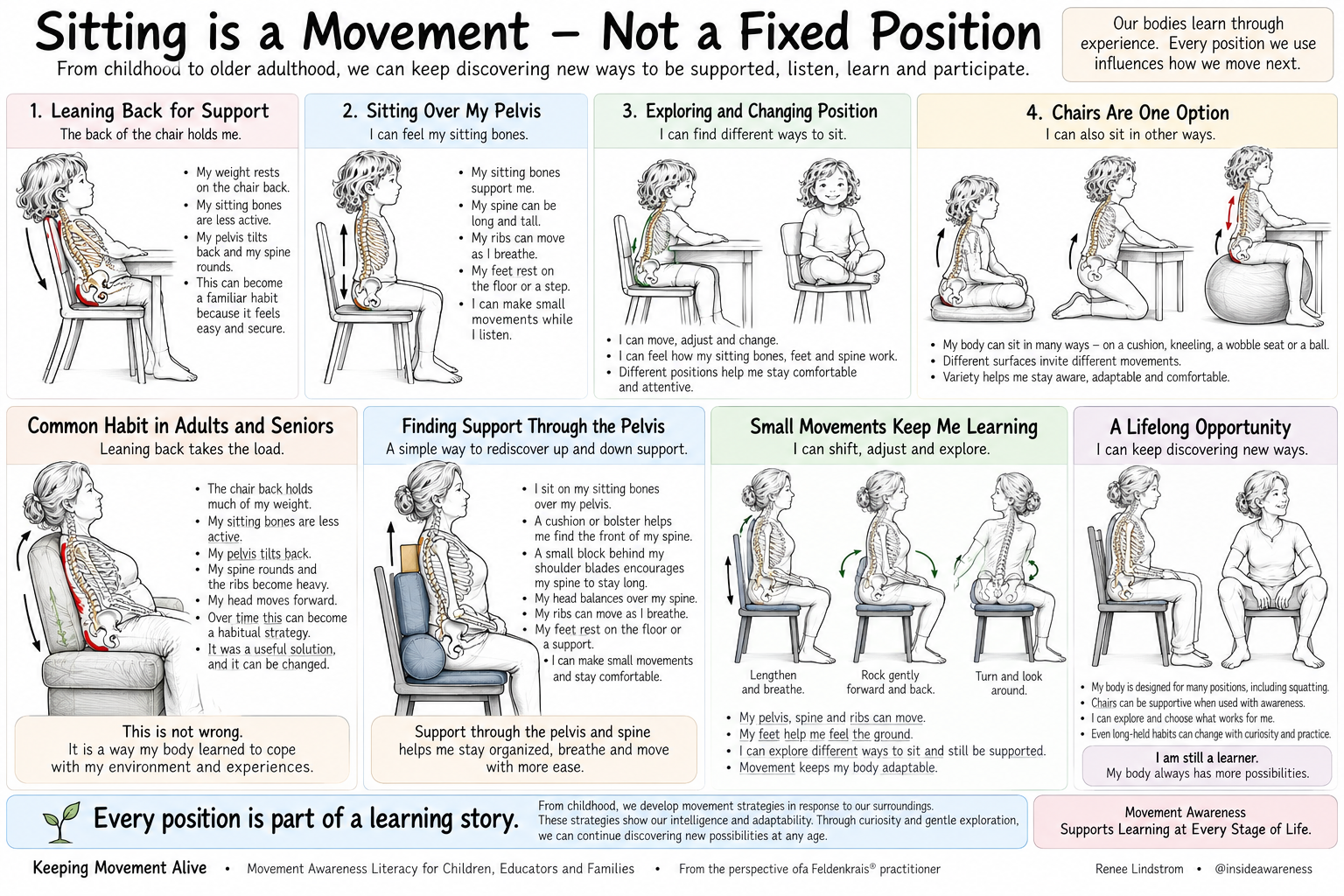
The relationship between furniture, adult expectations, and how a child learns to organize skeletal support. An eample:
The chair is not simply an object in the learning environment. It becomes part of the child’s movement experience.
What happens when one way of sitting becomes the dominant, unquestioned habit, particularly when a child is repeatedly asked to remain still. A child may learn to associate sitting with fixing the body in position, rather than discovering the many ways the skeleton can organize support.
The difference between sitting and being supported
When a child leans against the back of a chair, some of their trunk weight is transferred through the backrest rather than being managed entirely through the pelvis, sitting bones, feet, and active postural adjustments.
That is not inherently harmful. Backrests can provide useful support, and resting against one is a normal sitting option.
What happens when one way of sitting becomes the dominant, unquestioned habit, particularly when a child is repeatedly asked to remain still.
A child may learn to associate sitting with fixing the body in position, rather than discovering the many ways the skeleton can organize support.
The distinction is not between correct and incorrect sitting. It is between having movement choices and relying on one habitual organization without recognizing alternatives.
Every movement tells a learning story.
From childhood, we discover ways to sit, stand, balance, and move in response to our surroundings. Some strategies become familiar habits. Through curiosity, gentle movement, and changing support, we can continue discovering possibilities throughout life.
A habitual movement strategy in aging adults is evidence of earlier learning, not a failure to learn. What was useful or familiar in one circumstance may be worth exploring again as circumstances change. For example:
As one ages there may be a need to experience a different relationship between the shoulder girdle, spine, and pelvis that is relevant for support to discover something that may no longer recognize easily. The intention is not simply to sit straighter. It is to explore how one’s trunk can be organized over the pelvis, how support can pass through the sitting bones, and how small movements remain available.
For Parents and Educators – From the perspective of Renee Lindstrom, Feldenkrais® practitioner (2007), integrating insights from Nonviolent Communication, Tibetan Buddhist meditation, and nature-centred Feng Shui philosophy. @insideawareness
From Awareness to Recognition
Awareness invites us to notice how we are supported. Recognition grows as we explore these relationships through movement, discovering new possibilities for balance, choice, and everyday function.
“When we notice how we are supported, movement becomes an opportunity for discovery. Through exploration, awareness grows into recognition, opening possibilities for balance and everyday movement.”
Awareness: I notice where my weight rests.
Exploration: I discover how my pelvis, legs, and feet participate as I shift.
Recognition: I begin to understand and feel how these relationships support my movement, and recognize that I have choices.
Expanding capacity: I can explore and use these possibilities in standing, turning, and walking.
For Parents and Educators – From the perspective of Renee Lindstrom, Feldenkrais® practitioner (2007), integrating insights from Nonviolent Communication, Tibetan Buddhist meditation, and nature-centered Feng Shui philosophy. @insideawareness